
How Long Does It Take to Get FMLA Approved? Complete 2026 Timeline
 by Alisha Shabbir
 Last updated:
When applying for FMLA for a medical condition, the difficult part is often figuring out the paper work and long it takes to get your leave approved. Maybe you’re already missing work. Maybe your employer is asking questions. Or maybe you’re planning ahead for a surgery or pregnancy and need to know exactly what to expect.
Here’s the reassuring fact, federal law sets clear deadlines that employers must follow. The FMLA approval process typically takes between 5 and 25 business days from your initial request to final designation, though several factors can speed this up or slow it down. The biggest variable? How quickly you can get your medical certification completed.
Standard FMLA approval can take 5–10 business days, employers have five business days to respond, and medical certification may add five more. FMLADocs completes your certification in as little as 24 hours through board-certified physicians, accepted by employers in all 50 states. Start your FMLA certification.
This guide breaks down the exact timeline for each step of the FMLA approval process, explains what can cause delays (and how to avoid them), and shows you how to get your leave approved as fast as possible. Whether you’re dealing with anxiety, recovering from surgery, caring for a sick parent, or managing a chronic condition, understanding these timelines puts you back in control.
What Is FMLA and Who Qualifies?
The Family and Medical Leave Act is a federal law that provides eligible employees up to 12 weeks of unpaid, job-protected leave per year for qualifying medical and family reasons. During FMLA leave, your employer must maintain your health insurance coverage and restore you to the same or an equivalent position when you return.
FMLA covers leave for:
-
Your own serious health condition (physical or mental)
-
Caring for a spouse, child, or parent with a serious health condition
-
Birth of a child and bonding with a newborn
-
Placement of a child through adoption or foster care
-
Qualifying military family needs
To be eligible, you must meet three requirements:
-
Work for a covered employer (50+ employees within 75 miles)
-
Have worked for that employer for at least 12 months
-
Have worked at least 1,250 hours during the 12 months before leave begins
A “serious health condition” under FMLA means an illness, injury, or physical or mental condition that involves inpatient care or continuing treatment by a healthcare provider. This includes chronic conditions like anxiety, depression, migraines, diabetes, and back pain, as well as acute conditions requiring surgery or extended recovery.
Now let’s look at exactly how long each step of the approval process takes.
The Official FMLA Approval Timeline: What Federal Law Requires
The Family and Medical Leave Act establishes specific deadlines that your employer must follow when processing your leave request. These aren’t suggestions. They’re legal requirements enforced by the Department of Labor.
The total timeline from your initial request to official approval typically ranges from 5 to 25 business days. That’s a wide range, and where you fall depends largely on one factor: how quickly you can submit complete medical certification.
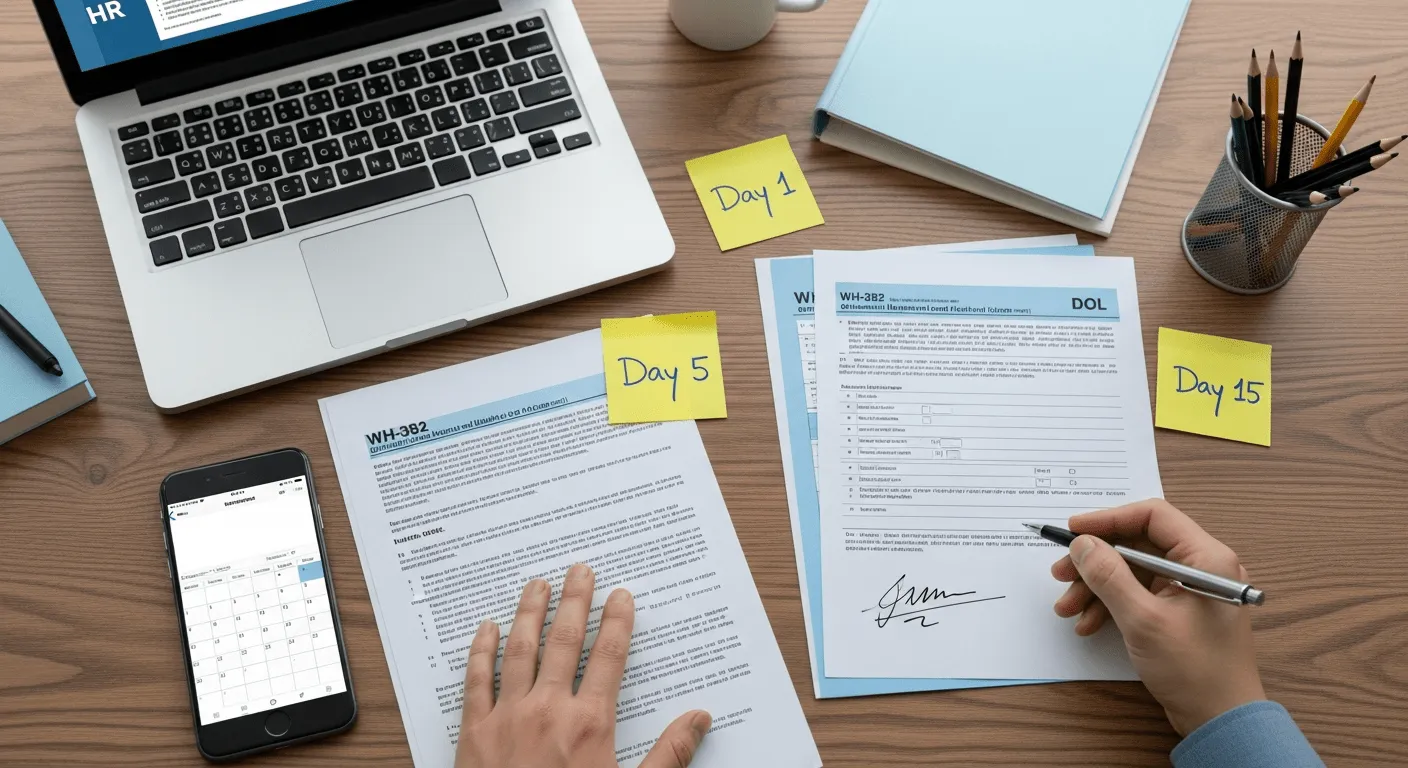
FMLA Approval Timeline: A Quick Overview
| Phase | Who’s Responsible | Deadline | What Happens |
|---|---|---|---|
| Initial Request | Employee | 30 days advance (foreseeable) or ASAP (emergency) | You notify your employer you need leave |
| Eligibility Notice | Employer | 5 business days | Employer confirms whether you qualify for FMLA |
| Medical Certification | Employee | 15 calendar days | You submit documentation from a healthcare provider |
| Designation Notice | Employer | 5 business days after receiving certification | Employer officially approves or denies your leave |
The Step-by-Step FMLA Approval Process
Let’s walk through each step so you know exactly what to expect.
Step 1: Employee Notification (Day 1)
The clock starts when you tell your employer you need leave. You don’t have to use the words “FMLA” or fill out specific forms at this stage. You simply need to provide enough information for your employer to understand that your leave might qualify under the Act.
-
For foreseeable leave (scheduled surgery, planned pregnancy, upcoming medical treatment), you should give 30 days’ notice when possible.
-
For unforeseeable situations (sudden illness, unexpected flare-up, family emergency), notify your employer as soon as practicable. This usually means the same day or next business day.
What counts as sufficient notice? Saying something like “I need to take time off for a medical procedure” or “I need leave to care for my mother who was just diagnosed with cancer” is enough. Your employer takes it from there.
Step 2: Employer Eligibility Response (Within 5 Business Days)
Once you’ve requested leave, your employer has exactly 5 business days to tell you whether you’re eligible for FMLA protection. They must provide this in writing, typically using Form WH-381 or a similar notice.
This eligibility notice will confirm:
-
Whether you meet the 12-month employment requirement
-
Whether you’ve worked the required 1,250 hours
-
Whether your worksite has 50+ employees within 75 miles
-
Your rights and responsibilities under FMLA
If your employer determines you’re not eligible, they must explain why. If they fail to respond within 5 business days, that’s a violation of federal law, and you should document the delay.
Step 3: Medical Certification (15 Calendar Days)
This is where most of the timeline variability happens. After your employer confirms eligibility, they’ll likely request medical certification from a healthcare provider. You have 15 calendar days to submit this documentation.
The certification form (typically Form WH-380-E for your own condition or WH-380-F for a family member’s condition) requires your doctor to confirm:
-
The nature of your serious health condition
-
When the condition began and how long it’s expected to last
-
Whether you need continuous or intermittent leave
-
Any treatment schedule or restrictions
Here’s the problem: getting a doctor’s appointment, having them review and complete the form, and returning it to you can easily take 1 to 3 weeks through traditional channels. Some doctors’ offices charge fees for completing FMLA paperwork, and many are simply slow. Which is why, many opt for online FMLA certification providers that usually deliver the same day.
If you genuinely cannot get certification within 15 days despite your best efforts, contact your employer immediately to explain the delay. Extenuating circumstances (like a hospitalized family member or difficulty reaching your physician) can extend this deadline.
Step 4: Employer Designation (Within 5 Business Days)
Once your employer receives complete and sufficient medical certification, they have 5 business days to make a final decision. They’ll provide a Designation Notice (Form WH-382) stating whether your leave is approved as FMLA-protected.
If approved, this notice will specify:
-
How much FMLA leave you have available
-
Whether you’ll need to use paid leave concurrently
-
Any requirements for returning to work (like a fitness-for-duty certification)
If your certification was incomplete or insufficient, your employer must tell you in writing exactly what additional information is needed. You’ll get at least 7 calendar days to provide the missing details.
Once your leave is designated as FMLA-protected, you’re covered. Your job is secure, your health benefits continue, and your employer cannot retaliate against you for taking this leave.
Confusing FMLA with short-term disability? short-term disability certification online
Why FMLA Approval Takes Longer Than Expected (And How to Speed It Up)
The legal minimums suggest FMLA approval could happen in as few as 10 business days. But real-world timelines often stretch to 3 or 4 weeks. Understanding why helps you avoid the most common pitfalls.
Delay #1: Doctor Availability
The single biggest delay is getting medical certification completed. If you don’t have an established relationship with a physician, or if your doctor’s office is backed up, you might wait 2 weeks just to get an appointment. Then the office needs time to complete the paperwork.
Solution: Start the certification process immediately after requesting leave. Don’t wait for your employer’s official request. And consider online FMLA certification services that can complete your paperwork within 24 to 72 hours.
Delay #2: Incomplete or Vague Certification
Employers can (and often do) reject certifications that are incomplete or don’t provide enough detail. Common problems include missing fields, illegible handwriting, vague descriptions of the condition, or failure to specify the need for intermittent leave.
Solution: Review the certification form before your doctor completes it. Make sure every field is filled out, the condition is clearly described, and the duration is specified. If you need intermittent leave, ensure this is explicitly stated with frequency and duration estimates.
Delay #3: Employer Dragging Their Feet
Some employers don’t respond within the required timeframes. This might be due to disorganization, unfamiliarity with FMLA requirements, or (unfortunately) intentional delay.
Solution: Document everything. Note the date you requested leave, the date you submitted certification, and all communications with HR. If deadlines pass without response, send a polite but firm written follow-up referencing the specific FMLA deadline they’ve missed.
Delay #4: Third-Party Administrators
Many larger companies use third-party leave administrators to process FMLA claims. While these services can streamline the process, they also add another layer. Claims are processed in the order received, and peak periods can mean longer wait times.
Solution: Submit your documentation as early as possible and check your claim status regularly through the administrator’s portal. Respond immediately to any requests for additional information.
Need faster FMLA certification? FMLADocs gets your medical certification completed and returned in 24 hours.
Online FMLA Certification vs. Traditional Doctor Visits: Timeline Comparison
One of the most effective ways to accelerate FMLA approval is choosing how you get your medical certification. The difference between traditional and online certification can mean weeks of saved time.
| Factor | Online FMLA Certification | Traditional Doctor Visit |
|---|---|---|
| Time to Schedule | Same day or next day | 1-3 weeks for appointment |
| Consultation Length | 15-30 minutes (video) | 15-30 minutes (in-person) |
| Paperwork Completion | 24-72 hours | 3-14 days |
| Total Time to Certification | 1-3 days | 1-4 weeks |
| Employer Acceptance | Yes, all 50 states | Yes |
| Follow-up Support | Included | Additional appointment needed |
Both options produce equally valid certifications. The Department of Labor does not distinguish between telehealth and in-person medical certifications. If a board-certified physician completes your FMLA paperwork after evaluating your condition, employers must accept it.
Online certification is particularly valuable when:
-
You don’t have a primary care physician
-
Your doctor is unavailable or slow with paperwork
-
You need certification urgently (already missing work)
-
Your condition is sensitive and you prefer privacy (mental health, for example)
-
You’re dealing with a chronic condition your doctor hasn’t specifically treated
For many people managing anxiety, depression, chronic pain, migraines, or other ongoing conditions, online FMLA certification offers a faster, more accessible path to protected leave.
What Happens If Your FMLA Request Is Denied or Delayed?
Not every FMLA request gets approved. Understanding why denials happen (and what you can do about them) prevents surprises and protects your rights.
Legitimate Reasons Your Employer Can Deny FMLA:
-
You haven’t worked for the employer for 12 months
-
You haven’t worked 1,250 hours in the past 12 months
-
Your employer has fewer than 50 employees within 75 miles
-
You’ve already used your full 12-week entitlement for the year
-
Your medical certification doesn’t support a serious health condition
-
You failed to provide certification within the required timeframe
Illegitimate Reasons (FMLA Violations):
-
“We’re too busy right now”
-
“Your condition isn’t serious enough” (when certification says otherwise)
-
“We can’t afford to have you out”
-
No response at all within required deadlines
-
Retaliation for requesting leave
If your request is denied for legitimate reasons related to your certification, you typically have options. Your employer must specify what’s deficient, and you’ll get at least 7 days to provide additional information or obtain a new certification.
For a complete breakdown of your options after a denial, including illegal denial reasons and the exact appeal steps, see what to do if your employer denies FMLA?
If you believe your FMLA rights have been violated, you can file a complaint with the Department of Labor’s Wage and Hour Division or consult with an employment attorney. The DOL will investigate and can recover lost wages and benefits on your behalf.
What about the waiting period? Here’s important reassurance: once you’ve made a request for leave that could qualify under FMLA, you have some protection even before official approval. Your employer cannot fire you simply for requesting FMLA leave. Retaliation is illegal, and courts have found that protection begins when the request is made, not when leave is formally designated.
Special Timeline Considerations
Several situations involve additional timeline factors worth understanding.
Intermittent FMLA
If you need leave in smaller blocks (a few hours here, a day there) rather than one continuous period, the approval process works the same way. You’ll still go through eligibility determination, certification, and designation. The difference is that your certification must specifically address the need for intermittent leave, including estimated frequency and duration of episodes.
Once approved, intermittent leave doesn’t require re-approval each time you use it. However, your employer can request recertification every 30 days if you’re actively using intermittent leave.
State Paid Leave Programs
If you live in a state with paid family leave (California, New York, New Jersey, Washington, Massachusetts, Colorado, Oregon, Connecticut, Rhode Island, or others), you may need to apply separately for paid benefits. State program timelines vary:
-
California PFL: Processing typically takes 2-3 weeks
-
New York PFL: Most claims processed within 18 days
-
Washington PFML: Current processing times published on their website
These state programs run concurrently with federal FMLA, meaning the time counts against both. But you’ll need to manage two separate applications with different requirements and timelines.
How to Get FMLA Approved as Fast as Possible
When you need protected leave quickly, every day matters. Here’s how to move through the process efficiently.
Notify Your Employer Immediately
Don’t wait until you’ve figured everything out. The FMLA clock starts when you give notice, and earlier notice gives you more time to gather documentation. Even if you’re not 100% sure you’ll need leave, notifying your employer preserves your options.
Prepare Your Medical Documentation in Advance
If you know you’ll need FMLA (upcoming surgery, pregnancy, planned treatment), start gathering medical records before you request leave. Having documentation ready means you can submit certification faster once your employer requests it.
Choose the Fastest Certification Path
If your regular doctor can complete FMLA paperwork within a few days, great. If not, online FMLA certification services offer a faster alternative. Board-certified physicians can evaluate your condition via video consultation and complete your certification within 24-72 hours.
Complete Every Field on the Certification Form
Incomplete certifications get sent back for clarification, adding days or weeks to your timeline. Before submitting, review every field. Make sure dates are specific, conditions are clearly described, and leave duration is explicitly stated. If you need intermittent leave, confirm this is documented with frequency estimates.
Submit Early and Follow Up
Don’t wait until day 14 of your 15-day window. Submit your certification as soon as it’s complete. Then follow up with HR or your leave administrator in writing to confirm receipt. A simple email creates a paper trail: “I submitted my FMLA certification on [date]. Please confirm you received it and let me know if anything else is needed.”
Know Your Employer’s Specific Process
Some employers have internal deadlines shorter than federal requirements. Some require you to use their specific forms rather than DOL forms. Some have designated HR contacts for leave requests. Check your employee handbook or ask HR about the specific process before you begin.
Summing Up
The FMLA approval timeline depends largely on one thing: how quickly you can get medical certification completed. Federal law gives you up to 15 days, but the faster you submit complete documentation, the sooner your leave is protected.
For many employees, the traditional path through a primary care physician takes 2-4 weeks. Scheduling an appointment, attending the visit, waiting for paperwork completion, and correcting any errors all add time. When you’re already missing work or facing a medical crisis, those weeks feel endless.
If you are running short on time, you can start your FMLA certification online with a board-certified FMLADocs physician and receive your completed, employer-ready paperwork typically within 24 hours — before your 15-day window closes.
Your mental health matters. Your physical health matters. Your job protection matters. Don’t let slow paperwork stand between you and the leave you need.
Frequently Asked Questions
How long does an employer have to approve or deny FMLA?
Your employer must provide a final designation within 5 business days of receiving complete and sufficient medical certification. Before that, they have 5 business days after your initial request to confirm your eligibility. So assuming you submit certification promptly, the employer's total required response time is approximately 10 business days from your request. If they miss these deadlines, document the delay and follow up in writing referencing the specific FMLA requirements.
Can my employer deny my FMLA request?
Employers can only deny FMLA for specific legitimate reasons: you don't meet eligibility requirements (12 months employment, 1,250 hours worked), your employer isn't covered (fewer than 50 employees within 75 miles), you've exhausted your 12-week entitlement, or your medical certification doesn't support a qualifying serious health condition. They cannot deny leave because it's inconvenient, you're "too valuable," or they don't believe your condition is serious enough if certification says otherwise.
How long do you have to submit FMLA paperwork?
Once your employer requests medical certification, you have 15 calendar days to submit it. If extenuating circumstances prevent you from meeting this deadline despite good-faith efforts (hospitalization, difficulty reaching your doctor, etc.), you may request additional time. Contact your employer before the deadline expires to explain the situation. Failing to submit certification without explanation can result in denial of FMLA protection.
What happens if FMLA is denied?
If denied due to incomplete or insufficient certification, you'll receive written notice of what's missing and at least 7 days to provide additional information. If denied because you don't meet eligibility requirements, review the notice carefully to confirm accuracy. If you believe your rights were violated (wrongful denial, retaliation, employer missed deadlines), you can file a complaint with the Department of Labor or consult an employment attorney. The DOL investigates FMLA violations and can recover lost wages and benefits.
Can I be fired while waiting for FMLA approval?
Once you've requested leave for a qualifying FMLA reason, you have protection against retaliation even before your leave is officially designated. Your employer cannot fire you simply for requesting FMLA leave. However, you can still be terminated for legitimate reasons unrelated to your leave request (company-wide layoffs, documented performance issues that predate your request). If you're terminated shortly after requesting FMLA, document everything and consider consulting an employment attorney.
Is FMLA approval automatic if you're eligible?
No. Even if you meet all eligibility requirements, your employer can require medical certification from a healthcare provider confirming you have a qualifying serious health condition. This certification must be complete and sufficient. Approval isn't automatic, but employers cannot arbitrarily deny leave to eligible employees with proper documentation. Once you've submitted valid certification and your employer has designated the leave, your FMLA protection is in place.
Meet the author
Alisha Shabbir
Alisha is a health content specialist with 7 years of experience writing about employee benefits, medical leave, and healthcare access. With a background in healthcare communications, she breaks down complex regulations and medical topics into practical, actionable guidelines. From workplace wellness to preventive health, she helps readers navigate the healthcare system with confidence. When she's not working, she enjoys long walks, baking, and spending time with her pets.
Get Your FMLA Certification Online in Minutes