
10 FMLA Mistakes to Avoid And Get Your Leave Approved
 by Alisha Shabbir
 Last updated:
For millions of employees dealing with serious health conditions or family caregiving responsibilities, the Family and Medical Leave Act is the difference between keeping their job and losing it. FMLA provides up to 12 weeks of job-protected leave per year for qualifying medical and family situations.
But the application process trips up many employees. According to the U.S. Department of Labor, incomplete paperwork, missed deadlines, and eligibility misunderstandings are among the most common issues that delay or derail requests. Some employees never apply because they assume their chronic migraines or anxiety disorder isn’t “serious enough.” Others miss the certification deadline because their doctor couldn’t see them in time.
This guide covers the 10 most common mistakes in the FMLA process and paperwork, and how to avoid each one.
1. Not Understanding If You Actually Qualify for FMLA
Many employees assume they qualify simply because they work full-time or have been with their company for a while. That’s not how FMLA eligibility works, and discovering you don’t qualify after taking time off can leave you vulnerable to discipline.
The Three Eligibility Requirements:
| Requirement | What It Means |
|---|---|
| 12 months employed | Worked for this employer at least 12 months (don’t have to be consecutive) |
| 1,250 hours worked | Logged at least 1,250 hours in the past 12 months (~24 hrs/week average) |
| 50+ employees | Employer has 50+ employees within 75 miles of your worksite |
Part-time employees can qualify if they meet the 1,250-hour threshold. If you’re unsure about your hours, request time records from HR before submitting paperwork.
Qualifying Reasons for Leave:
-
Your own serious health condition (physical or mental)
-
Caring for a spouse, child, or parent with a serious health condition
-
Birth of a child and bonding time
-
Placement of a child for adoption or foster care
-
Military caregiver leave (up to 26 weeks)
-
Qualifying exigency related to military deployment
Verify your eligibility before investing time in the application process.
Solution: Before submitting any paperwork, request your hours-worked records from HR and confirm your employer’s headcount near your worksite. Verifying all three eligibility criteria up front prevents you from investing weeks in an application you were never positioned to qualify for.
2. Missing Critical Deadlines
FMLA has multiple deadlines, and missing any of them can delay or jeopardize your leave.
| Deadline | When It Applies | Consequence |
|---|---|---|
| 30 days’ notice | Foreseeable leave (planned surgery, childbirth) | Employer can delay leave start |
| ASAP notice | Unforeseeable leave (sudden illness, emergency) | Required within 1-2 business days |
| 15 days to submit certification | After employer requests medical certification | Employer can deny leave |
| Recertification | Ongoing conditions (every 30 days) | Leave protection may lapse |
The 15-day certification window catches most employees off guard. Once your employer formally requests medical certification, you have just 15 calendar days to return completed forms. Not business days. Calendar days. If your doctor’s office has a three-week wait for appointments, you’re already in trouble before you’ve been seen.
Don’t wait until you have all details figured out before notifying HR. Start the conversation early. For pregnancy, starting the FMLA certification process in your second trimester is ideal.
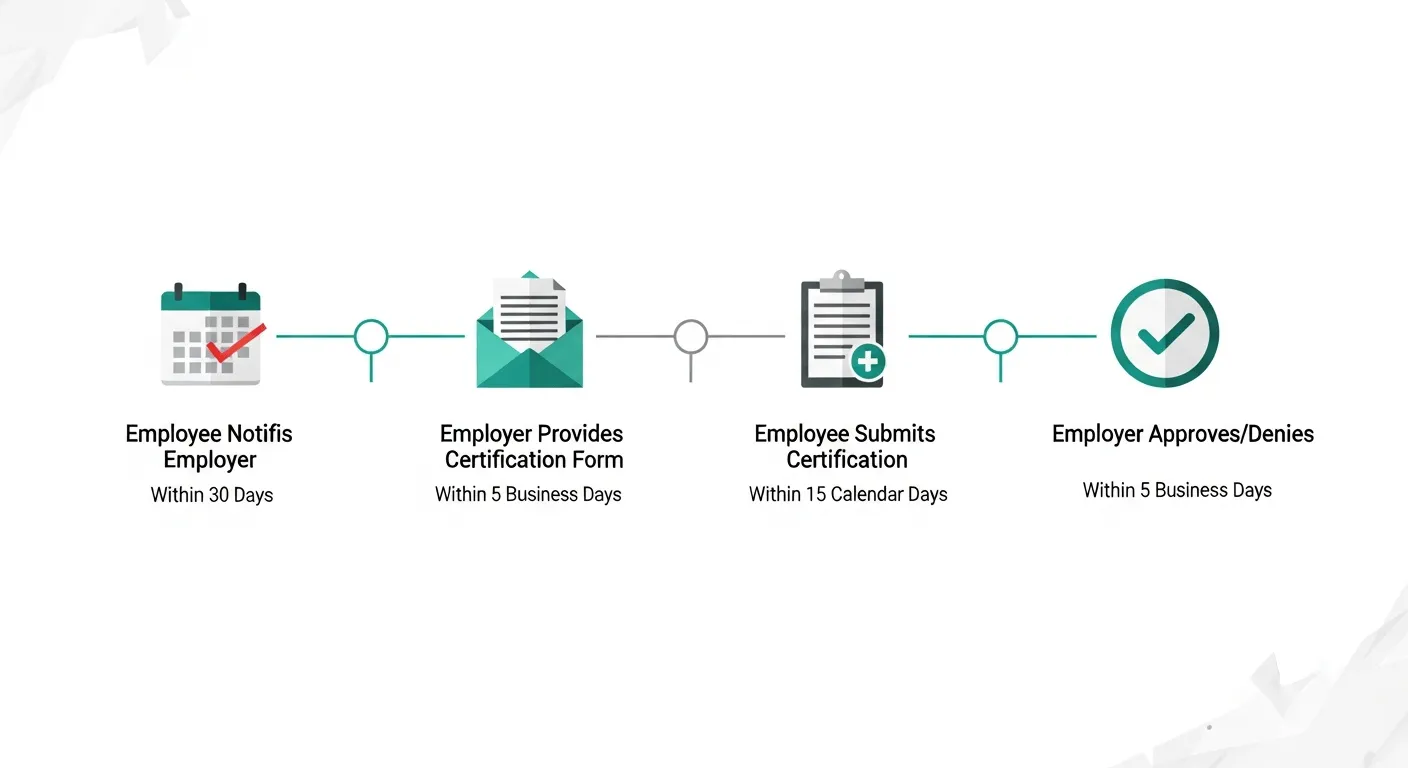
Solution: The moment your employer requests certification, mark the 15-day deadline on a calendar and start the provider conversation immediately rather than waiting for the formal request. Scheduling delays alone can eat most of that window, so early action is what actually protects the deadline.
3. Not Getting Medical Certification in Time
You need medical certification on official DOL forms, and getting them completed often takes longer than expected. Your 15-day window starts the moment your employer requests certification.
You’ll need:
-
Form WH-380-E for your own serious health condition, or
-
Form WH-380-F if you’re caring for a family member
These aren’t simple doctor’s notes. They ask detailed questions about diagnosis, treatment frequency, episode duration, and how your condition affects your ability to work.
Many employees assume they can call their PCP and walk out with completed paperwork. The reality is different. Scheduling delays of two to four weeks are common. Many providers aren’t familiar with FMLA forms and leave sections blank or provide vague answers. Some offices charge extra for form completion. And incomplete forms get rejected, starting the cycle over.
What Works:
-
Contact your doctor immediately after notifying HR (don’t wait for the formal request)
-
Ask specifically if they’re comfortable completing DOL WH-380 forms
-
Provide the blank form in advance so they can review requirements
-
Follow up persistently
Or, skip all this with FMLADocs. Our board-certified physicians complete FMLA certifications daily and understand exactly what employers need to see. Turnaround is typically 24-48 hours, which can make the difference between approval and denial when your 15-day clock is running.
Solution: Contact your provider the same day you notify HR, ask directly whether they’re comfortable completing DOL WH-380 forms, and hand over the blank form in advance so they can review it before your official deadline starts running.
4. Submitting Incomplete Medical Certification
Incomplete paperwork is the single most common reason FMLA applications get delayed. Employers reject certifications with missing information and request corrections, burning through your limited time.
Your certification must include the date your condition began and expected duration, whether inpatient care was required, whether continuing treatment is needed and how often, and how your condition affects your ability to perform job functions. The provider must sign and include their credentials and contact information.
For Intermittent Leave, Also Include:
-
Estimated frequency of episodes (e.g., “2-3 times per month”)
-
Expected duration of each episode (e.g., “4-8 hours” or “1-2 days”)
-
Whether episodes are predictable or unpredictable
Writing “ongoing” instead of a specific duration gets forms rejected. Writing “as needed” for frequency doesn’t establish an intermittent leave schedule. Listing a diagnosis without explaining functional impact doesn’t prove you can’t work.
When you work with FMLADocs, our physicians complete every required field with specific information the first time, so your application doesn’t bounce back for corrections.
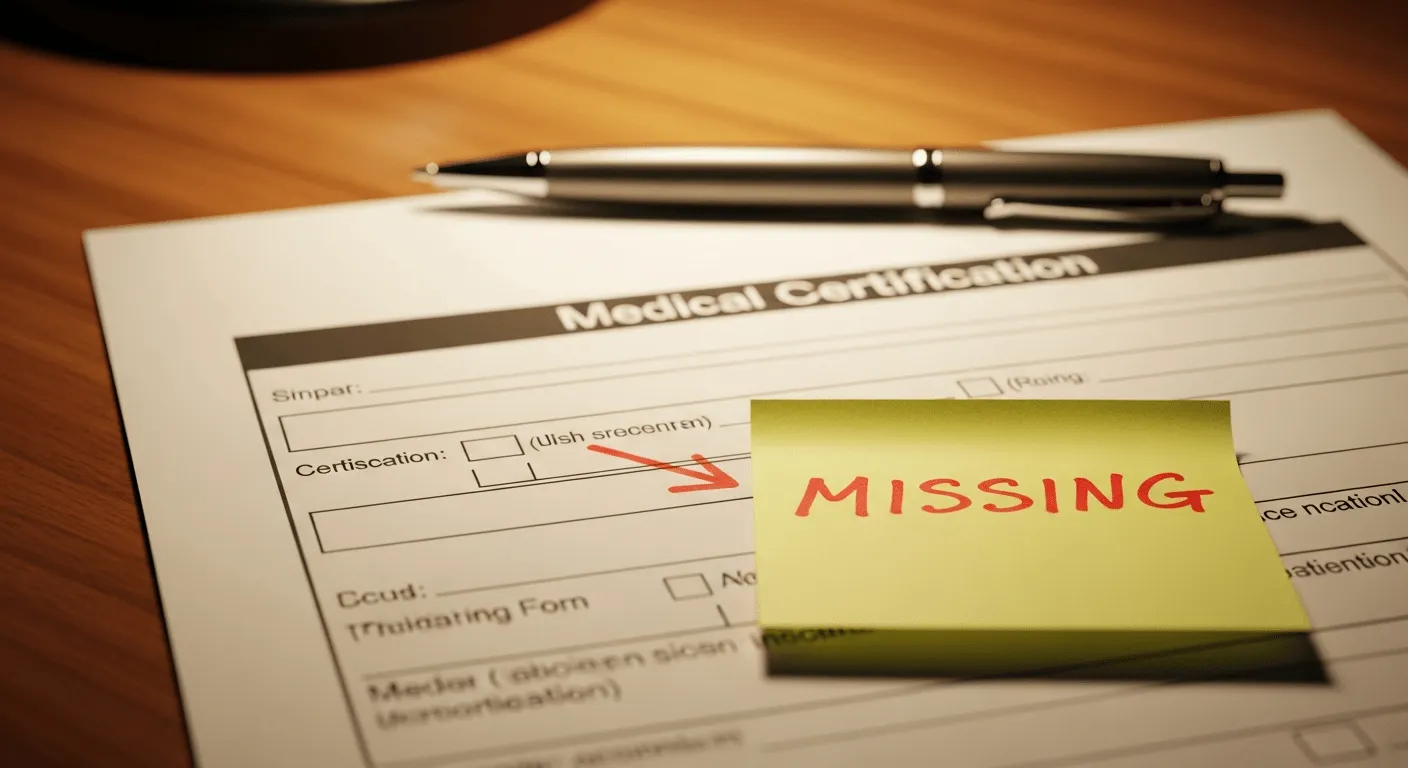
Solution: Before submitting, confirm your certification includes a specific onset date and duration, treatment frequency, functional impact on job duties, and the provider’s signature and credentials. Vague language like “ongoing” or “as needed” is exactly what gets forms bounced back.
5. Being Too Vague About Your Condition
There’s a balance between providing enough clinical detail for approval and protecting your privacy. Many certifications swing too far toward vagueness and get denied.
Writing “anxiety” with no symptom description isn’t enough. Listing “back pain” without frequency or treatment plan doesn’t establish a serious condition. Noting “depression” without explaining how it affects your ability to work leaves room for denial.
Effective certification describes how your condition actually manifests. For panic disorder, that might mean episodes occurring two to three times weekly, lasting 30-60 minutes, causing racing heart, difficulty breathing, and inability to concentrate or interact with coworkers.
For chronic migraines, episodes four to six times monthly, lasting 8-24 hours, with severe pain, light sensitivity, nausea, and complete inability to look at screens.
For Crohn’s disease, flare-ups requiring bathroom access every 15-30 minutes with severe abdominal pain, making sustained work impossible.
For pregnancy complications like hyperemesis gravidarum, certification should describe severe vomiting six to ten times daily, dehydration requiring IV treatment, and inability to maintain work attendance.
Your employer doesn’t see your exact diagnosis if the form is structured correctly. But providers must include enough functional detail that there’s no legitimate question your condition qualifies.
Solution: Ask your provider to describe how your condition manifests functionally, including frequency, duration, and specific work limitations, rather than listing only the diagnosis. Functional detail is what protects both your privacy and your approval odds.
6. Not Understanding What Qualifies as a “Serious Health Condition”
Many employees assume their condition isn’t “serious enough” and never apply. This self-disqualification leaves job-protected leave on the table.
Under DOL regulations, a serious health condition means any illness, injury, or physical/mental condition involving inpatient care or continuing treatment by a healthcare provider. “Continuing treatment” includes conditions causing more than three consecutive days of incapacity plus two or more provider visits, any pregnancy or prenatal care, chronic conditions requiring periodic visits (at least twice yearly) that may cause episodic incapacity, and conditions requiring multiple treatments like chemotherapy or dialysis.
Conditions That Commonly Qualify:
Mental Health: Major depression, generalized anxiety disorder, panic disorder, PTSD, bipolar disorder, OCD, severe adjustment disorder
Chronic Physical: Migraines (when causing periodic incapacity), diabetes, asthma (when severe), rheumatoid arthritis, fibromyalgia, Crohn’s disease, ulcerative colitis, endometriosis, lupus, multiple sclerosis, chronic back conditions, epilepsy
Other: Cancer and treatment, surgery and recovery, pregnancy complications (hyperemesis, preeclampsia, gestational diabetes)
Your anxiety is valid. Your depression is valid. These are recognized serious health conditions under federal law. Don’t disqualify yourself without consulting a healthcare provider who can evaluate your situation against the legal criteria.
Solution: Bring your symptoms to a licensed healthcare provider and ask directly whether they meet the DOL’s continuing-treatment standard. Only a provider’s clinical evaluation can make that determination, not a self-assessment against a list you read online.
7. Not Understanding Intermittent Leave
Many employees think FMLA only covers extended absences like six weeks after surgery. They don’t realize it also protects intermittent leave for chronic conditions, ongoing treatment, and unpredictable episodes.
Intermittent leave means taking FMLA-protected time in separate blocks rather than one continuous period. You might need every Tuesday afternoon for physical therapy. You might have migraine episodes two or three times monthly that force you to go home. You might need to leave unpredictably when anxiety symptoms become overwhelming. You might have Crohn’s disease that flares for a few days without warning.
With intermittent leave, you only use FMLA time for actual hours absent. A four-hour migraine uses four hours of your 12-week entitlement, not a full day. Your 12 weeks can stretch to cover an entire year of episodic absences.
Certification Must Include:
-
Estimated frequency (e.g., “2-4 times per month”)
-
Expected duration (e.g., “4-8 hours” or “1-3 days”)
-
Whether episodes are predictable or unpredictable
-
Why intermittent leave is medically necessary
Common mistakes include not requesting intermittent leave at all, underestimating frequency on certification, and failing to follow normal call-in procedures. If you have any condition causing recurring absences, ask about intermittent FMLA protection.
Solution: If your condition causes recurring absences, ask your provider to document estimated frequency, expected duration per episode, and whether episodes are predictable. That detail is what allows your certification to support an intermittent schedule instead of a single continuous block.
8. Not Keeping Records of Everything
Documentation becomes critical when disputes arise about what was approved or when you gave notice.
Save everything from your employer: the eligibility notice (required within five business days of your request), the designation notice confirming approval or denial, and any denial notices with stated reasons. Keep copies of completed WH-380 forms before submitting them, plus any recertification documents.
Maintain your own records too. Save all emails with HR to a personal account, not just work email. Take notes after phone conversations documenting date, time, who you spoke with, and what was said. Screenshot portal submissions with timestamps.
One practice that protects you: follow up phone calls with email summaries. After discussing leave with HR, send an email saying “Per our conversation today, you confirmed my leave is approved through [date] for up to [frequency] per month.” This creates written records of verbal communications that might otherwise be disputed.
Solution: Save every notice your employer sends, keep copies of your completed forms before submitting them, and follow up phone conversations with a summary email to HR restating what was agreed. A written record is what protects you if a verbal agreement is later disputed.
9. Not Understanding Your Rights During and After Leave
FMLA provides specific protections many employees don’t know about until they’ve been violated.
During leave, your employer must maintain your health insurance on the same terms as if you were working (you still pay your premium share). They cannot retaliate against you for requesting or taking leave. They cannot require you to work, though occasional status updates are permitted.
When you return, your employer must restore you to the same position or an equivalent one with same pay, duties, schedule, and location. Benefits accrued before leave cannot be taken away. They cannot demote you, cut hours, or move you to a worse shift because you took FMLA leave.
If you return to find your job “restructured” in ways that reduce your pay or responsibilities, that may violate your restoration rights. Document everything and consider filing a complaint with the DOL Wage and Hour Division. Learn more about your FMLA rights.
Solution: Before returning from leave, get your restoration terms in writing. If what you’re offered doesn’t match your prior position, pay, or schedule, document the discrepancy to HR in writing the same day, so you have a record if the issue needs to go further.
10. Confusing FMLA With Paid Leave
Federal FMLA provides job protection, not pay. Your employer must hold your position but doesn’t have to pay you while you’re out. This confusion causes real financial stress for employees expecting paychecks that don’t arrive.
You can often get paid during FMLA through other sources. State paid family leave programs in California, New York, New Jersey, Washington, Massachusetts, Connecticut, Oregon, Colorado, and Rhode Island provide partial wage replacement, typically 60-90% up to a cap. State disability insurance in California, New York, New Jersey, Rhode Island, and Hawaii covers your own medical conditions. Many employers offer short-term disability insurance or paid parental leave. You may also use accrued PTO concurrently with FMLA.
| Source | What It Covers | Availability |
|---|---|---|
| State paid family leave | Bonding, family care | CA, NY, NJ, WA, MA, CT, OR, CO, RI, MD |
| State disability insurance | Your own medical condition | CA, NY, NJ, RI, HI |
| Employer STD | Your own medical condition | Depends on employer |
| Accrued PTO | Any leave reason | Per employer policy |
These programs run concurrently with FMLA, meaning you get both job protection and income during the same period.
If you live in Florida, Texas, or other states without paid leave programs, FMLA is unpaid unless your employer provides benefits. Check with HR about your options before leave begins.
Solution: Before your leave begins, check with HR about state paid family leave programs, state disability insurance, employer short-term disability benefits, or accrued PTO you can use concurrently with FMLA. Any of these can provide income during leave that federal FMLA alone does not.
Takeaway Note
Most FMLA mistakes come down to not understanding requirements, missing deadlines, or submitting incomplete paperwork. Millions of Americans successfully use FMLA every year for mental health treatment, chronic conditions, pregnancy, surgery, and family caregiving. The system works when you know how to navigate it.
Being organized, understanding your eligibility, and working with providers who know what employers require makes all the difference between smooth approval and weeks of delays.
Frequently Asked Questions
What are common FMLA violations?
Denying eligible employees, counting FMLA absences against attendance policies, failing to restore equivalent positions, requiring work during leave, and retaliation. Document violations and file complaints with the DOL Wage and Hour Division.
How does FMLA work in California?
California provides dual protection under federal FMLA and state CFRA. State Disability Insurance covers your own conditions (~60-70% wages). Paid Family Leave covers family care and bonding up to 8 weeks. FMLADocs helps with both certifications.
How much do you get paid on FMLA in Florida?
Florida has no state paid leave program. FMLA is unpaid unless you have employer disability insurance or accrued PTO. Check with HR about available benefits.
Can my boss ask me why I'm taking FMLA?
Employers can request medical certification but cannot demand your specific diagnosis. Forms describe functional limitations, not diagnostic labels. Medical information goes to HR, not supervisors.
Why use FMLA instead of sick leave?
FMLA is federal law guaranteeing job protection; sick leave is company policy your employer controls. FMLA prevents discipline for absences and requires job restoration. Getting certified through FMLADocs ensures your absences are protected from day one.
Meet the author
Alisha Shabbir
Alisha is a health content specialist with 7 years of experience writing about employee benefits, medical leave, and healthcare access. With a background in healthcare communications, she breaks down complex regulations and medical topics into practical, actionable guidelines. From workplace wellness to preventive health, she helps readers navigate the healthcare system with confidence. When she's not working, she enjoys long walks, baking, and spending time with her pets.
Get Your FMLA Certification Online in Minutes