So, you’ve been staring at the FMLA paperwork for twenty minutes now, wondering if your anxiety is “bad enough” to qualify. Maybe you’ve convinced yourself that real mental health conditions look different from what you’re experiencing, that the crushing exhaustion, the Sunday night dread, the way you’ve started crying in your car before walking into the office… maybe that’s just normal work stress.
It’s not. And you’re far from alone.
According to recent workforce research, half of US workers experienced mental health challenges in 2025. Anxiety now ranks as the number one presenting issue among American employees. The truth is, FMLA leave for mental health isn’t some rare exception reserved for extreme cases. Millions of people use it every year to protect their jobs while getting the treatment they need.
Your mental health condition qualifies as a serious health condition under federal law. This guide will help you recognize the warning signs that indicate it’s time to consider FMLA leave for mental health, understand what qualifies, and walk you through exactly how to get certified.

What Qualifies as a Serious Mental Health Condition Under FMLA?
Before diving into the signs, let’s address the most common concern: you don’t need to be hospitalized or completely unable to function to qualify for FMLA leave for mental health. The threshold is lower than most people assume.
Under the Family and Medical Leave Act, a mental health condition qualifies as a “serious health condition” if it requires either inpatient care (like a hospital stay or residential treatment) OR continuing treatment by a healthcare provider. Most mental health FMLA cases fall into that second category.
Continuing treatment includes:
- Conditions that incapacitate you for more than three consecutive days and require ongoing medical care
- Chronic conditions (like anxiety, depression, or PTSD) that cause occasional periods when you can’t function normally and require treatment at least twice a year
If you’re seeing a therapist monthly, taking psychiatric medication, or attending regular counseling sessions, your condition likely meets this threshold.
One important point from the Department of Labor’s FMLA factsheet is that you do NOT need an official diagnosis to qualify for FMLA leave. Your healthcare provider certifies that you have a serious health condition requiring treatment. They don’t have to provide your employer with a diagnostic label.
Common Mental Health Conditions That Qualify for FMLA
| Condition | Common Symptoms | How It Affects Work |
| Generalized Anxiety Disorder | Persistent worry, restlessness, difficulty concentrating | Trouble focusing on tasks, avoiding responsibilities, decision paralysis |
| Major Depressive Disorder | Persistent sadness, fatigue, loss of interest | Reduced productivity, increased absences, withdrawal from colleagues |
| PTSD | Flashbacks, hypervigilance, emotional numbness | Triggered by workplace situations, difficulty with certain tasks |
| Panic Disorder | Sudden panic attacks, physical symptoms, anticipatory anxiety | Unable to function during episodes, avoidance behaviors |
| Bipolar Disorder | Mood episodes affecting energy, sleep, and behavior | Inconsistent performance, difficulty maintaining routines |
| Burnout (Chronic Workplace Stress) | Exhaustion, cynicism, reduced professional efficacy | Presenteeism, decreased engagement, emotional detachment |
7 Warning Signs You Need FMLA Leave for Mental Health
Recognizing when you’ve moved from “managing” to “struggling” to “unable to cope” can be difficult. Mental health conditions don’t announce themselves with the clarity of a broken bone. They build gradually, and we often adjust our sense of what’s normal until we’re operating at a fraction of our capacity.
These seven signs indicate your mental health condition may have reached the point where FMLA leave becomes necessary. If you recognize yourself in several of these scenarios, take your symptoms seriously.
Sign #1: Your Symptoms Are Interfering With Your Work Performance
Think back to six months ago, or a year ago. Could you complete tasks that now feel impossible? Projects you used to handle with confidence might now sit untouched because you can’t find the focus to start them. Emails that should take five minutes stretch into an hour because your mind keeps wandering.
Depression directly impairs cognitive function, affecting concentration, decision-making, and memory. When your brain is fighting depression, it has fewer resources available for work tasks.
You might be experiencing this sign if:
- You’re making mistakes you never would have made before
- Colleagues have started double-checking your work or asking if you’re okay
- You avoid certain tasks because they feel overwhelming
- Your performance reviews have declined without a clear external cause
- Simple decisions feel paralyzing
- You struggle to remember conversations or commitments
When mental health conditions impair cognitive function, work performance suffers. That’s a medical symptom, and it’s exactly what FMLA is designed to address.
Sign #2: You’re Experiencing Physical Symptoms From Mental Health Strain
Your body responds to mental health conditions in tangible ways. When anxiety or depression goes undertreated, or becomes too severe to manage while working, physical symptoms often emerge.
A 2024 Headspace workforce study found that 77% of employees say work stress has negatively impacted their physical health. The same research showed 75% reported stress-related weight changes.
Physical symptoms that may indicate you need leave:
- Chronic headaches or migraines that don’t respond to medication
- Persistent muscle tension, especially in neck, shoulders, or jaw
- Stomach problems, nausea, or significant appetite changes
- Insomnia or hypersomnia (sleeping too little or too much)
- Fatigue that doesn’t improve with rest
- Weakened immune system and frequent illness
- Heart palpitations or chest tightness
- Unexplained aches and pains
When mental health conditions start manifesting physically, your nervous system is signaling that it’s overwhelmed. These symptoms are just as legitimate and qualifying for FMLA as emotional ones.

Sign #3: You’ve Exhausted Other Coping Strategies
Maybe you started therapy six months ago. You’ve been taking your medication consistently. You requested a modified schedule, tried meditation apps, started exercising more, cut back on caffeine. You’re doing what you’re supposed to do.
And it’s still not enough.
Signs that standard interventions aren’t sufficient:
- Therapy provides temporary relief but symptoms return quickly
- Medication adjustments haven’t produced lasting improvement
- Weekends and PTO don’t provide enough recovery time
- EAP sessions helped initially but you’ve plateaued
- You need a higher level of care than outpatient treatment allows
- Self-care strategies that used to help no longer work
Some conditions require intensive outpatient programs, partial hospitalization, or dedicated time to focus on recovery without the ongoing stress of work responsibilities. When healing requires removing the source of stress, FMLA provides that option, whether as continuous or intermittent leave depending on your treatment needs.
Sign #4: Your Healthcare Provider Has Recommended Time Off
If your therapist, psychiatrist, or physician has suggested you take time off work, pay attention. These professionals don’t make that recommendation casually. They understand the financial and practical implications, and when they suggest leave anyway, it’s because they’ve assessed that continuing to work is harming your recovery.
What this recommendation might sound like:
- “I think you need more intensive support than we can provide while you’re working”
- “Your symptoms aren’t improving because you’re not getting enough rest”
- “I’d like to see you in a partial hospitalization or IOP program”
- “The stress from work is undermining everything we’re trying to do in treatment”
- “Have you considered taking FMLA leave?”
Their recommendation becomes the foundation for your FMLA certification. When a licensed healthcare provider documents that your condition requires time away from work, that’s exactly what employers need to approve your leave request.
Sign #5: You Dread Going to Work or Experience Panic Around Work
Sunday evening arrives and instead of enjoying your remaining weekend hours, you’re consumed with dread about Monday. Your stomach tightens. Sleep becomes difficult. You might find yourself mentally rehearsing conversations or imagining worst-case scenarios.
This goes beyond typical “I don’t love my job” feelings. Your nervous system is treating work as a genuine threat.
Indicators that work-related distress has become severe:
- Panic attacks in the parking lot, bathroom, or during meetings
- Crying before, during, or after work on a regular basis
- Heart racing and nausea triggered by work-related thoughts
- Calling in sick because you physically cannot make yourself go
- Dissociating or “checking out” to get through the day
- Severe anxiety that begins hours or days before returning to work
When your body responds to work with fight-or-flight activation, your mental health condition has reached a level of severity that qualifies for FMLA protection. This level of distress also creates a negative feedback loop; the stress worsens your condition, which makes work feel more threatening, which increases your symptoms. Breaking this cycle often requires stepping away.
Sign #6: You’re Using Unhealthy Coping Mechanisms to Get Through
Be honest with yourself here, even if it’s uncomfortable.
Warning signs of problematic coping:
- Increased alcohol consumption to “wind down” after work
- Relying on substances to manage symptoms or get through the day
- Taking more medication than prescribed to function
- Emotional numbing or dissociation as a survival strategy
- Binge eating, restricting food, or other disordered eating patterns
- Isolating from friends and family outside of work
- Excessive sleeping on days off to escape
These coping mechanisms make sense when you’re drowning, you grab whatever keeps you afloat. But they’re also warning signs that your current situation can’t continue. The need for chemical or psychological escape to function at work indicates a serious condition requiring proper treatment, not just survival strategies.
FMLA leave can provide space to address both the underlying mental health condition and any problematic coping patterns that have developed.
Sign #7: Your Symptoms Are Getting Worse, Not Better
Mental health conditions that progressively worsen despite intervention meet any reasonable definition of serious. If what started as occasional anxiety has become constant, if manageable depression has deepened into something darker, if symptoms you used to handle are now overwhelming you, that trajectory matters.
The World Health Organization estimates that depression and anxiety cost the global economy $1 trillion annually in lost productivity. Beyond the economic impact, there’s a clinical reality: the longer mental health conditions go inadequately treated, the more entrenched they become.
Signs of a worsening trajectory:
- Each month feels harder than the last
- Symptoms that were intermittent have become constant
- You’re losing ground instead of gaining it
- Coping strategies that worked six months ago no longer help
- You’ve started having thoughts of self-harm or suicide
- Your functioning has declined significantly over time
Early intervention leads to better outcomes. Waiting until you “can’t take it anymore” often means a longer, harder recovery than addressing the situation when warning signs appear.
How FMLA Protects You When Taking Mental Health Leave
Fear often prevents people from taking needed leave. Fear of job loss, of being seen differently, of career consequences. Understanding your legal protections, including when employers can and cannot deny FMLA requests, can help address those concerns.
The Family and Medical Leave Act is federal law, applying in all 50 states with specific, enforceable protections:
Your Rights Under FMLA for Mental Health Leave
| Protection | What It Means For You |
| Job Security | You must be returned to your same or equivalent position after leave |
| Health Benefits | Your employer maintains your coverage during leave under the same terms |
| Confidentiality | Medical records kept separate from personnel files; diagnosis stays private |
| Anti-Retaliation | Illegal to fire, demote, or discipline you for using FMLA |
| Intermittent Option | Take leave in smaller blocks for ongoing treatment if needed |
| No Diagnosis Required | Certification confirms serious health condition without revealing specifics |
You’re entitled to up to 12 weeks of job-protected leave within a 12-month period. You can take this continuously or intermittently, meaning you don’t have to use all 12 weeks at once if your condition is better managed with periodic time off for therapy, medication adjustments, or recovery from acute episodes.
Your employer cannot require you to disclose your diagnosis. Supervisors can be informed that you need time off or work restrictions, but they don’t get details about your condition or treatment.
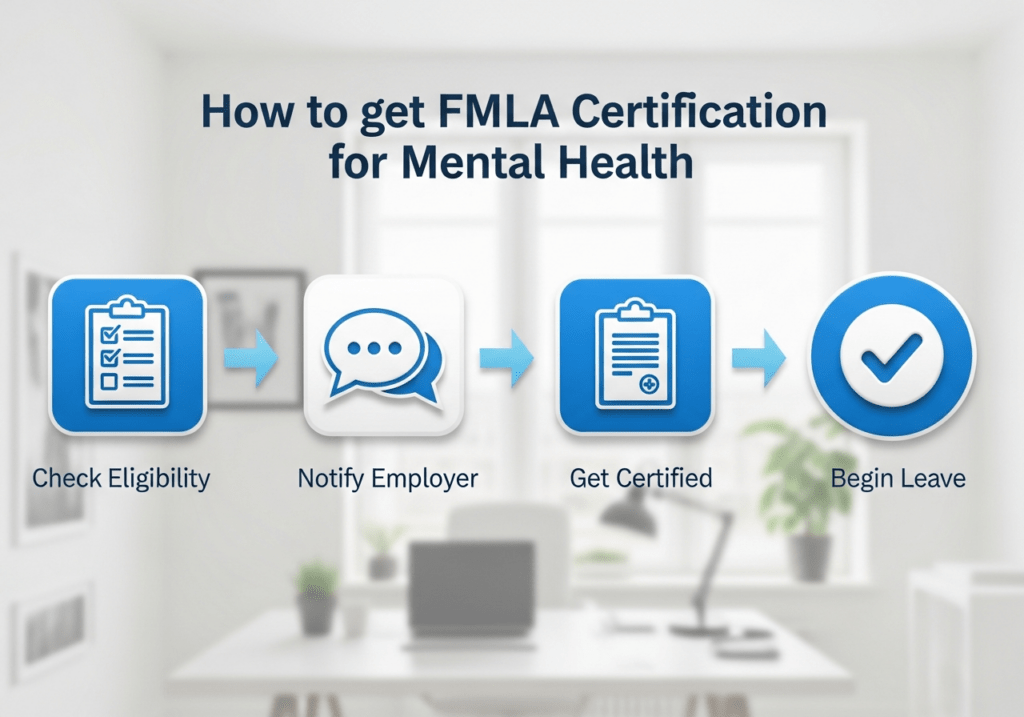
How to Get FMLA Certification for Mental Health
The certification process is more straightforward than many people expect.
Step 1: Confirm Your Eligibility
Before starting, verify you meet FMLA requirements:
- Your employer has at least 50 employees within 75 miles
- You’ve worked for your employer for at least 12 months
- You’ve worked at least 1,250 hours in the 12 months before leave starts
Step 2: Notify Your Employer
For foreseeable leave (like a planned treatment program), provide at least 30 days notice when possible. For unexpected needs, notify them as soon as you can. You don’t have to use the words “FMLA” or share your diagnosis, indicating you need time off for a serious health condition is sufficient.
Step 3: Obtain Medical Certification
Your employer will likely request medical certification from a healthcare provider confirming you have a serious health condition requiring leave.
Many people get stuck here. Their primary care doctor doesn’t feel qualified to certify mental health conditions, their therapist takes weeks to complete paperwork, or the psychiatrist’s office is backed up for months.
You don’t have to wait. Online FMLA certification services connect you with board-certified physicians licensed in all 50 states who specialize in completing this documentation. The process is often same-day or next-day, entirely confidential, and certifications are accepted by employers nationwide.
Step 4: Submit Your Certification
Submit certification to your employer within 15 days of their request. They have five business days to respond, though FMLA approval timelines can vary based on your employer’s process. Once approved, you can begin leave and focus on treatment.
Takeaway Note: Your Mental Health Deserves Protection
If you recognized yourself in several of these warning signs, you already know something needs to change. The exhaustion, the dread, the feeling that you’re barely holding it together, these are symptoms of a medical condition that deserves treatment.
Taking FMLA leave for mental health means recognizing that your health matters enough to protect. Millions of Americans use FMLA for mental health conditions every year. The law exists specifically to provide this protection.
You’ve spent enough energy trying to power through. Your body has been sending signals. Your work has suffered. And you’ve been wondering whether your situation qualifies, whether you’re “bad enough,” whether you deserve this protection.
You do. Get your FMLA certification today and take the protected time you need to heal.
FAQs
Is FMLA paid or unpaid for mental health?
FMLA leave is unpaid under federal law, it provides job protection, not pay. However, many employers allow or require you to use accrued paid time off (sick days, vacation, PTO) concurrently with FMLA leave. Some states also have paid family leave programs that may cover mental health conditions. Check your employer’s policy and your state’s laws to understand your options for paid leave.
How does depression qualify for FMLA?
Depression qualifies as a serious health condition under FMLA when it requires continuing treatment by a healthcare provider. This includes seeing a therapist or psychiatrist regularly, taking antidepressant medication, or receiving other ongoing care. You don’t need to be hospitalized, if your depression requires treatment and affects your ability to work, it likely meets the threshold.
How to get FMLA approved for anxiety?
To get FMLA approved for anxiety, notify your employer that you need leave for a serious health condition, then obtain medical certification from a healthcare provider (therapist, psychiatrist, or physician) who confirms your anxiety requires continuing treatment. Online FMLA certification services can connect you with board-certified physicians who complete documentation same-day if your regular provider is unavailable.
Is mental health a valid reason to leave work?
Yes. Mental health conditions are explicitly recognized as serious health conditions under federal FMLA law. The Department of Labor has issued specific guidance confirming that conditions like anxiety, depression, PTSD, and other mental health disorders qualify for job-protected leave when they require treatment. Your mental health is just as valid as any physical health condition.
How long can you be off work for mental health?
Under FMLA, you can take up to 12 weeks of job-protected leave within a 12-month period for mental health treatment. You can use this time continuously (taking several weeks at once) or intermittently (taking time as needed for appointments or episodes). Some employees also qualify for additional leave under the Americans with Disabilities Act (ADA) as a reasonable accommodation.