What Happens If Your Employer Denies Your FMLA Request?
 by Nida Hammad
 Last updated:
You asked for FMLA leave because you needed time off for a serious health problem, medical treatment, or a family emergency. You filled out the forms, gave the paperwork to your employer, and hoped your leave would be approved. Then your employer said no.
That can feel very stressful and upsetting. It is even harder when you are already dealing with sickness, pain, stress, anxiety, or family problems. Many people worry about missing work, losing money, or losing their job after getting an FMLA denial.
But a denial does not always mean the end. Many FMLA requests are denied because of paperwork mistakes. Sometimes the forms are missing information. Sometimes the doctor’s answers are too short or unclear. In other cases, the employer may ask for more medical details before approving the leave.
The Family and Medical Leave Act (FMLA) gives many workers legal rights. If you qualify, you may be able to take protected time off for your own health condition, to care for a family member, or for certain family and medical needs. Your employer cannot legally punish you for asking for protected leave.
If your FMLA request was denied, do not panic. You may be able to fix the paperwork, give more medical information, and send the request again. Understanding why your request was denied is the first step.
This guide will explain what to do after an FMLA denial, what your rights are, and how to make your paperwork stronger. Knowing your rights can help you protect your job and move forward with confidence.
Why Employers Deny FMLA Requests
Not every FMLA denial means your employer did something wrong or broke the law. In many situations, the problem is related to paperwork, missing information, or eligibility rules. The good news is that some of these problems can be fixed. Once you understand the reason for the denial, you may be able to correct the issue and submit a stronger request.
Here are some of the most common reasons why an FMLA request gets denied.
1. Incomplete medical forms:
One of the most common reasons for an FMLA denial is incomplete or unclear medical paperwork. The U.S. Department of Labor requires certain forms to be completed by a licensed healthcare provider. In most cases, employees use Form WH-380-E for their own health condition or Form WH-380-F to care for a family member.
If your doctor leaves sections blank, gives very short answers, writes unclear information, or uses words that are too general, your employer may not approve the leave right away.
Sometimes the wrong form is submitted, signatures are missing, dates are incorrect, or the paperwork is turned in late. Even small mistakes can delay the process or lead to a denial.
In many cases, employers must give employees a chance to fix missing or incomplete information before fully denying the request. That is why it is important to carefully review your paperwork before submitting it.
2. Missing eligibility requirements:
Not every employee qualifies for FMLA leave. Federal law has certain rules that workers must meet before they can receive protection under the Family and Medical Leave Act.
To qualify for FMLA, you must usually:
-
Work for your employer for at least 12 months
-
Work at least 1,250 hours during the past 12 months
-
Work at a location where the employer has at least 50 employees within 75 miles
If one of these requirements is missing, your employer may legally deny the request. Understanding these rules can help you know whether your leave request should be covered.
3. The condition does not qualify:
FMLA does not cover every illness or health problem. The law mainly protects employees with serious health conditions or family situations that require medical care or ongoing treatment.
FMLA usually covers:
-
Serious medical conditions
-
Hospital stays
-
Surgery and recovery
-
Pregnancy and childbirth
-
Mental health conditions that need treatment
-
Caring for a sick family member
-
Adoption or foster care placement
-
Certain military family situations
Minor illnesses like a common cold, mild flu, or short-term sickness that does not require ongoing treatment usually do not qualify for FMLA leave.
According to the U.S. Department of Labor, a serious health condition has a specific legal meaning. This often includes conditions that require hospital care, continuing treatment, multiple doctor visits, or time away from work because the employee cannot perform their job safely.
4. You already used your 12 weeks:
Under federal law, eligible employees usually get up to 12 weeks of FMLA leave during a 12-month period. If you already used all 12 weeks, your employer is generally not required to give more protected leave under the same law.
Some employees use FMLA leave all at once, while others use it slowly through intermittent leave. Intermittent leave means taking leave in smaller blocks of time, such as a few hours or days at a time for treatments or flare-ups.
Because intermittent leave adds up over time, some workers may not realize they already used most or all of their available leave. Once the 12 weeks are fully used, the employer may legally deny additional FMLA time.
It is a good idea to keep track of how much leave you have already taken so there are no surprises later.
5. You gave late notice without a good reason
If your leave is planned ahead of time, the law usually expects you to tell your employer at least 30 days before the leave begins. This gives the employer time to prepare for your absence and review your paperwork.
However, emergencies do happen. If your condition suddenly gets worse, you go to the hospital unexpectedly, or there is another emergency situation, you should notify your employer as soon as you reasonably can.
Good communication is important during the FMLA process. Letting your employer know early and submitting paperwork on time can help avoid delays, confusion, and possible denials.
| Denial Reason | What You Can Do |
|---|---|
| Incomplete medical certification | Contact your provider and correct the form within the 7-day cure period |
| Eligibility requirements not met | Verify your hours, tenure, and employer size; check state-level alternatives |
| Condition does not qualify as serious | Ask your provider to document the condition more specifically using FMLA legal standards |
| 12 weeks of leave already used | Explore state paid leave programs or ADA accommodations |
| Insufficient advance notice | Provide written explanation of why notice was not possible; request retroactive designation |
Understanding Your Legal Rights After a Denial
A denial letter is not the end of your FMLA journey. In many cases, you still have legal rights under federal law that protect you as an employee. Knowing these rights can help you understand what your employer must do and what steps you can take next. It can also help you spot mistakes in the process that can be corrected.
- Your employer must give you written notice:
Under FMLA rules, if your employer decides that your leave does not qualify, they must inform you in writing. This written notice is important because it creates a clear record of the decision. It should explain the exact reason your request was denied, such as missing documents, eligibility issues, or incomplete medical information.
If your employer only told you verbally and did not give you any written explanation, that may not follow FMLA rules. A verbal “no” is not enough in many cases. You have the right to understand clearly why your request was not approved.
Written notice also helps you fix the problem. When you know the exact reason, you can correct your paperwork or provide more medical details. Without written reasons, it becomes much harder to improve your request.
- You have the right to fix your paperwork:
If your FMLA request is denied because of missing or incomplete medical forms, your employer must give you a chance to fix it. In most cases, you must be given at least seven days to correct the paperwork.
This means your employer should not immediately reject your request forever if something is missing. Instead, they should tell you what is wrong and allow you time to update or complete the form.
Your doctor may need to fill in missing sections, provide more details about your condition, or clarify how your illness affects your ability to work. Sometimes even small updates can make a big difference in approval.
It is very important to act quickly during this time. If you do not submit the corrected paperwork within the given time, your employer may keep the denial in place. Fixing paperwork is one of the most common ways employees successfully turn a denial into an approval.
- You cannot be punished for asking for leave:
One of the strongest protections under FMLA is that your employer cannot punish you just because you asked for leave. This is true even if your request is denied.
Your employer cannot legally write you up, reduce your working hours, demote you, stop your promotion, or fire you just because you requested FMLA leave. Asking for protected leave is your legal right if you qualify.
The U.S. Department of Labor clearly states that employers cannot interfere with your FMLA rights. This includes blocking your ability to apply for leave or punishing you for trying to use it.
However, your employer can still expect you to follow normal work rules. This means you still need to show up for work when you are not on approved leave and follow company policies. But they cannot treat you unfairly just because you tried to use your legal rights.
- Your state may give you more protection.
Even if federal FMLA does not fully protect you, your state may have additional laws that give you more rights. Many states have their own leave programs that are sometimes stronger than federal rules.Some states allow paid leave instead of unpaid leave. Others have lower eligibility requirements or cover smaller companies that federal FMLA does not include.
States like California, New York, and Washington have paid family and medical leave programs. These programs can help workers take time off and still receive part of their income. They also work alongside federal FMLA, which means you may qualify for both in some cases.
This is important because even if your federal FMLA request is denied, you might still qualify under state law. Each state has different rules, so it is important to check what applies where you work.
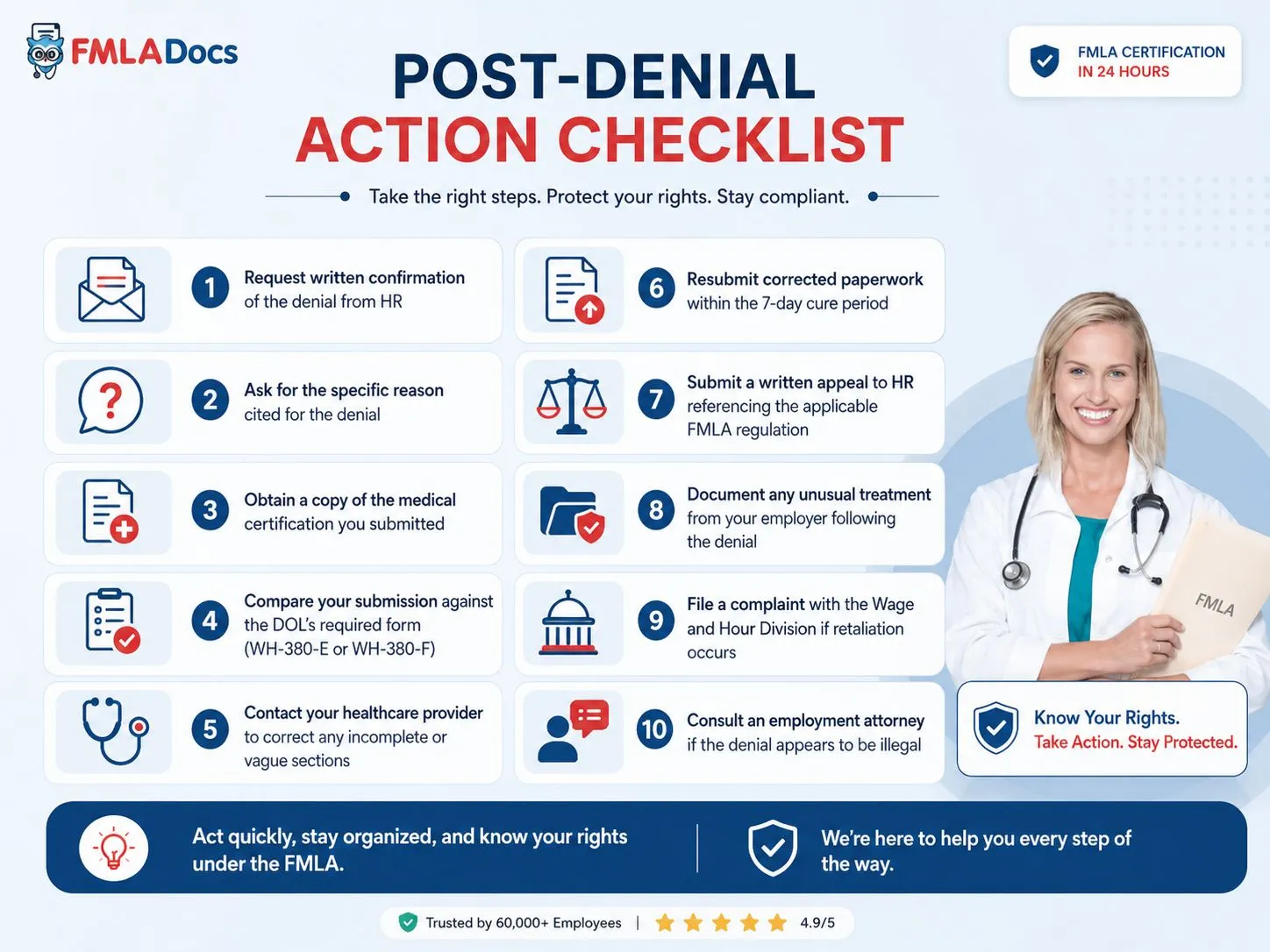
What to Do Immediately After a Denial: Step-by-Step
Moving quickly gives you the best chance of turning things around. Here is what to do in the days right after you get a denial.
Step 1: Get the denial in writing.
If your employer told you verbally, send HR an email asking them to confirm the denial in writing and explain the reason. You need written proof.
Step 2: Read the denial reason carefully.
Look at the notice and figure out what went wrong. Was it a paperwork problem? A question about your eligibility? A dispute about whether your condition qualifies? The reason tells you what to do next.
Step 3: Ask for a copy of your paperwork.
Ask HR for the medical certification you sent in and the WH-382 form they are supposed to give you. Compare what was submitted to what the DOL requires.
Step 4: Fix the paperwork.
If the denial is because of incomplete forms, call your doctor right away. Ask them to fill in anything that was missing, explain your condition more clearly, and resubmit before the seven-day window closes.
Step 5: Send a written appeal to HR.
Write a simple letter saying you believe the denial was wrong. Reference the FMLA rule that supports your position. Stay professional and stick to the facts.
Step 6: Contact the Department of Labor if the denial continues.
If your employer keeps denying a valid request or retaliates against you, you can file a complaint with the Wage and Hour Division of the Department of Labor. They investigate FMLA violations and can require employers to make things right.
The Role of Medical Documentation in FMLA Approval
Here is what most employees do not know: the medical certification is the most important part of
your FMLA request.
Employers cannot make medical calls on their own. They rely on what your doctor writes on the form. If that form is vague, incomplete, or unclear, the employer has a valid reason to deny or delay your leave.
The DOL uses two main forms for FMLA certification. Form WH-380-E covers your own serious health condition. Form WH-380-F covers a family member’s condition. These forms ask about the condition, how long the leave will be needed, whether it will be continuous or in separate blocks, and the medical facts behind the request. You can get these forms from the DOL’s FMLA forms library.
Your doctor must answer every question fully. Leaving fields blank, writing “see attached,” or saying “patient needs time off” is not enough. The form must give enough medical detail for the employer to see that the condition is serious under federal law.
That is where many people run into trouble. A regular doctor may not know exactly what FMLA requires. Or they may not have enough time to fill out the form with care.
FMLADocs was built for this exact problem. Our licensed doctors review your medical records, know what FMLA requires, and prepare forms that give your request the strongest possible foundation. If your FMLA request was denied because of paperwork issues, you can start over with better documentation. Check your eligibility and start y our certification at FMLADocs.
When a Denial May Be Illegal
Not every denial is valid. Some employers deny FMLA requests in ways that break federal law.
- Interfering with your right to take leave.
If your employer tries to stop or limit your right to take FMLA leave, that may be illegal interference. This happens when an employer makes it hard for you to apply for leave or discourages you from using it when you need it.
It can also be a problem if your employer does not clearly explain your FMLA rights or does not give you proper guidance about the process. Delaying your request without a valid reason or creating extra steps that are not required by law can also be considered interference.
Under federal FMLA rules, employers are not allowed to block, reduce, or prevent your right to take protected leave if you qualify. They must follow the law and treat your request fairly.
- Not labeling your leave as FMLA.
If your employer knows your absence may qualify under FMLA, they have a responsibility to review it correctly. They must also inform you when your leave is being counted as FMLA leave.
According to FMLA regulations at 29 CFR Part 825, employers have a responsibility to notify employees when leave qualifies as FMLA and to designate it accordingly.
If this step is not done correctly, your rights may be affected without you knowing. Employers are expected to follow proper notice and designation rules to make sure employees are fully informed.
- Requiring more documentation than allowed.
Employers must follow strict rules about what medical information they can request. They are only allowed to ask for the information needed under FMLA guidelines.
They cannot demand full medical records or unnecessary private health details. They also cannot request information that goes beyond what the official FMLA forms require.
In some cases, employers may request a second medical opinion, but only when the law allows it and under proper conditions. Even then, rules must be followed carefully, and extra demands are not allowed beyond what FMLA permits.
- Unfair denials.
Some FMLA denials may happen in a way that is not fair or clearly explained. This can be a legal issue if employees in similar situations are treated differently without a clear reason.
It can also become more serious if the decision seems connected to protected characteristics under employment laws.
Fair treatment is an important part of FMLA rules. Employers are expected to review all requests in a consistent and equal way. Decisions should be based on eligibility and medical information, not personal bias or unfair treatment.
If you feel your denial is unfair or possibly illegal, it is important to get legal advice. An employment lawyer can help you understand your rights and what steps you can take next. Many lawyers offer free first consultations, so you can get guidance before making decisions..
How to Strengthen Your FMLA Request Before Resubmitting
If your first request was denied and you want to try again, do not send the same paperwork. Make it stronger.
- Use a provider who knows FMLA paperwork:
Many doctors are excellent at treating medical conditions but are not always familiar with the details required in FMLA forms. Some providers give short answers, skip sections, or use vague wording that does not clearly meet federal leave standards. Unfortunately, incomplete answers can lead to delays or denials.
A healthcare provider who understands FMLA paperwork knows how to explain your condition in a way that supports your leave request. They are more likely to include details about symptoms, treatment plans, recovery periods, and work limitations. They can also explain why your condition qualifies as a serious health condition under the law.
Before the paperwork is submitted, review it carefully with your provider if possible. Make sure all sections are completed, dates are correct, and the answers are detailed enough to explain your medical needs clearly. Even one missing section or unclear answer can cause problems during the approval process.
- Be specific about intermittent leave:
If you need intermittent leave, your paperwork should clearly explain how often you may need time off and how long each absence may last. Intermittent leave is common for conditions that involve flare-ups, ongoing treatment, chronic pain, migraines, mental health conditions, or recurring symptoms.
One of the biggest mistakes people make is using vague phrases such as “leave as needed” or “occasional absences.” Employers often reject these answers because they do not provide enough information. Instead, the certification should estimate the expected frequency and duration of absences whenever possible.
The paperwork should also explain why intermittent leave is medically necessary. If your symptoms make it difficult to work during flare-ups, your provider should clearly state that in the certification.
- Show how your condition affects your work:
Your FMLA paperwork should do more than simply list your diagnosis. It should clearly explain how your condition affects your ability to perform your job duties. This is one of the most important parts of a strong leave request.
Your provider should also explain why time away from work is medically necessary. This may include recovery after treatment, surgery, therapy sessions, medication side effects, or periods when symptoms become too severe to safely perform your job.
The clearer the connection between your medical condition and your work limitations, the stronger your request will be.
- Request a second opinion if needed:
If your employer questions your medical certification, they may request a second opinion from another healthcare provider. In many cases, the employer must pay for that second opinion. This does not automatically mean your claim is weak, but it does mean the employer wants additional medical confirmation.
You can also take the initiative and get additional support on your own. If your original paperwork was too brief or unclear, consider asking a specialist to provide more detailed documentation. A specialist may be able to better explain your diagnosis, symptoms, treatment needs, and work restrictions.
- Keep copies of everything:
Good recordkeeping is extremely important during the FMLA process. Keep copies of every document related to your leave request, including certification forms, emails, letters, HR notices, doctor’s notes, and any paperwork you submit or receive.
It is also helpful to keep track of dates and communication with your employer or HR department. If you have a phone conversation, write down the date, time, and summary of what was discussed. Keeping organized records can protect you if problems come up later.
If your employer claims paperwork was never submitted or says deadlines were missed, your records may help prove otherwise. These documents can also become important if you need to file a complaint or speak with an employment attorney about possible FMLA violations.
What Happens If Your Employer Retaliates?
Retaliation after an FMLA request is one of the most serious violations an employer can commit. And it happens more often than most employees realize.
Retaliation can look like a sudden negative performance review,, a schedule change that makes things harder, a demotion, a pay cut, or being fired. It does not always look obvious. Sometimes it is quiet and gradual.
Federal law is clear on this point. Section 105 of the FMLA, codified at 29 U.S.C. 2615, prohibits any employer from punishing or discriminating against an employee for using their FMLA rights or opposing any unlawful practice under the act.
If you experience retaliation, document everything immediately. Note the date, what occurred, who was there, and how it connects to your FMLA request. Then file a complaint with the Wage and Hour Division. You can also take legal action in federal or state court.
The Society for Human Resource Management notes that FMLA claims are among the most frequently litigated employment law issues, partly because retaliation cases can result in significant damages for employees. If you believe you are being retaliated against, act quickly. There is a two-year statute of limitations for FMLA claims, or three years if the violation is willful.
State-Level Protections That May Apply to You
Even if your federal FMLA request was denied, your state may have its own protections.More than a dozen states have passed their own family and medical leave laws. Some cover employers with fewer than 50 employees. Some offer paid leave. Some allow leave for more types of family members.
According to the National Conference of State Legislatures overview of paid family leave laws, states including California, New Jersey, New York, Washington, Massachusetts, Connecticut, Oregon, and Colorado all have paid leave programs that may apply even when federal FMLA does not.
Here is what this means for you. If your employer has fewer than 50 employees and denied your FMLA request on the basis that the law does not apply, you may still qualify for state leave. Check your state’s department of labor or workforce agency to understand what protections exist where you work.
FMLADocs serves employees in all 50 states and can help you understand both the federal and state leave options available to you. Our licensed physicians are familiar with the documentation requirements under federal FMLA as well as many state programs.
Conclusion
A denied FMLA request is not the end. It is a sign to look closely at why it was denied, fix any paperwork problems, and know your rights.
Most denials come down to documentation. The medical certification is the base of every good FMLA request. When that paperwork is incomplete or unclear, even a qualifying employee can be turned away. The good news is that paperwork problems can be fixed.
You have seven days to correct your forms. You have the right to a written explanation. You cannot be punished for asking for leave. And if your employer breaks any of those rules, you have legal options through the Department of Labor and the courts.
The FMLA request process works best when your paperwork is complete, your doctor knows what federal law requires, and you act quickly after a denial.
FMLADocs connects you with licensed doctors who know how to complete FMLA forms correctly. The process is fully online, HIPAA-compliant, and accepted by employers in all 50 states. Most certifications are done within 24 hours. If your last request was denied because of paperwork gaps, stronger documentation can make all the difference. Start your FMLA certification at FMLADocs today and get employer-ready paperwork in 24 hours.
Frequently Asked Questions
Can my employer deny my FMLA request if I qualify?
If you meet all the requirements and your condition qualifies under federal law, your employer cannot legally say no. A denial in that case breaks the FMLA. You can appeal, send corrected forms, and file a complaint with the Department of Labor.
How long do I have to correct my medical certification after a denial?
Your employer must give you at least seven days to fix any problems with your medical forms. During that time, you can work with your doctor to complete or correct the paperwork. Missing this window does not bar you from FMLA forever, but it may slow things down.
What if my doctor won't fill out the FMLA paperwork?
Some doctors are reluctant to fill out FMLA forms due to time or unfamiliarity with the process. You have the right to see another licensed provider. Services like FMLADocs work directly with patients to make sure their medical forms meet federal FMLA standards.
Can I be fired for requesting FMLA leave?
No. Firing someone for asking for or taking FMLA leave is illegal retaliation. If this happens to you, write down the timeline of your FMLA request and any related messages. Then talk to an employment lawyer and file a complaint with the Wage and Hour Division.
What if I don't qualify for federal FMLA but still need time off?
Start by checking your state's leave laws. Many states cover smaller employers or a wider range of conditions. You can also talk to your employer about using your PTO, short-term disability benefits, or a workplace accommodation under the Americans with Disabilities Act if your condition applies.
Does my employer have to tell me why they denied my FMLA request?
Yes. Federal rules require employers to notify you in writing when a leave request is denied and to give the exact reason. If you did not get a written denial with an explanation, send HR an email and ask for one.
Can I reapply for FMLA after a denial?
Yes. A denial based on paperwork problems or eligibility questions does not stop you from applying again. If the denial was due to incomplete forms, fix them and resubmit. If you did not yet meet the time-at-work requirements, you may qualify later.
Does FMLA cover mental health leave?
Yes, FMLA can cover mental health conditions like depression, anxiety, or PTSD. It applies if the condition is serious and needs treatment, such as therapy, medication, or doctor visits. It also applies if the condition makes it hard for you to work or requires time off to recover.
Meet the author
Nida Hammad
I am a professional writer with over five years of experience creating clear, engaging, and well-researched content. I specialize in healthcare topics, helping readers understand complex information in simple wording. Currently, I write for FMLA DOC, where I focus on producing accurate and trusted guides for people seeking support with FMLA and medical needs.
Get Your FMLA Certification Online in Minutes