
What Your Employer Can and Can't Ask on FMLA Paperwork
 by Nida Hammad
 Last updated:
You requested FMLA leave and now you are staring at a stack of FMLA paperwork wondering what your employer actually has the right to ask for. It is a fair concern. The Family and Medical Leave Act (FMLA) gives employers the right to request medical certification. But it also puts firm limits on what that certification can contain, how your employer can use it, and what they are never allowed to request.
Employees get denied FMLA leave or feel pressured to share more than they are legally required to every day, often because neither the employee nor the HR department fully understands where those limits are. The FMLA forms and the certification process look bureaucratic, but the rules are actually quite specific. Knowing them protects you.
This guide explains exactly what your employer can ask on FMLA paperwork, what is strictly off-limits, what your rights are if you believe you have been asked for too much, and how FMLADocs handles the certification so the forms are completed correctly the first time.
If you need your FMLA certification completed quickly by a licensed physician, FMLADocs handles the process online in 24 hours, with employer-ready forms that meet DOL standards.
The Legal Foundation: What the FMLA Actually Allows
The FMLA gives covered employers the right to require medical certification when an employee requests leave. But that right comes with specific boundaries. The law is clear: your employer may ask only for information that is necessary to determine whether your leave qualifies under the FMLA. Nothing more.
The governing regulation is 29 CFR 825.306. It defines exactly what a medical certification may contain. Employers are not permitted to ask for information beyond what that regulation specifies. The WH-380-E form, the DOL’s standard certification form for an employee’s own serious health condition, is designed around these limits. And the form itself says it plainly: ‘You may not ask the employee to provide more information than allowed under the FMLA regulations.’
The key principle is functional, not diagnostic. Your employer needs to know whether your condition is serious enough to qualify for FMLA leave and how it affects your ability to work. They do not need to know the name of your condition, the specific diagnosis, or anything beyond what the law allows. This distinction matters more than most employees realize when they sit down to complete FMLA paperwork.
What Your Employer CAN Ask on FMLA Paperwork
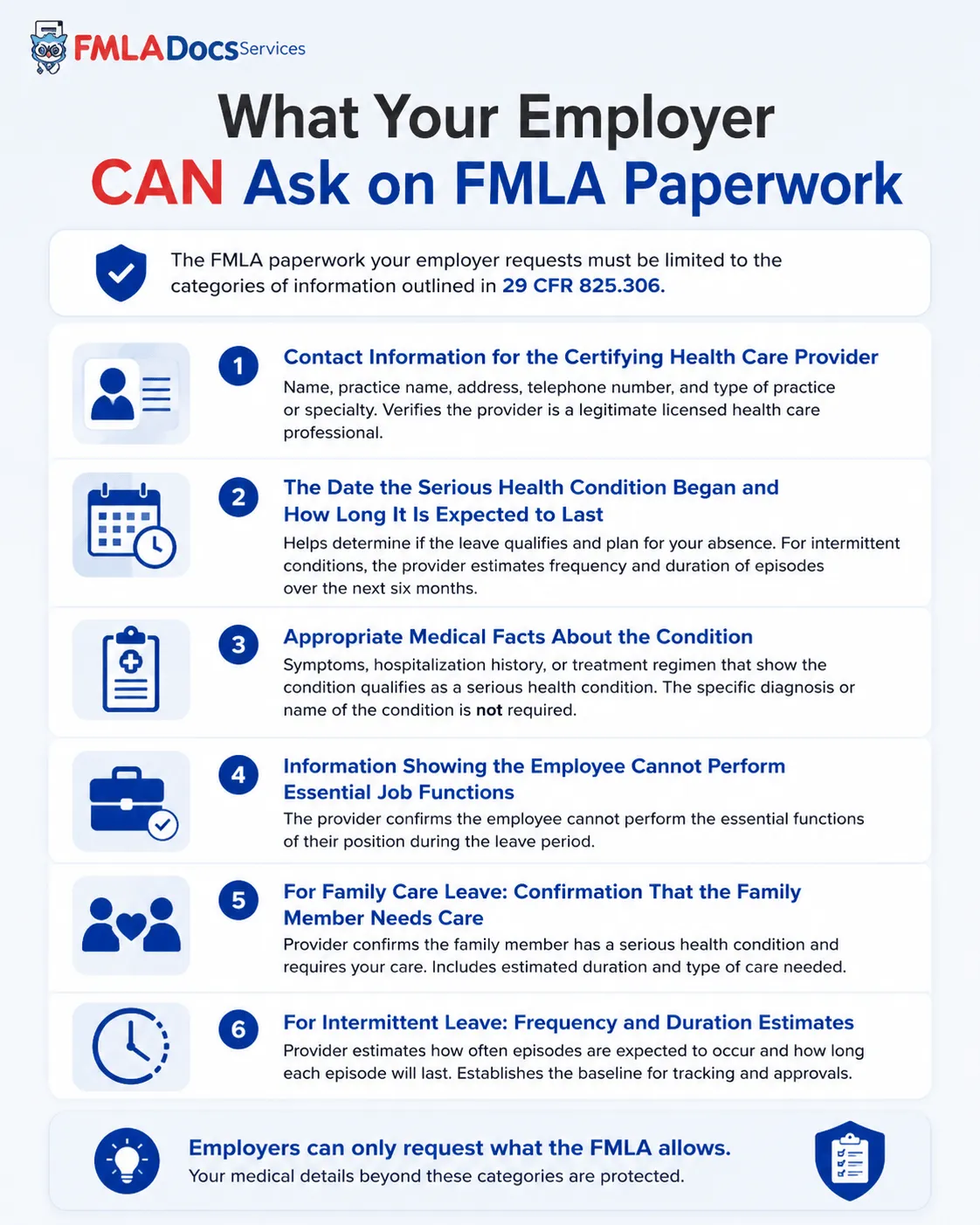
The FMLA paperwork your employer requests must be limited to the categories of information outlined in 29 CFR 825.306. Here is what falls clearly within those limits, based on DOL guidance and the structure of the WH-380-E and WH-380-F forms.
1. Contact Information for the Certifying Health Care Provider
Your employer can ask for the name, practice name, address, telephone number, and type of practice or specialty of the health care provider who is certifying your condition. This allows them to verify that the certifying provider is a legitimate licensed health care professional.
Under the FMLA, a qualifying health care provider includes doctors of medicine or osteopathy, podiatrists, dentists, clinical psychologists, optometrists, chiropractors, nurse practitioners, nurse-midwives, clinical social workers, physician assistants, and Christian Science practitioners, as long as they are authorized to practice in their state. This is confirmed in DOL Fact Sheet 28G on FMLA medical certification.
2. The Date the Serious Health Condition Began and How Long It Is Expected to Last
Your employer can ask when the condition started and roughly how long it is expected to continue. This helps the employer determine whether the leave qualifies as FMLA leave and plan for your absence. For intermittent leave conditions like migraines or anxiety, the provider should estimate the frequency and duration of expected episodes over the next six months.
The estimates do not have to be exact. The DOL specifically acknowledges that for chronic or episodic conditions, a provider can give a best medical estimate. The words ‘unknown’ or ‘variable’ are generally not acceptable as the only response, but a range (such as ‘two to four times per month, lasting four to 24 hours per episode’) is sufficient.
3. Appropriate Medical Facts About the Condition
Your employer can ask the health care provider to describe the medical facts about the condition, including symptoms, hospitalization history, or the treatment regimen. But this is where it gets important: the FMLA forms ask for facts that establish the condition qualifies as a serious health condition. They do not ask for the specific diagnosis or the name of the condition unless the provider volunteers it.
For example, a provider can describe ‘a chronic condition causing periodic episodes of incapacity lasting 24 to 48 hours, treated with prescription medication and rest’ without naming the condition at all. That description provides the employer with everything they need to evaluate FMLA eligibility.
4. Information Showing the Employee Cannot Perform Essential Job Functions
For leave based on the employee’s own serious health condition, the employer can ask the provider to confirm that the employee cannot perform the essential functions of their position during the leave period. The employer can provide a list of the employee’s essential job functions to the health care provider. According to DOL Fact Sheet 28G, the provider must state whether the employee is unable to perform any of those essential functions due to the condition.
5. For Family Care Leave: Confirmation That the Family Member Needs Care
If you are taking leave to care for a family member with a serious health condition, the employer can ask the provider to confirm that the family member requires care and that your presence is needed. The WH-380-F form handles this. The provider must state the estimated duration of the need for care and whether the care is psychological or physical in nature.
6. For Intermittent Leave: Frequency and Duration Estimates
When an employee requests intermittent FMLA paperwork certification, the employer can ask the provider to estimate how often episodes are expected to occur and how long each episode will last. This is the most important section of the certification for intermittent leave. It establishes the baseline for how the employer tracks and approves absences going forward.
What Your Employer CANNOT Ask on FMLA Paperwork
This is where many employers and even HR departments make mistakes. The FMLA is specific about what is off-limits. These are not gray areas. These are clear prohibitions that apply to every piece of FMLA paperwork in every workplace.
FMLA Paperwork: What Is Strictly Off-Limits
-
Your specific diagnosis. Your employer cannot require you to disclose the name of your condition. The certification describes functional limitations, not diagnoses.
-
Your complete medical history. The certification is limited to the condition for which you are seeking leave. Prior conditions, unrelated health issues, and your full medical background are not their business.
-
Genetic information. Under the Genetic Information Nondiscrimination Act (GINA) and the FMLA regulations, employers cannot request genetic information. The WH-380-E form explicitly instructs providers not to include genetic test results or information about genetic conditions in family members.
-
Direct contact with your doctor. Your employer cannot contact your health care provider directly to discuss your condition unless you have signed a written authorization or waiver giving them permission. This is not required and you cannot be forced to sign it.
-
Medical records. Your employer can ask for a completed certification form. They cannot ask for your medical records, copies of test results, or records from your treatment history.
-
A certification for bonding leave. If you are taking leave to bond with a healthy newborn, adopted child, or child placed for foster care, your employer cannot require any medical certification. This type of leave does not involve a serious health condition.
-
More information than the form allows. If the employer uses their own form instead of the DOL prototype, that form cannot ask for information beyond what 29 CFR 825.306-825.308 permits.
The Diagnosis Rule Explained
This is the most commonly misunderstood limit. Many employees believe they must tell their employer exactly what condition they have. They do not. The FMLA certification is designed to confirm that a serious health condition exists and that it causes the functional limitations being claimed. The name of the condition is not required.
In practice, providers often do include a diagnosis, and there is nothing wrong with that. But it is voluntary, not mandatory. If a provider chooses to describe the condition only in functional terms, such as ‘the patient has a chronic condition requiring at least two physician visits per year and causing episodic incapacity lasting two to three days per episode,’ the employer must accept that certification as complete. They cannot reject it or demand more specifics just because no diagnosis is named.
The regulation at 29 CFR 825.306(a)(3) confirms this. The employer may ask for ‘appropriate medical facts’ about the condition, but those facts are defined in terms of symptoms and functional impact, not diagnosis.
The Genetic Information Prohibition
This one catches employers off guard. Under both GINA (the Genetic Information Nondiscrimination Act) and the FMLA regulations, an employer cannot request genetic information as part of FMLA paperwork. The WH-380-E form even includes an explicit instruction to the health care provider: ‘Do not provide information about genetic tests, as defined in 29 C.F.R. 1635.3(f), genetic services, as defined in 29 C.F.R. 1635.3(e), or the manifestation of disease or disorder in the employee’s family members.’
If an employer receives genetic information as part of a medical certification, they are required to treat it as confidential and cannot use it in any employment decision. But the better approach is to ensure the certification forms do not request it in the first place.
The Direct Provider Contact Prohibition
Your employer cannot call, email, or otherwise contact your health care provider to discuss your condition without your written authorization. This is a firm rule under 29 CFR 825.307. If your employer wants to authenticate the certification or clarify something on the form, they can contact the provider, but only to confirm limited details: that the provider actually completed and signed the form, the provider’s contact information, and the meaning of technical terminology. They cannot use that contact to ask substantive questions about your condition.
You can voluntarily sign a release allowing direct contact. But you cannot be required to do so. If an employer conditions FMLA approval on you signing a blanket medical release, that is a violation of the law.
The Four Key FMLA Forms and What Each One Does
The FMLA paperwork process involves several DOL forms. Each one serves a specific purpose, and understanding which form does what helps employees know exactly what they are being asked and why. All forms are available on the DOL FMLA forms.
FMLA Forms: Who Completes Each One and When
| Form | Who Completes It | Purpose |
|---|---|---|
| WH-381 (Eligibility and Rights Notice) | Employer | Tells employee whether they are eligible for FMLA and their rights and responsibilities. Must be issued within 5 business days of leave request. |
| WH-382 (Designation Notice) | Employer | Tells employee whether their leave is approved as FMLA leave and how much time is designated. Also used to flag incomplete certifications. |
| WH-380-E (Employee’s Own Condition) | Health care provider (with employee completing Section II) | Certifies that the employee has a serious health condition that qualifies for FMLA leave. |
| WH-380-F (Family Member’s Condition) | Health care provider (with employee completing Section II) | Certifies that a family member has a serious health condition requiring the employee’s care. |
| WH-384 (Military Exigency) | Health care provider or military documentation | Certifies qualifying military exigency for leave related to a family member’s military service. |
| WH-385 (Military Caregiver) | Health care provider | Certifies serious injury or illness of a current servicemember or veteran being cared for by the employee. |
Do Employers Have to Use the DOL Forms?
No. The DOL forms are optional. Employers may use their own FMLA forms, as long as those forms ask only for the same basic information specified in the FMLA regulations. Employers cannot use their own custom forms to ask for more information than the DOL prototype forms allow.
Employees also have a choice. According to the DOL FMLA forms guidance, an employee can provide the required certification information in any format, such as a letter on the health care provider’s letterhead. The employer cannot reject a certification just because it is not on their preferred form, as long as it contains all the required information.
The 15-Day Rule for Returning FMLA Paperwork
Once your employer requests a completed certification, you have at least 15 calendar days to return it. This is a federal minimum, not a goal. Your employer must give you at least 15 days. If returning the certification within 15 days is not feasible despite your good-faith efforts, such as because your provider cannot complete the form in time, you may be allowed more time. But you should communicate that situation to your employer proactively.
If you fail to return the FMLA paperwork within the 15-day window without a valid reason, your employer may deny your FMLA leave request. This is one of the most common reasons employees lose FMLA protection when they otherwise qualify for it.
How Your Employer Must Protect Your Medical Information
The information you provide on FMLA paperwork is medical information. Federal law treats it as confidential. Many employees do not realize how strict the confidentiality requirements are, and many employers handle it incorrectly.
Separate Files, Not Personnel Files
Under 29 CFR 825.500, employers must keep all FMLA-related medical records in separate, confidential files. These records cannot be placed in the employee’s regular personnel file. This includes all certifications, recertifications, medical histories, and any other medical information gathered for FMLA purposes.
If the employer is also covered by the Americans with Disabilities Act (ADA), the confidentiality rules are even stricter. Medical records must be maintained in compliance with both 29 CFR 825.500 and 29 CFR 1630.14(c)(1). The WH-380-E form states this requirement explicitly. If you discover that your medical certification has been placed in your regular personnel file, that is a violation of federal law.
Who Can Access Your FMLA Medical Information
The FMLA regulations specify who can see your medical information and under what conditions. Supervisors and managers may be told that you need FMLA leave and when, but they generally cannot be told the reason for the leave or any information from the certification. The first-line supervisor who manages your daily schedule needs to know you will be absent. They do not need to know your health situation.
Safety officers can be told if your condition means you or others may need a safety accommodation at work. Government officials investigating FMLA compliance can access your records. And workers’ compensation carriers and insurance providers may access records as required by those programs. But beyond these specific exceptions, your medical information stays confidential.
Second Opinions and Recertification: Your Employer’s Other Rights
Even after you submit complete FMLA paperwork, your employer has two additional tools: the right to request a second opinion and the right to require recertification. Understanding both helps you know what is coming and what your rights are at each stage.
Second Opinion
If your employer has genuine reason to doubt the validity of your certification, they can require a second medical opinion. This second opinion must be from a health care provider of the employer’s choosing. But the employer cannot use a provider who is regularly used by the company in the ordinary course of business, which prevents conflicts of interest.
The employer pays for the second opinion. You cannot be required to pay for it. If the second opinion conflicts with the original certification, the employer can require a third opinion. The third opinion is binding on both parties, and again the employer pays. The third-opinion provider must be approved jointly by you and your employer.
Recertification
Employers can require recertification of FMLA paperwork no more often than every 30 days, and only in connection with an actual absence. They can request recertification sooner in three situations: you request an extension of leave, circumstances have changed significantly (such as absences lasting longer than the certification estimated), or the employer has information that casts doubt on the certification’s validity.
The DOL regulations at 29 CFR 825.308 also allow employers to request recertification every six months regardless of the above, in connection with an absence, for long-term or chronic conditions. You have at least 15 calendar days to provide the recertification.
One important limit on recertification: the employer cannot use the recertification process as a pretext for harassment or to discourage you from using FMLA leave. Requiring recertification every 30 days for every absence when your certified condition is stable and the absences match the certification estimates would be suspect behavior.
What Happens If Your Employer Asks for Too Much
If your employer asks for information on FMLA paperwork that goes beyond what the law allows, you have real options. Here is what to do at each stage.
Step 1: Know the Specific Violation
Before you escalate, identify exactly what rule has been broken. The most common violations are requesting a diagnosis when none is required, demanding that you sign a medical release authorizing direct contact with your doctor, asking for medical records beyond the certification, or using a custom form that asks for prohibited information. Match what you have been asked to the specific regulation so you can articulate the problem clearly.
Step 2: Document Everything
Write down what you were asked, when you were asked, and who asked it. Keep copies of all FMLA paperwork, communications, and forms. If requests were made verbally, follow up in writing to create a record. Documentation is your most important asset if the situation escalates.
Step 3: Raise It With HR or Compliance
In many cases, the issue is not intentional. HR staff who are not FMLA experts may have added questions to a custom form without knowing the legal limits. A direct conversation that references the specific regulation often resolves the issue. Come in with the citation, stay professional, and give the employer an opportunity to correct the problem before involving regulators.
Step 4: File a Complaint With the DOL Wage and Hour Division
If raising it internally does not resolve the problem, you can file a complaint with the DOL Wage and Hour Division (WHD). The WHD investigates FMLA violations. If they find your employer violated the law, the employer can be held liable for compensation and benefits lost because of the violation, plus other actual losses, liquidated damages, and legal fees in some cases. There is no cost to file a complaint. The DOL Wage and Hour Division complaint covers how to submit.
The FMLA also protects you from retaliation. If your employer punishes you for asserting your FMLA rights, that is a separate violation that can also be reported and litigated.
If your FMLA paperwork has been returned as incomplete or if you are struggling to get a complete and compliant certification from your health care provider, FMLADocs can help. Licensed physicians complete DOL-compliant FMLA certifications online within 24 hours. Get started at FMLADocs.
Employer Notification Requirements: What Your Employer Must Tell You
The FMLA paperwork process runs both ways. Your employer has notification obligations that run parallel to your certification obligations. Failing to meet them can constitute an interference with your FMLA rights, and employers can be held liable for that failure.
The full employer notification rules are covered in DOL Fact Sheet 28D on employer notification requirements.
| Employer Notice Requirement | Deadline and Details |
|---|---|
| General FMLA Notice (poster) | Must be posted in a visible location at all worksites at all times. Must be in a language employees can read if a significant portion are non-English speakers. |
| Eligibility Notice (WH-381) | Must be issued within 5 business days of the employee’s leave request or when the employer learns the leave may be FMLA-qualifying. |
| Rights and Responsibilities Notice (WH-381) | Issued together with the eligibility notice. Tells the employee what is expected of them, what the certification deadline is, and what happens if they do not comply. |
| Designation Notice (WH-382) | Must be issued within 5 business days after the employer receives enough information to designate the leave as FMLA leave or not. |
| Notice of Incomplete Certification | If the certification is incomplete, employer must tell the employee in writing exactly what is missing and give at least 7 calendar days to correct it. |
If your employer fails to give you a proper eligibility notice, rights notice, or designation notice, that failure can prevent them from counting the leave against your FMLA entitlement. Courts have found that employers who do not meet their own notification obligations lose some of their enforcement rights under the FMLA. Keeping track of when your employer sends each notice is part of protecting yourself in any FMLA dispute.
State Laws That Go Further Than Federal FMLA
The federal FMLA sets the floor. Many states have passed their own family and medical leave laws that provide broader protections. If you work in a state with a state-level family leave law, your employer’s FMLA paperwork obligations may include state-specific forms, and the state law may cover situations the federal FMLA does not.
Common ways state laws go further than federal FMLA: covering employers with fewer than 50 employees, covering more qualifying reasons for leave, providing longer leave periods, covering more family relationships (siblings, grandparents, domestic partners), applying lower hour thresholds for eligibility, and providing paid leave rather than unpaid leave.
If you live in California, New York, New Jersey, Washington, Oregon, Colorado, Connecticut, Massachusetts, or several other states, your leave rights may be significantly broader than what the federal FMLA alone provides. Check your state’s Department of Labor or equivalent agency for state-specific family leave rules. FMLADocs handles state family leave certification as well. See the FMLADocs services for current state coverage.
Conclusion
The rules around FMLA paperwork are more protective of employees than most people realize. Your employer can ask for a completed medical certification from a licensed provider. They can ask for a general description of your condition, how it limits your ability to work, and how long the leave is expected to last. They cannot ask for your diagnosis, your medical records, your genetic information, or anything beyond what the regulations specify.
Understanding these limits lets you engage with the FMLA forms process confidently. You know what you are required to provide. You know what you can decline to share. And you know what to do if your employer oversteps.
The most common reason FMLA paperwork causes problems for employees is not the rules themselves. It is getting a complete, DOL-compliant certification from a health care provider who understands what the forms need. FMLADocs solves that problem. Licensed physicians complete your FMLA certification online within 24 hours, with forms that meet DOL standards and are accepted by employers nationwide. Start your FMLA certification at FMLADocs and have your FMLA paperwork handled today.
Frequently Asked Questions
Does my employer have the right to know my diagnosis on FMLA paperwork?
No. Your employer is not entitled to know your specific diagnosis as part of FMLA paperwork. The certification describes functional limitations, the nature of the condition in general terms, and how it affects your ability to work. A provider can describe your condition without naming it. The employer must accept a compliant certification that does not include a diagnosis.
Can my employer contact my doctor directly about my FMLA certification?
Only in limited circumstances and only if you have signed a written authorization. Without your authorization, your employer can contact your doctor only to verify limited administrative details: confirming the provider completed and signed the form, verifying contact information, and clarifying the meaning of specific technical terms. They cannot ask substantive questions about your condition or your treatment.
Can my employer ask for my medical records?
No. The FMLA forms are the extent of what your employer can request. They cannot ask for your medical records, test results, treatment notes, or any documentation beyond a completed certification form. If your employer makes this request, it is a violation of the FMLA.
What if the FMLA paperwork my employer gave me asks for too much information?
If your employer is using a custom form that asks for information beyond what 29 CFR 825.306-825.308 allows, you are not required to provide that extra information. You can complete only the portions of the form that are legally required. If the employer is trying to condition your leave approval on your completing prohibited questions, that is an FMLA violation you can report to the DOL Wage and Hour Division.
How long do I have to return FMLA paperwork to my employer?
You have at least 15 calendar days from the date your employer requests the completed FMLA paperwork. Your employer must tell you this deadline on the Rights and Responsibilities Notice (WH-381). If you cannot meet the 15-day deadline despite good-faith efforts, communicate that to your employer and explain why. Extensions may be granted in some circumstances.
Can my employer share my FMLA medical information with my manager?
Your employer can tell your manager that you need FMLA leave and when you will be absent. They cannot share the reason for the leave or any information from your medical certification with your manager. The medical information you provide on FMLA paperwork must be kept in separate confidential files, not in your personnel file, and access is restricted to those with a specific, legally recognized need.
Can my employer deny my FMLA leave if my paperwork is incomplete?
Yes, but only after following the correct process. If the employer finds your FMLA paperwork incomplete, they must notify you in writing of exactly what is missing and give you at least 7 calendar days to correct it. If you provide a corrected, complete certification within that window, the employer must reconsider. Denying leave without following this cure process is itself an FMLA violation.
What if my employer requires a second opinion on my FMLA certification?
Your employer can require a second opinion if they have genuine doubt about the validity of your certification. They must pay for it. The second-opinion provider must be chosen by the employer but cannot be someone the employer regularly uses for other business purposes. If the second opinion conflicts with yours, a third (binding) opinion can be required, also at the employer's expense and from a provider jointly agreed upon by you and your employer.
Meet the author
Nida Hammad
I am a professional writer with over five years of experience creating clear, engaging, and well-researched content. I specialize in healthcare topics, helping readers understand complex information in simple wording. Currently, I write for FMLA DOC, where I focus on producing accurate and trusted guides for people seeking support with FMLA and medical needs.
Get Your FMLA Certification Online in Minutes