FMLA For Remote Workers: Can You Take Leave While Remote?
 by Nida Hammad
 Last updated:
FMLA for remote workers is not a gray area. The U.S. Department of Labor (DOL) made this clear in February 2023 when it issued Field Assistance Bulletin No. 2023-1. Remote employees qualify for FMLA leave on the same basis as employees who work in a physical office. If you work from home, you are not automatically disqualified from taking job-protected leave under the Family and Medical Leave Act.
This matters because more than 35.5 million Americans teleworked in Q1 2024, representing about 22.9% of all workers at work, according to the U.S. Bureau of Labor Statistics. Many of these workers do not know their full rights under federal law, especially when it comes to leave.
This article explains the exact work from home FMLA eligibility rules, how the 50/75 worksite rule applies to teleworkers, what qualifies as a valid reason for leave, and what your employer is required to do when you request it.
FMLA for Remote Workers: The Core Eligibility Rules
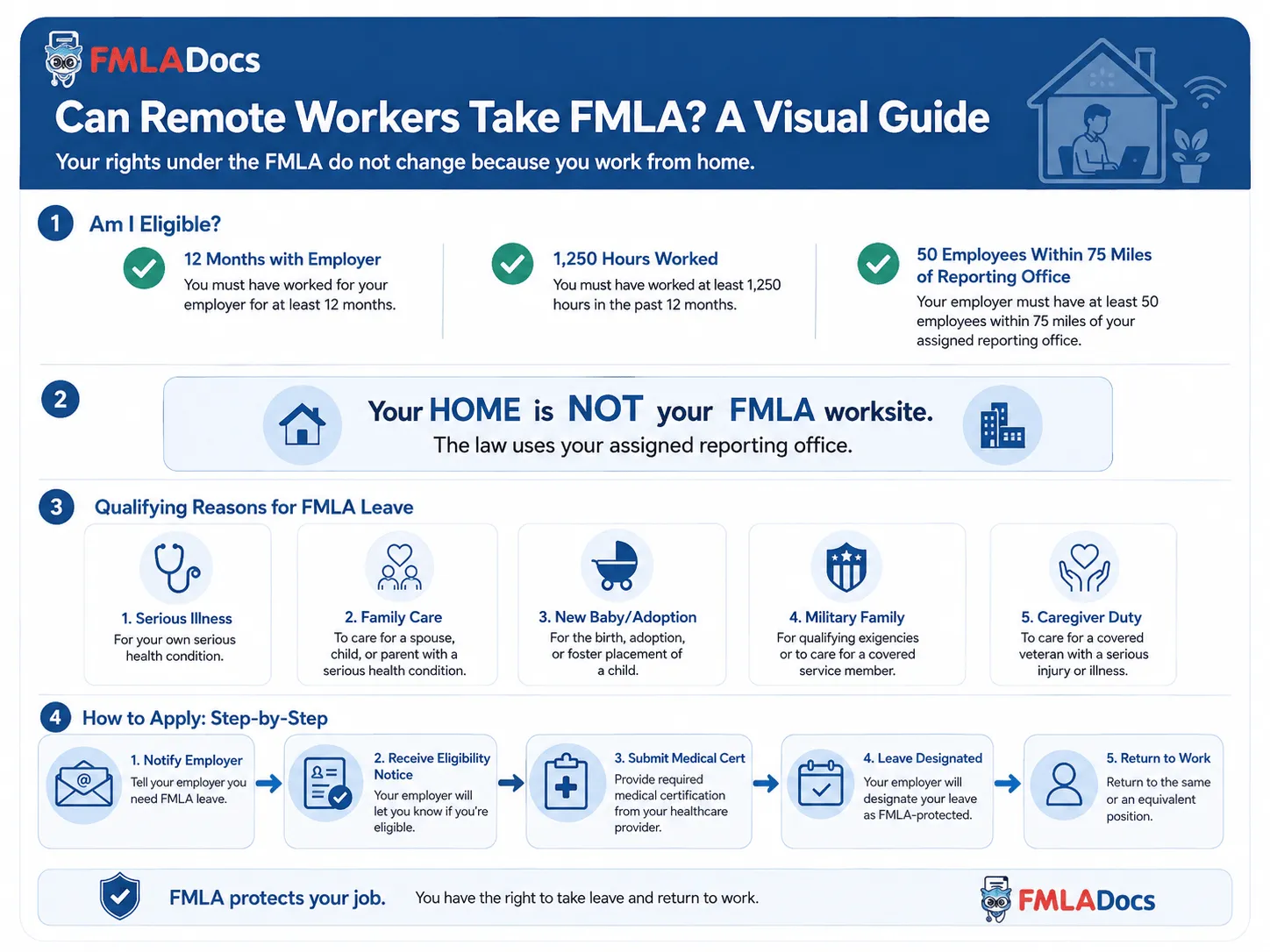
The FMLA applies to eligible employees of covered employers. The law has not changed for remote workers. What changed is how the DOL clarified how existing rules apply to telework situations. According to the DOL’s official FMLA guidance, you must meet three conditions to qualify for FMLA leave.
Condition 1: Length of Employment
You must have worked for your employer for at least 12 months. These months do not need to be consecutive. If you took a break and returned to the same employer, those prior months can count. This rule is the same whether you work in an office, from home, or in a hybrid setup.
Condition 2: Hours Worked
You must have worked at least 1,250 hours in the 12 months before your leave starts. That averages out to about 24 hours per week. For remote workers, the DOL made clear in FAB 2023-1 that hours worked from home count the same as hours worked on-site. Breaks under 20 minutes are also compensable time and count toward your hours total.
Condition 3: The 50/75 Worksite Rule
This is where most confusion arises for remote employees. The FMLA requires that you work at a location where the employer has at least 50 employees within 75 miles. For remote workers, the law does not use your home address to measure this.
The DOL Field Assistance Bulletin No. 2023-1 states clearly: your home is not your worksite for FMLA purposes. Your worksite is the office to which you report or from which your assignments are made. So even if you live 200 miles from the office, you still qualify if that office has 50 or more employees within 75 miles of it.
| TABLE: FMLA Eligibility Criteria for Remote Workers vs. In-Office Employees | |||
| Eligibility Criteria | Standard Rule | How It Applies to Remote Workers | Key Note |
| Length of Employment | At least 12 months with the employer | Same rule applies; remote months count fully | Months do not need to be consecutive |
| Hours Worked | At least 1,250 hours in the prior 12 months | Remote hours count the same as in-office hours | Breaks under 20 min are compensable (DOL FAB 2023-1) |
| 50/75 Worksite Rule | 50+ employees within 75 miles of the worksite | Home address is NOT the worksite; the reporting office is | Even fully remote employees can qualify if their assigned office meets this threshold |
| Covered Employer | Private employer with 50+ employees in 20+ workweeks | Same; remote workers count toward the employer's 50-employee total | Public agencies and schools are covered regardless of size |
| Qualifying Reason | Serious health condition, birth/adoption, military exigency | No difference for remote workers; same qualifying reasons apply | Working remotely during leave is not required or expected |
Source: U.S. Department of Labor, Field Assistance Bulletin No. 2023-1; 29 CFR Part 825.
Work from Home FMLA Eligibility: What Counts as Your Worksite
The worksite question is the most important one for remote workers. Getting this wrong can mean either missing leave you are legally entitled to, or having your employer incorrectly deny your request.
Here is the rule in plain terms: your home is not your FMLA worksite. The DOL defines your worksite as the physical office location where you report to work or receive your work assignments from. This is true even if you have never set foot in that office.
Fully Remote Workers
If you are a fully remote employee who never visits any physical office, the DOL says the determination is fact-specific. Key factors include which office sends you assignments, which manager supervises you, and which location appears in your employment records. In many cases, the headquarters or main branch of your employer serves as your reporting worksite.
Hybrid Workers
If you split time between home and a physical office, your worksite is the office you regularly report to. Hybrid workers typically have no trouble meeting the 50/75 rule because they are already tied to a clear physical location.
Multi-State Remote Workers
If you live in a different state from your employer’s offices, this does not disqualify you. The analysis still looks at the reporting office, not where you physically live. An employee in Texas assigned to a New York office of a qualifying employer still has FMLA rights based on that New York office.
This point was highlighted by multiple employment attorneys after the 2023 DOL bulletin. As one legal analysis noted, employers cannot treat a remote worker as a single-employee worksite, which would make them ineligible. They must evaluate the reporting office instead. For more detail, review the FMLA employer requirements from the DOL Wage and Hour Division.
Remote Employee FMLA Rights: Qualifying Reasons for Leave
The reasons that qualify for FMLA leave do not change based on where you work. A remote employee has the same qualifying reasons as an on-site employee. The FMLA provides up to 12 workweeks of unpaid, job-protected leave per 12-month period for:
-
Your own serious health condition that makes you unable to perform the essential functions of your job
-
Caring for a spouse, child, or parent with a serious health condition
-
The birth, adoption, or foster placement of a child (leave must be taken within 12 months of the event)
-
Qualifying exigencies related to a family member’s military deployment
-
Up to 26 workweeks in a single 12-month period to care for a covered servicemember with a serious injury or illness
What Is a Serious Health Condition
The FMLA defines a serious health condition as an illness, injury, impairment, or physical or mental condition that involves inpatient care or continuing treatment by a health care provider. According to DOL Fact Sheet 28P on serious health conditions, this includes:
-
Any overnight stay in a hospital, hospice, or residential medical care facility
-
A period of incapacity of more than three consecutive full calendar days with follow-up treatment
-
Chronic conditions that cause occasional periods of incapacity, such as asthma, diabetes, or epilepsy
-
Permanent or long-term conditions under the supervision of a health care provider, such as Alzheimer’s or terminal cancer
-
Pregnancy, including prenatal care and related incapacity
Mental health conditions qualify too. Depression, anxiety disorders, PTSD, and other diagnosed mental health conditions can meet the definition of a serious health condition when they require continuing treatment from a provider.
Does Working From Home Affect What Qualifies
No. The qualifying reason is based on your medical situation, not your work location. A remote worker recovering from surgery qualifies just as an in-office worker would. You do not need to be physically unable to work at a desk to qualify. What matters is whether your health care provider certifies that you cannot perform the essential functions of your job, or that you need to be absent for treatment or recovery.
If you need FMLA documentation fast, start your FMLA certification request at FMLADocs.com and a licensed provider will review your case and complete your paperwork within 24 hours.
Telework FMLA Rules: What Your Employer Must Do
When you request FMLA leave, your employer has specific legal obligations. These obligations apply regardless of whether you work remotely or in person.
Providing General FMLA Notice
Your employer is required to post a notice about FMLA rights in the workplace. For remote workers, the DOL confirmed in FAB 2020-7 that electronic posting via email or an intranet website satisfies this requirement. So not receiving a physical poster does not mean you lack notice of your rights.
Responding to Your Leave Request
Within five business days of learning about your potential need for FMLA leave, your employer must notify you whether you are eligible. If you are not eligible, they must tell you why. They must also notify you whether your leave qualifies as FMLA-protected and provide you with your rights and responsibilities under the law.
Requesting Medical Certification
Your employer may ask for a medical certification from your health care provider. You have at least 15 calendar days to obtain this. The certification is completed using official forms from the DOL, such as Form WH-380-E for the employee’s own condition. For complete details, see the FMLA medical certification forms available from the DOL.
Your employer cannot ask for more medical information than the certification form requires. They cannot contact your doctor directly without your permission. And they must keep your medical information confidential.
Health Benefits During Leave
Your employer must continue your group health insurance during FMLA leave under the same terms as if you had not taken leave. If you normally pay a portion of your premium, you still owe that portion during leave. If you do not pay and your leave is unpaid, your employer may recover those premiums if you do not return to work.
Job Protection
When you return from FMLA leave, you are entitled to return to the same position you held before leave, or an equivalent position with the same pay, benefits, and working conditions. For remote workers, this means your employer cannot use your leave as a reason to require you to report to an office if you previously had a remote arrangement.
How to Request FMLA Leave as a Remote Worker
The process for requesting FMLA leave is the same for remote and on-site employees. Here is a step-by-step breakdown.
Step 1: Notify Your Employer
When the need for leave is foreseeable, you must give at least 30 days notice. If it is not foreseeable, notify your employer as soon as practicable, which usually means within one or two business days. You do not need to use the words “FMLA” when making the request. You simply need to provide enough information for your employer to recognize that the FMLA may apply. Email is a standard way remote workers submit this notice.
Step 2: Receive Eligibility and Rights Notice
Your employer has five business days to respond. They will tell you if you are eligible and provide a rights and responsibilities notice outlining what is expected of you during the leave.
Step 3: Obtain Medical Certification
Your employer may require certification from your health care provider. You have 15 calendar days to submit it. If the certification is incomplete, your employer must tell you what is missing and give you a reasonable opportunity to fix it. A telemedicine visit with a licensed provider counts as an in-person visit for FMLA purposes under DOL FAB 2020-8, which helps remote workers in areas with limited access to in-person care.
Step 4: Leave is Designated and Begins
Once your employer has enough information to determine that the leave qualifies, they must designate it as FMLA leave. They cannot delay designation indefinitely. Once designated, your leave counts against your 12-week entitlement.
Step 5: Return to Work
Before returning, your employer may require a fitness-for-duty certification confirming you are able to return and perform your job functions. This is only valid if you were told about this requirement before your leave started.
Common Misconceptions About FMLA for Remote Workers
Misconception 1: Your Home Address Determines Eligibility
This is the most widespread mistake. Many remote employees believe they cannot qualify for FMLA because they live far from any company office. The law does not measure distance from your home. It measures whether 50 or more employees are employed within 75 miles of your assigned reporting office.
Misconception 2: You Must Be Completely Unable to Work
FMLA covers situations where you cannot perform your job functions due to a serious health condition. But it also covers intermittent leave, where you take leave in separate blocks of time. A remote employee managing a chronic condition can take intermittent FMLA to attend regular medical appointments or handle flare-ups, even while otherwise continuing to work.
Misconception 3: Remote Workers Cannot Take Intermittent Leave
Intermittent leave is fully available to remote workers. The February 2023 DOL opinion letter clarified that an employee can use intermittent FMLA to limit their workday to eight hours per day for a chronic serious health condition, even if they normally work more than eight hours. The format of how work is done (remote vs. in-person) does not change this right.
Misconception 4: Your Employer Can Monitor You During FMLA
Your employer cannot require you to work during FMLA leave. If you are on full continuous leave, you are not expected to answer emails, join calls, or complete tasks. For intermittent leave, the non-leave hours you work are subject to your normal duties. But your employer cannot check in on you constantly or require documentation beyond what the FMLA allows.
Misconception 5: FMLA and ADA Do Not Interact for Remote Workers
If you have a disability, both the FMLA and the Americans with Disabilities Act (ADA) may apply to your situation. The ADA may require your employer to provide reasonable accommodations, which could include a modified schedule or continued remote work access during or after leave. These two laws work side by side and do not replace each other.
State Law and FMLA for Remote Workers: What Else Might Apply
Federal FMLA sets a minimum standard. Many states have their own family and medical leave laws that provide broader coverage. If you work remotely, the state law that applies is generally the state where you physically perform your work, meaning where you live and work from home.
For example, California’s CFRA (California Family Rights Act) covers employers with five or more employees, far below the federal threshold of 50. New York’s Paid Family Leave provides paid leave benefits. Oregon’s PFMLI offers paid family and medical leave. If your state has a more expansive law, you may have protections that go beyond federal FMLA even if you do not meet the federal eligibility criteria.
Check with your state labor agency or a qualified employment attorney to understand what protections apply in your specific situation. Federal FMLA, state leave law, and ADA accommodations can all exist simultaneously and should all be evaluated when you need to take leave.
FMLA for Remote Workers: What You Need to Know Before You Apply
The core message is simple. FMLA for remote workers follows the same rules as for any other employee. Your work location does not determine your eligibility. What matters is how long you have worked for your employer, how many hours you have logged, and whether your assigned reporting office meets the 50/75 employee threshold.
The DOL’s February 2023 guidance removed most of the ambiguity. Remote hours count. Your home is not your worksite. And your employer cannot deny you leave simply because you telework. Your job is protected while you are on leave, your health benefits continue, and you are entitled to return to the same or equivalent position.
If your health condition qualifies and you meet the eligibility conditions, FMLA protects you. The most important step you can take is to act quickly, notify your employer, and secure your medical certification from a licensed provider. Work from home FMLA eligibility may be simpler than you think, but documentation is what makes your claim solid and your protections enforceable.
If you are ready to start the process, get your FMLA medical certification through FMLADocs.com where a licensed provider can complete your required paperwork in as little as 24 hours, entirely online and HIPAA-compliant.
Frequently Asked Questions
Can I take FMLA leave if I work fully from home?
Yes. Fully remote employees can take FMLA leave if they meet the three eligibility requirements: 12 months of employment, 1,250 hours worked, and 50 employees within 75 miles of their assigned reporting office. Your home address is not used to determine worksite eligibility.
Does my employer have to approve FMLA if I work remotely?
If you meet all eligibility conditions and your reason qualifies under the FMLA, your employer must approve the leave. They cannot deny FMLA leave simply because you work remotely. If they deny an eligible request, that may constitute an FMLA violation.
How do remote hours count toward the 1,250-hour requirement?
Remote hours count the same as in-office hours. The DOL confirmed this in FAB 2023-1. All hours you perform work for your employer, regardless of location, count toward the 1,250-hour threshold. Breaks under 20 minutes that occur during your workday are also considered compensable time.
What if my employer has no physical office near me?
If your employer has no physical office within 75 miles of anywhere and operates as a fully virtual company, the 50/75 rule becomes harder to meet. However, many courts and the DOL look at the specific reporting structure and assignment origin rather than requiring a traditional brick-and-mortar location. Speak with an employment attorney if you are in this situation.
Can I be fired for requesting FMLA leave while working from home?
No. Retaliation for requesting or taking FMLA leave is illegal. Your employer cannot terminate you, demote you, reduce your hours, or take any other adverse action because you exercised your FMLA rights. This protection applies to all eligible employees, including remote workers.
Can I take intermittent FMLA as a remote employee?
Yes. Intermittent FMLA leave is available to all eligible employees including remote workers. You can take leave in separate blocks of time or reduce your scheduled hours due to a chronic or ongoing serious health condition. The DOL's 2023 opinion letter confirmed this applies even to reducing daily work hours.
Does FMLA cover mental health conditions for remote workers?
Yes. Mental health conditions that qualify as a serious health condition under the FMLA are covered regardless of your work location. Conditions such as severe depression, anxiety disorder, PTSD, or bipolar disorder can qualify when they require continuing treatment from a licensed mental health provider.
Meet the author
Nida Hammad
I am a professional writer with over five years of experience creating clear, engaging, and well-researched content. I specialize in healthcare topics, helping readers understand complex information in simple wording. Currently, I write for FMLA DOC, where I focus on producing accurate and trusted guides for people seeking support with FMLA and medical needs.
Get Your FMLA Certification Online in Minutes