

Connecticut PFML: Get Up to 95% of Your Wages in 2026
 by Areeba Imran
 Last updated:
Connecticut PFML can replace up to 95% of your average weekly wage when you need time away from work for a qualifying family or medical reason. In 2026, the maximum weekly benefit is $1,016.40. Most workers don’t realize they qualify until facing a crisis, and confusion about eligibility
To meet the earnings requirement, you must have earned at least $2,325 in your highest-earning quarter during the base period. CT Paid Leave generally provides up to 12 weeks of benefits in a 12-month period, with an additional two weeks potentially available for pregnancy-related incapacitation. CT Paid Leave provides income replacement; job protection comes from separate leave laws when applicable.
This guide breaks down precisely who qualifies for Connecticut paid family and medical leave, how much you’ll receive, and what situations the program covers. You’ll learn the specific eligibility requirements, how benefit calculations work, and the precise steps to file a claim. We’ll also show you how Connecticut PFML works with federal FMLA protections and where to get help if you run into problems.
How Does Connecticut PFML Work?
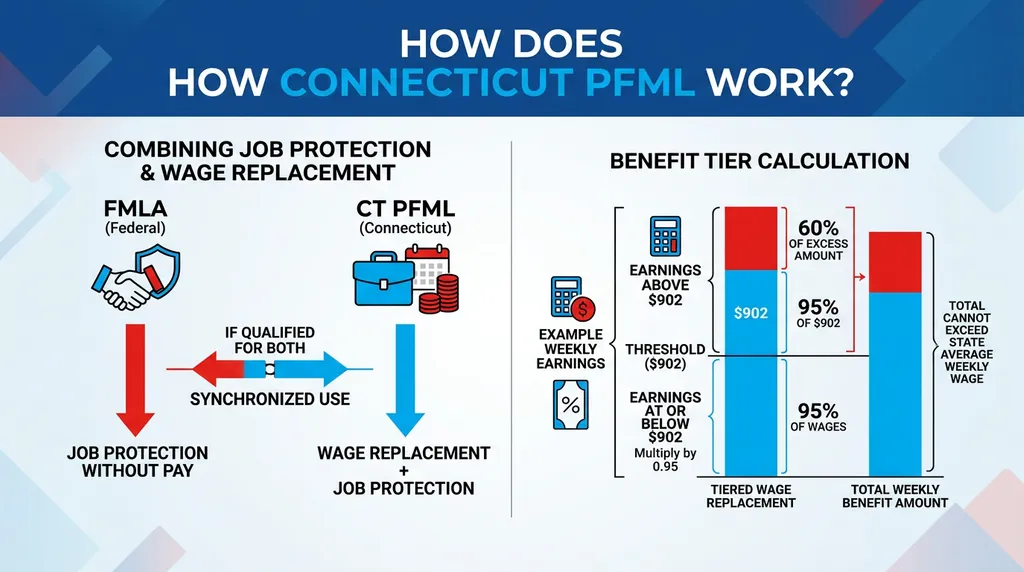
Connecticut PFML provides income replacement when you need time away from work for a qualifying family or medical reason. Benefits are generally available for up to 12 weeks in a 12-month period, with an additional two weeks potentially available for pregnancy-related incapacitation. Qualifying reasons include your own serious health condition, caring for a family member, bonding with a new child, and other reasons recognized by Connecticut law.
The program is funded through employee payroll contributions. Employers deduct 0.5% from covered wages and remit those contributions to the CT Paid Leave Authority; there is no employer match. To request benefits, you apply through the CT Paid Leave claims process, and the claims administrator reviews the application and supporting documents.
Your payment method can be direct deposit or debit card. CT Paid Leave does not impose a general one-week waiting period before benefits begin. Payment timing depends on the claim and required documentation.
CT Paid Leave provides income replacement, while federal FMLA and Connecticut FMLA (CTFMLA) can provide job-protected leave when their separate eligibility requirements are met. If a particular leave qualifies under both CT Paid Leave and FMLA, the periods may run concurrently rather than creating two separate leave periods.
How Much Does Connecticut PFML Pay in 2026?
For 2026, the maximum Connecticut PFML weekly benefit is $1,016.40. This maximum is based on 60 times Connecticut’s minimum wage of $16.94 per hour. The state adjusts the maximum benefit each year based on changes to the minimum wage.
Most workers receive 95% of their average weekly wage up to $677.60 per week in 2026. If your average weekly wage is $677.60 or less, your weekly benefit is 95% of that amount. For example, someone with an average weekly wage of $600 would receive $570 per week.
Higher earners use a two-tier calculation. You receive 95% of your average weekly wage up to $677.60, plus 60% of the amount above $677.60. The total weekly benefit cannot exceed $1,016.40 in 2026. This formula provides a higher percentage of wage replacement for lower-wage workers while limiting the maximum benefit for higher earners.
How Is the Connecticut PFML Benefit Calculated?

The state looks at the first four of the five most recently completed quarters in your base period. It identifies your two highest-earning quarters, adds those wages together, and divides the total by 26 to calculate your average weekly wage. Only wages from covered Connecticut employers count toward this calculation.
Here’s how the calculation works for different income levels:
-
Average weekly wage of $677.60 or less: receive 95% of your average weekly wage.
-
Average weekly wage above $677.60: receive 95% of $677.60 plus 60% of the amount above $677.60.
-
Maximum weekly benefit: $1,016.40 in 2026
The system uses reported earnings from covered employers to calculate employee benefits. Self-employed individuals and sole proprietors can opt into CT Paid Leave, but they have specific rules for reporting and calculating self-employment earnings. Their benefits are based on net profit from self-employment, and the Authority uses a separate method to determine base weekly earnings.
CT Paid Leave benefits are subject to both Federal and Connecticut state income taxes. Taxes are not automatically withheld from your benefit payments, but you can request voluntary federal and state tax withholding. If you do not have taxes withheld, you may owe taxes when you file your tax returns.
Do Connecticut PFML Benefits Change Every Year?
Yes, the maximum benefit adjusts annually based on Connecticut’s minimum wage. The weekly benefit cap is 60 times the current minimum wage, while the 95% benefit threshold is 40 times the minimum wage. For 2026, the $16.94 minimum wage results in a $677.60 threshold and a $1,016.40 maximum weekly benefit.
The maximum CT Paid Leave benefit is tied to Connecticut’s minimum wage, not the state average weekly wage. For 2026, the maximum weekly benefit is $1,016.40, which equals 60 times the state’s $16.94 minimum wage.
The CT Paid Leave contribution rate can change, but it is 0.5% for 2026. The CT Paid Leave Board of Directors voted to maintain the 0.5% rate for 2026. Employees contribute 0.5% of covered wages up to the Social Security contribution and benefit base.
Am I Eligible for Connecticut PFML?
Connecticut PFML is available to eligible workers who meet the program’s employment and earnings requirements. There is no minimum number of hours you must work. Generally, you must currently work for a covered Connecticut employer or have worked for one within the previous 12 weeks. You must also have earned at least $2,325 in your highest-earning quarter during the first four of the five most recently completed quarters. Connecticut residents who are self-employed or sole proprietors may also qualify if they have enrolled in CT Paid Leave.
What Are the Connecticut PFML Earnings Requirements?
You must have earned at least $2,325 in your highest-earning quarter during the first four of the five most recently completed quarters. This four-quarter period is your base period. For example, if your leave begins in July 2026, the applicable base period generally covers April 1, 2025, through March 31, 2026. The state then checks whether you earned at least $2,325 in any one of those four quarters.
Reaching $2,325 in your highest-earning quarter satisfies the minimum earnings requirement, but you must also meet the program’s employment or coverage requirements and have a qualifying reason for leave. The earnings threshold applies regardless of whether you work full-time, part-time, per diem, or seasonally. Unlike federal FMLA, CT Paid Leave does not require a minimum number of hours worked or a minimum length of employment.CT Paid Leave does not require the federal FMLA’s minimum 12-month employment or 1,250-hour requirements.
Which Workers Are Covered?
Most private-sector employees working for covered employers are included in CT Paid Leave, subject to statutory exclusions and special public-sector rules. The program is funded through a 0.5% employee payroll contribution.
That said, some workers are exempt:
-
Federal employees
-
Certain municipal workers
-
Some union members with comparable benefits
Self-employed individuals can opt into the program voluntarily. This gives freelancers and independent contractors access to paid leave benefits they wouldn’t otherwise have.
CT Paid Leave generally applies to covered employers with one or more employees, subject to statutory exclusions and special rules for certain public-sector employers. The program is funded through employee payroll deductions; employers do not match the contribution.
Can Part-Time and Seasonal Workers Get Connecticut PFML?
Part-time workers may qualify if they meet the program”s coverage and earnings requirements. There is no minimum number of hours worked for CT Paid Leave eligibility, but meeting the earnings threshold alone does not establish eligibility.
Seasonal workers may qualify if they meet the applicable coverage and earnings requirements. Earning at least $2,325 in a qualifying quarter satisfies the earnings requirement, but other eligibility rules still apply.
Your work schedule does not create a separate minimum-hours requirement for CT Paid Leave. Part-time and seasonal workers can qualify when they meet the program”s applicable requirements.
What Reasons Qualify for Connecticut PFML?
Connecticut PFML covers a broad range of family and medical situations. The program provides paid time off for your own health needs, family caregiving, and bonding with a new child. You can also take leave for military-related reasons and organ donation. Understanding what qualifies helps you plan ahead and access benefits when you need them most.
Can I Get PFML for My Own Medical Condition?
Yes. CT Paid Leave can provide benefits for your own qualifying serious health condition. Examples can include pregnancy-related incapacity, chronic conditions requiring continuing treatment, and recovery from surgery. The condition must meet the program”s requirements for a serious health condition, such as inpatient care or qualifying continuing treatment.
Serious health conditions under CT paid leave benefits include:
-
Inpatient care at a hospital, hospice, or residential medical facility
-
Continuing treatment for chronic conditions like diabetes, asthma, or migraines
-
Pregnancy-related incapacity and prenatal medical care
-
Permanent or long-term conditions requiring ongoing supervision
-
Recovery from surgery or conditions needing multiple treatments
The state defines serious health conditions similarly to federal standards. However, Connecticut PFML eligibility requirements are more flexible than FMLA in some areas. You don’t need to meet the same strict hour and tenure requirements that federal law demands.
Can I Get PFML to Care for a Family Member?

You can take leave to care for a family member with a serious health condition. Connecticut’s definition of family member is broader than federal FMLA. It includes your spouse, child, parent, sibling, grandparent, and grandchild. This expanded definition means more people can access support when family members need care.
Caring for a family member qualifies when they have:
-
A serious health condition requiring inpatient care
-
Chronic conditions needing regular medical appointments
-
Pregnancy complications or prenatal care needs
-
Conditions that need your direct care or supervision
Qualifying family care can include helping with medical appointments, treatment, or other care required because of the family member”s serious health condition. Whether a particular activity qualifies depends on the circumstances and the program”s definition of care.
Can I Get PFML for Bonding With a New Child?
Bonding leave is available after the birth of a child or the placement of a child for adoption or foster care, subject to the program”s eligibility rules. Bonding benefits generally must be used within the first year after birth or placement. Each parent may have a separate entitlement when eligible; whether leave can be taken at the same time depends on the applicable leave rules.
Bonding leave covers:
-
Birth of a biological child
-
Adoption of a child of any age
-
Foster care placement in your home
-
Time to establish routines and attachment
Many families use bonding leave to adjust to new schedules and care needs. The 12-month window gives you flexibility to take leave when it works best for your family. You don’t need to take all the time at once. You can split it into multiple periods if that fits your situation better.
What Other Reasons Qualify for CT Paid Leave?
Connecticut Paid Leave covers additional qualifying situations, including certain military-related leave and organ or bone marrow donation. CT Paid Leave provides income replacement; separate job-protection laws may apply depending on the leave and the worker”s eligibility.
Qualifying exigency leave applies when a family member is deployed on active military duty. You can take time off to handle arrangements, attend military events, or manage childcare needs. This mirrors federal FMLA protections but adds Connecticut’s wage replacement benefit. The leave helps military families manage the challenges of deployment without losing income.
Organ or bone marrow donation also qualifies for Connecticut paid leave. You can take time off for the donation procedure and recovery period. This includes pre-donation testing, the surgery itself, and follow-up care. The state recognizes that organ donation saves lives and shouldn’t create financial hardship for donors.
Depending on the leave reason, you may need medical certification or other supporting documentation. Required documents can include medical forms, adoption records, court documents, or military documentation. Providing complete documentation can help avoid processing delays.
How Long Can You Get Connecticut PFML?
Connecticut PFML gives eligible workers time to handle serious health issues and family care needs. The program balances employee needs with employer operations. You get specific time limits based on your situation.
How Many Weeks of Paid Leave Can You Get?
Eligible workers may receive up to 12 weeks of CT Paid Leave benefits in a 12-month period for most qualifying reasons. An additional two weeks may be available for a serious health condition resulting in incapacitation during pregnancy. The applicable 12-month period should be described according to the program rules rather than assuming a single rolling method for every claim.
For bonding with a new child, leave must be taken within 12 months of the child’s birth or placement. This gives you flexibility while setting clear boundaries. Check your eligibility to see if you qualify for Connecticut paid family and medical leave benefits.
Can You Take Connecticut PFML Intermittently?
CT Paid Leave benefits may be used for block leave, a reduced schedule, or intermittent leave when the applicable qualifying reason and documentation requirements are met. Intermittent leave can be useful for recurring treatment or other situations that require separate periods away from work.
For example, a worker receiving recurring medical treatment may need leave on separate days rather than taking one continuous block. A worker caring for a family member may also need intermittent time away from work. The documentation required depends on the qualifying reason.
Can You Take PFML for More Than One Reason?
You can use CT Paid Leave benefits for more than one qualifying reason during the applicable benefit period, subject to the program”s overall limits. For most reasons, the standard maximum is 12 weeks in a 12-month period, with an additional two weeks potentially available for pregnancy-related incapacitation.
Your available CT Paid Leave benefit is reduced by qualifying leave already used during the applicable benefit period. The exact 12-month calculation should be based on the rules that apply to your claim.
Does Connecticut PFML Protect Your Job?
Connecticut PFML provides income replacement rather than job protection. Job-protected leave may be available separately under the Connecticut Family and Medical Leave Act (CTFMLA), federal FMLA, or another applicable law, depending on your employer and your eligibility.
Understanding these protections helps you plan your leave with confidence. You’ll know what to expect when you return to work.
What Job Protection Does Connecticut Law Provide?
CTFMLA provides eligible employees with job-protected leave at covered employers, and covered employers generally must return an eligible employee to the same or an equivalent position after qualifying leave. CTFMLA applies to employers with one or more employees, subject to statutory exclusions, and an employee generally must have been employed for at least three consecutive months.
CTFMLA is separate from CT Paid Leave and generally applies to employers with one or more employees, subject to statutory exclusions. Federal FMLA has different employer-coverage rules. Whether you have job protection depends on which law covers your leave and whether you meet that law”s eligibility requirements.
Because job protection depends on the applicable law and your eligibility, review your employer”s leave policy and confirm which job-protection law applies to your situation.
Continuation of group health insurance depends on the applicable job-protection law. For employees covered by federal FMLA, group health coverage generally continues under the same terms and conditions as if the employee were still working, subject to the employee”s normal share of premiums.
Applicable Connecticut and federal leave laws prohibit certain interference, discrimination, or retaliation related to protected leave. The specific protection depends on the law covering your leave. Examples of prohibited conduct can include:
-
Demotion or pay cuts after you return
-
Negative performance reviews tied to your leave
-
Termination because you requested or took leave
-
Threats or intimidation for using your benefits
When a job-protection law applies, restoration generally means returning to the same or an equivalent position, subject to that law”s requirements. The definition of an equivalent position can include comparable pay, benefits, and working conditions.
What Happens When You Return From Leave?
When you return from qualifying job-protected leave, the applicable law generally requires restoration to the same or an equivalent position. The precise restoration and benefit rules depend on whether CTFMLA, federal FMLA, or another law applies.
If your leave is protected, the employer must follow the applicable restoration rules even if workplace changes occurred during your absence. The specific rights depend on the job-protection law that applies.
Employers covered by CTFMLA can have job-restoration obligations even when they have fewer than 50 employees. Employers covered only by a different leave law may have different obligations, so workers should confirm which protections apply.
Before you return, confirm your start date with HR. Ask about any workplace changes that happened during your absence. This helps you transition back smoothly without surprises on your first day.
How Does Connecticut PFML Work With FMLA?
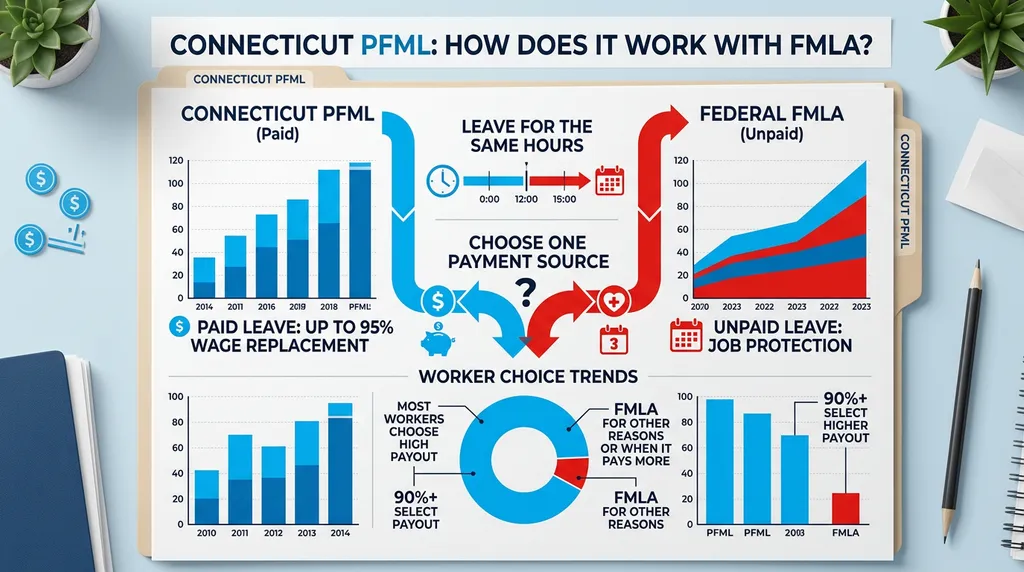
CT Paid Leave and federal FMLA serve different purposes, and a qualifying leave may be covered by both. When the same leave qualifies under both programs, the periods may run concurrently rather than creating two separate blocks of leave.
Federal FMLA can provide job protection, while CT Paid Leave provides partial income replacement. Connecticut also has its own CTFMLA job-protection law. When the applicable requirements are met, these protections can work together.
What Is the Difference Between Connecticut PFML and FMLA?

Federal FMLA provides eligible employees of covered employers with unpaid, job-protected leave for qualifying family and medical reasons, generally up to 12 weeks in a 12-month period. It also generally requires continuation of group health coverage under the same terms as if the employee had remained at work.
CT Paid Leave provides partial income replacement during qualifying leave. Benefits are generally available for up to 12 weeks in a 12-month period, with an additional two weeks potentially available for pregnancy-related incapacitation. In 2026, the benefit calculation provides 95% of average weekly wages up to $677.60, with 60% applied to wages above that threshold, subject to a $1,016.40 weekly maximum.
Federal FMLA generally applies to private employers with 50 or more employees in 20 or more workweeks in the current or preceding calendar year, as well as covered public agencies. For private employers, an employee must generally work at a site where the employer has at least 50 employees within 75 miles. CT Paid Leave has different coverage rules and generally covers employers with one or more employees, subject to statutory exclusions.
The programs also differ in funding. FMLA costs employers nothing beyond holding positions. Connecticut PFML is funded through payroll contributions. Workers pay into the system through automatic deductions.
Can Connecticut PFML and FMLA Run at the Same Time?
Yes, the same period of leave can count under both CT Paid Leave and federal FMLA when the leave qualifies under both programs. In that situation, the periods may run concurrently. CT Paid Leave provides income replacement, while FMLA provides job protection.
You generally cannot turn the same qualifying period into 24 weeks simply by combining CT Paid Leave with federal FMLA. When the same leave qualifies under both, the periods may run concurrently.
CT Paid Leave can interact with other income-replacement benefits, including employer-provided paid leave. Combined compensation generally cannot exceed 100% of a worker”s regular rate of compensation, and certain benefits cannot be received at the same time as CT Paid Leave. The applicable coordination rules depend on the benefit involved.
Workers receiving workers” compensation or another state or federal wage-replacement benefit may be subject to restrictions on receiving CT Paid Leave for the same period or reason. Check the applicable coordination rules before claiming both.
What Are the FMLA Eligibility Requirements?
FMLA requires you to work for a covered employer for 12 months. These months don’t need to be back-to-back. Any time on payroll counts toward the requirement.
You must also work 1,250 hours in the past year. This averages about 24 hours per week. Only actual work time counts, not vacation or sick days.
For federal FMLA, an employee generally must work at a site where the employer has at least 50 employees within 75 miles. Federal rules also contain specific provisions for remote employees, so the applicable worksite must be determined under those rules.
CT Paid Leave does not impose the federal FMLA”s 12-month employment and 1,250-hour requirements. However, eligibility is not based on earnings alone; workers must also meet the program”s coverage, employment, and qualifying-reason requirements.
What FMLA Paperwork Do You Need?
When an FMLA leave request involves a serious health condition, an employer may request medical certification from an appropriate healthcare provider. The certification supports the need for leave and provides the information required under federal FMLA rules.
The certification must contain the information required by the applicable FMLA certification form, which can include the expected duration of the condition, relevant medical facts, and information about the employee”s ability to perform essential job functions or the family member”s need for care.
Under federal FMLA rules, an employer generally must give an employee at least 15 calendar days to provide requested medical certification. If the certification is incomplete or insufficient, the employer must identify what information is lacking and provide a reasonable opportunity to cure the deficiency.
Federal FMLA permits recertification in specified circumstances, including when permitted by the applicable rules for the duration of the condition or when circumstances change. An employer may also seek a second medical opinion in certain cases at the employer”s expense. Medical information obtained for FMLA purposes must be maintained as confidential medical records separate from ordinary personnel files.
How Do You Apply for Connecticut PFML?
To apply for CT Paid Leave, start at ctpaidleave.org and follow the current online claims process. You will sign in through CT.gov and then access the CT Paid Leave claims portal. Have your identifying information, employment information, and documents supporting your leave reason ready.
When Should You Apply?
Apply as soon as you know you will need CT Paid Leave. If the leave reason occurred within the past 45 days, you can apply immediately. If you request benefits for a date more than 45 days in the past, you may need to provide good cause for the delay.
Do not delay your application. If you are filing more than 45 days after the initial date for which you are requesting benefits, CT Paid Leave may require an explanation showing good cause for the delay. The Authority considers factors such as notice, circumstances outside your control, and how promptly you applied once the barrier was removed.
What Documents Do You Need?
Be prepared to provide identity and employment information, including details about your employer and the dates of your leave. The claim process will tell you which documents are required for your specific leave reason.
Documentation requirements depend on the reason for your claim. Medical leave may require medical certification or other supporting medical records, while other qualifying reasons may require different documents. The Authority will identify the documents needed to evaluate your claim.
For family leave, you may need documents showing the qualifying family relationship and, when applicable, documentation supporting the family member”s serious health condition and your need to provide care. The exact documents depend on the reason for leave.
What Happens After You Apply?
Once the required information and documents are received, the claims administrator reviews the application and determines eligibility. Processing time can vary depending on the claim and whether additional information is needed. You will receive a determination after the review is completed.
If a claim is denied, you may have the right to appeal through the Connecticut Department of Labor”s CT Paid Leave appeals process. Follow the deadline and instructions provided with the determination rather than relying on a blanket appeal period.
Once approved, benefits are paid according to the approved claim and applicable payment schedule. Your payment method can be direct deposit or debit card. Keep copies of your claim documents, notices, and correspondence for your records.
Where Can You Get Help With Connecticut PFML?
You don’t have to handle Connecticut PFML alone. Multiple resources exist to guide you through applications, appeals, and documentation requirements.
Connecticut Paid Leave Agency Contact
The CT Paid Leave Authority offers free assistance through their customer service team. They answer questions about eligibility, application status, and benefit calculations.
You can contact CT Paid Leave through its official customer-service channels or online portal for questions about applications, eligibility, and benefits.
If your claim is denied, review the determination for instructions on how to appeal. Connecticut”s Paid Leave appeals process is administered by the Connecticut Department of Labor. The applicable deadline and next steps should be taken from the determination and current CTDOL guidance.
If a determination identifies missing or incomplete information, review the notice carefully and follow the stated instructions for supplying additional documentation or pursuing an appeal.
Official Connecticut PFML Resources
Legal aid organizations can help with complex cases or appeals. These services are often free or low-cost for qualifying individuals.
Always notify both your employer and the CT Paid Leave Authority about other benefits you’re receiving. This prevents overpayment issues and potential penalties.
For medical leave situations requiring documentation, follow the certification instructions provided by your employer or the applicable leave program. The required documentation depends on the reason for leave.
The CT Paid Leave Authority website provides downloadable forms, benefit calculators, and step-by-step application guides. These tools help you understand your Connecticut paid family and medical leave entitlement before applying.
Conclusion
Connecticut PFML gives you wage replacement when life demands time away from work. You’ve learned how the program works, who qualifies, what situations it covers, and how long benefits last. You also know how job protection works, how PFML pairs with FMLA, and where to get help.
CT Paid Leave can replace up to 95% of average weekly wages at the first tier, subject to the program”s calculation formula and maximum benefit. It covers qualifying family and medical reasons, and it does not require the federal FMLA”s minimum 12-month employment or 1,250-hour requirements.
Start by checking your eligibility at ctpaidleave.org. Review your earnings history now. Gather your documentation before you need it. This preparation saves stress when a qualifying event happens.
If you need FMLA documentation, follow your employer”s instructions and use the applicable federal certification process. CT Paid Leave provides income replacement, while federal FMLA and CTFMLA may provide job protection when their requirements are met. Check the official CT Paid Leave eligibility information before applying.
Frequently Asked Questions
How much does Connecticut PFML pay in 2026?
Connecticut PFML pays up to 95% of your weekly wages, capped at $902 per week in 2026. If you earn $902 or less weekly, you get 95% of your actual wages. Higher earners get 95% of the first $902 plus 60% of wages above that amount. The cap is set at 40 times Connecticut's $15 minimum wage and adjusts each year.
Who is eligible for Connecticut PFML?
You're eligible if you earned at least $2,325 in your highest-earning quarter of your base period. There's no minimum hours or tenure requirement, so full-time, part-time, and seasonal workers can all qualify. Most private-sector employees are covered automatically, and self-employed workers can opt in voluntarily.
How many weeks of paid leave can you get in Connecticut?
Eligible employees can take up to 12 workweeks of Connecticut PFML in a rolling 12-month period. This applies whether you're using leave for your own health condition, caring for a family member, or bonding with a new child. You can split the 12 weeks across multiple qualifying reasons within that period.
What reasons qualify for Connecticut PFML?
Connecticut PFML covers your own serious health condition, caring for a family member with a serious health condition, and bonding with a new child through birth, adoption, or a new home placement. It also covers qualifying military exigency leave and organ or bone marrow donation. Medical certification is required for most of these reasons.
Can you get Connecticut PFML and FMLA at the same time?
Yes, Connecticut PFML and federal FMLA can run concurrently when you qualify for both. Your 12 weeks of PFML counts toward your 12 weeks of FMLA rather than adding extra time. FMLA provides job protection while Connecticut PFML provides the wage replacement, so together they give you both income and job security.
Can you take Connecticut PFML intermittently?
Yes, you can take Connecticut PFML intermittently in separate blocks of days, weeks, or even hours instead of all at once. This works well for ongoing treatments or unpredictable health conditions, like periodic chemotherapy appointments. The leave must be medically necessary and documented by a healthcare provider.
Does Connecticut PFML protect your job?
Connecticut PFML itself provides wage replacement but doesn't automatically guarantee job protection. Employers with 50 or more employees must restore you to the same or an equivalent position after leave. If your employer has fewer than 50 employees, job restoration isn't required by state law, though you still receive wage replacement.
Is Connecticut PFML taxable?
Connecticut PFML benefits are subject to federal income tax but are not taxed at the state level. You can choose to have federal taxes withheld from each payment, or pay them when you file your federal return. Connecticut does not add its own state tax on top of these benefits.
Meet the author
Areeba Imran
I am a healthcare professional and seasoned medical writer with 13+ years of experience across health, wellness, and clinical content. My work focuses on delivering trustworthy, evidence-based information that empowers readers to make informed decisions. With a keen interest in innovation and evolving areas of patient care, I bring a modern perspective to today's healthcare setup.
Get Your FMLA Certification Online in Minutes