
Can My Employer Deny FMLA?
 by Anam Moin
 Last updated:
You need time away from work because of surgery, a serious health condition, pregnancy, or a family medical emergency, but your employer questions whether your leave request will be approved.
An employer can deny FMLA in certain situations. However, an employer cannot deny qualifying FMLA leave simply because your absence creates inconvenience, increases workload for coworkers, or makes scheduling more difficult.
The Family and Medical Leave Act (FMLA) provides eligible employees with unpaid, job-protected leave for specific medical and family-related reasons.
However, FMLA protection depends on meeting several requirements involving your employer, your length of employment, your hours worked, your reason for leave, and your medical documentation.
Many employees misunderstand FMLA because they assume every medical issue automatically qualifies or that every employer must approve leave. In reality, FMLA follows specific federal rules that determine when leave is protected and when an employer may legally deny a request.
This guide explains when an employer can deny FMLA, when a denial may violate your rights, what paperwork is required, and what steps you can take after a denied request.
Can My Employer Deny FMLA? The Short Answer
Yes, an employer may deny FMLA when you do not meet the legal requirements for protected leave.
However, your employer generally cannot deny FMLA simply because:
-
Your absence creates staffing problems.
-
Your manager does not want to approve leave.
-
The timing is inconvenient.
-
The company is busy.
-
Your position is difficult to replace.
A valid FMLA denial usually involves a specific eligibility or documentation issue.
For example, an employer may deny FMLA if:
-
You have worked there for less than 12 months.
-
You have not completed 1,250 hours of work.
-
Your employer is not covered under FMLA.
-
Your reason for leave does not qualify.
-
You have already used your available FMLA entitlement.
-
You fail to provide required medical certification.
The U.S. Department of Labor explains that eligible employees of covered employers may receive up to 12 workweeks of unpaid, job-protected leave for qualifying reasons, while certain military caregiver situations may qualify for up to 26 workweeks.
How Does FMLA Work?
Before understanding why an employer may deny FMLA, it is important to understand what FMLA actually protects.
The Family and Medical Leave Act is a federal law designed to allow eligible employees to take protected time away from work for specific family and medical reasons.
FMLA generally provides:
| FMLA Protection | What It Means |
|---|---|
| Job-protected leave | Your employer generally must restore you to the same or an equivalent position after qualifying leave |
| Unpaid leave | FMLA protects your job but does not require employers to pay wages during leave |
| Health insurance continuation | Employer health benefits generally continue under the same conditions |
| Medical and family leave | Leave may apply to qualifying health conditions, family care, birth, adoption, and military situations |
| Intermittent leave | Qualified employees may take leave in separate blocks when medically necessary |
FMLA does not guarantee approval for every employee or every situation. Instead, it creates protections for employees who meet specific federal requirements.
When Can an Employer Deny FMLA?
An employer can deny FMLA when one or more legal requirements are not satisfied.
Understanding these situations helps you determine whether your employer’s decision is likely based on a valid reason.
Can an Employer Deny FMLA If the Company Is Too Small?
Yes. A private employer may deny federal FMLA when it does not meet the required coverage rules.
Generally, private employers must:
-
Have at least 50 employees.
-
Have those employees working within 75 miles of the employee’s worksite.
Public agencies and certain schools follow different coverage requirements.
Example:
You work for a private company with 30 employees at one location.
In this situation:
| Situation | FMLA Result |
|---|---|
| Employer has fewer than 50 employees | Federal FMLA may not apply |
| Employer has multiple nearby locations reaching 50 employees | Coverage may need additional review |
| Employer is a public agency | Different coverage rules may apply |
A company being small does not automatically remove every leave protection. State laws, disability accommodations, paid leave programs, or company policies may provide additional rights.
Can My Employer Deny FMLA If I Have Not Worked There for 12 Months?
Yes.
One of the most common reasons employees receive FMLA denials is that they have not completed the required employment period.
To qualify for federal FMLA, you generally must have:
-
Worked for the employer for at least 12 months.
-
Completed at least 1,250 hours of service during the previous 12 months.
Your 12 months of employment do not always need to be consecutive. Previous employment with the same employer may count in certain situations.
Example:
| Employee Situation | FMLA Eligibility |
|---|---|
| Worked 10 months with no prior service | Usually not eligible |
| Worked 12+ months and meets hours requirement | May qualify |
| Worked previously for same employer and returned | Prior service may count |
| Worked previously for same employer and returned | Prior service may count |
If your employer denies FMLA because you have not worked there long enough, review your employment history before accepting the decision.
Can My Employer Deny FMLA If I Do Not Have 1,250 Hours?
Yes.
The FMLA requires eligible employees to have worked at least 1,250 hours during the 12 months before leave begins.
The calculation generally includes actual hours worked.
It usually does not include:
-
Vacation time.
-
Holidays.
-
Sick leave.
-
Paid or unpaid time away from work.
Example:
An employee has worked for the company for two years but only worked 1,000 hours during the previous year.
The employee may not meet the federal FMLA hours requirement.
If your employer denies your request because of hours worked, request the calculation they used and compare it with your payroll records.
FMLA Eligibility Checklist: Do You Qualify?
Before requesting leave, review the following checklist.
| Requirement | Question To Ask |
|---|---|
| Employer coverage | Does my employer meet FMLA coverage rules? |
| Employment duration | Have I worked there for at least 12 months? |
| Hours worked | Have I completed 1,250 hours in the previous year? |
| Qualifying reason | Does my situation meet FMLA requirements? |
| Available leave | Do I still have FMLA time remaining? |
| Certification | Can I provide required medical documentation? |
Meeting these requirements does not mean approval is automatic. Employers still review each request based on the facts, documentation, and applicable rules.
What Reasons Qualify for FMLA?
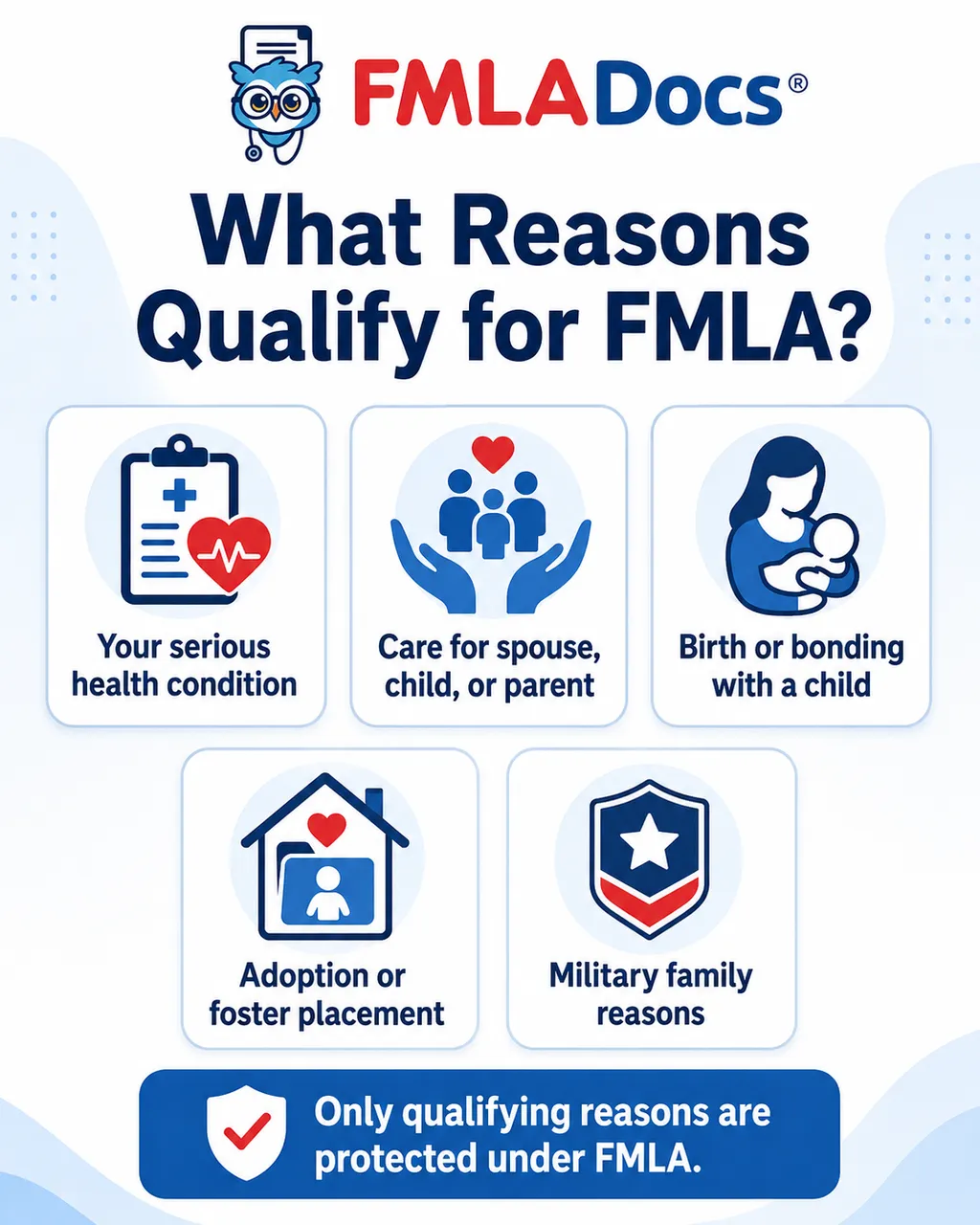
Not every absence qualifies for FMLA protection. The law protects specific medical and family situations.
Qualifying reasons may include:
-
Your own serious health condition.
-
Caring for a spouse, child, or parent with a serious health condition.
-
Birth and bonding with a newborn child.
-
Adoption or foster placement.
-
Certain military family circumstances.
The reason for leave must meet the definition under FMLA regulations.
Can My Employer Deny FMLA for Surgery?
Surgery is one of the most common reasons employees request FMLA.
However, surgery alone does not automatically guarantee protected leave.
The key questions include:
-
Does the condition prevent you from performing your job?
-
Do you require medical treatment?
-
Is recovery medically necessary?
-
Does your healthcare provider support the need for leave?
Examples of potentially qualifying situations include:
| Situation | Possible FMLA Consideration |
|---|---|
| Major surgery requiring recovery | May qualify |
| Hospital stay | May qualify |
| Follow-up medical treatment | May qualify |
| Cosmetic procedure without medical necessity | May not qualify |
Medical certification helps employers determine whether the request meets FMLA requirements.
Can an Employer Deny FMLA Because of Paperwork?
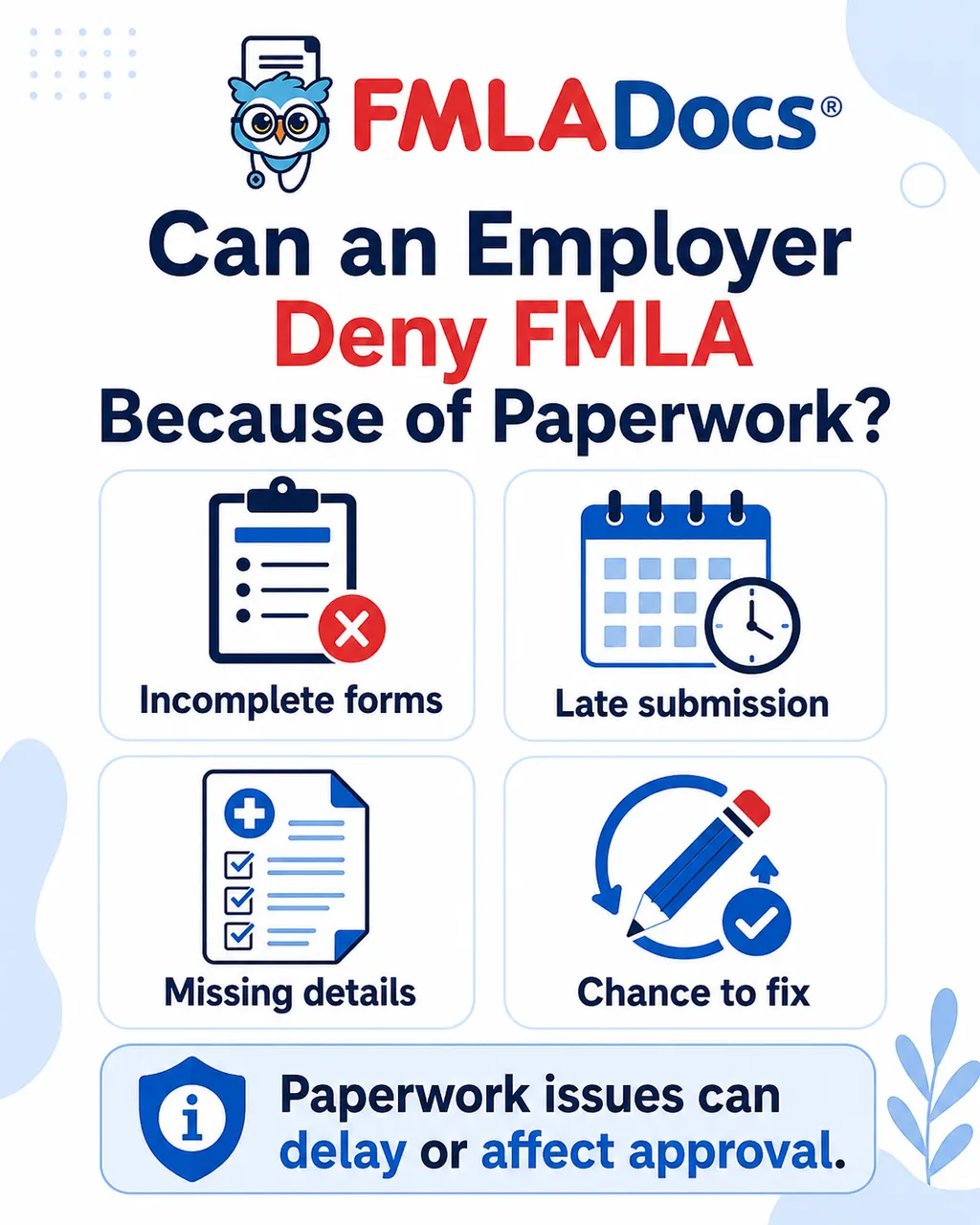
Medical certification is one of the most important parts of the FMLA process. While an employer can request documentation to determine whether your leave qualifies, the employer must follow specific rules when requesting, reviewing, and evaluating medical information.
Many employees believe that a paperwork issue automatically means their FMLA request can be denied. However, there is an important difference between a missing document, an incomplete certification, and a request that does not meet FMLA requirements.
Understanding how certification works can help you avoid unnecessary delays and respond appropriately if your employer questions your leave request.
What Medical Information Can an Employer Request for FMLA?
An employer may request enough medical information to determine whether your leave request meets the definition of a serious health condition under FMLA.
The purpose of medical certification is to confirm the need for protected leave, not to review your entire medical history.
A healthcare provider may provide information such as:
| Medical Information | Why It Matters |
|---|---|
| Description of the medical condition | Helps determine whether the condition may qualify under FMLA |
| Date the condition began | Establishes when the medical issue started |
| Expected duration of the condition | Helps determine how much leave may be needed |
| Treatment schedule | Supports intermittent or reduced-schedule leave requests |
| Medical facts related to inability to work | Explains why leave may be necessary |
Employers generally cannot require unlimited medical records or information unrelated to your FMLA request.
For example, if you request leave for surgery recovery, your employer may request information confirming the medical need and expected recovery period. The employer generally does not need your entire medical history.
Can My Employer Deny FMLA Because My Doctor Did Not Use Their Form?
No, an employer generally cannot deny FMLA simply because your healthcare provider did not use the company’s preferred form.
The Department of Labor provides optional-use FMLA forms, but employers must accept a complete and sufficient certification regardless of the format.
An employer generally cannot reject documentation only because it is:
-
A healthcare provider’s letter.
-
A faxed copy.
-
A different certification format.
-
Written on medical office letterhead.
The important factor is whether the information provided allows the employer to determine if the leave qualifies under FMLA.
How Long Do You Have to Complete FMLA Certification?
When an employer properly requests medical certification, employees generally receive at least 15 calendar days to provide the completed certification.
If additional time is needed because of circumstances outside your control, communicate with your employer and healthcare provider as soon as possible.
Failing to provide certification without explanation may allow an employer to delay or deny FMLA protection.
What Happens If FMLA Certification Is Incomplete?
An employer cannot simply reject an incomplete certification without explaining the problem.
If the certification does not contain enough information, the employer generally must identify what information is missing and provide an opportunity to correct the issue.
What Are the Different FMLA Certification Forms?
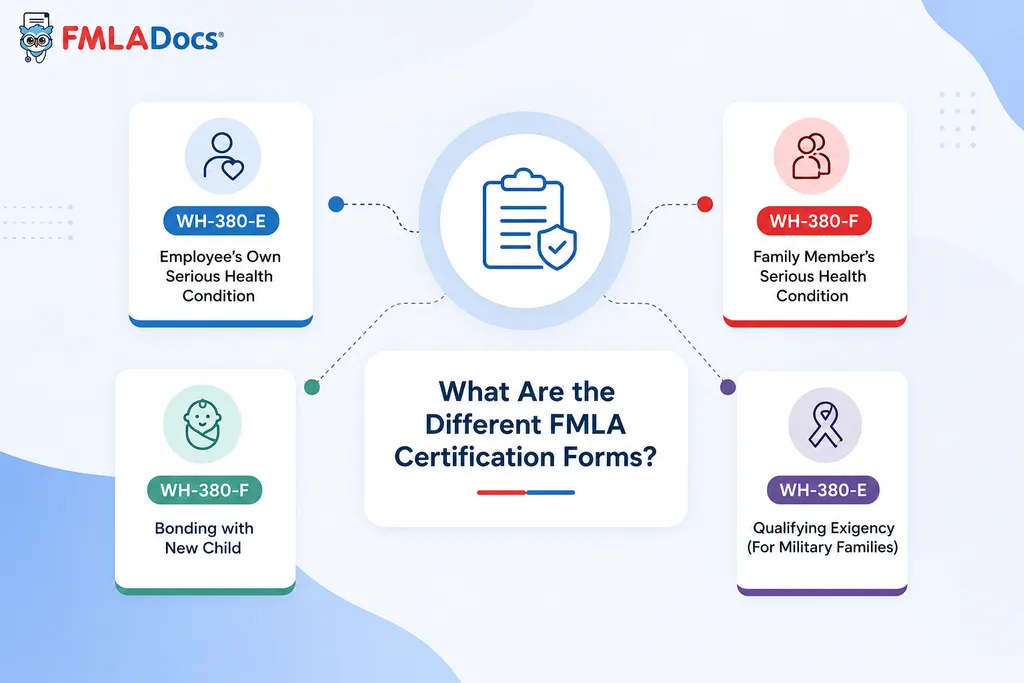
The Department of Labor provides several optional-use certification forms depending on the reason an employee requests leave.
These forms help employers collect the information needed to evaluate whether leave qualifies under federal FMLA rules.
The forms do not automatically approve leave. They simply provide medical and factual information needed for the review process.
WH-380-E: Employee Serious Health Condition Form
The WH-380-E form is used when an employee requests FMLA because of their own medical condition.
This form may apply when an employee needs leave for:
-
Surgery and recovery.
-
Chronic medical conditions.
-
Ongoing treatment.
-
Hospitalization.
-
Conditions preventing normal job duties.
The healthcare provider explains the medical facts supporting the need for leave, expected duration, and whether continuous or intermittent leave may be necessary.
WH-380-F: Family Member Serious Health Condition Form
The WH-380-F form is used when an employee requests FMLA to care for a covered family member with a serious health condition.
The healthcare provider provides information about:
-
The family member’s medical condition.
-
The need for caregiving.
-
Expected duration of care.
Federal FMLA generally covers care for a spouse, child, or parent.
What Are Military FMLA Certification Forms?
FMLA provides additional protections for certain military family situations.
Employees requesting military-related leave may use specialized certification forms.
WH-384: Qualifying Exigency Certification
This WH-384 form applies when leave is needed because of certain circumstances involving a family member’s military deployment.
Examples may include:
-
Military events.
-
Childcare arrangements.
-
Financial or legal preparations.
-
Deployment-related activities.
WH-385: Military Caregiver Certification
This WH-385 form applies when an eligible employee needs leave to care for a covered current servicemember with a serious injury or illness.
WH-385-V: Veteran Caregiver Certification
This WH-385-V form applies when an employee needs leave to care for an eligible veteran with a serious injury or illness.
FMLA Certification Forms Comparison Chart
The following table summarizes the main FMLA certification forms and when they are used.
| Form | Purpose | Used By |
|---|---|---|
| WH-380-E | Employee’s own serious health condition | Employee requesting medical leave |
| WH-380-F | Family member’s serious health condition | Employee caring for eligible family member |
| WH-384 | Military qualifying exigency | Employee with military-related leave needs |
| WH-385 | Current servicemember caregiver leave | Employee caring for servicemember |
| WH-385-V | Veteran caregiver leave | Employee caring for eligible veteran |
What FMLA Notices Must Employers Provide?
The FMLA process is not only about employee responsibilities. Employers also have notification requirements.
Employers must provide employees with information about eligibility, responsibilities, and whether leave has been designated as FMLA-protected.
What Are the Main Employer FMLA Notice Forms?
Employers may use the following forms when communicating FMLA information.
| Form | Purpose |
|---|---|
| General Notice | Provides basic information about FMLA rights |
| WH-381 Eligibility Notice | Explains whether the employee qualifies |
| WH-381 Rights and Responsibilities Notice | Explains employee obligations during leave |
| WH-382 Designation Notice | Explains whether leave is approved as FMLA leave |
Receiving these notices helps employees understand why a request was approved, delayed, or denied.
Can an Employer Deny FMLA Because the Company Is Short-Staffed?
No, ordinary business challenges generally do not allow an employer to deny qualifying FMLA leave.
Employers often struggle with staffing when an employee takes extended leave. However, the purpose of FMLA is to protect employees during important medical and family situations.
An employer generally cannot deny FMLA because:
-
The department is understaffed.
-
Coworkers must cover additional work.
-
Finding a replacement is difficult.
-
The company is experiencing a busy period.
Business inconvenience alone is not a valid reason to deny qualifying FMLA.
Can My Employer Deny FMLA Because Nobody Can Replace Me?
No, the difficulty of replacing an employee generally does not allow an employer to deny protected FMLA leave.
Some employees believe they cannot take leave because they have a critical position or specialized responsibilities.
However, FMLA protections apply regardless of how important the employee’s role may be. Employers must manage staffing challenges while respecting eligible employees’ leave rights.
Valid vs Invalid Reasons for FMLA Denial
Understanding the difference between a lawful denial and a potentially improper denial can help you evaluate your situation.
| Employer Reason for Denial | Usually Allowed? | Explanation |
|---|---|---|
| Employee worked only 10 months | Yes | Employee may not meet eligibility requirements |
| Employer does not meet coverage rules | Yes | Federal FMLA may not apply |
| Employee has no remaining FMLA leave | Yes | Available entitlement is exhausted |
| Certification is incomplete | Sometimes | Employer may request corrections |
| Company is too busy | No | Business inconvenience is generally not enough |
| No replacement employee available | No | Staffing issues do not remove rights |
| Manager does not approve of leave | No | FMLA is not based on manager preference |
What Should You Do If Your Employer Denies FMLA?
If your FMLA request is denied, the first step is understanding why the denial occurred.
A denial caused by missing information may be corrected. A denial caused by eligibility issues may require reviewing your employment situation more carefully.
Request the Reason for Denial in Writing
Ask your employer to explain:
-
Why was your request denied?
-
Which requirement was not satisfied.
-
Whether additional information is needed.
-
Whether another type of leave may apply.
Keeping written communication creates a record of the process.
Review Your Eligibility Information
Compare the denial explanation with your actual circumstances.
Review:
-
Your employment start date.
-
Hours worked.
-
Employer size.
-
Worksite location.
-
Leave already used.
-
Certification submitted.
Errors can happen, especially when employees work variable schedules or multiple locations.
Correct Any Documentation Problems
If the issue involves medical certification, work with your healthcare provider to correct the missing information.
Common corrections include:
-
Adding missing dates.
-
Clarifying treatment schedules.
-
Explaining expected recovery time.
-
Providing additional permitted medical facts.
Avoid submitting unrelated medical records unless required under applicable rules.
Continue Following Workplace Procedures
While your FMLA request is being reviewed or disputed, continue following normal workplace procedures.
This includes:
-
Reporting absences.
-
Communicating with HR.
-
Responding to requests.
-
Keeping copies of documents.
A disagreement about FMLA does not remove all workplace responsibilities.
Can an Employer Deny Intermittent FMLA?
Intermittent FMLA allows eligible employees to take leave in separate blocks of time instead of taking one continuous period away from work. This type of leave is commonly used for recurring medical appointments, chronic health conditions, treatment schedules, and situations where an employee needs occasional time away from work.
However, intermittent leave follows the same eligibility rules as regular FMLA. Your employer may review whether the request qualifies, but it generally cannot deny medically necessary intermittent leave simply because managing the schedule is difficult.
Understanding how intermittent FMLA works can help you determine whether your request is protected and what documentation may be required.
When Does Intermittent FMLA Apply?
Intermittent FMLA may apply when a qualifying medical condition requires employees to take leave periodically instead of being absent continuously.
Common examples include:
| Situation | May Intermittent FMLA Apply? |
|---|---|
| Regular medical appointments | Yes, if related to a qualifying condition |
| Physical therapy sessions | Yes, when medically necessary |
| Chronic condition flare-ups | Yes, if requirements are met |
| Ongoing treatment schedules | Yes, when supported by certification |
| Personal appointments unrelated to a medical condition | Usually no |
The healthcare provider’s certification generally explains the expected frequency and duration of intermittent leave.
For example, a provider may indicate that an employee may need several appointments per month or occasional absences due to flare-ups.
Can an Employer Deny Intermittent FMLA Because It Is Difficult to Schedule?
No, scheduling challenges alone generally do not allow an employer to deny qualifying intermittent FMLA.
Employers may discuss scheduling options when treatment can reasonably occur outside working hours. However, they cannot reject medically necessary leave simply because it creates operational challenges.
A company may need to adjust staffing, redistribute tasks, or plan coverage, but those business concerns do not automatically remove an employee’s FMLA protections.
Can My Employer Require Me to Change My Schedule Instead of Using FMLA?
An employer may discuss alternative scheduling arrangements, but it generally cannot force an employee to give up protected FMLA rights.
For foreseeable medical treatment, employees should make reasonable efforts to schedule appointments in a way that minimizes workplace disruption when possible.
However, medical necessity remains the deciding factor.
Can My Employer Deny FMLA for Surgery Recovery?
Surgery is one of the most common reasons employees request FMLA leave.
A surgery-related leave request may qualify when the condition requires medical treatment, prevents the employee from performing job duties, or requires a period of recovery.
However, the fact that a procedure occurred does not automatically guarantee FMLA protection.
The important factors include:
| Factor | Why It Matters |
|---|---|
| Medical necessity | Determines whether the condition may qualify |
| Recovery period | Shows whether time away from work is required |
| Work restrictions | Explains whether job duties can be performed |
| Follow-up treatment | May support continuing leave needs |
Examples of situations that may qualify include:
-
Surgery requiring recovery time.
-
Hospitalization.
-
Follow-up medical treatment.
-
Physical therapy after a procedure.
-
Restrictions preventing normal job duties.
A healthcare provider must provide sufficient medical certification explaining the need for leave.
Employees who need help preparing medical certification can use FMLADocs FMLA certification services to connect with licensed healthcare professionals who review documentation and complete certification when appropriate.
Can My Employer Deny FMLA for Mental Health Conditions?
Mental health conditions may qualify for FMLA when they meet the requirements for a serious health condition.
FMLA protections apply to qualifying mental health conditions in the same way they apply to qualifying physical conditions.
Examples may include:
-
Severe anxiety requiring treatment.
-
Depression requiring ongoing care.
-
Therapy appointments.
-
Inpatient mental health treatment.
-
Conditions that prevent an employee from performing essential job duties.
A diagnosis alone does not automatically qualify an employee for FMLA. The medical facts, treatment requirements, and impact on work ability determine whether the condition meets FMLA standards.
Can My Employer Deny FMLA to Care for a Family Member?
FMLA allows eligible employees to take leave to care for certain family members with serious health conditions.
Federal FMLA generally protects leave for:
-
A spouse.
-
A child.
-
A parent.
The relationship between the employee and family member matters because not every relative is covered under federal FMLA.
Does FMLA Cover Caring for a Grandparent?
Generally, caring for a grandparent does not automatically qualify under federal FMLA.
However, exceptions may apply in certain situations.
For example, a grandparent may qualify if they acted in the role of a parent to the employee when the employee was a child.
Employees should also review state family leave laws because some states provide broader family definitions than federal FMLA.
Can My Employer Deny FMLA for My Child’s Medical Condition?
No, an eligible employee generally cannot be denied FMLA simply because they need time to care for a child with a qualifying serious health condition.
Examples of covered situations may include:
-
Hospital visits.
-
Medical appointments.
-
Treatment schedules.
-
Recovery assistance.
The employee must still meet all other FMLA requirements, including employer coverage, eligibility rules, and required documentation.
Can an Employer Deny FMLA After Approving It?
An employer may change an FMLA decision in limited situations if new information shows that requirements are not met.
Examples may include:
| Situation | Possible Employer Action |
|---|---|
| Certification does not support qualification | Employer may request clarification |
| Employee does not provide required information | Leave protection may be delayed |
| FMLA entitlement is exhausted | Additional FMLA may be denied |
| Employee no longer meets requirements | Employer may review eligibility |
However, an employer generally cannot withdraw approved FMLA simply because the leave becomes inconvenient.
Can an Employer Fire You for Requesting FMLA?
Generally, no.
The FMLA protects employees from interference and retaliation when they request or use protected leave.
An employer cannot punish an employee simply because they exercised their FMLA rights.
What Is FMLA Retaliation?
FMLA retaliation occurs when an employer takes negative employment action because an employee requested or used protected leave.
Examples may include:
| Possible Retaliation | Example |
|---|---|
| Termination | Employee is fired after requesting protected leave |
| Demotion | Employee loses position after taking leave |
| Reduced hours | Schedule changes because of leave request |
| Negative treatment | Employee is treated differently after leave |
Employers may still discipline employees for legitimate reasons unrelated to FMLA. The key question is whether the action occurred because of protected leave activity.
What Should You Document After an FMLA Denial?
Keeping accurate records can help you understand what happened and protect your rights.
Important documents may include:
-
Leave request forms.
-
Emails with HR.
-
Certification requests.
-
Denial notices.
-
Medical documentation submissions.
-
Conversations with supervisors.
A timeline can help identify whether the issue involved eligibility, paperwork problems, or possible interference.
What Are Common FMLA Denial Examples?
Every FMLA situation depends on specific facts. The examples below show how common scenarios may be evaluated.
Example: Employee Worked Only 10 Months
An employee requests FMLA after working for the employer for 10 months.
| Question | Answer |
|---|---|
| Does the employee meet the 12-month requirement? | No |
| Can the employer deny federal FMLA? | Possibly yes |
| Could other protections apply? | Possibly |
The employee should review state leave laws and company policies.
Example: Employee Needs Surgery Recovery Leave
An employee has worked for the employer for several years and needs surgery recovery time.
| Question | Answer |
|---|---|
| Has the employee met eligibility requirements? | Yes |
| Does surgery require recovery? | Potentially |
| Can employer deny because staffing is difficult? | Generally no |
If certification supports the medical need, the request may qualify.
Example: Employee Needs Leave for Grandparent Care
An employee requests FMLA to care for a grandparent with a serious illness.
| Question | Answer |
|---|---|
| Is grandparent automatically covered? | No |
| Could an exception apply? | Possibly |
| Should state law be reviewed? | Yes |
The family relationship must be evaluated carefully.
FMLA Denial vs FMLA Violation: What Is the Difference?
A denied request is not automatically an FMLA violation.
The difference depends on whether the employer followed FMLA requirements.
| Situation | Likely Result |
|---|---|
| Employee does not meet eligibility rules | Denial may be valid |
| Employer requests proper certification | Usually allowed |
| Certification is incomplete | Employer may request correction |
| Employer denies because of inconvenience | May violate FMLA |
| Employer punishes employee for requesting leave | May be retaliation |
Understanding the reason behind the denial is the most important step.
Understanding FMLA Denial With FMLADocs
Understanding whether your employer deny FMLA starts with knowing your eligibility requirements, documentation responsibilities, and workplace protections.
Employers may deny requests when federal requirements are not met. However, qualifying FMLA leave generally cannot be denied simply because it creates inconvenience or operational challenges.
At FMLADocs, we help employees connect with licensed healthcare professionals who review medical information and complete FMLA certification when appropriate. Our online process helps simplify medical certification for employees across the United States.
If you need support preparing your FMLA medical certification, FMLADocs provides nationwide FMLA certification support for employees seeking help with medical documentation.
Frequently Asked Questions
Can my employer deny FMLA if I meet all requirements?
Generally, an employer cannot deny qualifying FMLA when coverage, eligibility, qualifying-reason, and documentation requirements are satisfied. However, employers may still request permitted certification and clarification.
Can my employer deny FMLA because my position is important?
No. The importance of your position does not remove your FMLA rights. Employers must manage staffing while following federal leave requirements.
Can my employer deny FMLA because they do not believe I need leave?
Employers may request medical certification. However, they generally cannot deny leave based only on personal opinions about whether an employee needs medical care.
Can my employer deny FMLA without explanation?
Employers must provide required notices explaining eligibility and leave decisions. Employees should request written clarification if the reason for denial is unclear.
Can my employer deny FMLA after receiving medical certification?
Employers may challenge certification in limited situations, but a complete certification supporting a qualifying condition generally provides FMLA protection.
Can my employer deny FMLA for a chronic condition?
A chronic condition may qualify when it requires ongoing treatment or causes periodic inability to work, such as recurring medical appointments or flare-ups requiring care.
Meet the author
Anam Moin
I'm Anam Moin, and my work at FMLADocs focuses on workplace leave and FMLA education. I cover certification, documentation, employee rights, and leave-related questions to provide readers with useful information when they need it most.
Get Your FMLA Certification Online in Minutes