

Complete Online FMLA Guide
 by Tayyaba Amir
 Last updated:
If you need time away from work due to a health condition or a family care responsibility, the Online FMLA Guide can save you weeks of confusion, paperwork delays, and unnecessary stress. The Family and Medical Leave Act (FMLA) is one of the most important workplace protection laws ever enacted in the United States. Since it was signed into law in 1993, the FMLA has been used more than 100 million times to help employees take job-protected time off without losing their positions, health insurance, or benefits. Yet for many workers, the process of filing for leave and getting online FMLA certification remains confusing and overwhelming.
This complete FMLA guide walks you through everything you need to know, from eligibility requirements and qualifying conditions to the specific FMLA docs you need to complete, how FMLA certification online works, and how an FMLA online doctor can help you get employer-ready paperwork within 24 hours. Whether you are dealing with a serious physical illness, a mental health condition, a chronic disease, pregnancy, or a caregiving responsibility for a loved one, this guide gives you everything you need to exercise your rights confidently and correctly.
What Is the FMLA? History, Purpose, and Scope
The Family and Medical Leave Act of 1993 (FMLA) is a United States labor law requiring covered employers to provide employees with job-protected, unpaid leave for qualified medical and family reasons. The law was introduced in the House as H.R. 1 and signed by President Bill Clinton on February 5, 1993. It was one of his major first-term domestic priorities, driven by the recognition that the lack of employment policies to accommodate working parents and caregivers was forcing millions of Americans to choose between their job security and their family obligations.
The United States Congress passed the Act with the understanding that it is important for the development of children and the family unit that both fathers and mothers be able to participate in early childrearing, and that the absence of such policies was creating measurable harm to families and workers. The law covers Title 29 of the U.S. Code, codified at 29 U.S.C. Section 2601, and is enforced under 29 CFR Part 825 by the Wage and Hour Division (WHD) of the U.S. Department of Labor. For most federal employees, the Office of Personnel Management (OPM) administers FMLA separately.
Since its enactment, the FMLA has served as the cornerstone of the Department of Labor’s efforts to promote work-life balance. According to the DOL’s Employer’s Guide to the FMLA, the law made it a priority to give workers the ability to balance the demands of work and family, and made the healthy development of babies, healthy families, and healthy workplaces a national priority. Military Family Leave provisions were added to the FMLA in 2008, extending FMLA protections to military families facing deployment-related challenges. In 2019, the Federal Employee Paid Leave Act (FEPLA) further amended the FMLA to give federal employees up to 12 weeks of paid leave for the birth, adoption, or foster care placement of a new child.
Which Employers Are Covered by FMLA?
Before thinking about how to get FMLA online or what FMLA docs you need, you first need to confirm your employer is covered. According to the DOL FMLA FAQ, the FMLA applies to:
- All public agencies, including local, state, and federal employers, and local education agencies (schools), regardless of the number of employees.
- Private-sector employers who employ 50 or more employees for at least 20 workweeks in the current or preceding calendar year, including joint employers and successors of covered employers.
When counting employees for coverage purposes, employers must include all employees who work in the United States, employees on paid or unpaid leave (including prior FMLA leave), part-time, temporary, seasonal, and full-time employees, and employees of foreign firms operating in the United States. The workweeks counted do not need to be consecutive.
Private employers with fewer than 50 employees are not covered by the federal FMLA, but may be covered by state family and medical leave laws. Many states have enacted their own expanded FMLA-like programs with lower thresholds for employer coverage, so it is always worth checking your state’s specific rules even if your employer does not technically meet the 50-employee threshold.
Who Is Eligible for FMLA Leave? The Four-Step Test
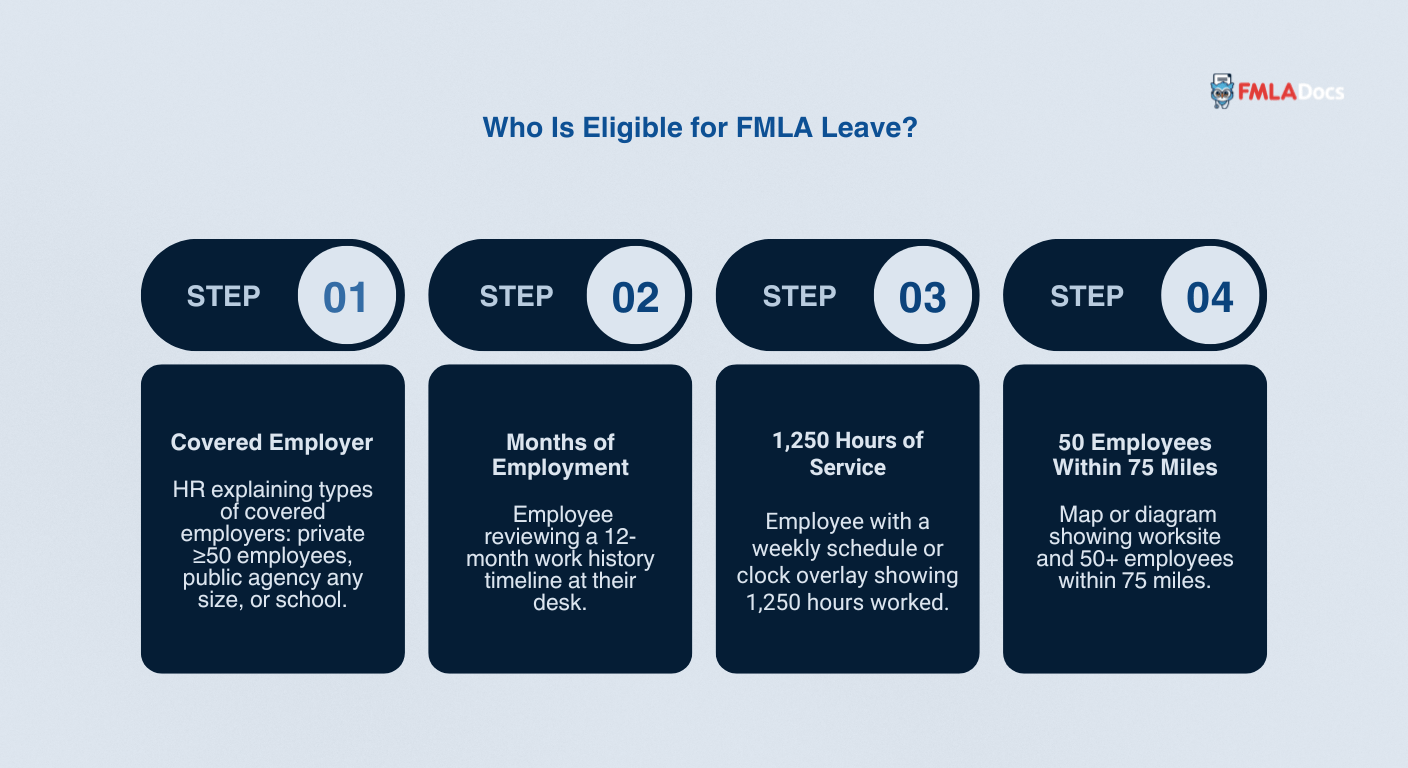
Even if your employer is covered, you must meet four specific criteria to be eligile for FMLA leave. According to the DOL’s FMLA eligibility guidelines, eligibility follows a four-step process:
Step 1: Covered Employer
You must work for an employer covered by the FMLA, as defined above. This means a private company with 50 or more employees, a public agency of any size, or a public or private elementary or secondary school.
Step 2: 12 Months of Employment
You must have worked for your employer for at least 12 months. These 12 months do not need to be consecutive. In general, only employment within the last seven years is counted unless the break in service was due to military obligations or is covered by a collective bargaining agreement. If you previously worked for the same employer, that service time can count toward the 12-month requirement.
Step 3: 1,250 Hours of Service
You must have worked at least 1,250 hours during the 12-month period immediately before your FMLA leave begins. This figure is based only on hours actually worked. Paid leave, unpaid leave, and vacation time are not included in this calculation. For context, 1,250 hours over 12 months works out to roughly 25 hours per week on average. Special rules apply to airline flight crew employees.
Step 4: 50 Employees Within 75 Miles
Your employer must have 50 or more employees within 75 miles of your worksite. This applies even if you work from home. In that case, your worksite is the location to which you are assigned or where you report, not your home address. As USA.gov notes, some states have different eligibility rules for their own family leave programs, so checking your state rules is also recommended.
What Qualifies as a Serious Health Condition Under FMLA?
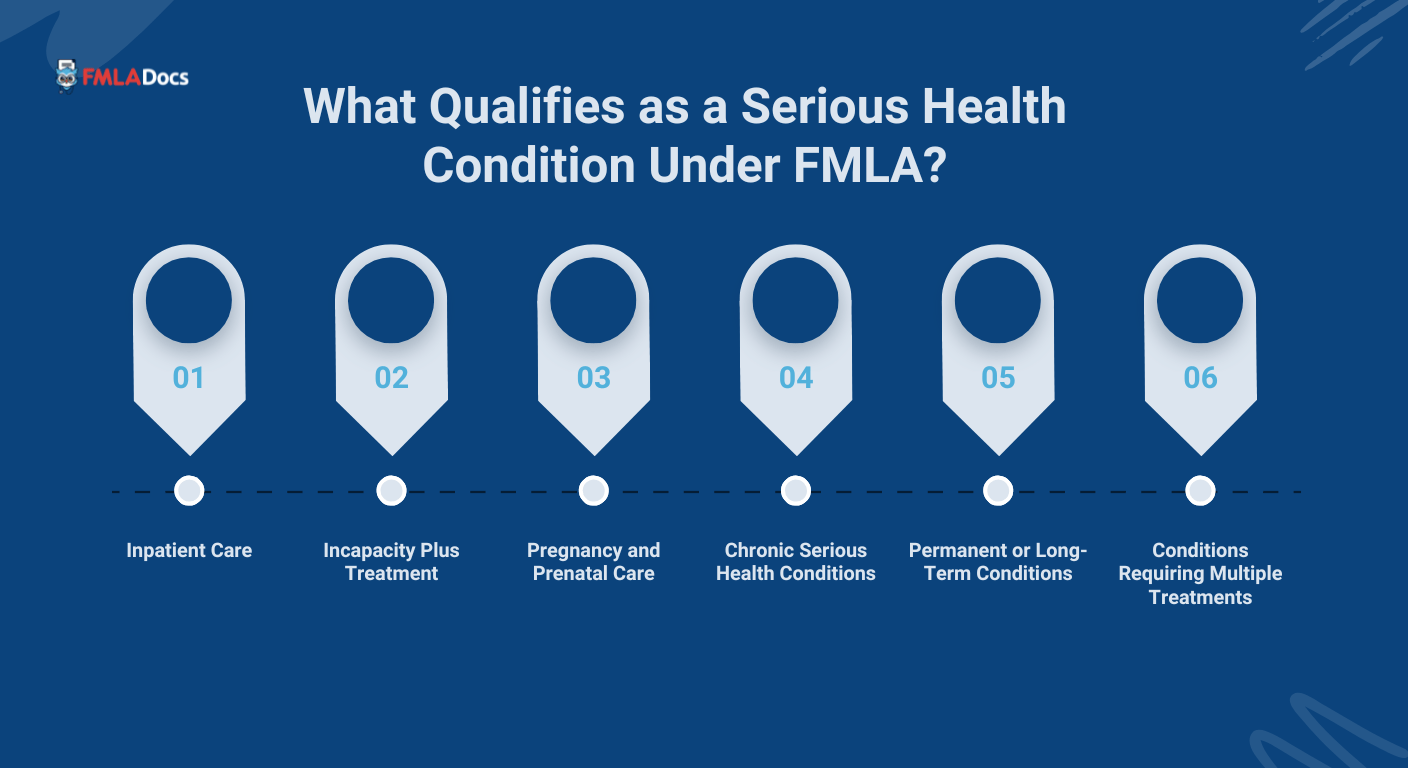
One of the most important and often misunderstood aspects of the FMLA is the definition of a serious health condition. Not every illness or injury meets the threshold. According to the Montgomery County Government FMLA Triggers guide and the DOL’s own FAQ, a serious health condition is defined as an illness, injury, impairment, or physical or mental condition that involves either an overnight stay in a medical care facility, or continuing treatment by a health care provider for a condition that either prevents the employee from performing the essential functions of their job or prevents a qualified family member from participating in school or other daily activities.
There are six specific categories of conditions that meet the definition of a serious health condition under FMLA regulations:
1. Inpatient Care
Any condition that results in an overnight stay in a hospital, hospice, or residential medical care facility automatically qualifies. This includes any period of incapacity or subsequent treatment connected to the inpatient stay. The overnight admission itself is sufficient to trigger FMLA eligibility without any additional requirements.
2. Continuing Treatment After a 3-Day Incapacity
A condition that incapacitates you for more than three consecutive full calendar days, combined with ongoing medical treatment, meets the threshold. The treatment requirement can be satisfied by two or more in-person visits to a healthcare provider within 30 days (with the first visit occurring within seven days of the first day of incapacity), or by one in-person visit within the first seven days combined with a continuing treatment regimen such as prescription medication or physical therapy. Examples include pneumonia, surgery, and broken or fractured bones.
3. Pregnancy and Prenatal Care
Any period of incapacity related to pregnancy or for prenatal care qualifies, regardless of its duration. A pregnant employee does not need to be incapacitated for more than three days for this protection to apply. This means that severe morning sickness, preeclampsia, gestational diabetes, or other pregnancy-related complications can qualify, and no visit to a healthcare provider is required for each separate absence.
4. Chronic Serious Health Conditions
Chronic conditions that require periodic visits to a healthcare provider at least twice per year, continue over an extended period of time, and may cause episodic rather than continuous periods of incapacity are covered. A visit to a healthcare provider is not necessary for each separate absence. Examples include asthma, diabetes, epilepsy, migraines, Crohn’s disease, lupus, arthritis, and similar recurring conditions.
5. Permanent or Long-Term Conditions
Conditions that are permanent or long-term, for which treatment may not be effective, also qualify. Only supervision by a healthcare provider is required, not active treatment. Examples include Alzheimer’s disease, severe stroke, ALS (Lou Gehrig’s disease), and terminal illnesses where ongoing curative treatment may not be the focus.
6. Multiple Treatments for Restorative Surgery or Conditions
Any absences to receive multiple treatments, such as for restorative surgery after an accident, for a condition like cancer, severe arthritis, or kidney disease, or for a condition that would likely result in incapacity of more than three days if left untreated, also meets the serious health condition standard.
Qualifying Medical Conditions for Online FMLA Certification
Over 80% of people in the United States live with ongoing mental or physical health challenges that may entitle them to FMLA-protected time off. If you are unsure whether your condition qualifies, reviewing what qualifies for FMLA leave can help you understand your options before you begin the process. Here is a breakdown of the most common qualifying conditions:
Mental Health Conditions
Mental health conditions are among the most commonly overlooked qualifying categories for FMLA leave. Conditions including generalized anxiety disorder, panic disorder, social anxiety, major depressive disorder, PTSD, bipolar disorder, OCD, and severe stress and burnout can all qualify when they constitute a serious health condition that interferes with your ability to perform your job. The DOL has confirmed that mental health conditions are fully protected under FMLA when they meet the clinical threshold of a serious health condition. An FMLA online doctor can help certify these conditions using the appropriate DOL forms.
Physical Health Conditions
Serious physical conditions including cancer requiring chemotherapy or radiation, heart disease, diabetes with significant management needs, chronic migraines, chronic pain disorders such as fibromyalgia, asthma and respiratory conditions, Crohn’s disease, multiple sclerosis, and similar conditions routinely qualify. Post-surgical recovery, recovery from serious injuries, and ongoing treatment for chronic conditions also fall under this category.
Pregnancy-Related Conditions
Pregnancy complications such as severe morning sickness, hyperemesis gravidarum, preeclampsia, gestational diabetes, premature labor risk, and other conditions that incapacitate the employee all qualify. Additionally, bonding leave after childbirth, placement for adoption, and recovery from childbirth are all protected under FMLA.
Caregiving Responsibilities
If you need to care for a spouse, child, or parent with a serious health condition, you are entitled to FMLA leave. This includes supporting a loved one through chemotherapy, post-surgical recovery, an acute medical crisis, or the management of a long-term serious condition. The caregiver role can encompass attending medical appointments, providing hands-on assistance, making care arrangements, or simply being present during a critical period of treatment.
Types of FMLA Leave: Continuous, Intermittent, and Reduced Schedule
FMLA leave does not have to be taken all at once. Understanding the three types of leave available to you is critical to making the most of your FMLA rights. According to the Employee Rights and Responsibilities under FMLA, leave can be taken intermittently or on a reduced schedule when medically necessary.
Continuous FMLA Leave
Continuous leave is a single, uninterrupted block of time off. You take your leave all at once and return to work at the end. This is the appropriate option for situations such as surgery and recovery, a hospitalization for a serious illness, childbirth and bonding leave, or any other situation that requires sustained time away from work. You can take up to 12 weeks per year under this format, or up to 26 weeks for military caregiver leave.
Intermittent FMLA Leave
Intermittent leave allows you to take FMLA leave in separate, non-consecutive blocks of time for a single qualifying reason. This is particularly valuable for employees managing chronic conditions, ongoing treatment schedules, or unpredictable flare-ups. For example, someone managing migraines, Crohn’s disease, anxiety, or diabetes might take a few days off each month without exhausting a full continuous leave block. Learn more about how intermittent FMLA works and whether it is the right structure for your needs.
When intermittent leave is for foreseeable medical treatments, you must make a reasonable effort to schedule treatment so as not to unduly disrupt your employer’s operations, subject to the approval of your healthcare provider. In some cases, an employer may temporarily transfer you to an equivalent alternative position that better accommodates your recurring intermittent leave schedule.
Reduced Schedule FMLA Leave
A reduced schedule allows you to temporarily reduce the number of hours you work each day or week. Rather than taking full days off, you might cut your hours from 40 per week to 20 per week, or work shorter days to accommodate treatment schedules, fatigue, or recovery needs. All reduced hours under this arrangement are covered by FMLA protections. This format is beneficial for employees who are still able to work part of the time but need the flexibility that a full-time schedule does not allow.
An important note: intermittent or reduced schedule leave for bonding with a newborn or newly placed child is only available with employer approval. However, if a newly born or newly placed child has a serious health condition, intermittent leave to care for that child is available as a matter of right without needing employer approval.
Not Sure Whether You Qualify? Check Your FMLA Eligibility Now.
Getting your FMLA certification starts with understanding whether you qualify. FMLADocs offers a simple online eligibility check that takes just a few minutes. If you qualify, a licensed healthcare provider will review your case and complete your employer-ready FMLA paperwork, typically within 24 hours. No waiting rooms, no scheduling delays. 93% of FMLADocs customers are approved for certification, and every application comes with a money-back guarantee.
How to Request FMLA Leave: A Step-by-Step Walkthrough
The DOL’s guide on how to talk to your employer about taking time off provides detailed guidance on the notification and request process. Here is a complete walkthrough of what to expect:
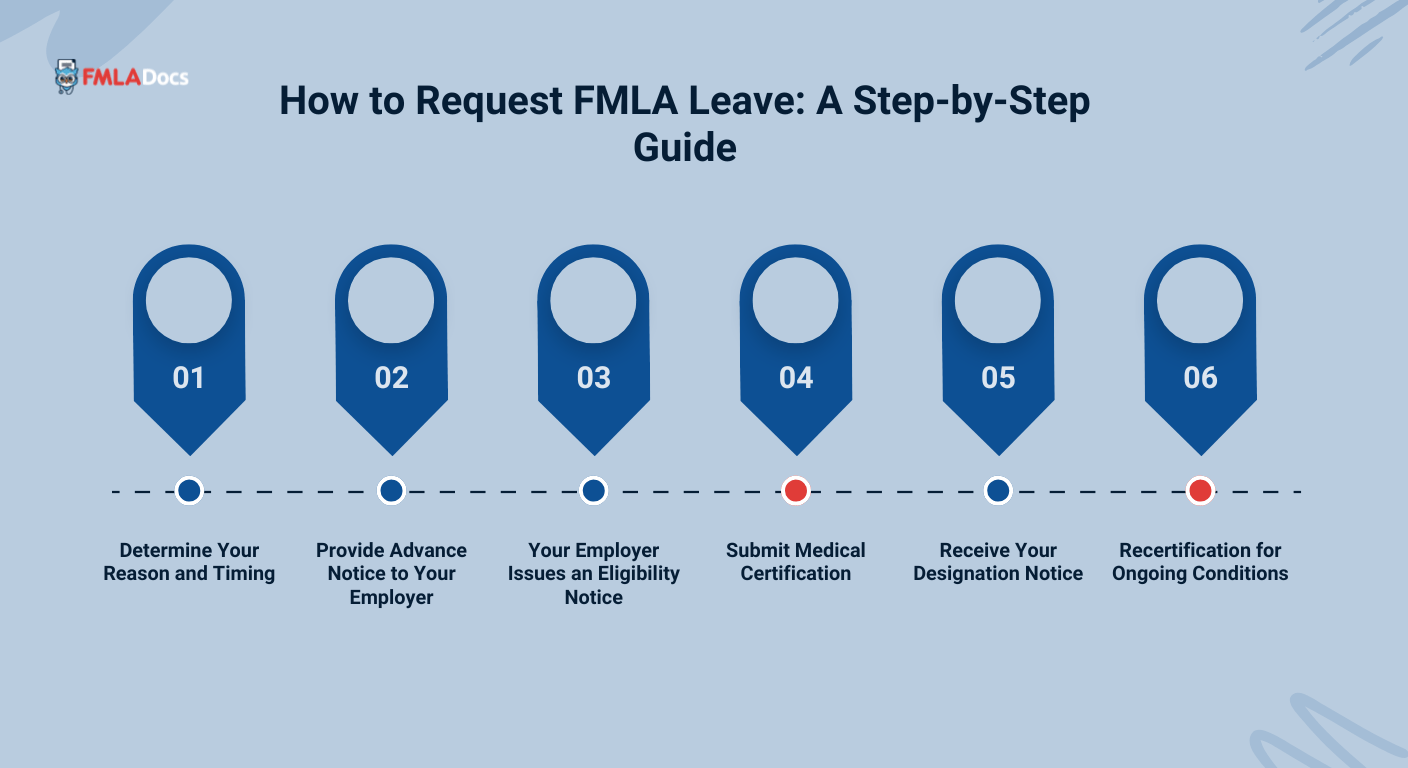
Step 1: Determine Your Reason and Timing
Before initiating a request, confirm that your reason for leave is FMLA-qualifying and that you meet the eligibility criteria. Review your employment history, confirm your employer’s size, and gather any relevant medical information. The more organized you are before you initiate the request, the smoother the process will be.
Step 2: Provide Advance Notice to Your Employer
If you know in advance that you will need FMLA leave, you must provide at least 30 days advance notice to your employer. For example, if your surgery is scheduled three weeks from now, you should notify your employer as soon as the surgery is confirmed. You do not need to explicitly use the phrase “FMLA leave” in your request. You simply need to provide sufficient information for your employer to recognize that the leave may qualify under the FMLA. This might include stating that you need leave because of a medical condition that requires hospitalization, or that you need time off to care for a family member with a serious health condition.
If the need for leave is unforeseeable, you must provide notice as soon as is practical, generally the same day or the next business day after you become aware of the need. You must also generally comply with your employer’s normal call-in procedures unless extraordinary circumstances prevent you from doing so.
Step 3: Your Employer Issues an Eligibility Notice
Within five business days of receiving your leave request, your covered employer must provide you with a written eligibility notice. This notice informs you whether you are eligible for FMLA leave and, if you are not, must specify at least one reason why. Alongside the eligibility notice, your employer must also provide you with a Rights and Responsibilities Notice explaining the specific expectations and obligations associated with your leave request.
Step 4: Submit Medical Certification
Your employer may request a medical certification to support your leave request. Once that request is made, you have 15 calendar days to submit the completed certification. In some circumstances, such as when your healthcare provider is unavailable to complete the certification promptly, you may request additional time. If the certification is incomplete or insufficient, your employer must give you written notice of the deficiency and at least seven days to correct it.
Step 5: Receive Your Designation Notice
After reviewing your certification, your employer must provide you with a Designation Notice confirming whether the leave request has been approved as FMLA-qualifying and how much leave time will be counted against your 12-week entitlement. If the leave is approved, your FMLA protections are in effect from the beginning of the leave.
Step 6: Recertification for Ongoing Conditions
For ongoing or chronic conditions, your employer may request recertification of your need for leave. In general, recertification may be requested no more often than every 30 days, and only in connection with an absence. If circumstances have changed significantly, or if the employer has reason to doubt the continuing validity of the certification, recertification can be requested sooner.
Understanding FMLA Docs: The Official Forms and How They Work
The DOL has developed optional-use certification forms that function as the standard FMLA docs across the country. According to the DOL FMLA Forms page, these electronically fillable PDFs can be saved and transmitted digitally. Employers may use their own versions of these forms as long as they request only the same basic information. There are five main certification forms:
- WH-380-E: Certification of Healthcare Provider for the Employee’s Serious Health Condition. This is the form your doctor completes when you are requesting leave for your own medical condition. It asks for basic medical facts, expected treatment duration, and any functional limitations that affect your ability to work.
- WH-380-F: WH-380-F: Certification for a Family Member’s Serious Health Condition. Used when you are taking leave to care for a seriously ill spouse, child, or parent. The form asks for information about the family member’s condition and the care you are being asked to provide.
- WH-381: Combined Eligibility and Rights and Responsibilities Notice. The employer provides this to you when you request leave. You can review the WH-381 form to understand exactly what information your employer is required to give you.
- WH-382: Designation Notice. Confirms whether your leave is approved, how much FMLA time is being used, and whether additional information is needed.
- WH-384 / WH-385 / WH-385-V: Military family leave certification forms for qualifying exigency leave and military caregiver leave for both active servicemembers and covered veterans.
There are several important rules about how these forms work in practice:
- Employers cannot reject a complete and sufficient certification simply because it is not on their standard form. They must accept faxed or copied certifications and certifications completed on the letterhead of the healthcare provider.
- You should never send completed certifications directly to the DOL. The certification goes from your healthcare provider to you, and you provide it to your employer.
- Employers can require only the information that relates to the serious health condition for which the current need for leave exists. They cannot demand information beyond what the FMLA regulations specify.
- The expiration date shown on DOL forms relates only to the Office of Management and Budget information collection review process and does not affect the form’s validity for FMLA purposes.
How to Get FMLA Online: The Faster, Simpler Alternative
Traditionally, getting FMLA certification meant scheduling an appointment weeks in advance, driving to a clinic, waiting, discussing your condition in person, and then waiting again for paperwork to be completed and returned to you. For someone already dealing with a serious illness, chronic pain, or a family crisis, this traditional process adds unnecessary burden. Today, it is possible to get FMLA online through legitimate, licensed, HIPAA-compliant platforms that connect you with healthcare providers remotely.
What Online FMLA Certification Involves
When you use a platform like FMLADocs to handle your FMLA certification online, the process is straightforward:
- You answer a few simple questions about your condition, your leave needs, and your medical history. The process is entirely online and designed to be clear and easy to complete.
- A licensed healthcare provider reviews your information for accuracy, medical appropriateness, and FMLA compliance. No in-person visit is required.
- Once approved, your signed, employer-ready FMLA certification form is delivered to you. The documentation is accurate, DOL-compliant, and ready for submission to your HR department.
FMLADocs is trusted by over 60,000 employees across the United States and processes most certifications within 24 to 48 hours. All documentation uses 256-bit encryption and is fully HIPAA-compliant. The service is the lowest-cost online FMLA certification option in the US and comes with a money-back guarantee if your application is not approved.
Who Benefits Most from Online FMLA Certification
Online FMLA certification is especially valuable for employees who do not have an established relationship with a specialist in their qualifying condition, those who live in areas with limited healthcare access, those whose condition makes travel to a clinic difficult or impossible, those who need certification quickly due to an urgent leave situation, and those who have previously been frustrated by the slow pace of in-person FMLA paperwork. It is equally valid for physical health conditions, mental health conditions, caregiving situations, and pregnancy-related leave requests.
What FMLA Conditions Can Be Certified Online
All of the following conditions can be evaluated and certified through an online FMLA process when they meet the clinical threshold for a serious health condition:
- Mental health: anxiety disorders, depression, PTSD, OCD, bipolar disorder, stress and burnout
- Physical health: cancer, heart conditions, diabetes, migraines, chronic pain, fibromyalgia, asthma, respiratory conditions
- Pregnancy: morning sickness, preeclampsia, gestational diabetes, postpartum recovery, prenatal care
- Caregiving: supporting a spouse, child, or parent through serious illness, surgery, or medical crisis
- Surgery and recovery: post-surgical rehabilitation, mobility limitations, treatment side effects
Get Your FMLA Docs in 24 Hours. No Waiting Room Required.
Thousands of employees have used FMLADocs to complete their FMLA certification online without ever leaving home. The process is fast, secure, and handled by licensed healthcare providers who understand exactly what your employer and HR department need. With a 4.9/5 average patient rating and certifications accepted nationwide, FMLADocs is the most trusted platform for online FMLA documentation. Check your eligibility and start your application today.
Employee Rights and Protections Under FMLA
FMLA provides powerful job protection that extends well beyond the leave period itself. According to DOL Fact Sheet #77B on FMLA Protections, Section 105 of the FMLA and section 825.220 of the FMLA regulations prohibit a wide range of employer actions:
Job Reinstatement
When you return from FMLA leave, your employer must restore you to the same job or to an equivalent position with the same pay, benefits, schedule, and terms and conditions of employment. An equivalent position must have virtually identical responsibilities, privileges, and status. The right to reinstatement means that your employer cannot change your role, reduce your pay, move you to a less favorable location, or strip you of responsibilities you held before taking leave.
Health Benefits Continuation
During FMLA leave, your employer is required to maintain your group health insurance coverage under the same terms and conditions as if you had continued to work. If you were enrolled in family coverage before your leave, family coverage must be maintained throughout your leave. You remain responsible for any employee premiums that you normally pay, but the employer’s portion must continue as if you were still actively employed.
Protection Against Retaliation
Your employer is explicitly prohibited from interfering with, restraining, or denying the exercise of any FMLA right. This means your employer cannot fire you, demote you, deny a promotion, cut your shifts, remove your responsibilities, give you negative performance reviews, assign you attendance points, or otherwise penalize you in any way because you requested or used FMLA leave. As USA.gov’s employer FMLA guide confirms, employers must not retaliate or discriminate against an employee for taking FMLA leave.
Protection for Opposing Unlawful Practices
FMLA protections extend even further than the leave taker themselves. All persons, including individuals who are not employees, are protected from retaliation for opposing unlawful FMLA practices, for filing a charge related to FMLA, for giving information in an FMLA inquiry or proceeding, or for testifying in any FMLA-related proceeding. This means that a coworker who speaks up on your behalf cannot be legally punished for doing so.
No Loss of Accrued Benefits
Use of FMLA leave cannot result in the loss of any employment benefit that accrued prior to the start of the leave. If you had vacation days, retirement contributions, or other benefits that had built up before you went on leave, you cannot lose those benefits simply because you took FMLA leave.
Enforcement
FMLA is enforced by the Wage and Hour Division of the U.S. Department of Labor. If you believe your rights have been violated, you can file a complaint with the WHD by calling 1-866-487-9243, or you may bring a private lawsuit against your employer in federal or state court. State employees may be subject to certain limitations regarding direct lawsuits for their own serious health conditions, but the DOL complaint process is available to all covered employees.
FMLA and Pay: Will You Receive Income During Leave?
FMLA is a job-protection law, not a paid leave mandate. The law requires only unpaid leave. However, there are several ways you may be able to receive income during your FMLA period:
Substitution of Paid Leave
Both employees and employers have rights regarding paid leave during FMLA. Employees may choose to use accrued paid vacation leave, paid sick leave, or other paid leave while taking FMLA leave. Employers may also require employees to use accrued paid leave during FMLA leave. When paid leave runs concurrently with FMLA leave, the leave time still counts against the employee’s 12-week FMLA entitlement. Importantly, employees must follow the employer’s normal paid leave policies in order to use paid leave during FMLA.
State Paid Leave Programs
Many states have enacted paid family and medical leave programs that can run concurrently with federal FMLA. When this happens, you receive income from the state program while federal FMLA protects your job. States with active paid leave programs include California (up to 8 weeks), New York (up to 12 weeks), New Jersey, Washington, Oregon, Colorado, Connecticut, Massachusetts, Rhode Island, and Washington D.C. Several additional states including Delaware, Maryland, and Minnesota have programs scheduled to begin providing benefits in 2026.
Even when state paid leave is available, FMLA still provides the critical protection of job security. If you live in a state with paid leave but work for a company too small to be covered by FMLA, you may receive pay through the state program but without the guaranteed right to return to your position at the end of leave.
Short-Term Disability
If your FMLA leave is for your own serious health condition, you may also qualify for benefits through an employer-provided or state-sponsored short-term disability plan. Short-term disability typically pays a percentage of your wages during a medically certified period of incapacity. When short-term disability and FMLA leave both apply to the same absence, they generally run concurrently.
Military Family Leave Under FMLA: A Special Entitlement
Military families face unique challenges when a service member is deployed or seriously injured. The FMLA’s military leave provisions, added in 2008, provide special protections for these situations. According to the DOL Military Family Leave Guide, there are two types of military family leave:
Qualifying Exigency Leave
If your spouse, parent, son, or daughter is a military member deployed or about to be deployed to a foreign country, you may take up to 12 workweeks of FMLA leave to address qualifying exigencies. Qualifying exigencies include making different daycare arrangements for the military member’s children, attending official military ceremonies or briefings, addressing financial and legal matters arising from the deployment, and attending counseling related to the deployment. Covered active duty means deployment to areas outside the United States for members of the regular Armed Forces, or deployment under a contingency operation for National Guard and Reserve members.
Military Caregiver Leave
If you are the spouse, parent, son, daughter, or next-of-kin of a covered servicemember who is undergoing medical treatment, recuperation, or therapy for a serious injury or illness, you may take up to 26 workweeks of leave during a single 12-month period. This is the only FMLA provision that allows more than 12 weeks of leave. A covered servicemember includes current active duty members of the Armed Forces (including National Guard and Reserve) and certain veterans who were honorably discharged within the five years before the leave begins. The definition of serious injury or illness for servicemembers and veterans is distinct from the standard FMLA definition of serious health condition.
Common FMLA Mistakes to Avoid
Many employees lose their FMLA protections not because they do not qualify, but because they make procedural errors that jeopardize their claim. Here are the most common mistakes to avoid:
- Failing to give timely notice. If the need for leave is foreseeable, you must provide at least 30 days notice. If it is unforeseeable, you must notify your employer as soon as practicable.
- Not providing enough information. You do not need to say “FMLA” explicitly, but you must give your employer enough information for them to recognize the leave may be FMLA-qualifying. Vague requests without context can lead to denial.
- Submitting an incomplete certification. Certifications that are missing required information can be rejected. Review your certification before submission to ensure all fields are completed.
- Missing the 15-day deadline. You have 15 calendar days to return a requested medical certification. Missing this deadline without requesting an extension can result in your leave not being designated as FMLA-protected.
- Assuming your employer knows the rules. Not all HR departments are fully versed in FMLA requirements. It is your responsibility to understand your rights and to follow the proper procedures to invoke them.
- Waiting too long to consult a healthcare provider. For the 3-day incapacity rule to apply, you must visit a healthcare provider within seven days of the first day of incapacity. Waiting longer may disqualify your leave under that category.
How FMLA Interacts with Other Laws and Employer Policies
FMLA does not operate in isolation. According to the DOL Employer’s Guide to FMLA, the law interacts with several other federal and state frameworks:
- Americans with Disabilities Act (ADA): The ADA may provide additional protections and accommodations beyond what FMLA requires. An employee with a disability may be entitled to a reasonable accommodation that allows them to continue working in a modified capacity even after exhausting FMLA leave.
- Pregnancy Discrimination Act (PDA): Employers cannot discriminate against employees based on pregnancy, childbirth, or related conditions. FMLA, the PDA, and the ADA together provide layered protections for pregnant employees and new parents.
- HIPAA Privacy Rule: Medical certifications obtained in connection with FMLA requests are subject to HIPAA confidentiality protections. Employers must keep medical information they receive in connection with FMLA leave in separate, confidential files.
- Workers’ Compensation: FMLA and workers’ compensation leave can run concurrently when the injury or illness is work-related. This means the leave counts against both the workers’ compensation entitlement and the employee’s FMLA leave.
- State Leave Laws: Nothing in the FMLA prevents employees from receiving greater protections under state law. Workers have the right to benefit from all laws that apply to their situation.
Conclusion: Your FMLA Rights Are Yours to Use
FMLA is one of the most important workplace protections available to American workers. With the law having been used more than 100 million times since 1993, it is not an obscure provision. It is a fundamental right that millions of employees rely on every year to manage serious health conditions, care for loved ones, and welcome new children without sacrificing their jobs or their health coverage. Understanding the law, knowing what qualifies, completing the right FMLA docs, and using a trusted FMLA online doctor to get your FMLA certification online are the steps that protect your rights and keep your leave on solid legal ground.
The ability to get FMLA online through HIPAA-compliant, licensed platforms has made this process significantly more accessible for employees across the country. Whether you are managing a chronic condition, recovering from surgery, dealing with a mental health crisis, or stepping up to care for a family member, your rights under online FMLA are clear, your protections are real, and the process of getting certified has never been more straightforward.
Frequently Asked Questions
Can I get FMLA online without visiting a doctor in person?
Yes. Licensed healthcare providers can review your medical information and complete your FMLA certification entirely online. Platforms like FMLADocs allow you to submit your information digitally and receive a signed, employer-ready certification without any in-person appointment. This is legal, HIPAA-compliant, and fully valid for employer submission.
Is online FMLA certification accepted by employers?
Yes. As long as the certification is completed by a licensed healthcare provider and contains the information required under FMLA regulations, employers must accept it regardless of how it was obtained. An employer cannot reject a valid certification simply because it was issued through an online process or is not on their preferred form.
How long does FMLA certification take when done online?
Through dedicated platforms, most certifications are reviewed and issued within 24 to 48 hours of submission. Traditional in-person routes can take two to six weeks or more due to scheduling delays and slow documentation turnaround. For urgent situations, the speed advantage of online certification is especially significant.
What happens if my employer retaliates against me for taking FMLA leave?
FMLA strictly prohibits employer retaliation. If your employer fires you, demotes you, cuts your hours, gives you a negative review, or takes any other adverse action because you used FMLA leave, you can file a complaint with the DOL's Wage and Hour Division at 1-866-487-9243, or pursue a private lawsuit in federal or state court. Document all communications with your employer regarding your leave request to preserve your evidence.
Can mental health conditions qualify for FMLA leave?
Absolutely. Mental health conditions including anxiety disorders, depression, PTSD, bipolar disorder, and OCD can qualify for FMLA when they constitute a serious health condition that prevents you from performing the essential functions of your job. A licensed healthcare provider must certify the condition. Online FMLA certification is fully available for mental health conditions, and the DOL has explicitly confirmed that mental health is protected under FMLA.
Does FMLA apply to remote workers?
Yes. Remote workers are covered by FMLA. For coverage purposes, a remote worker's worksite is considered to be the office, site, or location they report to or are assigned to, not their home. If that location has 50 or more employees within 75 miles, the employee meets the worksite requirement. Remote workers who meet all four eligibility criteria are fully entitled to FMLA leave.
Meet the author
Tayyaba Amir
Hi, I'm Tayyaba Amir, a content writer who helps people understand workplace rights and employee benefits. I aim to make complex information easy to understand so readers can make informed decisions. I focus on helping employees learn about their FMLA rights and how to use them. My goal is to simplify the rules so you can focus on what matters most; your health and your family. In my free time, I enjoy exploring new trends in digital media and finding ways to make everyday life easier.
Get Your FMLA Certification Online in Minutes