
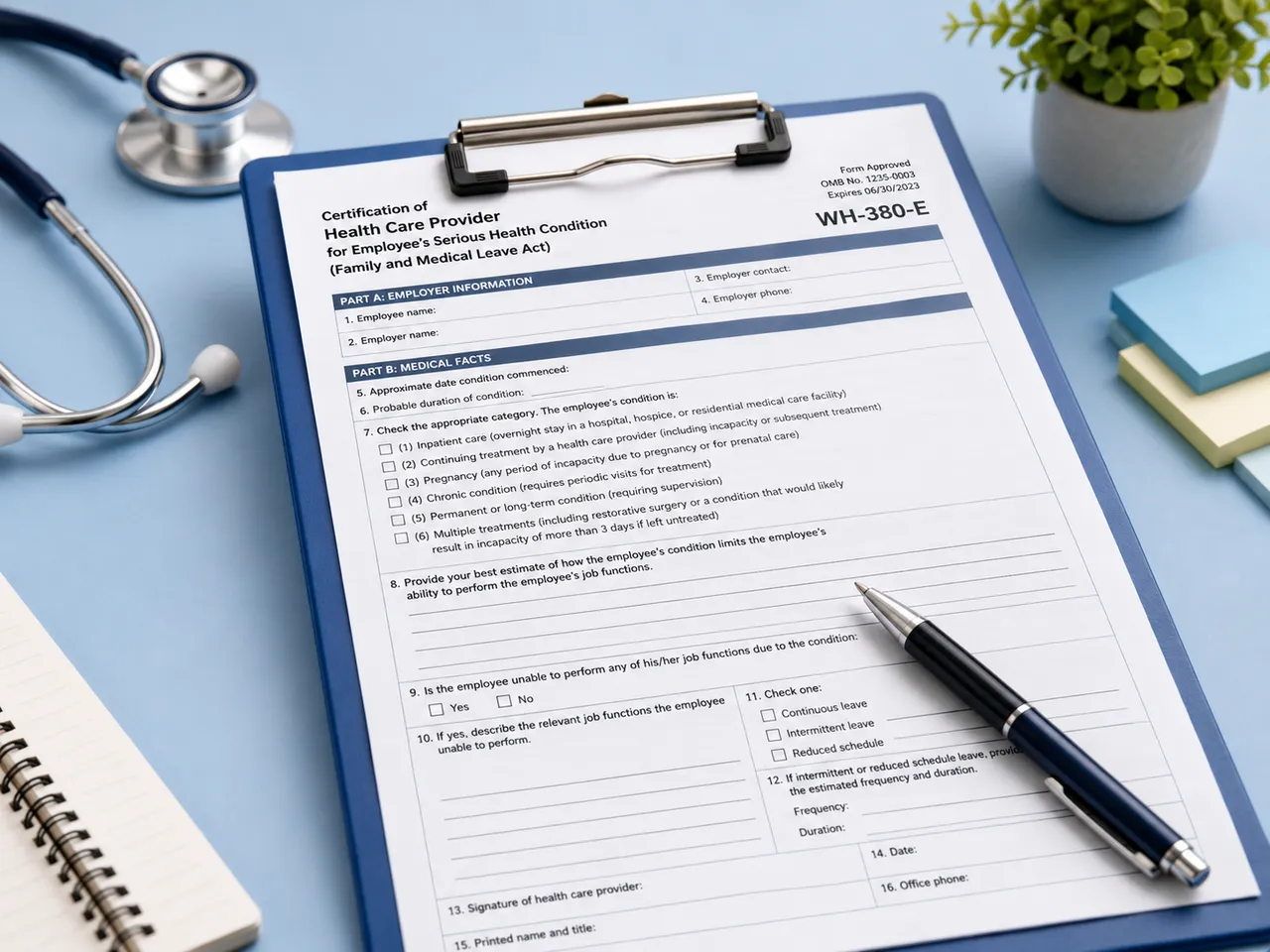
FMLA Form WH-380-E: Get It Right the First Time
 by Nida Hammad
 Last updated:
If you have ever had an FMLA certification sent back as incomplete, you already know what is at stake. A missing field, a vague description of your condition, or a provider who did not document your functional limitations the way the DOL requires can put your leave protection in jeopardy. You can get FMLA certification online from a licensed provider. FMLA Form WH-380-E is the document that stands between your medical reality and your protected leave. Getting it right the first time matters.
This guide walks through every section of the DOL’s WH-380-E form (Revised June 2020) in plain language. You will know exactly what the employee fills in, what the provider fills in, what constitutes a serious health condition under the law, how to document intermittent or continuous leave, and where most forms fail so yours does not.
What Is FMLA Form WH-380-E?
WH-380-E stands for Wage and Hour Division Form 380, Employee version. It is the U.S. Department of Labor’s optional-use medical certification form for employees requesting FMLA leave because of their own serious health condition. The companion form, WH-380-F, covers leave to care for a family member. Learn how FMLA certification works.
The form exists because the Family and Medical Leave Act allows employers to require medical certification before granting leave. Without a complete certification, your employer may deny the leave request or require you to use PTO. A properly completed WH-380-E is how you turn your physician’s clinical assessment into federally protected leave.
The current revision is dated June 2020. The form carries an OMB expiration date, but the DOL has confirmed that the expiration date is administrative and the form remains valid regardless of that date.
Who this form is for: You are an employee. Your condition is affecting your own ability to work. You need up to 12 weeks of job-protected leave under FMLA. This is the form your healthcare provider needs to complete to certify that leave.
Who Completes Each Section: Employee vs. Healthcare Provider
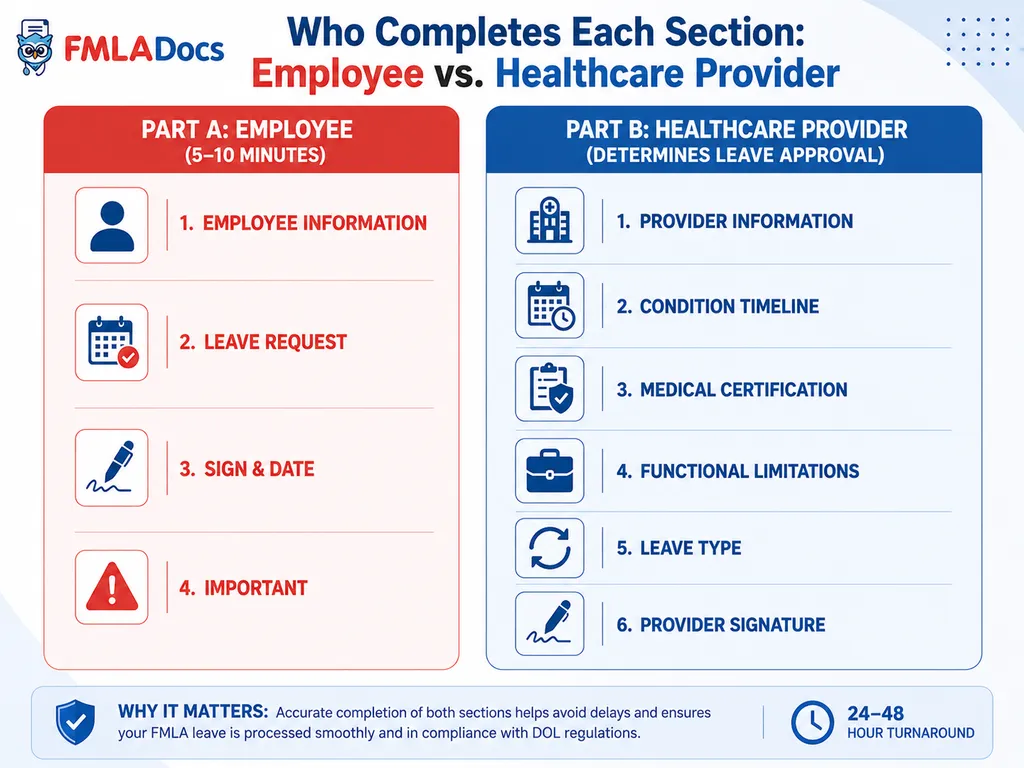
One of the most common errors on WH-380-E is role confusion. The form has two distinct sections with two distinct owners. Your employer cannot complete either section. You cannot complete the provider section. Here is the breakdown:
| Section | Who Completes It | What It Covers |
|---|---|---|
| Section I (Part A) | Employee | Your name, employer name, job title, leave dates, and the nature of your leave request |
| Section II (Part B) | Licensed healthcare provider | Clinical information: diagnosis category, symptoms, functional limitations, treatment, leave duration, frequency for intermittent leave |
Section-by-Section Walkthrough: Part A For Employee
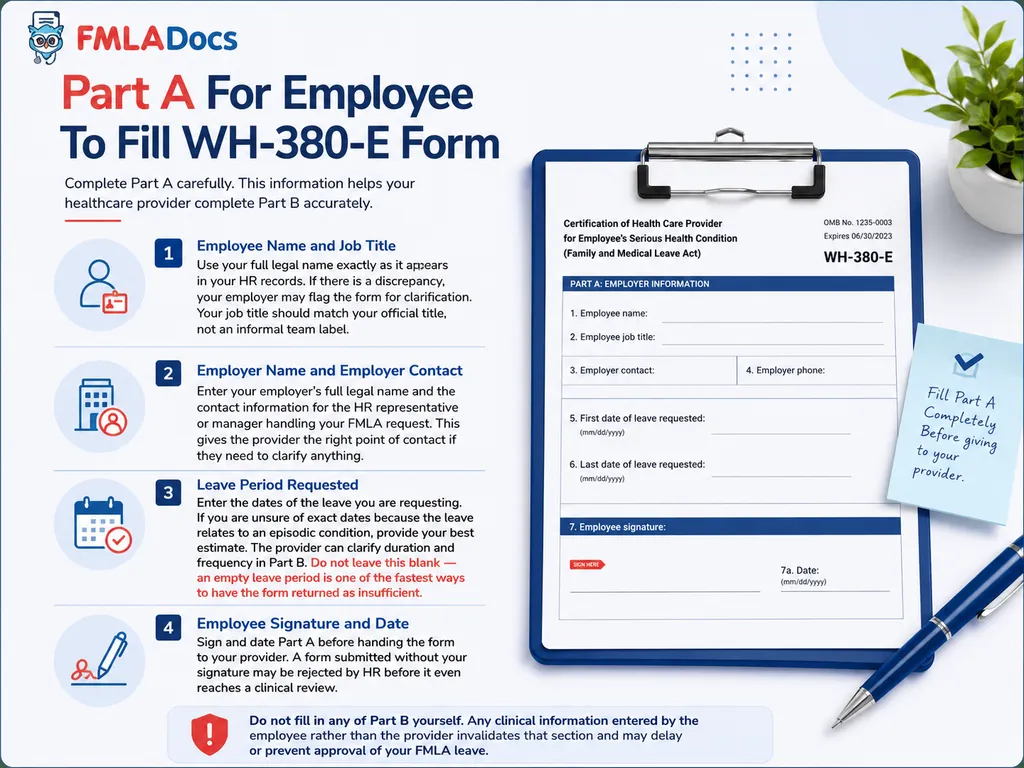
Part A: Employee fills out, it takes 5 to 10 minutes.
1. Employee Name and Job Title
Use your full legal name exactly as it appears in your HR records. If there is a discrepancy, your employer may flag the form for clarification. Your job title should match your official title, not an informal team label.
2. Employer Name and Employer Contact
Enter your employer’s full legal name and the contact information for the HR representative or manager handling your FMLA request. This gives the provider the right point of contact if they need to clarify anything.
3. Leave Period Requested
Enter the dates of the leave you are requesting. If you are unsure of exact dates because the leave relates to an episodic condition, provide your best estimate. The provider can clarify duration and frequency in Part B. Do not leave this blank — an empty leave period is one of the fastest ways to have the form returned as insufficient.
4. Employee Signature and Date
Sign and date Part A before handing the form to your provider. A form submitted without your signature may be rejected by HR before it even reaches a clinical review.
NOTE: Do not fill in any of Part B yourself. Any clinical information entered by the employee rather than the provider invalidates that section. Your employer has the right to contact the provider directly to verify the certification.
Your leave protection starts with a correctly completed WH-380-E. Skip the scheduling delays and the guesswork. FMLADocs physicians complete your certification typically within 24 to 48 hours, employer-ready and DOL-compliant. Start my certification
Section-by-Section Walkthrough: Part B For Healthcare Provider
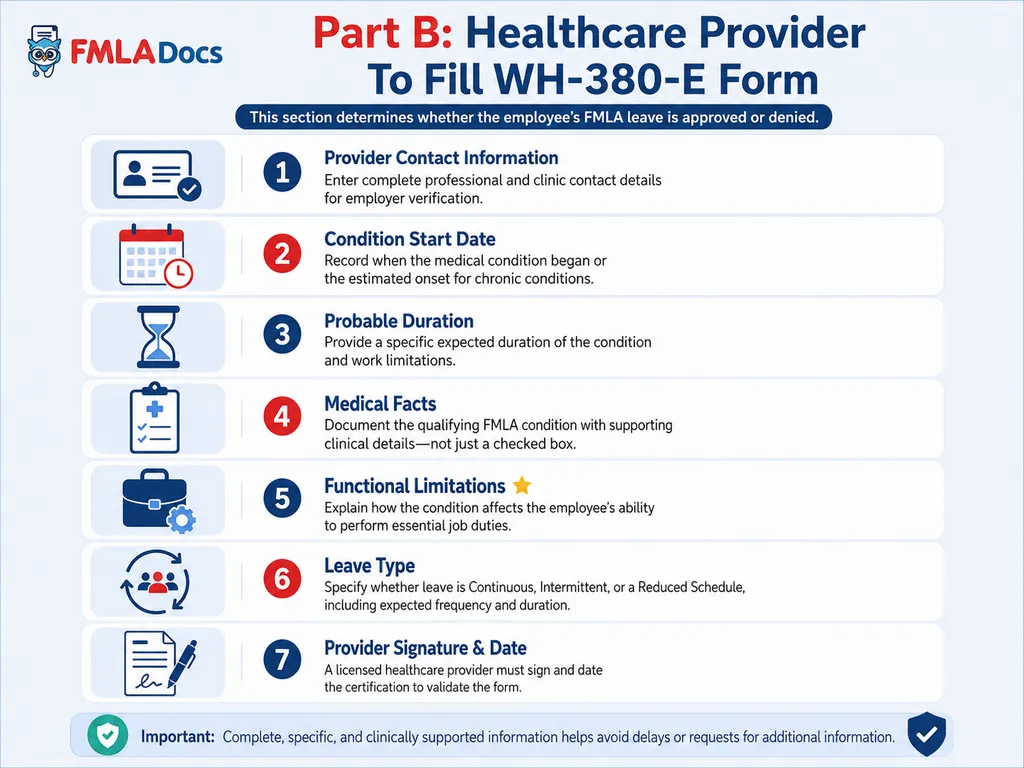
Part B: Healthcare provider fills out. This is the section that determines whether your leave is approved or denied.
1. Provider Contact Information
The provider must enter their full name, professional title, practice or clinic name, phone number, and address. This information is required for your employer to authenticate the certification. A signature with no contact information is not sufficient. The provider’s license number is not required on the form itself but should be available if your employer requests it.
2. Approximate Date the Condition Commenced
The provider enters when your condition began. This does not have to be exact to the day for chronic or progressive conditions, but it must be specific enough to establish a medical history. For conditions with multiple episodes, the provider may note the onset of the underlying condition rather than each individual episode.
3. Probable Duration
This is one of the most scrutinised fields on the form. The provider must indicate how long your condition is expected to last and, if applicable, how long you will be unable to perform the functions of your position. Vague entries like “indefinite” or “as needed” are often flagged as insufficient. The provider should give a specific duration range even for progressive or chronic conditions.
4. Medical Facts
This is where the form earns its clinical weight. The provider must check one or more of the following categories under the DOL’s definition of a serious health condition under 29 CFR § 825.113:
| Category | DOL Standard | Common Examples |
|---|---|---|
| Inpatient care | An overnight stay in a hospital, hospice, or residential medical care facility | Surgery, acute illness requiring hospitalisation |
| Continuing treatment — Incapacity 3+ days | More than 3 consecutive full calendar days of incapacity plus at least 2 treatment visits, or 1 visit resulting in a regimen of continuing treatment | Flu, infection, back injury, mental health episode |
| Pregnancy | Incapacity due to pregnancy or for prenatal care | Morning sickness, prenatal appointments, pregnancy complications |
| Chronic serious health condition | Requires periodic visits (at least twice per year) to a healthcare provider, may cause episodic incapacity | Asthma, migraines, epilepsy, diabetes, Crohn’s disease |
| Permanent or long-term condition | Period of incapacity which is permanent or long-term, requires continuing supervision | Alzheimer’s, terminal illness, severe stroke |
| Multiple treatments | Restorative surgery or a condition that would result in 3+ days of incapacity without treatment | Chemotherapy, dialysis, physical therapy post-injury |
The provider must not only check the correct category but also provide enough narrative detail to explain why the condition meets that standard. A checked box without supporting description is the single most common reason certifications are returned as insufficient.
5. Functional Limitations: The Most Important Field on the Form
This is where most certifications fail. The provider must specifically describe how the condition limits your ability to perform the functions of your job. It is not enough to list a diagnosis. The provider must explain the functional impact: whether you cannot stand for extended periods, cannot concentrate for more than a set amount of time, cannot be exposed to certain environments, or cannot work a full shift without rest. This description must be clinical, specific, and connected to your job responsibilities. Describe your specific job duties — how long you stand, whether you lift, what cognitive demands your role involves, how much consecutive concentration is required. The more the provider understands your job, the more precisely they can document the functional limitation.
6. Continuous vs. Intermittent Leave
The provider must indicate whether the leave will be continuous, intermittent, or a reduced schedule. This field determines how your employer tracks and applies your FMLA entitlement.
| Leave Type | What the Provider Must Document | How Your Employer Tracks It |
|---|---|---|
| Continuous leave | Start date, expected duration, whether you can perform any work at all during the period | Blocks out a full period of leave against your 12-week entitlement |
| Intermittent leave | Expected frequency of episodes (e.g., 1 to 3 times per week), expected duration of each episode (e.g., 1 to 4 hours), whether flare-ups are predictable or triggered by a pattern | Tracks each absence individually and counts hours against your 12-week entitlement |
| Reduced schedule | How many hours per day or days per week of work are medically appropriate | Counts the difference between your scheduled hours and your reduced hours against your entitlement |
For intermittent leave, the frequency and duration estimates are critical. Under 29 CFR § 825.306, your employer cannot demand specific dates in advance, but the provider must give a medically reasonable estimate of how often and how long episodes are expected to last. An entry of “as needed” without a frequency range gives your employer no basis for planning and may be returned as insufficient.
7. Provider Signature and Date
The form must be signed by a licensed healthcare provider as defined under 29 CFR § 825.125. This includes:
- Medical doctors (MD, DO) licensed to practice in any state
- Nurse practitioners and physician assistants acting within their scope of practice
- Licensed clinical social workers (for mental health conditions)
- Psychologists, chiropractors, and dentists (for conditions within their scope)
- Optometrists, podiatrists, and Christian Science practitioners in their defined scope
A signature without a date is insufficient. A date more than 15 calendar days before submission may trigger questions. The provider’s signature certifies under penalty of law that the information provided is accurate.
Continuous vs. Intermittent Leave: What the Difference Means for Your Leave Balance
How your leave is designated affects your 12-week annual entitlement significantly. Under DOL Fact Sheet #28, continuous leave runs as a block — you are away from work entirely for the certified period. Intermittent leave is taken in separate blocks, sometimes as little as an hour at a time for a medical appointment, a flare-up, or a treatment session.
The certification must be specific enough for your employer to apply the correct tracking method. Employees taking intermittent leave for a chronic condition — migraines, anxiety, Crohn’s, chronic back pain — must have the frequency and duration of expected episodes documented clearly. If your provider writes “1 to 2 episodes per month, each lasting 1 to 3 days,” your employer has a basis for tracking. If they write “varies,” your employer may challenge the designation each time you take leave.
Common Mistakes That Get WH-380-E Returned as Insufficient
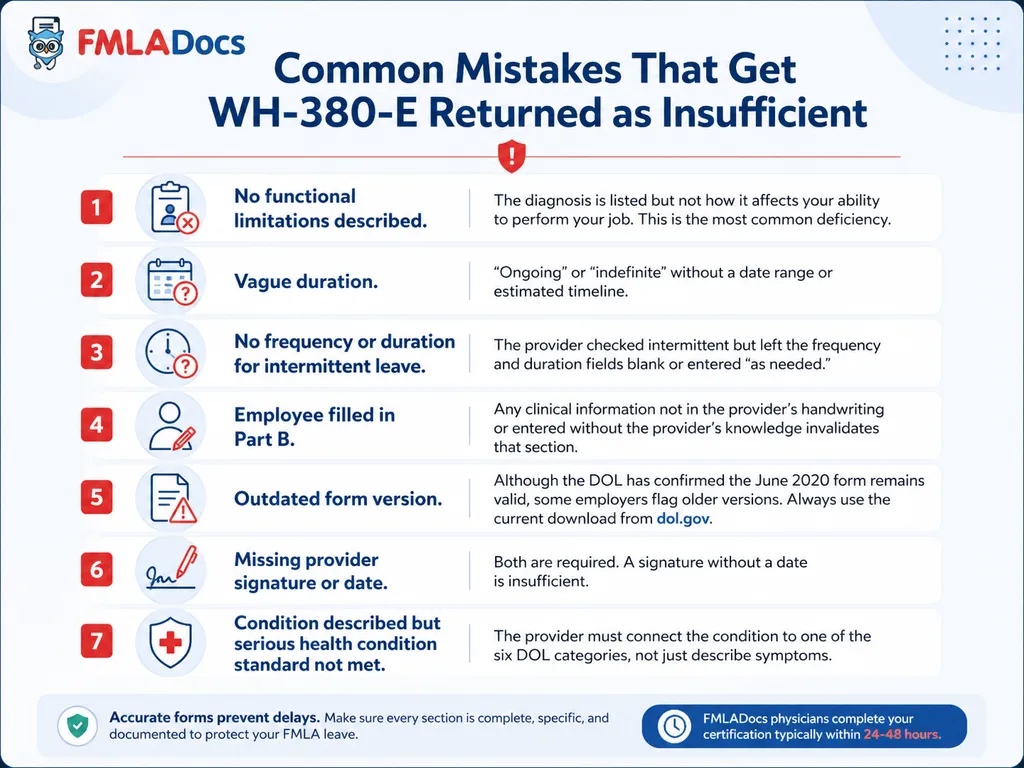
The DOL allows employers to request clarification or a second opinion when a certification is incomplete, unclear, or inconsistent. Under 29 CFR § 825.307, your employer must specify in writing what is deficient and give you at least 7 calendar days to correct it. These are the fields that most often create that problem:
- No functional limitations described. The diagnosis is listed but not how it affects your ability to perform your job. This is the most common deficiency.
- Vague duration. “Ongoing” or “indefinite” without a date range or estimated timeline.
- No frequency or duration for intermittent leave. The provider checked intermittent but left the frequency and duration fields blank or entered “as needed.”
- Employee filled in Part B. Any clinical information not in the provider’s handwriting or entered without the provider’s knowledge invalidates that section.
- Outdated form version. Although the DOL has confirmed the June 2020 form remains valid, some employers flag older versions. Always use the current download from dol.gov.
- Missing provider signature or date. Both are required. A signature without a date is insufficient.
- Condition described but serious health condition standard not met. The provider must connect the condition to one of the six DOL categories, not just describe symptoms.
Can Your Employer Require Their Own Form Instead of WH-380-E?
Under the FMLA regulations, your employer may use their own certification form instead of the DOL’s optional-use form, but only if it requests no more information than the DOL form requires. Your employer cannot require a different format that asks for more clinical detail, specific diagnoses beyond what the DOL form requires, or information about conditions unrelated to the current leave request. Under 29 CFR § 825.306, the employer must also accept a certification completed on the DOL form in lieu of their own form if it contains all required information. The short answer to can my employer deny FMLA over the form itself is no: you cannot be denied leave solely because you used the official DOL form.
How Fast Must the Doctor Return the Certification?
You have 15 calendar days from the date your employer requests certification to return the completed form. Your employer cannot set a shorter deadline. If the delay is caused by your provider’s schedule and you have made diligent efforts to obtain the form, communicate this to your employer in writing and request an extension. The employer may grant more time at their discretion. Under 29 CFR § 825.305, an employer cannot deny leave solely because the certification was not returned within 15 days if there was a legitimate reason for the delay and the employee provided timely notice of the reason.
This is where the 15-day window creates real risk. If your doctor is booked two weeks out and the form cannot be completed in time, your leave designation may be delayed or challenged. FMLADocs physicians complete WH-380-E typically within 24 to 48 hours of your evaluation, which removes the scheduling bottleneck entirely.
How FMLADocs Completes WH-380-E Online
FMLADocs connects you with a board-certified physician who reviews your medical information through a secure online evaluation and completes Part B of WH-380-E on your behalf. The physician documents your serious health condition, your functional limitations, your leave type, and the expected duration and frequency — all in the specific language the DOL and your employer require. You receive a signed, dated, submission-ready certification form delivered to your inbox typically within 24 to 48 hours.
This process eliminates the three most common failure points on WH-380-E: vague functional limitation descriptions, missed intermittent leave frequency documentation, and provider scheduling delays that push employees past the 15-day deadline.
Frequently Asked Questions
What is FMLA Form WH-380-E used for?
WH-380-E is the U.S. Department of Labor's medical certification form used when an employee requests FMLA leave because of their own serious health condition. The healthcare provider completes Part B to certify that the condition meets the DOL's definition of a serious health condition and to document the employee's functional limitations, leave duration, and whether the leave will be continuous or intermittent.
Who can sign WH-380-E?
A licensed healthcare provider as defined under 29 CFR § 825.125 must sign the form. This includes medical doctors, osteopathic physicians, nurse practitioners, physician assistants, licensed clinical social workers (for mental health conditions), psychologists, chiropractors, and others operating within their scope of practice and licensed in any state. The provider must also date their signature. An unsigned or undated form is insufficient.
Can my employer require their own certification form instead of WH-380-E?
Your employer may use their own form, but it cannot ask for more information than the DOL form requires. Under 29 CFR § 825.306, your employer must also accept a properly completed WH-380-E in lieu of their own form. You cannot be denied FMLA leave solely because you used the official DOL form rather than an employer-specific version.
How fast must the doctor return the completed WH-380-E?
You have 15 calendar days from the date your employer requests certification to return the completed form. Your employer cannot demand it faster. If there is a delay outside your control — your provider is unavailable, for example — inform your employer in writing and explain the reason. The employer may grant additional time at their discretion under 29 CFR § 825.305.
What makes a WH-380-E certification insufficient?
The most common reasons a certification is returned as insufficient include: no functional limitations described (the diagnosis is listed but not how it limits job performance), vague or missing duration, no frequency or duration estimate for intermittent leave, a missing provider signature or date, and failure to connect the condition to one of the DOL's six serious health condition categories. Under 29 CFR § 825.307, your employer must identify in writing what is deficient and give you at least 7 calendar days to correct it.
Can I use WH-380-E for mental health conditions?
Yes. Mental health conditions including anxiety, depression, PTSD, bipolar disorder, and others may qualify as a serious health condition under FMLA when they meet the continuing treatment standard — for example, more than 3 consecutive days of incapacity combined with at least one treatment visit. The provider must document the functional impact on your ability to work, not just the diagnosis. Any licensed healthcare provider within their scope, including licensed clinical social workers and psychologists, may certify mental health conditions on WH-380-E.
What is the difference between WH-380-E and WH-380-F?
WH-380-E is used when the employee is requesting leave for their own serious health condition. WH-380-F is used when the employee is requesting leave to care for a family member — a spouse, child, or parent — with a serious health condition. Using the wrong form will result in the certification being rejected.
Does a diagnosis alone qualify me for FMLA leave?
No. A diagnosis is the starting point, not the determination. The condition must meet the DOL's definition of a serious health condition under 29 CFR § 825.113, and the healthcare provider must document how the condition creates a functional limitation that affects your ability to perform your job. Two employees with the same diagnosis may receive different eligibility determinations depending on the severity of their functional limitations. This is why thorough, specific documentation in Part B of WH-380-E is the most important factor in a successful certification.
Can I start FMLA leave before the WH-380-E is returned?
Yes. Under FMLA regulations, leave may begin before certification is complete when the need is urgent. You have 15 calendar days from the date your employer requests certification to return the completed form. If you need to begin leave immediately — for a hospitalisation, an acute episode, or a scheduled surgery — you may start leave and submit the certification within the 15-day window. If the certification is not returned in time without a legitimate reason, the employer may deny FMLA designation for that leave period.
Meet the author
Nida Hammad
I am a professional writer with over five years of experience creating clear, engaging, and well-researched content. I specialize in healthcare topics, helping readers understand complex information in simple wording. Currently, I write for FMLA DOC, where I focus on producing accurate and trusted guides for people seeking support with FMLA and medical needs.
Get Your FMLA Certification Online in Minutes