
FMLA Form WH-380-F: Certified in 24 Hours
 by Nida Hammad
 Last updated:
If your spouse, parent, or child has a serious health condition and you need time away from work to care for them, FMLA Form WH-380-F is the document your employer will likely ask for. It is the health care provider’s certification that establishes the medical basis for your leave, and getting it filled out correctly the first time is what keeps your leave request from being delayed or returned as insufficient.
This guide walks through exactly what WH-380-F covers, who counts as a qualifying family member, what your family member’s provider needs to document, and how to avoid the documentation gaps that most often trip up caregiver leave requests.
What Is FMLA Form WH-380-F?
Form WH-380-F, officially titled the Certification of Health Care Provider for Family Member’s Serious Health Condition, is one of the primary optional-use administration forms published by the United States Department of Labor (DOL). Its creation and strict limitations are governed by federal code under 29 CFR § 825.306. This document is used strictly when an eligible employee requests job-protected leave under the Family and Medical Leave Act (FMLA) to care for a covered family member experiencing a severe illness or injury, rather than for the employee’s own medical needs.
Document Structure and Responsibilities
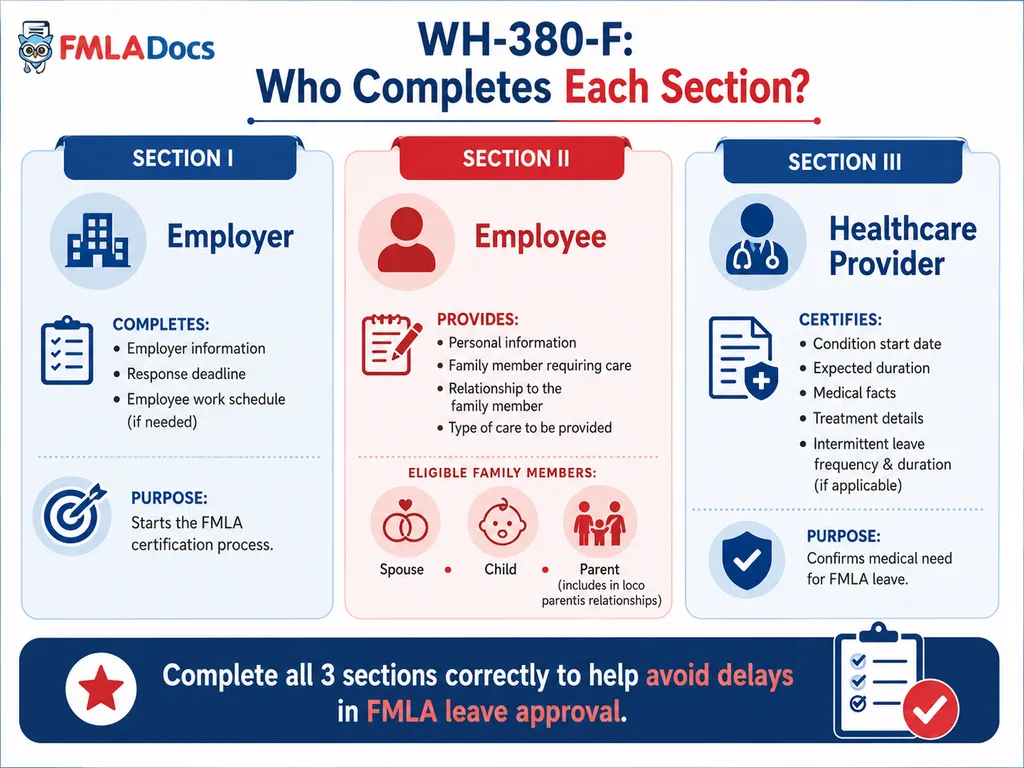
The administrative workflow of Form WH-380-F is divided into three distinct operational sections, each outlining explicit legal expectations for the involved parties:
-
Section I: For Completion by the Employer. The employer initiates the process by inputting basic identifying corporate information, establishing explicit response deadlines, and outlining the employee’s essential job schedule if relevant to the care layout.
-
Section II: For Completion by the Employee. The employee provides their personal details and explicitly identifies the family member requiring care. Under FMLA guidelines, a covered family member is defined strictly as a spouse, parent, or a child under the age of 18 (or an adult child who is incapable of self-care due to a mental or physical disability). Notably, this includes individuals in in loco parentis relationships, meaning no legal or biological relationship is strictly necessary if parental obligations were assumed. The employee must also briefly outline the nature of the physical or psychological care they will provide.
-
Section III: For Completion by the Health Care Provider. The medical professional treating the family member completes the medical validation portion. This section requires the provider to give an approximate date the condition commenced, its probable duration, and relevant medical facts (such as symptoms, hospitalization history, or ongoing specialized treatment regimens). Crucially, the provider must estimate the timing, frequency, and duration of any intermittent leave or medical flare-ups expected over the subsequent six months.
Legal Guidelines and Employer Adoption
While employers have the right to demand medical validation for a leave request, using the exact Form WH-380-F is technically optional under FMLA regulations. Employers are legally permitted to accept the form as-is, utilize their own internally designed equivalent questionnaires, or accept a medical provider’s standard structural letterhead.
However, statutory guardrails dictate that an employer may never demand more medical or personal data from the employee than what is expressly authorized by the standard federal categories.
Important Compliance Timelines
Once an employer requests this documentation, they must grant the employee a minimum of 15 calendar days to return the completed form. If the returned form is incomplete or vague, the employer must state the deficiencies in writing and allow the employee at least 7 calendar days to cure the paperwork errors. Failure to provide a sufficient certification within these timelines may result in a lawful deferral or outright denial of the protected FMLA leave.
In daily human resource operations, the vast majority of U.S. employers choose to utilize Form WH-380-F directly or deploy a mirror variant. Utilizing the standardized federal paperwork heavily mitigates the risk of running afoul of worker privacy protections while ensuring that the organization accurately captures the required clinical framework necessary to validate job-protected leave.
Need to get your family leave certification started? Begin your family leave certification today with FMLA online and connect with a licensed provider.
FMLA Form WH-380-F vs WH-380-E: Understanding the Distinctions in FMLA Medical Certifications
A frequent point of confusion for employees navigating the Family and Medical Leave Act (FMLA) is the assumption that a single, catch-all medical form covers every scenario. In reality, the United States Department of Labor (DOL) issues two distinctly different medical certification documents. Submitting the wrong form to a Human Resources department is one of the most common administrative hurdles that causes a leave request to be flagged as incomplete, triggering unnecessary delays during critical personal periods. The U.S. Department of Labor FMLA Forms Library has up-to-date versions of both documents.
Key Statutory Requirements and Timelines
Both forms operate under strict statutory guidelines enforced by the DOL’s Wage and Hour Division. Understanding the basic regulatory timeline is essential for maintaining job protection:
-
The 15-Day Rule: Once an employer requests a medical certification, they must provide the employee with at least 15 calendar days to return the completed paperwork.
-
The Right to Cure: If a doctor submits a form that is vague, ambiguous, or leaves sections blank, the employer cannot simply deny the leave immediately. According to federal guidelines, the employer must state the deficiencies in writing and grant the employee a minimum of 7 calendar days to fix or “cure” the form.
-
Privacy Guardrails: Employers are strictly forbidden from demanding detailed medical records or a history of genetic conditions. The forms are designed to extract only the information necessary to determine if the medical event qualifies under FMLA law.
Which Family Relationships Qualify for FMLA Form WH-380-F?
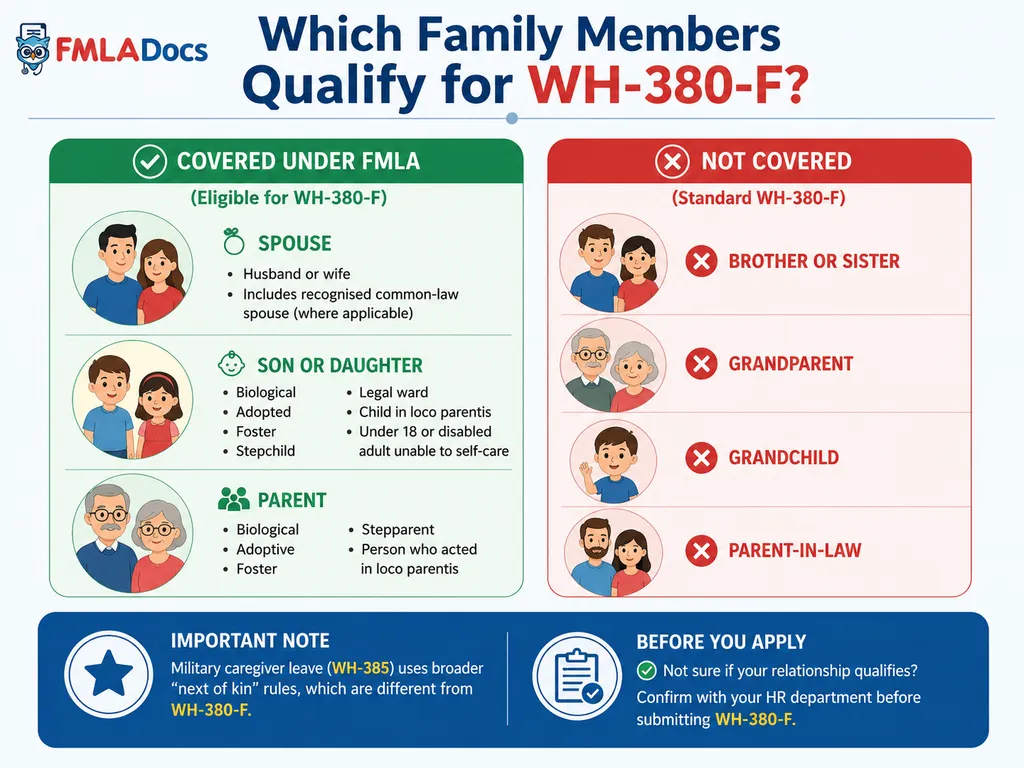
Under 29 CFR § 825.122, FMLA leave to care for a family member’s serious health condition is limited to a specific list of relationships. Not every relative you might describe as “family” qualifies under the statute. WH-380-F is the DOL form used when you need leave to care for a spouse, child, or parent with a serious health condition, not for your own condition (that is WH-380-E).
Covered Relationships
-
Spouse: a husband or wife as defined or recognized under the law of the state where the employee resides, including common law marriage where recognized.
-
Son or daughter: a biological, adopted, or foster child, a stepchild, a legal ward, or a child of someone standing in loco parentis, who is either under 18, or 18 or older and incapable of self-care because of a disability.
-
Parent: a biological, adoptive, step, or foster mother or father, or an individual who stood in loco parentis to the employee when the employee was a child. This does not include parents-in-law.
Not Covered Under Standard FMLA Caregiver Leave
Siblings, grandparents, grandchildren, and parents-in-law do not qualify an employee for FMLA leave to provide care, even when the caregiving responsibility is real. A separate, broader definition of “next of kin” applies only to military caregiver leave for a covered servicemember, which uses a different form (WH-385).
If you are uncertain whether your relationship to the family member qualifies, that is worth confirming with your employer’s HR team before requesting the form, since it determines whether WH-380-F is even the right document for your situation.
What the Provider Must Attest To
The health care provider completing WH-380-F is not simply confirming that a family member is sick. Under 29 CFR § 825.306, the provider’s certification must include specific, functional information:
-
Approximate date the condition began and its probable duration
-
A statement that the patient requires assistance for basic medical, hygiene, nutritional, safety, or transportation needs, or that the family member’s presence would be beneficial to the patient’s care
-
Whether the family member’s condition qualifies as a “serious health condition” under FMLA’s regulatory categories, such as inpatient care, a period of incapacity with continuing treatment, or a chronic condition requiring periodic visits
-
The estimated amount of leave needed, whether continuous, reduced schedule, or intermittent
Certifications that use vague language are more likely to be rejected or returned for clarification. Phrases such as “lifetime,” “unknown,” or “indeterminate” without supporting medical details often fail to meet FMLA certification requirements. Instead, the healthcare provider should clearly explain the family member’s serious health condition, describe its functional limitations, and specify why the employee’s caregiving assistance is medically necessary. Providing clear, specific information helps employers evaluate the request and reduces the risk of delays or requests for additional documentation.
Any licensed health care provider recognized under 29 CFR § 825.125 can complete this certification. This is not limited to specialists treating the specific condition, and applies to mental health conditions as much as physical ones.
What Counts as “Care” Under FMLA
Employees are sometimes surprised by how broadly FMLA defines caregiving. Under 29 CFR § 825.124, “needed to care for” a family member covers more than hands-on medical tasks. It includes:
-
Providing psychological comfort and reassurance that would help a family member undergoing treatment
-
Filling in for the family member’s own care needs, such as meals, hygiene, or household responsibilities they can no longer manage
-
Transporting the family member to medical appointments
-
Arranging for a change in care, such as transferring the family member to a nursing home
The certification should reflect the specific type of care being provided, since a vague “will help family member” statement carries less weight than a description tied to one or more of these functional categories.
Intermittent and Reduced-Schedule Care Patterns
Caregiving does not always require one continuous block of leave. FMLA allows leave to be taken in separate blocks, as little as one hour at a time, when the family member’s condition requires it.
WH-380-F asks the provider two related but distinct questions:
-
Will the patient require care on an intermittent or reduced schedule basis, including recovery time? If so, the provider estimates the expected frequency and duration of episodes.
-
Will the condition cause episodic flare-ups that periodically prevent the patient from participating in normal daily activities, requiring the employee’s presence?
These questions are especially important for chronic or long-term serious health conditions that require intermittent FMLA leave, such as cancer treatments, dialysis, progressive neurological disorders, or mental health conditions with recurring episodes. Healthcare providers should provide the most accurate estimate possible for the expected frequency and duration of leave, for example, “two days per month during flare-ups” or “four to eight hours per episode.” Clear, detailed estimates help employers administer intermittent leave correctly, minimize scheduling conflicts, and reduce the likelihood that the certification will be questioned or returned for clarification.
Under the FMLA, employers generally cannot request recertification more than once every 30 days in connection with an absence for an ongoing condition. However, they may request recertification sooner if the circumstances described in the original certification have changed significantly, the employee requests an extension of leave, or the employer receives information that casts doubt on the validity of the need for leave. Providing a thorough and accurate initial certification can help avoid unnecessary delays and additional paperwork.
FMLA Form WH-380-F Certification Documentation Tips for Caregivers
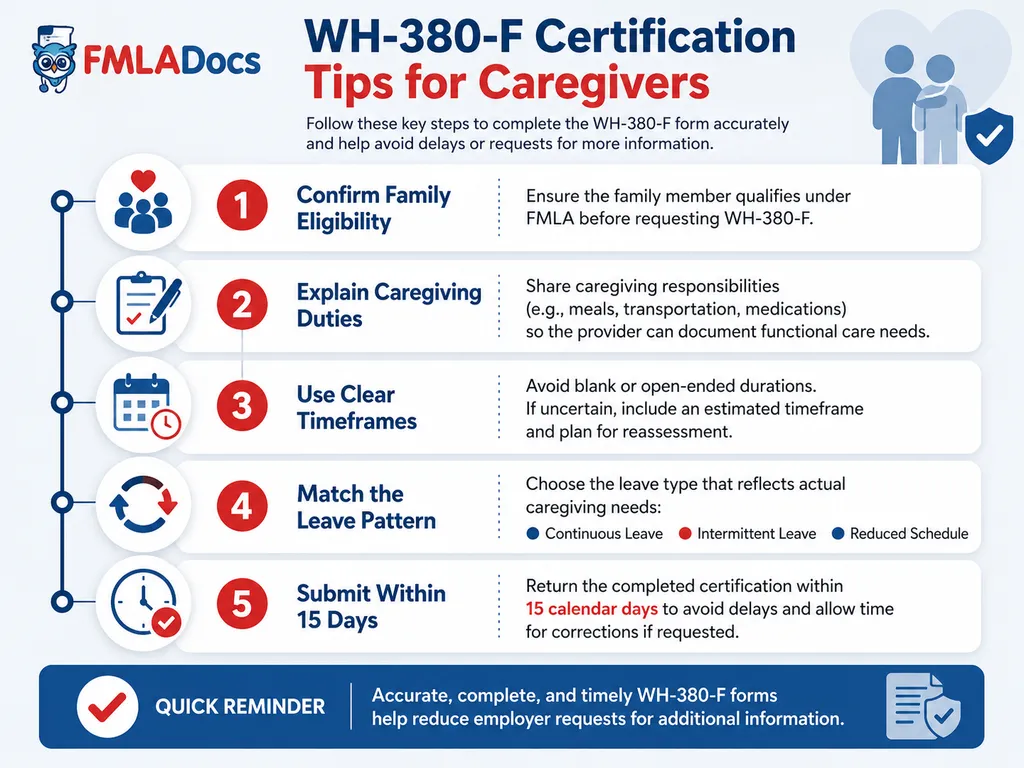
A few practices consistently reduce the chance that a WH-380-F certification comes back as insufficient:
-
Confirm the relationship qualifies before requesting the form. Submitting WH-380-F for a sibling or grandparent will not result in FMLA-protected leave.
-
Give the provider context, not just a form. A brief written summary of the caregiving tasks involved, meals, transportation, and medication management helps the provider document care in the functional terms the form requires.
-
Avoid open-ended timelines. If the condition’s duration is genuinely uncertain, the provider should say so with a plan for reassessment rather than leaving the field blank.
-
Match the leave pattern to reality. If care needs fluctuate, intermittent leave estimates should reflect an honest average, not a worst-case or best-case figure.
-
Return the form within the 15-calendar-day window. Employers are required to allow at least 15 calendar days to submit a completed certification, but earlier submission gives room to address any request for more information before the deadline.
Caregivers juggling a family member’s treatment schedule rarely have time to track down a provider appointment just to get a form signed. FMLADocs connects family member’s clinical information to a board-certified physician who can complete WH-380-F online, typically within 24 to 48 hours, without requiring a separate in-person visit.
Frequently Asked Questions
Which family members qualify for WH-380-F leave?
Only a spouse, parent, or son or daughter as defined under 29 CFR § 825.122. Siblings, grandparents, and parents-in-law are not covered under standard FMLA caregiver leave, even if the employee is their primary caregiver.
Does the family member need to see the same doctor I use?
No. The certification must come from the family member's own health care provider, or a provider treating the family member's condition. It does not need to be the employee's doctor, and any licensed health care provider recognized under FMLA regulations can complete it.
Can my employer deny my caregiver leave request?
An employer can deny leave if the certification is incomplete, if the relationship does not meet FMLA's definition of a covered family member, or if the employee does not otherwise meet FMLA eligibility criteria, such as the 1,250-hour and 12-month employment thresholds. An employer cannot deny a properly certified request that meets these standards.
How long does my family member's provider have to complete the form?
There is no fixed deadline for the provider, but the employee generally has at least 15 calendar days from the employer's request to return a completed certification.
Can I use WH-380-F for a parent-in-law?
No. Parents-in-law are explicitly excluded from the FMLA definition of "parent" under 29 CFR § 825.122.
What if my family member's condition is intermittent, like a chronic illness with flare-ups?
The provider should estimate the frequency and duration of expected episodes on the form. This supports an intermittent or reduced-schedule leave designation rather than one continuous block.
Is mental health caregiving covered under WH-380-F?
Yes. If a family member's mental health condition meets the DOL's serious health condition standard, and the employee's presence provides psychological comfort or practical care, it can be certified the same as a physical condition.
Can my employer request a second opinion on my family member's certification?
Yes. If an employer has reason to doubt the certification, it may require a second, and if necessary a third, medical opinion at the employer's expense, following the process described in 29 CFR § 825.307.
Meet the author
Nida Hammad
I am a professional writer with over five years of experience creating clear, engaging, and well-researched content. I specialize in healthcare topics, helping readers understand complex information in simple wording. Currently, I write for FMLA DOC, where I focus on producing accurate and trusted guides for people seeking support with FMLA and medical needs.
Get Your FMLA Certification Online in Minutes