

FMLA Form WH-382: Understanding Your Employer's Designation Notice
 by Nida Hammad
 Last updated:
FMLA Form WH-382 is the notice that tells you what your employer decided about your leave request. You do not fill this one out. Your employer completes it after reviewing your request and any medical certification, then sends it to you in writing.
A lot of employees receive an FMLA designation notice, glance at it, and file it away without understanding what it actually locks in. That is a mistake, because this single form sets the terms for your whole leave. It tells you whether your job is protected, whether you will be paid, and how much of your 12 weeks the leave will use.
This guide breaks down what the FMLA form WH-382 covers section by section, what to check for accuracy, and what your options are if your employer gets it wrong or skips sending one entirely.
Ready for the next step? Begin your FMLA documentation process online through FMLA Docs and receive guidance from a licensed provider.
FMLA Form WH-382: What the Designation Notice Must Include
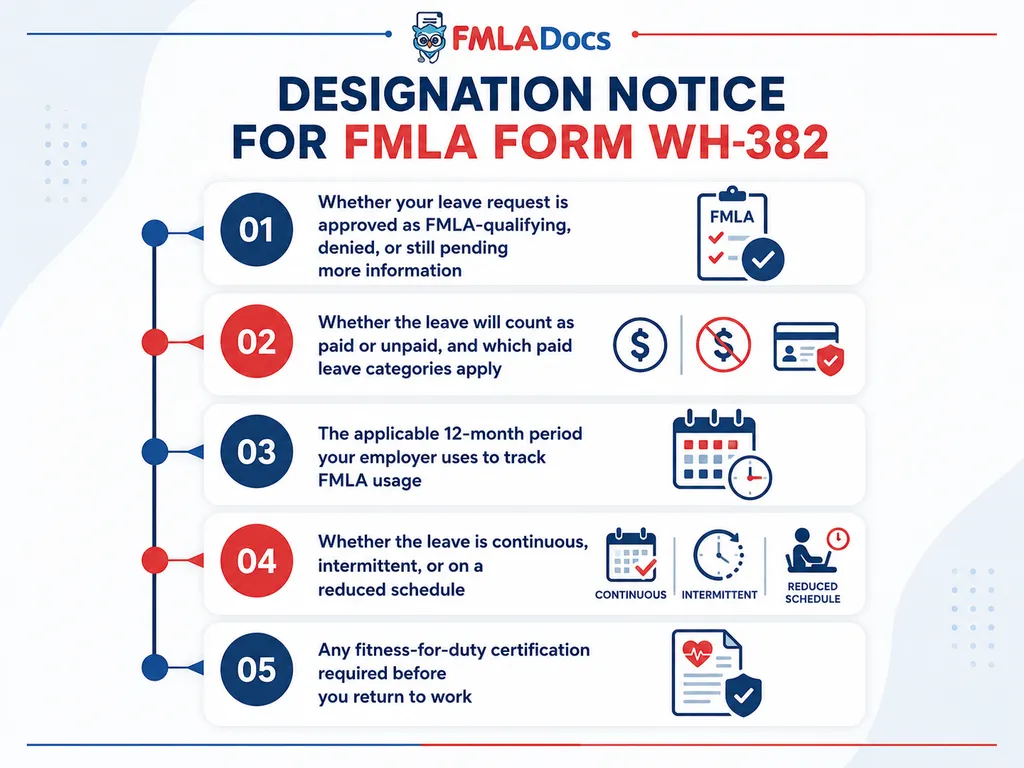
Before getting into the specific sections, it helps to know what a complete FMLA designation notice actually has to say. The official WH-382 published by the Department of Labor lays out the standard structure, and most employer-drafted notices follow the same basic sections even when they use their own letterhead instead of the government template.
-
Whether your leave is designated as FMLA-qualifying, denied, or pending: The notice states whether your leave qualifies for FMLA protection, has been denied, or requires additional information before a decision can be made.
-
Whether your leave is paid or unpaid: It explains whether your FMLA leave will be unpaid or run concurrently with paid leave such as sick leave, vacation, or PTO.
-
Which 12-month tracking method applies: The notice identifies the 12-month period your employer uses to calculate your available FMLA leave and remaining entitlement.
-
How your leave is designated: It specifies whether your leave is approved as continuous, intermittent, or a reduced work schedule, which determines how your leave will be counted.
-
Whether a fitness-for-duty certification is required: If you must provide medical clearance before returning to work, the notice will explain that requirement.
Employers do not have to use the official FMLA Form WH-382 issued by the U.S. Department of Labor. Many organizations issue designation notices through their own HR systems or leave management software. However, regardless of the format, the notice must include all information required by the FMLA regulations. The legal obligation comes from federal law, not from using a specific government template.
FMLA Form WH-382: Designated vs. Non-FMLA Leave
The core purpose of the FMLA form WH-382 is to answer one question clearly: is this leave FMLA-protected, or is it not?
Once your employer has enough information about your request, they are required to notify you in writing whether it qualifies. This requirement comes from the employer notice requirements regulation, which sets the legal foundation for every designation notice issued in the country. Designated leave carries real weight. Your position, or an equivalent one, has to be waiting for you when you return, and your group health benefits continue on the same terms as if you were working.
The Power of FMLA-Designated Leave
Officially designated leave carries significant federal weight. Under the guidelines enforced by the Wage and Hour Division, your rights are legally protected:
-
Job Reinstatement: Your exact position, or an equivalent one with identical pay and benefits, must be waiting for you when you return.
-
Health Benefits Protection: Your group health benefits must continue on the same terms as if you were actively working.
What Happens with Non-FMLA Leave?
Non-FMLA leave works entirely differently. While your company’s internal HR policies might still permit the time off, it will not carry federal job protection.
If your employer issues an official Form WH-382 stating that your leave does not qualify:
-
None of that time counts against your annual 12-week FMLA bank.
-
You lose the federal reinstatement guarantee, leaving your job security up to state laws or company discretion.
| Feature | Designated FMLA Leave | Non-FMLA Leave |
|---|---|---|
| FMLA protection | Yes | No |
| Counts toward 12 weeks | Yes | No |
| Job protection | Guaranteed under FMLA | Depends on employer policy |
| Health benefits | Continue under FMLA | Employer policy applies |
| WH-382 result | Leave is designated as FMLA | Leave is not FMLA-qualifying |
Warning on Incomplete Notices: There is a third possibility worth watching for. Sometimes the notice states your employer needs more information before making a final call, usually due to an incomplete medical certification. When this occurs, the notice must specify exactly what details are missing and provide a deadline of at least 7 calendar days to fix it. Vague language here is a major red flag; a properly issued designation notice must use clear, direct wording that leaves no room for guesswork.
FMLA Form WH-382: Paid vs. Unpaid Leave Designation
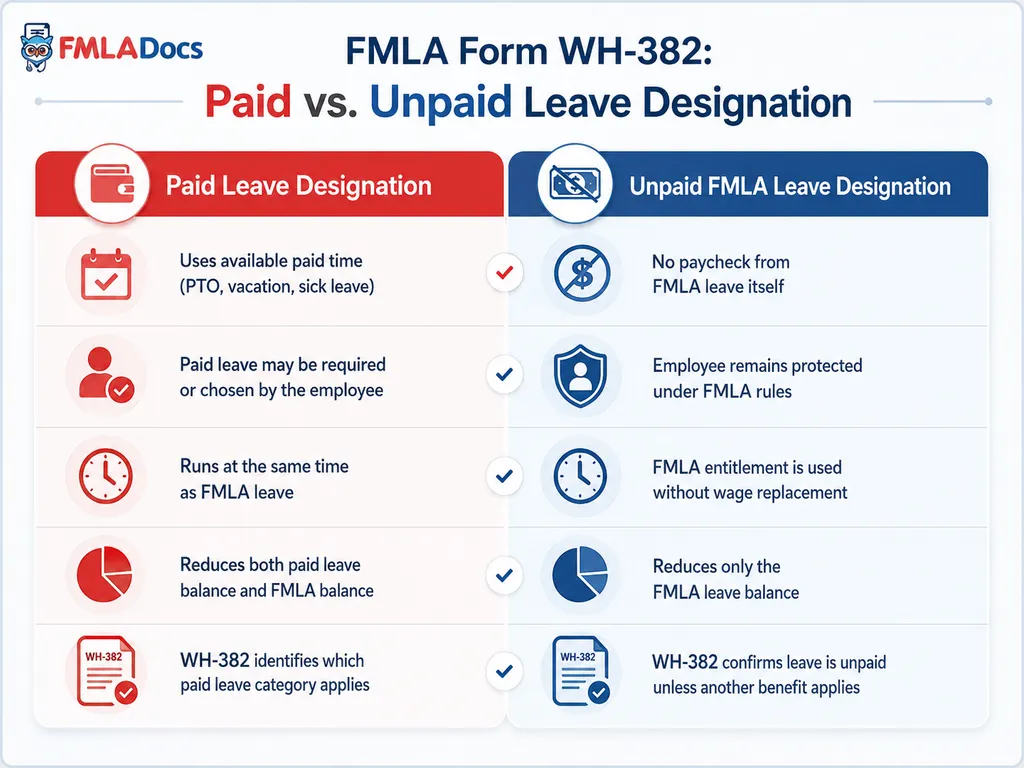
The Family and Medical Leave Act guarantees unpaid, job-protected time off. While the federal law itself does not require your employer to pay you during your absence, your official Form WH-382 must state exactly how your specific leave will be handled financially. This is crucial, as most workers have accrued paid time off sitting in the background.
The Rules of Paid Leave Substitution
Under federal guidelines, your employer can legally require you to substitute accrued paid leave like vacation, personal days, or sick time for what would otherwise be unpaid FMLA leave. You also have the right to choose to do this on your own.
Regardless of who initiates it, the substitution of paid leave rule establishes two critical constraints:
-
Concurrent Tracking: This paid time runs concurrently with (at the same time as) your FMLA leave, rather than stacking on top of it to extend your total time away from work.
-
Explicit Tracking: Your designation notice must explicitly specify whether substitution applies to your case and detail exactly which paid categories are being utilized.
State-Level Paid Leave vs. Federal Framework
Several states run independent paid family and medical leave programs that offer wage replacement alongside the federal framework. It is important to remember that your FMLA Form WH-382 only covers the federal designation piece. A state program’s wage benefit typically requires a completely separate application.
If certification delays are the reason your paperwork is stuck, that part is often the fastest to fix. Start your FMLA certification with FMLADocs to connect with a licensed physician who can complete the required DOL certification form online, often within 24 to 48 hours.
FMLA Form WH-382: Intermittent Leave Designation
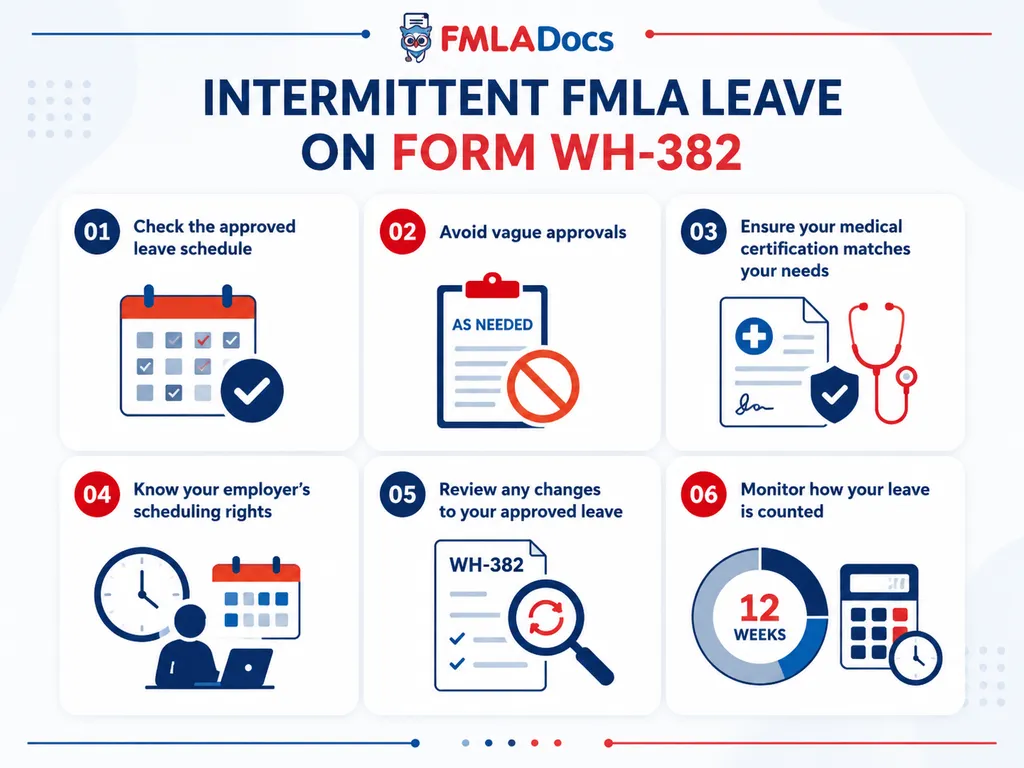
Not every leave request needs one continuous block of time off. Federal FMLA leave can be taken intermittently, in separate blocks, or on a reduced schedule when medically necessary, and your FMLA form WH-382 needs to reflect this if it applies to you.
When intermittent leave is approved, the notice should specify the frequency and duration your employer has authorized. That might read as “up to two absences per month, lasting one to three days each” or “reduced schedule of six hours per day, three days a week.” Broad language like “as needed” does not give either side a way to track hours accurately, and it tends to create disputes down the line. The intermittent leave regulation defines this leave type and explains when it can be used for your own condition or for caring for a covered family member.
Intermittent designation depends heavily on what your medical certification says about your treatment schedule or your condition’s flare-up pattern. If your certification only describes one continuous block of leave, but your real situation involves occasional days off for follow-up appointments or flare-ups, ask your provider to update the certification so your designation notice actually matches how you need to use the leave.
Scheduling intermittent leave around a business’s operational needs adds another layer. The scheduling rules for reduced leave allow employers some flexibility when leave is foreseeable, such as scheduled treatments, but they cannot use that flexibility to deny leave that is medically necessary. If your employer’s WH-382 tries to shrink your approved schedule without new medical information, that is worth questioning. Tracking these smaller increments, sometimes as little as an hour at a time, is one of the most common sources of confusion between employees and HR departments.
FMLA Form WH-382: How Leave Counts Against Your 12 Weeks
Once your employer designates your absence as FMLA-approved, the time begins counting against your protected entitlement. Under federal law, eligible employees are granted up to 12 workweeks of leave in a 12-month period for qualifying family and medical reasons. Your official Form WH-382 must explicitly outline how much leave will be deducted from this bank and detail which tracking method your company utilizes.
To comply with the U.S. Department of Labor (DOL) employer notice requirements, your designation notice must clearly state:
-
The 12-Month Tracking Method: Employers can choose from four distinct tracking methods (such as a calendar year or a rolling 12-month period measured backward) to calculate your FMLA year.
-
The Leave Schedule Structure: The form must indicate whether your leave is continuous (one solid block of time), intermittent (taken in separate blocks for a single qualifying reason), or a reduced schedule (reducing your daily or weekly hours).
-
The Counting Metric: It must specify how your time away will be tracked, whether in full weeks, partial weeks, or incremental hours.
-
Your Remaining FMLA Balance: When applicable, the notice should provide a clear readout of your available job-protected hours or weeks.
FMLA Form WH-382: Correcting Errors on Your Designation Notice
Errors on a WH-382 happen more often than most employees expect. Wrong dates, the wrong leave type checked, an incorrect paid-leave box, or a designation that simply does not match what your certification supports.
Step 1: Raise the Mistake in Writing Immediately
The federal regulation on designating FMLA leave states that disputes over whether an absence qualifies should be resolved through discussion between you and your employer. Do not settle for a quick verbal promise over the phone. Email your HR department to ensure the conversation is fully documented.
Step 2: Request an Updated, Written Designation Notice
If you spot a mistake, raise it with HR in writing as soon as you notice it. The regulation on designating FMLA leave states that disputes over whether leave qualifies should be resolved through discussion between you and your employer, and that conversation needs to be documented. Do not settle for a verbal fix over the phone. Ask for a corrected, written designation notice so there is a clear paper trail.
Step 3: Check for Proper Retroactive Adjustments
Retroactive designation is allowed under this same regulation. If your employer failed to designate your leave properly the first time around, they can go back and correct it later, as long as the original delay did not cause you harm. Both of you can also mutually agree to retroactively count earlier leave as FMLA-protected, which covers most everyday paperwork delays that were not anyone’s fault.
Step 4: Address Employer Interference If the Error Is Not Fixed
If your employer refuses to correct a clear error or if a delayed designation already cost you pay, benefits, or job protection you were entitled to, that pattern can amount to interference with your FMLA rights.
Frequently Asked Questions
What if my employer doesn't send a WH-382?
Your employer is not required to use the exact government form, but they must give you written notice once they have enough information to decide. If nothing arrives, ask HR directly and put your own request in writing. A missing designation notice does not cancel your underlying FMLA protection, though it may be a compliance issue on your employer's end.
Can a WH-382 designation be retroactive?
Yes. Federal regulation allows an employer to retroactively designate leave as FMLA leave if the original delay did not cause you harm. You and your employer can also agree to retroactive designation by mutual consent, which covers most routine paperwork delays without any dispute at all.
How long does my employer have to send the designation notice?
Generally five business days from the point your employer has enough information to make a decision, barring unusual circumstances. This timeline applies to your FMLA designation notice specifically, separate from the earlier eligibility notice your employer sends when you first request leave.
Does the FMLA form WH-382 mean my leave is automatically approved?
No single form guarantees approval on its own. The notice simply reflects your employer's decision after reviewing your request and supporting certification. If the certification does not describe a qualifying serious health condition, your employer can designate the leave as non-qualifying instead, even after issuing the form.
Can my employer change my designation after issuing the WH-382?
Yes, if new information comes in, such as an updated medical certification or a change in how you are using your leave. Any change should be communicated to you in writing within five business days of your next leave request after that change occurs.
Does the WH-382 tell me if my leave will be paid?
It should state whether paid leave substitution applies to your situation and which categories of paid time off run alongside your unpaid FMLA leave. FMLA itself does not require pay, so this part of the notice simply reflects your employer's own existing leave policies.
What happens if the WH-382 lists the wrong leave dates?
Contact HR in writing right away and request a corrected notice. Keep a copy of your original leave request and any medical certification on hand, so the dates on file can be cross-checked against what you actually submitted in the first place.
Do part-time or intermittent workers get a different WH-382?
The same form applies to everyone, but the details inside it differ. For intermittent or reduced-schedule leave, the notice should spell out the specific frequency and duration authorized, rather than listing a single continuous block of dates like a standard leave request.
Meet the author
Nida Hammad
I am a professional writer with over five years of experience creating clear, engaging, and well-researched content. I specialize in healthcare topics, helping readers understand complex information in simple wording. Currently, I write for FMLA DOC, where I focus on producing accurate and trusted guides for people seeking support with FMLA and medical needs.
Get Your FMLA Certification Online in Minutes