

FMLA Form WH-384: Job Protection Guide
 by Nida Hammad
 Last updated:
When a family member is deployed, the paperwork that follows is not just theirs. It is yours too. Power of attorney. School arrangements. Financial accounts. Care for aging parents. Childcare restructured around a missing spouse. None of these things appear on a military checklist, and all of them may mean you need time away from work. FMLA Form WH-384 is the certification that makes that time job-protected.
This guide covers every section of WH-384, all eight qualifying exigency categories and exactly what to document for each, how this form differs from WH-385 and WH-385-V, and the one eligibility rule that is different for qualifying exigency leave versus every other type of FMLA. Download the current form directly from the DOL FMLA Forms Library before you start.
What Is FMLA Form WH-384?
Form WH-384 is the Department of Labor’s Certification of Qualifying Exigency for Military Family Leave. Its current revision is June 2020, governed by 29 CFR § 825.309. It is used when an employee’s spouse, son or daughter, or parent is on covered active duty or has been notified of an impending call or order to covered active duty in the Armed Forces.
The form is fundamentally different from every other FMLA certification form in the series. WH-380-E, WH-380-F, WH-385, and WH-385-V all involve a healthcare provider certifying a medical condition. WH-384 involves no medical provider at all. The employee certifies the qualifying exigency themselves, supported by whatever documentation is relevant to the specific type of leave being taken.
WH-384 is entirely employee-completed. No physician. No healthcare provider signature. No clinical documentation. The certification is based on the military member’s deployment status and the specific deployment-related need the employee is taking leave to address.
The WH-384 Form Series: Where It Fits
| Form | Leave Type | Who Certifies | Medical Provider Required |
|---|---|---|---|
| WH-380-E | Employee’s own serious health condition | Employee + healthcare provider | Yes |
| WH-380-F | Family member’s serious health condition | Employee + family member’s provider | Yes |
| WH-384 | Qualifying exigency military deployment of covered family member | Employee only (third-party contact info where applicable) | No |
| WH-385 | Military caregiver leave — current servicemember serious injury or illness | Employee + DOD/VA/TRICARE/civilian provider | Yes |
| WH-385-V | Military caregiver leave — covered veteran serious injury or illness | Employee + authorized provider | Yes |
Who Qualifies: Covered Active Duty and Covered Family Members
Who Is a Covered Military Member?
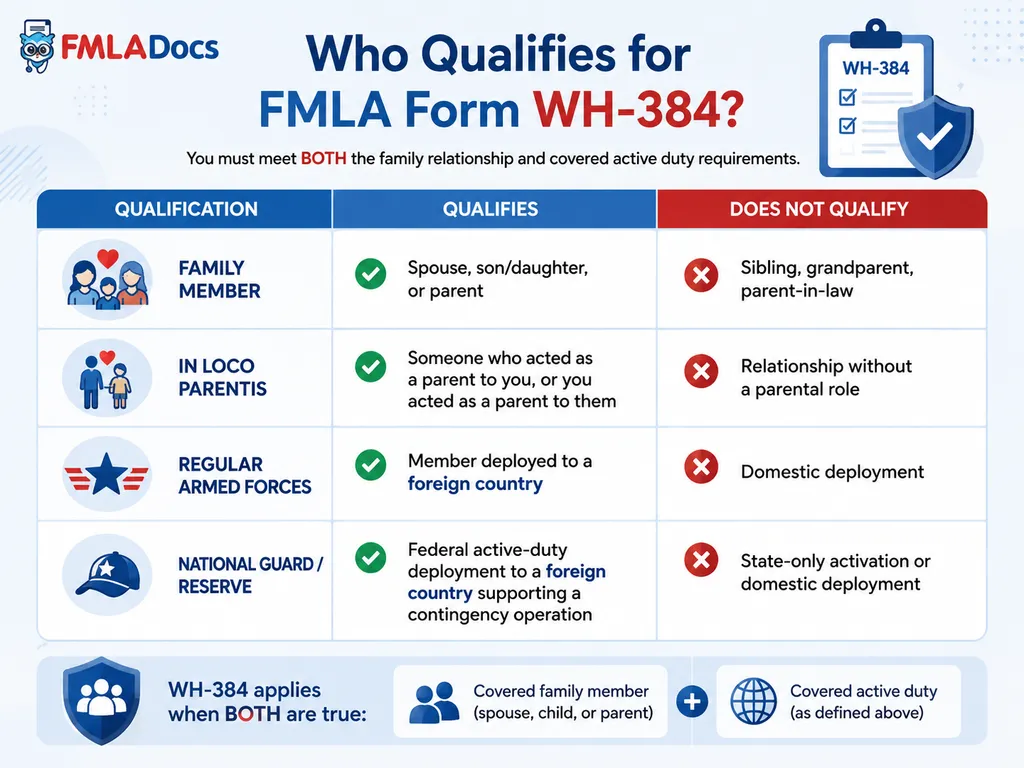
The military member whose deployment triggers WH-384 leave must be the employee’s spouse, son or daughter, or parent. Under 29 CFR § 825.122, these terms include in loco parentis relationships: someone who stood in a parental role to the employee, or to whom the employee stood in a parental role, even without a legal or biological connection. Siblings, grandparents, and parents-in-law do not qualify for WH-384 exigency leave.
What Is Covered Active Duty?
Covered active duty has two definitions depending on the military branch involved:
| Branch | What Counts as Covered Active Duty |
|---|---|
| Regular Armed Forces (Army, Navy, Air Force, Marine Corps, Coast Guard, Space Force) | Deployment to a foreign country |
| National Guard or Reserves | Deployment to a foreign country under a Federal call or order to active duty in support of a contingency operation |
The covered active duty definition matters. For members of the Regular Armed Forces, any deployment to a foreign country triggers WH-384 eligibility. For National Guard and Reserve members, the deployment must be under a Federal call in support of a contingency operation — not all state activations qualify. If you are unsure whether your family member’s orders trigger federal qualifying exigency leave, confirm with your HR team or the DOL Wage and Hour Division.
The Eligibility Rule That Is Different for WH-384
Standard FMLA medical leave under WH-380-E or WH-380-F requires both 12 months of employment AND at least 1,250 hours worked in the prior 12-month period. Qualifying exigency leave under WH-384 requires only 12 months of employment. The 1,250-hour threshold does not apply. This means employees who have recently returned from leave, changed positions, or otherwise have lower hours may still qualify for exigency leave when they would not qualify for medical FMLA.
The Eight Qualifying Exigency Categories
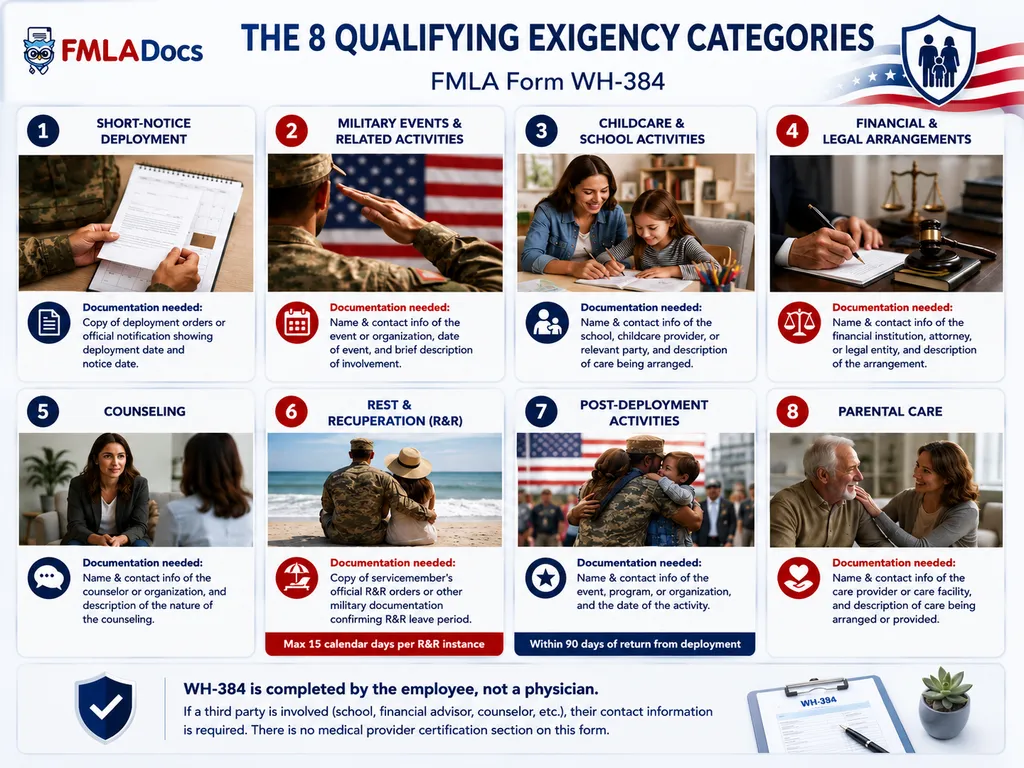
Under 29 CFR § 825.126, eight categories of qualifying exigency are recognized. Each has different documentation requirements on WH-384. WH-384 Part C asks the employee to check the applicable category and describe the specific need.
1. Short-Notice Deployment
Leave to address issues arising when the military member receives deployment orders with seven or fewer calendar days’ notice before deployment. This is limited to 7 calendar days beginning on the date of the deployment notification.
Documentation needed: A copy of the deployment orders or official notification showing the deployment date and notice date.
2. Military Events and Related Activities
Leave to attend official military ceremonies, programs, or events related to the military member’s active duty assignment. Also covers programs and informational briefings sponsored by the military, military service organizations, or the American Red Cross.
Documentation needed: The name and contact information of the event or organization, the date of the event, and a brief description of the employee’s involvement.
3. Childcare and School Activities
Leave to arrange childcare or attend school activities for the military member’s child when the need arises from the deployment. This includes enrolling a child in a new school, arranging new daycare, or attending school meetings that became necessary because of the deployment. This category covers leave for the employee’s own child only when that child is the military member’s child.
Documentation needed: The name and contact information of the school, childcare provider, or relevant party, and a description of the care being arranged.
4. Financial and Legal Arrangements
Leave to make financial or legal arrangements to address the military member’s absence. Examples include executing powers of attorney, preparing or reviewing wills or trusts, updating beneficiaries, transferring financial accounts, or managing real property on behalf of the deployed servicemember.
Documentation needed: The name and contact information of the financial institution, attorney, or legal entity, and a description of the specific arrangement being handled.
5. Counseling
Leave to attend counseling provided by a professional counselor who is not a healthcare provider, when the need for counseling arises from the deployment. This covers counseling for the employee, for the military member, or for the military member’s child. It does not cover healthcare appointments — those fall under standard FMLA medical leave.
Documentation needed: The name and contact information of the counselor or counseling organization, and a description of the nature of the counseling.
6. Rest and Recuperation (R&R) Leave
Leave to spend time with the military member during a short-term, temporary Rest and Recuperation leave from deployment. This is limited to a maximum of 15 calendar days for each R&R instance, regardless of the total duration of the military member’s R&R leave.
R&R leave has a hard cap and a mandatory documentation requirement. You may take up to 15 calendar days per R&R instance, not 15 days per deployment or per year. A copy of the military member’s official R&R orders or other military documentation confirming the R&R leave period must accompany WH-384 for this category. The employer cannot process this category without that documentation.
7. Post-Deployment Activities
Leave to attend military events and activities related to the transition period immediately after the military member returns from deployment. This includes arrival ceremonies, reintegration briefings, and similar programs that occur within 90 calendar days after the termination of the military member’s covered active duty status.
Documentation needed: The name and contact information of the event, program, or organization, and the date of the activity.
8. Parental Care
Leave to care for or assist with care arrangements for the military member’s parent who is incapable of self-care when the need for care arises from the deployment. This covers arranging alternative care, admitting or transferring the parent to a new care facility, attending to urgent care needs, or providing care when alternative care arrangements are disrupted by the deployment.
Documentation needed: The name and contact information of the care provider or care facility, and a description of the care being arranged or provided.
Section-by-Section Walkthrough of WH-384
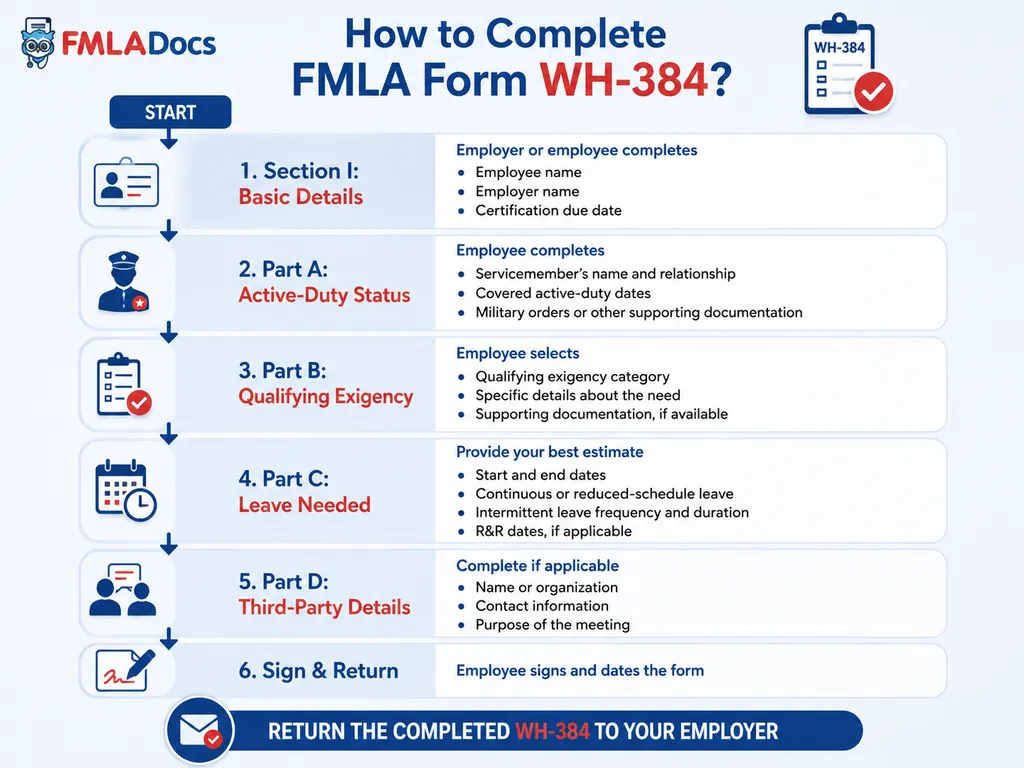
Section I: Employer or Employee (Administrative)
Either the employer or the employee may complete Section I. It covers basic administrative information: the employee’s name and the employer’s contact information. The employer also uses this section to specify the leave dates or period being requested. This section is typically completed before the form is given to the employee for Part A and Part B.
Part A: Covered Active Duty Status (Employee)
The employee completes Part A. This section documents the military member’s deployment status, whether they are currently on covered active duty or have been notified of an impending call to covered active duty. It requires the military member’s name, branch of service, rank, and unit assignment, and whether they have already deployed or are awaiting orders.
The employee also certifies whether they have previously provided the employer with written documentation of the military member’s covered active duty status. If documentation has already been provided for a prior exigency, it does not need to be resubmitted for a new leave request of the same type unless the employer has reason to question the ongoing validity of the status.
Part B: Employee Information (Employee)
The employee completes Part B. This is where the specific qualifying exigency is identified. The employee checks the applicable category from the eight listed above, describes the specific need arising from the deployment, and provides the dates or estimated duration of leave, whether it is a single continuous period, intermittent, or reduced schedule.
For third-party meetings, financial arrangements, counseling, and school activities, the employee must provide the name and contact information of the third party. For R&R leave, the military orders must accompany the form. For all categories, a description of the specific purpose is required, not just the category name.
Be specific in Part B. “Financial arrangements” is not sufficient. “Meeting with attorney at [firm name] on [date] to execute power of attorney for [servicemember’s name]” is. The more precisely the specific need is described, the less likely the employer will return the form for clarification and the stronger the leave designation.
FMLA Form WH-384: When Can Leave Begin?
One of the most important and least understood features of qualifying exigency leave is when it can begin. Under 29 CFR § 825.126, exigency leave may begin the moment the employee becomes aware of an impending call or order to covered active duty before the military member actually deploys. You do not have to wait for deployment to start.
This is particularly relevant for short-notice deployment leave, which begins on the date of notification. It is also relevant for financial and legal arrangements, which often need to happen in the window between notification and departure. The certification deadline — 15 calendar days from the employer’s request — still applies, but the leave itself may start immediately.
WH-384 vs. WH-385: How They Are Different?
For a complete walkthrough of all FMLA paperwork requirements and deadlines in one place, see the FMLA Paperwork Hub.
| Feature | WH-384 (Qualifying Exigency) | WH-385 (Military Caregiver) |
|---|---|---|
| Purpose | Address deployment-related needs — logistics, care, legal, financial — while servicemember is deployed | Provide direct care for a servicemember with a serious injury or illness |
| Medical provider required | No, employee certifies the exigency | Yes, DOD, VA, TRICARE, or civilian licensed provider |
| Leave entitlement | Up to 12 workweeks per year | Up to 26 workweeks per single 12-month period |
| Hours requirement | No, only 12 months of employment required | Yes, 1,250 hours in the prior 12 months required |
| What triggers it | Covered active duty or impending call to covered active duty | Serious injury or illness incurred in line of duty |
| Recertification | Employer may request recertification if circumstances change | Not permitted |
| R&R limit | 15 calendar days per R&R instance | Not applicable |
Common Mistakes That Can Delay WH-384 Approval
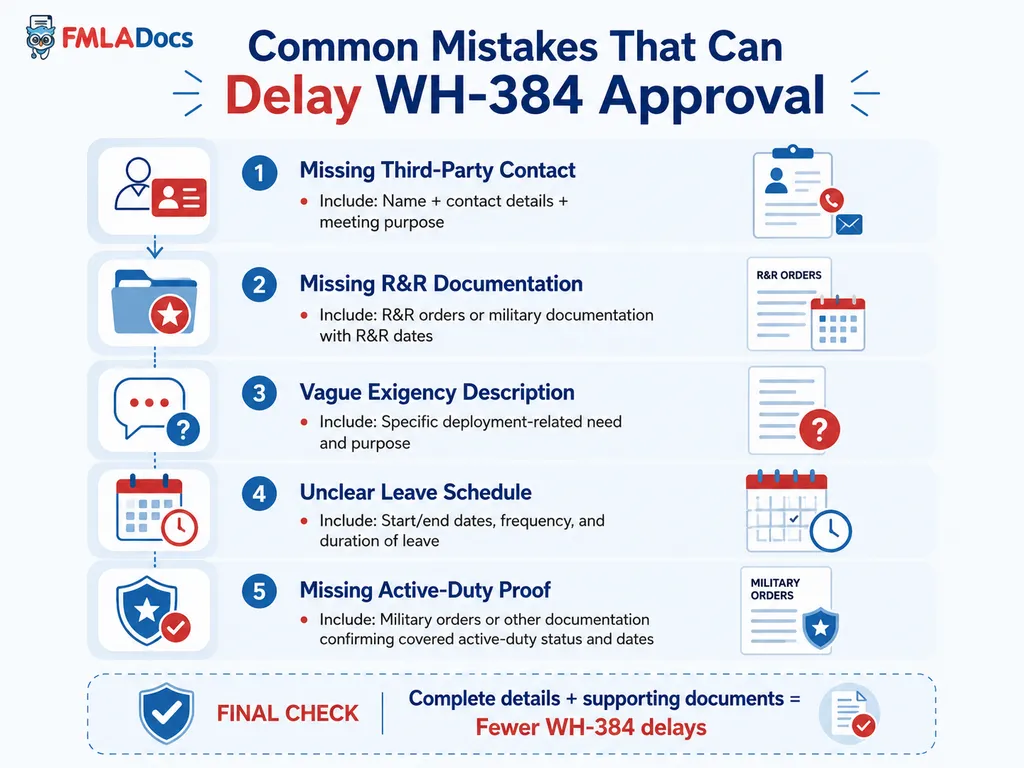
No Third-Party Contact Information
If your qualifying exigency involves a meeting with a school, childcare provider, counselor, financial advisor, attorney, or another third party, include their name and contact information on WH-384. Your employer may use this information to verify the meeting and its purpose.
Missing R&R Documentation
If you are requesting leave to spend time with a servicemember during Rest and Recuperation (R&R), include the servicemember’s R&R orders or other military documentation showing the R&R dates.
Vague Description of the Qualifying Exigency
Simply selecting a qualifying exigency category is not enough. Clearly describe the specific deployment-related need, what you need to handle, and any relevant details that support your request under federal.
Unclear Leave Dates or Schedule
For continuous leave, provide the expected start and end dates. For intermittent or reduced-schedule leave, provide your best estimate of how often leave will be needed and how long each absence may last.
Missing Active-Duty Documentation
When requesting qualifying exigency leave, your employer may ask for the servicemember’s active-duty orders or other military documentation confirming covered active-duty status and dates. This generally only needs to be provided once for that deployment.
Deployment is already complicated. Your FMLA paperwork shouldn’t make it harder. FMLADocs helps you identify the right FMLA form and complete your certification correctly, typically within 24 to 48 hours. Start My Certification
Frequently Asked Questions
What Is FMLA Form WH-384 Used For?
FMLA Form WH-384 is used to certify a request for qualifying exigency leave when an employee's spouse, child, or parent is on covered active duty or has been notified of an impending call or order to covered active duty.
What Qualifies for FMLA Exigency Leave?
Qualifying exigencies can include short-notice deployment, military events, childcare and school arrangements, financial or legal arrangements, counseling, R&R leave, certain post-deployment activities, and other qualifying events agreed upon by the employee and employer.
Do I Need Military Orders for FMLA Form WH-384?
Your employer may require documentation confirming the military member's covered active-duty status or impending call to active duty. This can include active-duty orders or other appropriate military documentation. For R&R leave, the employer may also request documentation confirming the R&R dates.
How Much Leave Can I Take With WH-384?
Eligible employees can generally take up to 12 workweeks of FMLA leave during the applicable 12-month period for qualifying exigencies. The leave may also be taken intermittently or on a reduced schedule when appropriate.
Can I Take WH-384 Leave Before Deployment?
Yes. Qualifying exigency leave can apply when a family member has been notified of an impending call or order to covered active duty, so you may not have to wait until the actual deployment begins. You should notify your employer as soon as practicable when you know you will need leave.
How Do I Complete FMLA Form WH-384?
Complete the required sections with information about the military member, the qualifying exigency, supporting documentation, and the amount or schedule of leave you expect to need. Depending on the type of exigency, you may also need to provide information about a third-party meeting or military documentation.
Is FMLA Leave Under WH-384 Paid or Unpaid?
FMLA leave is generally unpaid under federal law. However, you may be able to use accrued paid leave, such as vacation or other qualifying paid leave, at the same time as your FMLA leave, subject to applicable employer rules.
How Is WH-384 Different From WH-385?
WH-384 and WH-385 cover two different types of military-related FMLA leave. WH-384 is for qualifying exigencies related to a family member's covered active-duty deployment, such as childcare, military events, financial or legal arrangements, and R&R leave. WH-385 is for military caregiver leave when an eligible employee needs to care for a current servicemember with a serious injury or illness.
Meet the author
Nida Hammad
I am a professional writer with over five years of experience creating clear, engaging, and well-researched content. I specialize in healthcare topics, helping readers understand complex information in simple wording. Currently, I write for FMLA DOC, where I focus on producing accurate and trusted guides for people seeking support with FMLA and medical needs.
Get Your FMLA Certification Online in Minutes