
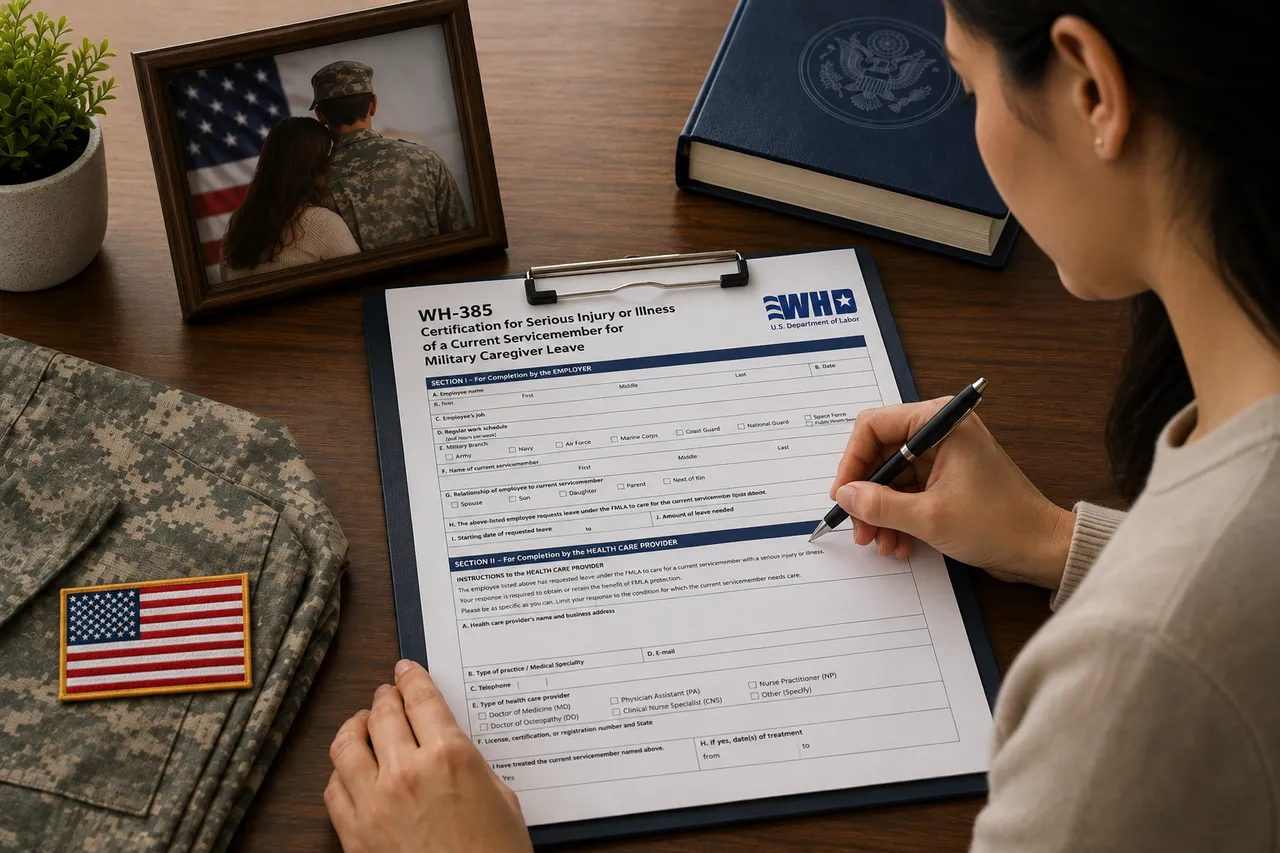
FMLA Form WH-385
 by Nida Hammad
 Last updated:
You are ready to care for a servicemember in your life, but the paperwork stands in the way. Military caregiver leave under FMLA is the largest leave entitlement in federal law, up to 26 workweeks, yet most employees have never heard of Form WH-385 or how it differs from standard FMLA certification.
This guide walks through every section of WH-385: what it covers, who can complete it, what the provider must document, how military caregiver leave differs from standard FMLA, and how to coordinate it with WH-385-V if your servicemember transitions from active duty to veteran status during your leave period.
What Is FMLA Form WH-385?
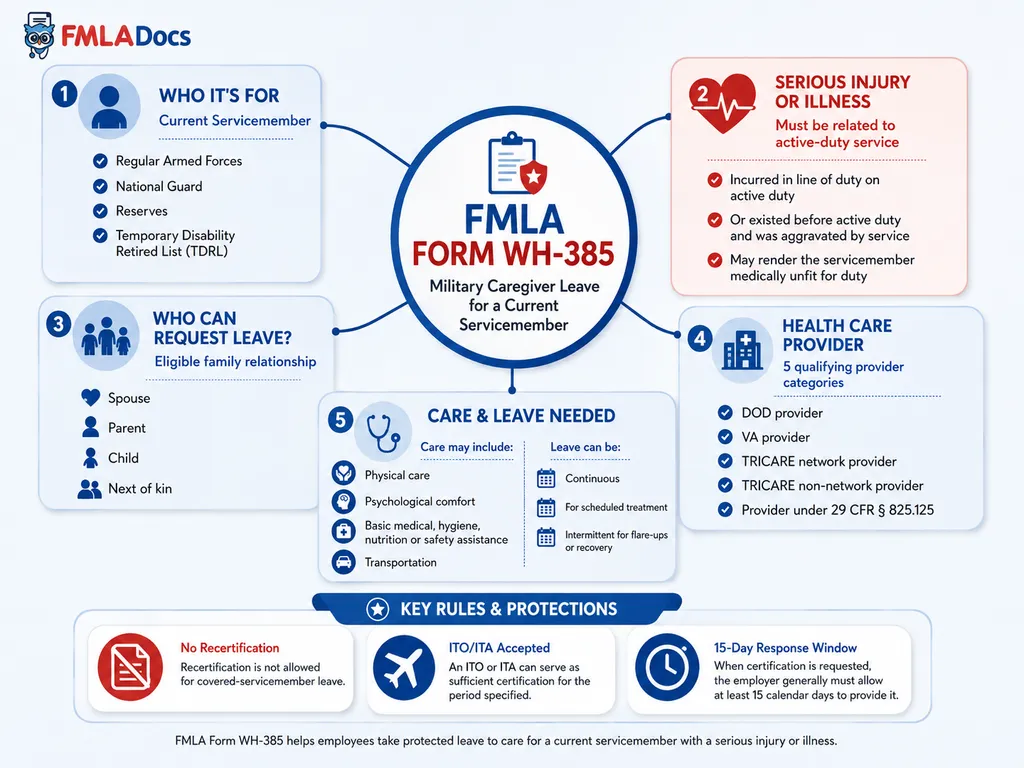
Form WH-385 is the U.S. Department of Labor’s Certification for Serious Injury or Illness of a Current Servicemember for Military Caregiver Leave. Its current revision is June 2020, and it applies under the military caregiver leave provisions of the FMLA codified at 29 CFR § 825.310.
The form applies strictly to current servicemembers of the Armed Forces, National Guard, or Reserves who are on active duty or on the Temporary Disability Retired List (TDRL). It does not apply to veterans who have already separated from service. For veterans, the correct form is WH-385-V.
The form is optional for employees but powerful for employers. While use of WH-385 is technically optional under FMLA, employers may require any certification that meets the regulatory standard. WH-385 is designed to capture every element that standard requires. Using it eliminates ambiguity and gives your employer no procedural basis to dispute the leave.
FMLA Form WH-385 vs. WH-385-V: Which Form Applies?
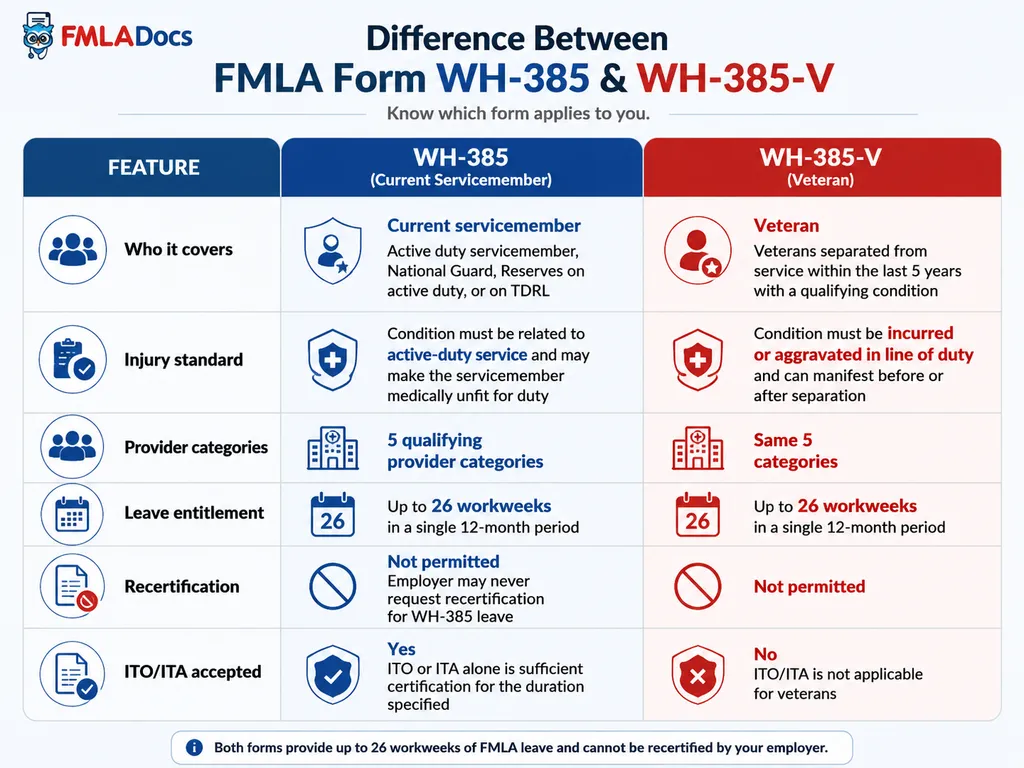
| Feature | WH-385 (Current Servicemember) | WH-385-V (Veteran) |
|---|---|---|
| Who it covers | Active duty servicemember, National Guard, Reserves on active duty, or on TDRL | Veterans separated from service within the last 5 years with a qualifying condition |
| Injury standard | Serious injury or illness incurred in line of duty on active duty that may render the servicemember medically unfit for duty | Serious injury or illness incurred or aggravated in line of duty, manifested before or after separation from service |
| Provider categories | 5 categories: DOD, VA, TRICARE network, TRICARE non-network, or 29 CFR § 825.125 provider | Same 5 categories |
| Leave entitlement | Up to 26 workweeks per single 12-month period | Up to 26 workweeks per single 12-month period |
| Recertification | Not permitted; employer may never request recertification for WH-385 leave | Not permitted |
| ITO/ITA accepted | Yes; ITO or ITA alone is sufficient certification for the duration specified | No; ITO/ITA is not applicable for veterans |
FMLA Form WH-385: The 26-Week Military Caregiver Entitlement
Military caregiver leave under WH-385 provides up to 26 workweeks of job-protected leave during a single 12-month period. This is the largest leave entitlement available under federal law, more than twice the 12 workweeks available for standard FMLA medical or family leave. Understanding how this entitlement works prevents leave from being miscounted or applied incorrectly.
| Feature | Standard FMLA (WH-380-E / WH-380-F) | Military Caregiver FMLA (WH-385) |
|---|---|---|
| Maximum entitlement | 12 workweeks per year | 26 workweeks per single 12-month period |
| 12-month period | Rolling, calendar, or fixed; employer chooses | Single 12-month period beginning the first day of leave, always fixed, not rolling |
| Intermittent leave | Yes, in blocks as small as one hour | Yes, same rules apply |
| Combined leave | Up to 12 weeks total for any reason | Combined with standard FMLA, total cannot exceed 26 weeks in the same 12-month period |
| Recertification | Permitted every 30 days in connection with an absence | Never permitted |
| Benefit maintenance | Employer maintains group health coverage | Same; employer maintains coverage for the full 26-week period |
The 12 months is fixed for military caregiver leave. Unlike standard FMLA, where the employer can choose a rolling or calendar year, the 12 months for WH-385 leave always begins on the first day of military caregiver leave and runs for 12 months from that date. If you combine WH-385 leave with standard FMLA leave in the same 12-month period, the total cannot exceed 26 workweeks. The standard 12-week entitlement does not stack on top of the 26 weeks.
Section-by-Section Walkthrough of WH-385
Section I: Employer or Employee
Section I may be completed by either the employer or the employee. It covers the employee’s name, address, and employer information, and identifies the servicemember’s name, military branch, rank, and current unit assignment. It also asks whether the servicemember is assigned to a military medical facility as an outpatient or to a medical hold or warrior transition unit, and the name of the facility or unit. If the servicemember is on the Temporary Disability Retired List, that must be indicated here as well.
The section also asks for a description of the care the employee will provide and an estimate of the leave needed. This is not a clinical question; it is a practical description of caregiving: transportation to appointments, assistance with daily activities, psychological support, coordinating care. The more specifically this is described, the stronger the basis for the leave request.
Section II: Healthcare Provider (The Determining Section)
-
A United States Department of Defense (DOD) health care provider
-
A United States Department of Veterans Affairs (VA) health care provider
-
A DOD TRICARE network authorized private health care provider
-
A DOD TRICARE non-network authorized private health care provider
-
Any health care provider as defined in 29 CFR § 825.125, the standard FMLA provider category
Category 5 is the most commonly used for employees whose servicemember is receiving care from civilian providers. It includes licensed physicians, nurse practitioners, physician assistants, and others. FMLADocs physicians fall within Category 5 and can complete Section II based on a review of the servicemember’s medical information.
What the Provider Must Document in Section II
-
Confirmation of covered servicemember status. The provider confirms the servicemember is a current member of the Armed Forces, National Guard, or Reserves and that the condition qualifies as a serious injury or illness under the FMLA military caregiver standard.
-
Nature of the serious injury or illness. The injury or illness must have been incurred in the line of duty on active duty, or must have existed before active duty and been aggravated by service in line of duty. The provider must describe the condition in sufficient clinical detail to support this standard, not just a diagnosis.
-
How the condition renders the servicemember medically unfit for duty or requires ongoing medical treatment, recuperation, therapy, rest, or supervision by a health care provider.
-
Whether the servicemember is or was assigned to a military medical unit such as a medical hold or warrior transition unit.
-
Estimated leave duration and whether intermittent leave is medically necessary. For intermittent leave, the provider must estimate the frequency and duration of leave episodes, for example, twice per month for one to three days per episode.
-
Provider credentials. Full name, title, license number, state of licensure, practice address, and signature with date. All are required. A missing or undated signature is insufficient.
Give the provider full context before Section II is completed. The provider needs to understand the servicemember’s specific condition, their current duty status, the nature of the injury, and what caregiving the employee will provide. A brief written summary including the servicemember’s branch, the nature of the injury, where they are receiving treatment, and what care tasks the employee will perform makes a significant difference in the quality and completeness of the documentation.
The ITO/ITA Shortcut: When You Can Skip FMLA Form WH-385 Entirely
Under 29 CFR § 825.310, if the military has issued an Invitational Travel Order (ITO) or an Invitational Travel Authorization (ITA) to your family member to join an injured or ill servicemember at their bedside, your employer must accept that document as sufficient certification for the entire duration specified in the order. WH-385 does not need to be completed.
This is a significant but frequently overlooked shortcut. ITOs and ITAs are issued by the military when a servicemember’s condition is serious enough to require family presence. If you have received one of these orders, provide a copy to your employer and request written confirmation that the military caregiver leave has been designated. Your employer may require confirmation of the covered family relationship, for example, a marriage certificate or birth certificate, but may not require WH-385 in addition to the ITO/ITA.
Keep a copy of every ITO or ITA document. These documents have a defined duration. When the duration expires, you may need to provide updated military orders or a completed WH-385 to extend the leave designation. The employer cannot request recertification for military caregiver leave, but the ITO/ITA itself sets the covered period.
Coordinating FMLA Form WH-385 With WH-385-V
Employees who take military caregiver leave may sometimes face a change in circumstances while their leave is still in progress. For example, you may begin FMLA leave using FMLA Form WH-385 while your family member is an active-duty servicemember. If that servicemember later separates from the military and becomes a veteran, you may need to determine whether your leave can continue under WH-385-V.
This transition is not automatic. Once the servicemember separates from active duty, their medical condition must meet the eligibility requirements that apply to a covered veteran under the FMLA. Generally, WH-385-V applies when the veteran separated from the military within the previous five years and has a qualifying serious injury or illness that meets one of the specific criteria established under the law.
A new medical certification may also be required. Your original WH-385 certification does not simply transfer to WH-385-V. The healthcare provider may need to complete the appropriate WH-385-V certification to establish that the veteran’s condition qualifies for military caregiver leave.
The amount of FMLA leave available after the transition also requires careful attention. A change from WH-385 to WH-385-V does not automatically create a new 26-week entitlement. Your eligibility and remaining leave depend on the specific circumstances and the applicable FMLA rules. Before assuming that your leave entitlement has restarted, confirm how the change in the servicemember’s status affects your leave.
If you are dealing with a change from active-duty status to veteran status, getting the correct certification matters. Get your FMLA form filled online to help make sure you are using the appropriate FMLA paperwork for your situation.
Common Mistakes That Can Delay FMLA Form WH-385 Approval
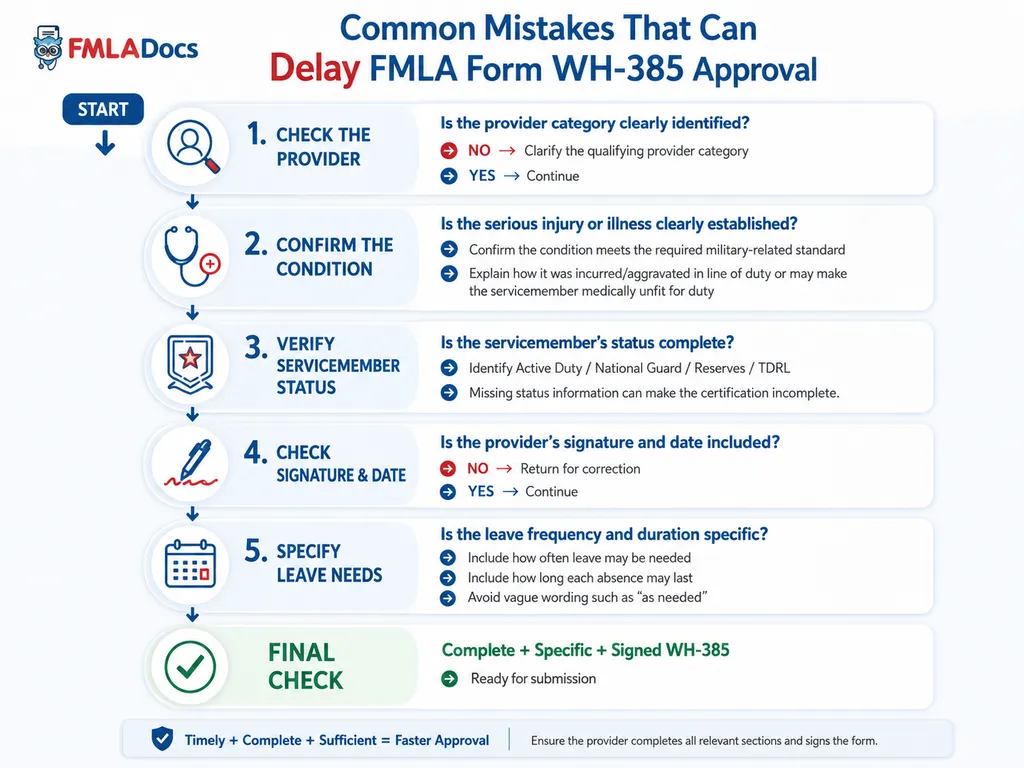
Provider Category Is Not Clearly Identified
The healthcare provider must meet an accepted provider category. If the form does not clearly identify the applicable category, the employer may question whether the provider is authorized to complete FMLA Form WH-385.
Serious Injury or Illness Is Not Clearly Established
A diagnosis alone may not be enough. The certification should explain how the servicemember’s condition was incurred in the line of duty or why it makes the servicemember medically unfit for duty.
Servicemember Status Is Missing
Section I should identify whether the servicemember is on active duty, in the National Guard or Reserves, or on the Temporary Disability Retired List (TDRL). Missing information can make the certification incomplete.
Provider Signature or Date Is Missing
The completed FMLA Form WH-385 must include the required provider signature and date. If either is missing, the employer may return the form for correction.
Leave Frequency or Duration Is Too Vague
For intermittent leave, the provider should estimate how often leave may be needed and how long each absence may last. Writing only “as needed” without a frequency or duration estimate may be insufficient.
Deployment is already complicated. Your FMLA paperwork shouldn’t make it harder. FMLADocs helps you identify the right FMLA form and complete your certification correctly, typically within 24 to 48 hours.
Frequently Asked Questions
What is the difference between WH-385 and WH-385-V?
WH-385 is used when you need military caregiver leave to care for a current servicemember with a serious injury or illness. WH-385-V is used when you are caring for a covered veteran who meets the FMLA requirements for military caregiver leave. The U.S. Department of Labor lists WH-385 for current servicemembers and WH-385-V for covered veterans.
How many weeks of leave does WH-385 provide?
Eligible employees can receive up to 26 workweeks of FMLA military caregiver leave during a single 12-month period. This is a combined FMLA limit, so if you use other qualifying FMLA leave during that same period, the total cannot exceed 26 workweeks. The military caregiver 12-month period starts on the first day you use military caregiver leave and runs for 12 months.
Is military caregiver leave paid?
No. FMLA military caregiver leave is unpaid under federal law, but it is job-protected for eligible employees. You may be able to use available paid leave, such as vacation or sick leave, at the same time as your FMLA leave when permitted or required under applicable rules. Some states also offer separate paid family leave programs that may provide wage replacement.
Can WH-385 be used more than once?
Yes, depending on the circumstances. The 26-week entitlement is generally applied per covered servicemember, per serious injury or illness, subject to the single 12-month-period limit. You may qualify for another 26-week entitlement in a later 12-month period if the same servicemember has a different qualifying serious injury or illness. Military caregiver leave can also apply to another covered servicemember, but you cannot exceed 26 workweeks during any single 12-month period.
Can my employer request recertification for WH-385?
Generally, no. FMLA regulations do not allow an employer to require recertification for military caregiver leave for a current servicemember. However, the employer may have rights to authenticate or clarify information when appropriate. This is different from some other types of FMLA medical leave, where periodic recertification may be allowed.
What is an ITO or ITA, and how does it affect WH-385?
An Invitational Travel Order (ITO) or Invitational Travel Authorization (ITA) may provide sufficient certification for military caregiver leave when it contains the information required under the FMLA rules. In that situation, you may not need a separate WH-385 certification for the same leave request.
Which providers can complete Section II of WH-385?
WH-385 can be completed by an authorized health care provider who meets the FMLA requirements. This can include certain Department of Defense, Department of Veterans Affairs, TRICARE-authorized, and other qualified health care providers. The certification must provide the information needed to establish the serious injury or illness and the employee's need for leave.
What happens if my servicemember becomes a veteran during my leave?
The rules can change when a current servicemember separates from active military service. A covered veteran must meet the FMLA definition of a covered veteran, including the applicable five-year separation requirement and serious injury or illness criteria. In some situations, you may qualify for military caregiver leave as a veteran caregiver as well. The 26-week entitlement does not automatically reset simply because the servicemember's status changes.
Does my family member have to be in the United States for WH-385 to apply?
No. The servicemember's physical location is not the main test for WH-385 eligibility. What matters is whether the servicemember meets the FMLA requirements for a covered current servicemember with a serious injury or illness and whether you are an eligible family member or next of kin who needs leave to provide care.
Meet the author
Nida Hammad
I am a professional writer with over five years of experience creating clear, engaging, and well-researched content. I specialize in healthcare topics, helping readers understand complex information in simple wording. Currently, I write for FMLA DOC, where I focus on producing accurate and trusted guides for people seeking support with FMLA and medical needs.
Get Your FMLA Certification Online in Minutes