
FMLA Form WH-385-V
 by Nida Hammad
 Last updated:
Caring for a veteran who returned home with a serious injury or illness is challenging enough without having to navigate complex workplace paperwork. If you need time away from work to provide essential care, FMLA Form WH-385-V is the document that helps you request job-protected leave under the Family and Medical Leave Act (FMLA) for an eligible veteran.
However, even small mistakes or missing information on the form can delay approval or lead to additional requests from your employer. Understanding who qualifies, what medical certification is required, and how to complete the paperwork correctly can make the process much smoother.
Need help completing your FMLA paperwork? Visit FMLADocs to access expert guidance, understand your leave options, and confidently navigate the certification process so you can focus on caring for the veteran who needs you most.
What Is FMLA Form WH-385-V?
FMLA Form WH-385-V is an optional certification form issued by the U.S. Department of Labor (DOL). It helps employers verify that a qualifying military veteran and their serious injury or illness meet the eligibility requirements for FMLA military caregiver leave.
Although employers are not required to use the official WH-385-V form, they may provide their own certification form instead. However, any alternative form can only request the information a health care provider must supply for a covered service member’s certification under the federal regulation. Because the DOL’s version already complies with federal requirements, many employers choose to use it.
It’s important to note that Form WH-385-V is only used when the covered family member is a veteran. If you are requesting military caregiver leave to care for a current service member, you will need FMLA Form WH-385 instead. Understanding this distinction before submitting your leave request can help prevent delays and ensure you complete the correct certification process.
| Quick Fact | Details |
|---|---|
| Who files Form WH-385-V? | The employee requesting FMLA military caregiver leave. |
| Who completes the form? | The veteran’s authorized health care provider completes the medical certification section. |
| How much leave is available? | Eligible employees may take up to 26 workweeks of military caregiver leave during a single 12-month period. |
| How long do you have to return the certification? | Employers must generally allow employees at least 15 calendar days to submit the completed certification after requesting it. |
Who Qualifies as a Covered Veteran for FMLA Form WH-385-V?
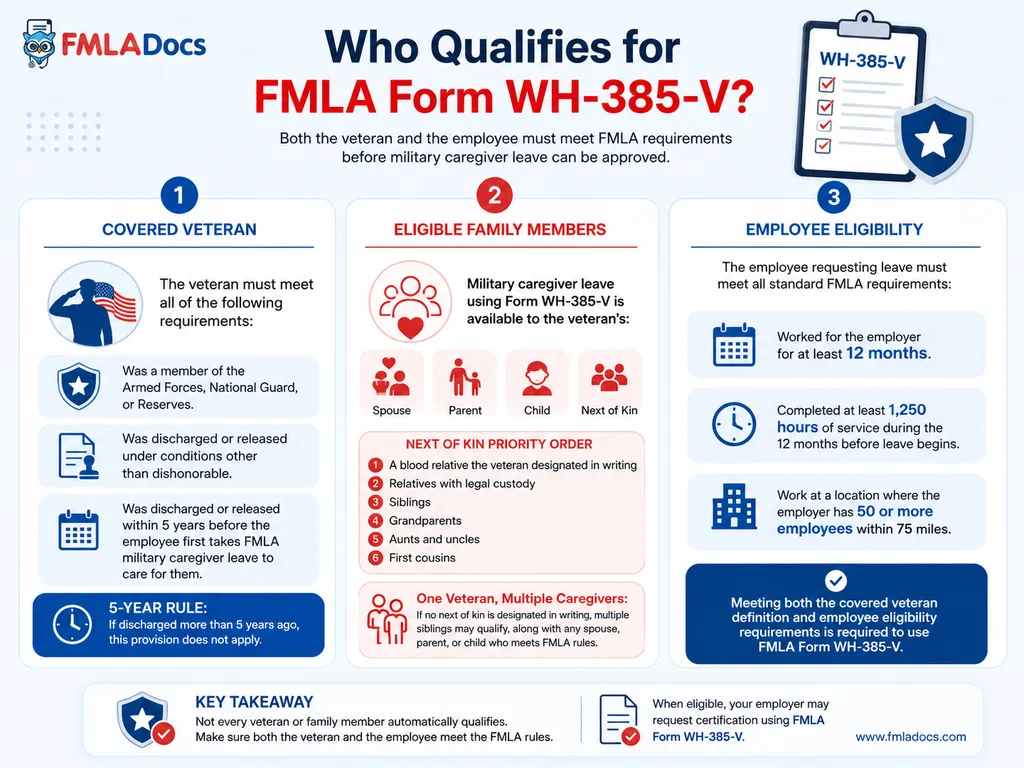
Not every veteran automatically qualifies a family member for military caregiver leave under the Family and Medical Leave Act (FMLA). To use FMLA Form WH-385-V, both the veteran receiving care and the employee requesting leave must meet the law’s specific eligibility requirements.
A covered veteran is a former member of the Armed Forces, National Guard, or Reserves who was discharged or released under conditions other than dishonorable within the five-year period before the employee first takes FMLA military caregiver leave to care for them. This five-year window is a key part of the eligibility criteria. If the veteran was discharged more than five years before the employee’s first use of military caregiver leave, they generally do not qualify as a covered veteran under FMLA Form WH-385-V, although other leave provisions under 29 CFR Part 825 may still apply depending on the situation.
The FMLA also limits who can take military caregiver leave for a covered veteran. Leave under FMLA Form WH-385-V is available only to the veteran’s spouse, parent, child, or next of kin. If you are applying as the veteran’s next of kin, the law follows a specific order of priority. It first recognizes a blood relative designated by the veteran in writing. If no designation exists, eligibility generally follows the order of relatives with legal custody, siblings, grandparents, aunts and uncles, and then first cousins.
In addition to meeting the covered veteran requirements, the employee requesting leave must also satisfy the FMLA’s general eligibility rules. This means the employee must have worked for a covered employer for at least 12 months, completed at least 1,250 hours of service during the 12 months before the leave begins, and work at a location where the employer has at least 50 employees within a 75-mile radius. Meeting both the employee eligibility requirements and the covered veteran definition is necessary before leave supported by FMLA Form WH-385-V can be approved.
In-the-Line-of-Duty Injury or Illness Under FMLA Form WH-385-V
-
Service-Related Condition Required: The injury or illness must be connected to the veteran’s military service. Not every medical condition qualifies for FMLA Form WH-385-V.
-
Must Meet One of Four Criteria: The condition must be a continuation of a service-related injury, involve a 50% or higher VA disability rating, substantially limit employment due to a service-connected disability, or qualify the veteran for the VA Family Caregiver Program.
-
Physical and Mental Health Conditions Qualify: Eligible conditions may include PTSD, traumatic brain injury (TBI), combat-related depression, and other service-connected physical or mental health conditions.
-
Healthcare Provider Must Certify: The medical provider completing FMLA Form WH-385-V must determine and certify which qualifying category applies.
-
Other FMLA Leave May Still Apply: If the condition does not meet the WH-385-V requirements, the employee may still qualify for leave under the FMLA’s serious health condition provisions using a different certification form.
FMLA Form WH-385-V vs. FMLA Form WH-385: Key Differences
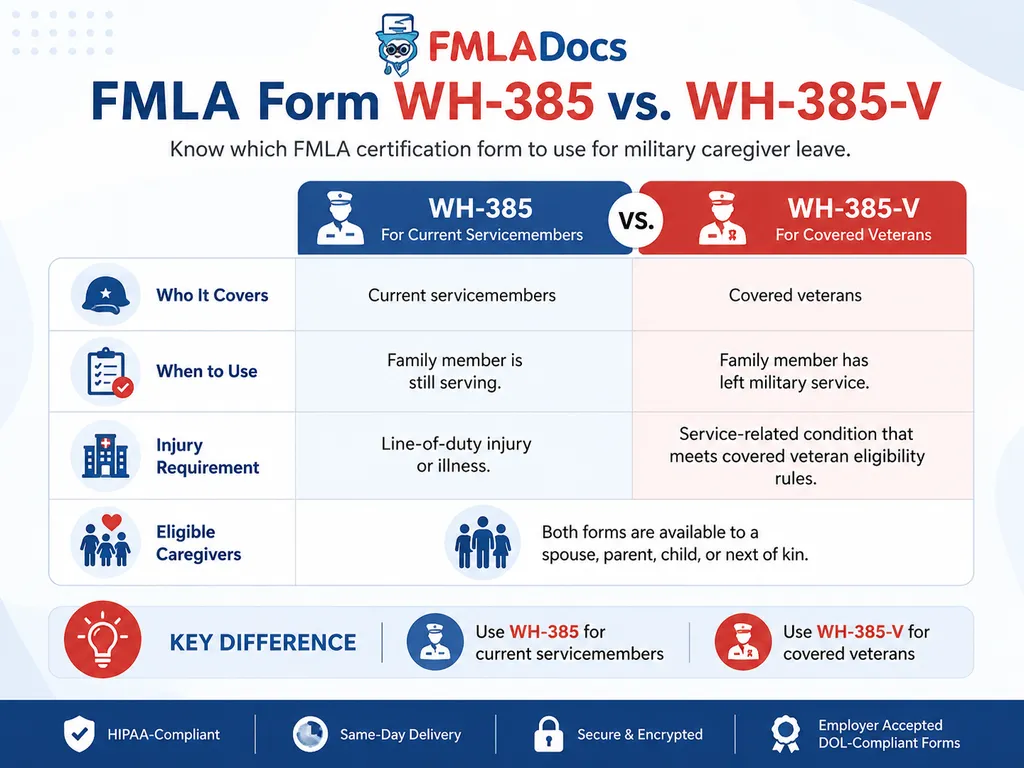
Although FMLA Form WH-385 and FMLA Form WH-385-V are both used for military caregiver leave, they apply to different situations. Understanding the difference can help prevent certification delays and ensure you submit the correct form.
FMLA Form WH-385 Is for Current Servicemembers
Use FMLA Form WH-385 when requesting leave to care for a current member of the Armed Forces, National Guard, or Reserves. This includes servicemembers on active duty, in the Guard or Reserves, or receiving medical treatment while still serving.
For a current servicemember, the serious injury or illness must have been incurred or aggravated in the line of duty and may render the servicemember medically unfit to perform military duties.
FMLA Form WH-385-V Is for Covered Veterans
Use FMLA Form WH-385-V when the family member has left military service and qualifies as a covered veteran under the FMLA. The veteran must meet the law’s eligibility requirements, including the covered veteran definition and qualifying injury or illness criteria.
For a covered veteran, the condition must also be service-related but must meet one of the FMLA’s additional qualifying criteria, such as a qualifying VA disability rating or eligibility for the VA Family Caregiver Program.
Military Caregiver Leave May Continue After Separation
If a servicemember transitions to veteran status while you are providing care, you may be eligible to take military caregiver leave twice for the same serious injury or illness—once while they are a current servicemember and again after they become a covered veteran. Each entitlement is available during its own 12-month leave period.
Re-certification Is Not Required
Once an employer accepts a properly completed FMLA Form WH-385 or FMLA Form WH-385-V, the FMLA does not require or permit recertification for that same military caregiver leave request. This helps reduce paperwork and administrative delays during an already challenging time.
What the Health Care Provider Must Attest on FMLA Form WH-385-V
-
Only authorized healthcare providers can complete the form. Eligible providers include Department of Defense (DoD) healthcare providers, VA healthcare providers, TRICARE-authorized providers, and other healthcare providers recognized under the FMLA regulations.
-
The provider must certify the veteran’s medical condition. This includes the date the injury or illness began, its expected duration, and the veteran’s current medical status.
-
The provider must confirm eligibility. They must identify which of the four qualifying in-the-line-of-duty injury or illness categories applies to the covered veteran.
-
The provider must describe the caregiving needs. The certification should explain the type of care required and estimate how much leave the employee will need to provide that care.
-
VA and DoD certifications receive additional protection. If the certification is completed by a VA or DoD healthcare provider, the employer cannot request a second or third medical opinion. Employers also cannot ask for medical information beyond what FMLA Form WH-385-V requires.
Documentation Veterans Should Gather Before Filing FMLA Form WH-385-V
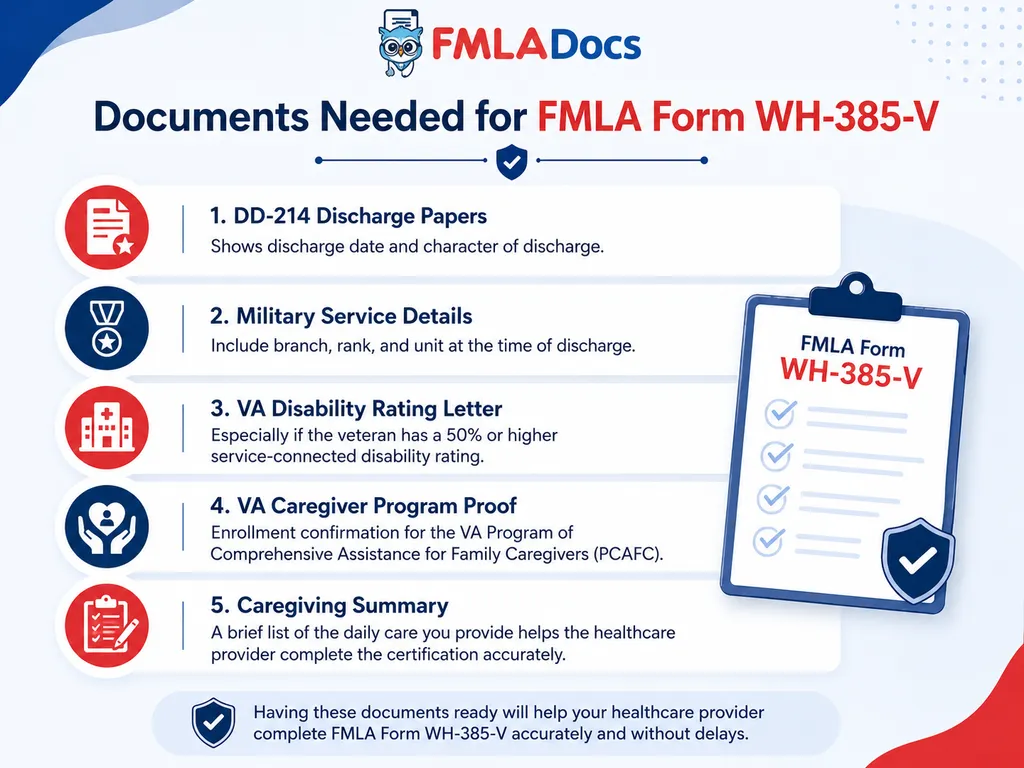
Walking into a provider appointment prepared saves weeks of back-and-forth. Before your veteran’s provider sits down with FMLA form WH-385-V, try to have these on hand.
-
Discharge paperwork (DD-214) showing the character of discharge and discharge date
-
Military branch, rank, and unit information at the time of discharge
-
Any VA disability rating letter, especially if it shows 50 percent or higher
-
Enrollment confirmation if the veteran is in the VA Program of Comprehensive Assistance for Family Caregivers
-
A short written summary of the daily care tasks you already handle
That last item matters more than people expect. Providers write stronger, more specific certifications when they can see the caregiving in concrete terms rather than guessing at it during a short visit.
Here’s a shortcut worth knowing. If you already have a copy of the VASRD rating determination or VA caregiver program enrollment documentation, your employer must accept it as sufficient certification of the veteran’s serious injury or illness, regardless of whether you’re the named caregiver on that document. You may still need to separately confirm your family relationship and the veteran’s discharge details, but the medical piece is already done.
If your goal is simply to get this certification handled without chasing appointments for weeks, starting your certification with FMLADocs connects you with a licensed provider who understands exactly what Section III of FMLA form WH-385-V requires.
How to Complete FMLA Form WH-385-V: Step-by-Step
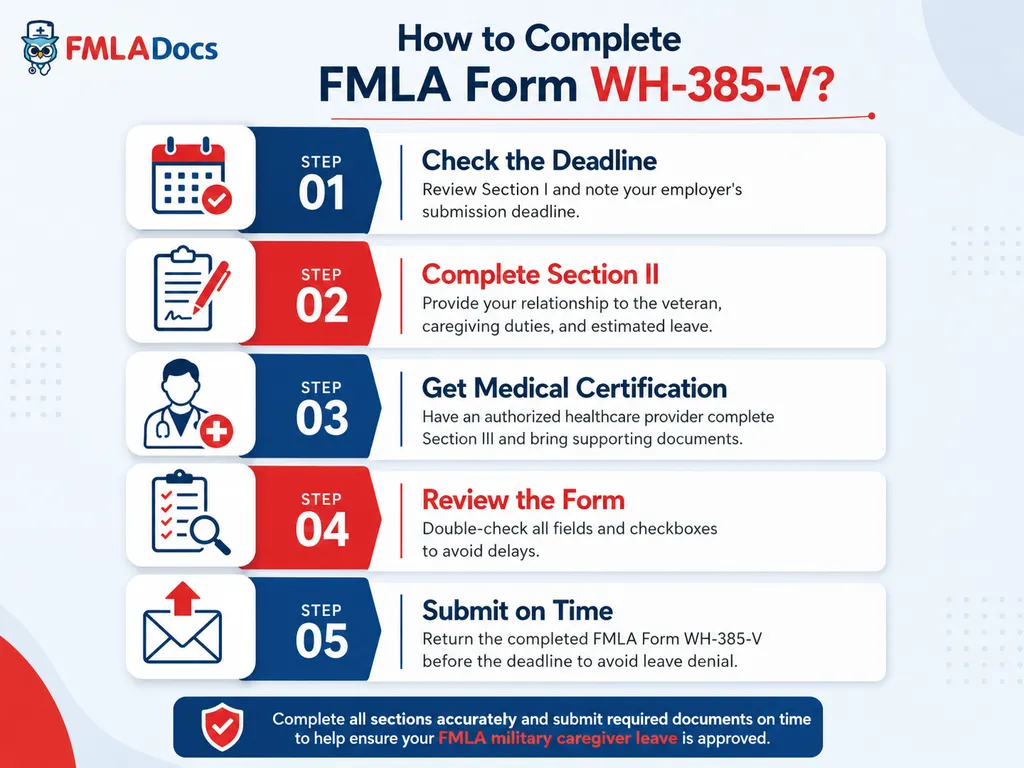
Completing FMLA Form WH-385-V is easier when you work through each section in order. Following these steps can help you avoid common mistakes and prevent delays in your military caregiver leave request.
Step 1: Review Your Employer’s Deadline
Start by checking Section I, which is completed by your employer. This section includes the deadline for returning the certification. Under the FMLA, employers must generally provide at least 15 calendar days for you to submit the completed FMLA Form WH-385-V.
Step 2: Complete Section II
Next, fill out Section II before visiting the healthcare provider. Provide your relationship to the covered veteran, describe the care you will provide, and estimate the amount of leave or work schedule adjustment you expect to need. Completing your portion first helps the provider accurately certify your leave request.
Step 3: Have the Healthcare Provider Complete Section III
Take the form to an authorized healthcare provider to complete Section III. Bring supporting documents, such as the veteran’s DD-214 discharge papers and VA disability rating letter, to help the provider verify eligibility and complete the certification accurately.
Step 4: Review the Form for Errors
Before submitting the form, carefully review every section to ensure all required fields and checkboxes are completed. Missing information is one of the most common reasons employers return FMLA Form WH-385-V for corrections.
Step 5: Submit the Form on Time
Return the completed certification to your employer before the stated deadline. Submitting an incomplete or late FMLA Form WH-385-V may delay or even result in the denial of your military caregiver leave request, even if the veteran otherwise qualifies.
What Happens After You Submit FMLA Form WH-385-V?
After you submit FMLA Form WH-385-V, your employer reviews the certification to determine whether it meets the FMLA’s military caregiver leave requirements. The review focuses on whether the employee is eligible, the veteran qualifies as a covered veteran, the serious injury or illness meets the legal definition, and the certification has been completed correctly by an authorized healthcare provider. If all requirements are satisfied, your employer will issue a Designation Notice confirming that your leave is protected under the Family and Medical Leave Act (FMLA). This is not a discretionary approval—FMLA leave is a federal entitlement when all eligibility criteria are met.
If your employer determines that the certification is incomplete or insufficient, they cannot simply deny your request. Instead, they must provide written notice explaining what information is missing or needs clarification and give you an opportunity to correct the certification. In most cases, employees have seven calendar days to resolve any deficiencies. Even minor omissions, such as an unanswered question or missing signature, can delay the leave designation, making it important to review the form carefully before submitting it.
Once your FMLA Form WH-385-V is accepted, military caregiver leave may be taken in the format certified by the healthcare provider. Depending on the veteran’s medical needs, leave can be taken as a continuous block of time, on a reduced work schedule, or intermittently. Intermittent leave is often used when caring for a covered veteran who requires ongoing medical appointments, rehabilitation, therapy sessions, or treatment for recurring symptoms rather than continuous care.
Conclusion
Getting FMLA form WH-385-V right comes down to three things: confirming the veteran meets the five-year discharge window, matching their condition to one of the four service-connected categories, and giving the provider enough documentation to write a specific certification. Skip any one of those steps and the process slows down right when your family needs stability most.
None of this is a substitute for a provider’s own clinical judgment about whether your veteran’s condition qualifies. But knowing what FMLA form WH-385-V actually asks for means you walk into that appointment prepared instead of guessing. If you’re ready to move forward, start your certification through FMLADocs and get a licensed physician’s review of your situation without waiting weeks for an in-person visit.
Skip the paperwork. Get certified online. Stop hunting for forms and guessing which version is current. FMLADocs physicians handle all documentation requirements for you and deliver signed, submission-ready documentation in 24 to 48 hours. Get certified online with FMLADocs.
Frequently Asked Questions
What is FMLA Form WH-385-V used for?
FMLA form WH-385-V documents that a family member's veteran status and injury meet the federal standard for military caregiver leave. Employers use it to decide whether requested leave qualifies for job protection under the FMLA. It covers up to 26 workweeks in a single 12-month period.
What's the difference between WH-385 and WH-385-V?
WH-385 applies when the family member is a current servicemember still in the Armed Forces, National Guard, or Reserves. WH-385-V applies once that family member has been discharged and become a veteran. The underlying injury still has to trace back to their active duty service.
Does VA documentation replace WH-385-V?
Partially. A VASRD disability rating letter or enrollment in the VA's family caregiver program counts as sufficient medical certification on its own. You may still need to separately document your relationship to the veteran and their discharge status to complete the request.
Who can complete Section III of FMLA Form WH-385-V?
A DOD health care provider, a VA health care provider, a TRICARE-authorized private provider, or any health care provider recognized under the FMLA regulations can complete it. Using a military-affiliated provider also means your employer cannot request a second opinion on the certification.
How long does my employer have to give me to return the form?
Federal rules require at least 15 calendar days from the date your employer requests certification, unless a shorter window is genuinely unavoidable. If the certification is incomplete, you typically get about seven more calendar days to fix it.
Can I use this form for a stepfamily veteran or in-law?
The FMLA covers spouses, children, parents, and next of kin as defined by blood relationship priority. Stepfamily and in-law relationships generally don't qualify under military caregiver leave unless the person legally stands in loco parentis to the veteran.
How much FMLA leave can I take to care for a covered veteran?
Eligible employees can take up to 26 workweeks total during a single 12-month period for military caregiver leave. That period is combined with any other FMLA leave reasons used during the same window, up to that 26-week ceiling.
What happens if the certification is incomplete?
Your employer must tell you in writing what's missing rather than denying the request outright. You generally get about seven calendar days to correct it. Missing checkboxes and vague timeframes are the most common reasons certifications get sent back.
Meet the author
Nida Hammad
I am a professional writer with over five years of experience creating clear, engaging, and well-researched content. I specialize in healthcare topics, helping readers understand complex information in simple wording. Currently, I write for FMLA DOC, where I focus on producing accurate and trusted guides for people seeking support with FMLA and medical needs.
Get Your FMLA Certification Online in Minutes