
FMLA Maternity Leave For Pregnancy
 by Nida Hammad
 Last updated:
Pregnancy is one of the most protected periods in employment law. Federal law lets eligible employees take FMLA maternity leave before and after childbirth. These protections start at the first prenatal appointment and continue through bonding time during the child’s first year. But the rules for those 12 weeks are more complex than most expecting parents realize — covering when leave starts, how it works with other leave, and what documents you need.
This guide covers FMLA pregnancy leave from start to finish: who qualifies, what the FMLA covers during prenatal and postpartum care, how to plan leave to use your full entitlement, what your employer must do, what the Pregnant Workers Fairness Act adds to the FMLA, and how to complete your certification without delays.
If you need your FMLA certification completed, FMLADocs connects you with a licensed healthcare provider who completes your WH-380E correctly and on time, including the frequency and duration fields employers often require for prenatal and postpartum intermittent leave.
FMLA Maternity Leave: The Basics
The Family and Medical Leave Act (FMLA) allows eligible employees to take up to 12 workweeks of unpaid, job-protected leave each year. This leave may be used for FMLA maternity leave. Those 12 weeks are not separate entitlements for each pregnancy-related purpose — they are one combined bank that covers all pregnancy, childbirth, postpartum recovery, and bonding uses.
According to DOL Fact Sheet #28, The Family and Medical Leave Act, covered uses for FMLA leave include:
- The birth of a child or placement of a child with the employee for adoption or foster care
- The care for a child, spouse, or parent who has a serious health condition
- A serious health condition that makes the employee unable to work
- Reasons related to a family member’s service in the military
What 12 Weeks Actually Means
The 12-week entitlement under FMLA maternity leave is not 12 calendar weeks of time. It is 12 workweeks, measured proportionally to your normal schedule. An employee who works 40 hours per week has 480 hours of FMLA leave in their annual bank. An employee who works 20 hours per week has 240 hours. Leave is deducted proportionally to your normal schedule for any absence taken.
The critical planning point is that prenatal leave and postpartum leave draw from the same 12-week bank. If you use 3 weeks of FMLA before your due date for prenatal appointments and pregnancy complications, you have 9 weeks remaining for recovery and bonding after delivery. Planning how to allocate this bank is one of the most important decisions an expecting parent makes before leave begins.
The 12-Month Period
Employers choose from four methods for measuring the 12-month period within which the 12 weeks must be used. The most common is the rolling backward 12-month period, which looks back from the date leave is taken. Some employers use a calendar year or a fixed 12-month period based on the employee’s anniversary date. Understanding which method your employer uses affects your available leave, especially if you took FMLA leave in the past 12 months.
Eligibility for FMLA Pregnancy Leave
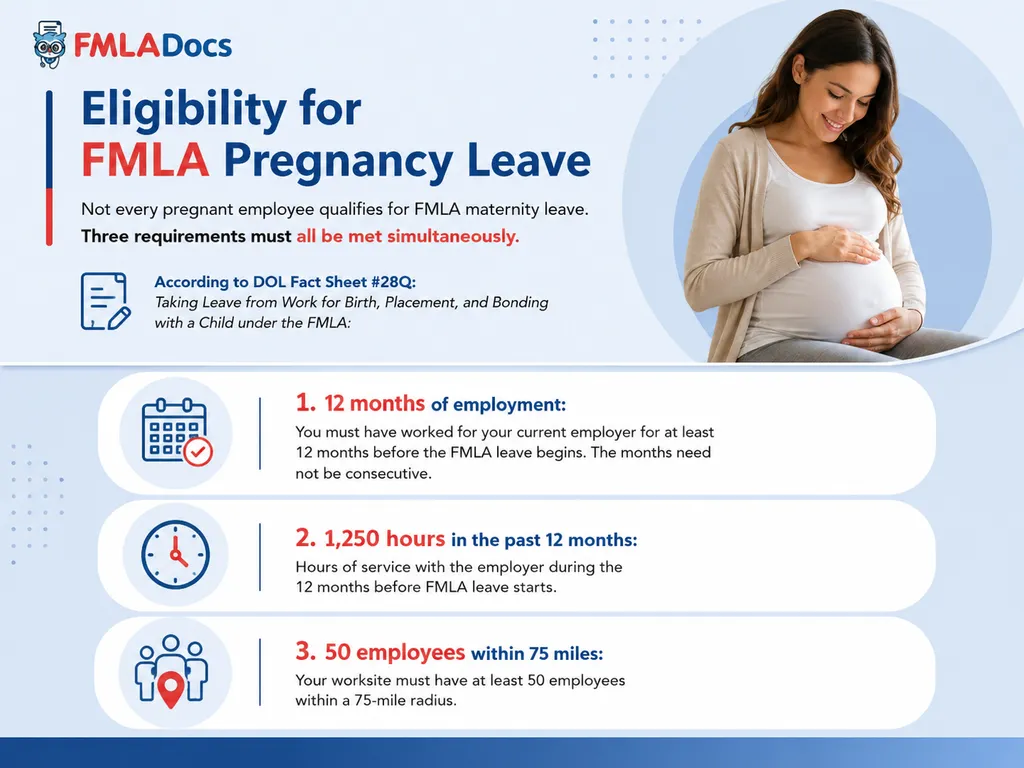
Not every pregnant employee qualifies for FMLA maternity leave. Three requirements must all be met simultaneously. According to DOL Fact Sheet #28Q: Taking Leave from Work for Birth, Placement, and Bonding with a Child under the FMLA:
- 12 months of employment: You must have worked for your current employer for at least 12 months before the FMLA leave begins. The months need not be consecutive.
- 1,250 hours in the past 12 months: Hours of service with the employer during the 12 months before FMLA leave starts.
- 50 employees within 75 miles: Your worksite must have at least 50 employees within a 75-mile radius.
What If You Do Not Qualify for FMLA
Employees who do not meet the eligibility thresholds for FMLA pregnancy leave are not without options. The Pregnant Workers Fairness Act (PWFA) took full effect in June 2024. It requires covered employers with 15 or more employees to provide reasonable accommodations for workers with known limits related to pregnancy, childbirth, or related medical conditions — even if you are not eligible for FMLA. It can include schedule changes, temporary job changes, light duty, and extra leave beyond FMLA.
Many states also have their own family and medical leave laws with lower eligibility thresholds. California’s CFRA covers employers with 5 or more employees. New York’s Paid Family Leave covers virtually all employees regardless of employer size. Employees who do not qualify for federal FMLA maternity leave should check their state’s law before assuming they have no protection.
Prenatal Care FMLA: Leave Before Your Due Date
Prenatal care FMLA is one of the most underused features of the FMLA for pregnant employees. Most people think of maternity leave as starting at birth. Under the FMLA, leave protection begins at the first qualifying prenatal event, which may be weeks or months before your due date.
What Prenatal Conditions Qualify
The FMLA covers prenatal care FMLA leave for a broad range of pregnancy-related conditions and appointments, including:
- Prenatal medical appointments including OB-GYN visits, consultations, and routine prenatal checkups
- Prenatal testing including ultrasounds, amniocentesis, glucose testing, and other diagnostic procedures
- Severe morning sickness (hyperemesis gravidarum) that requires treatment or causes incapacity
- Gestational diabetes requiring medical management or treatment
- Preeclampsia or hypertension requiring monitoring or treatment
- Placenta previa or other complications requiring activity restrictions or bed rest
- Bed rest ordered by a physician for any pregnancy-related reason
- Pregnancy-related sciatica, pelvic girdle pain, or musculoskeletal conditions limiting work capacity
- Mental health conditions exacerbated by pregnancy, including prenatal anxiety and depression, when requiring treatment
Intermittent Prenatal FMLA Leave
Many pregnant employees use prenatal care FMLA on an intermittent basis, taking a few hours off for each prenatal appointment rather than a continuous block. The employee submits an FMLA certification at the start of the pregnancy, and all qualifying prenatal appointments and pregnancy-related absences throughout the pregnancy are covered under that single certification.
For scheduled prenatal appointments, you must give 30 days advance notice when possible. For unforeseeable prenatal-related absences — such as sudden severe morning sickness or an emergency prenatal visit — you must notify your employer as soon as practicable, typically the same day or the following business day.
The certification for prenatal intermittent leave should specify the expected frequency of appointments and the expected duration of each absence. A certification that says “prenatal appointments as needed” without specifying frequency gives employers grounds to dispute individual absences. FMLADocs physicians complete certifications with the specific frequency and duration language that prevents these disputes.
Planning the Trade-Off: Prenatal vs. Postpartum Leave
Every hour of prenatal care FMLA leave used reduces the time available for postpartum recovery and bonding. Consider:
- How many prenatal appointments you have scheduled and how long each takes
- Whether you have any existing complications that may require additional prenatal leave
- How long you expect to need for postpartum physical recovery — usually 6 to 8 weeks after a vaginal birth, and often longer after a cesarean birth
- Whether your partner has FMLA bonding leave they can use to supplement your time at home
- Whether your state has paid family leave that may allow you to extend your total leave beyond 12 weeks
Prenatal appointments alone can use 2 to 4 weeks of FMLA leave if you take each visit as a full day. Taking prenatal appointments as intermittent half-day absences, instead of full days, can save more leave for postpartum recovery.
Postpartum FMLA Leave: Recovery, Complications, and Mental Health
Postpartum FMLA leave covers the period following childbirth and applies to the birth mother’s own serious health condition. This is separate from bonding leave and is driven by medical need rather than a choice to spend time with the newborn.
Standard Postpartum Recovery
Childbirth is a serious health condition under the FMLA, and recovery from it qualifies automatically for postpartum FMLA leave. The standard recovery period is typically 6 weeks for vaginal birth and 8 weeks or more for cesarean section. Your OB-GYN or midwife will certify the expected duration of medical recovery on Form WH-380E.
Medical recovery leave does not require employer consent and does not require the leave to be taken in a continuous block if complications extend the recovery in episodic ways.
Postpartum Complications That Qualify
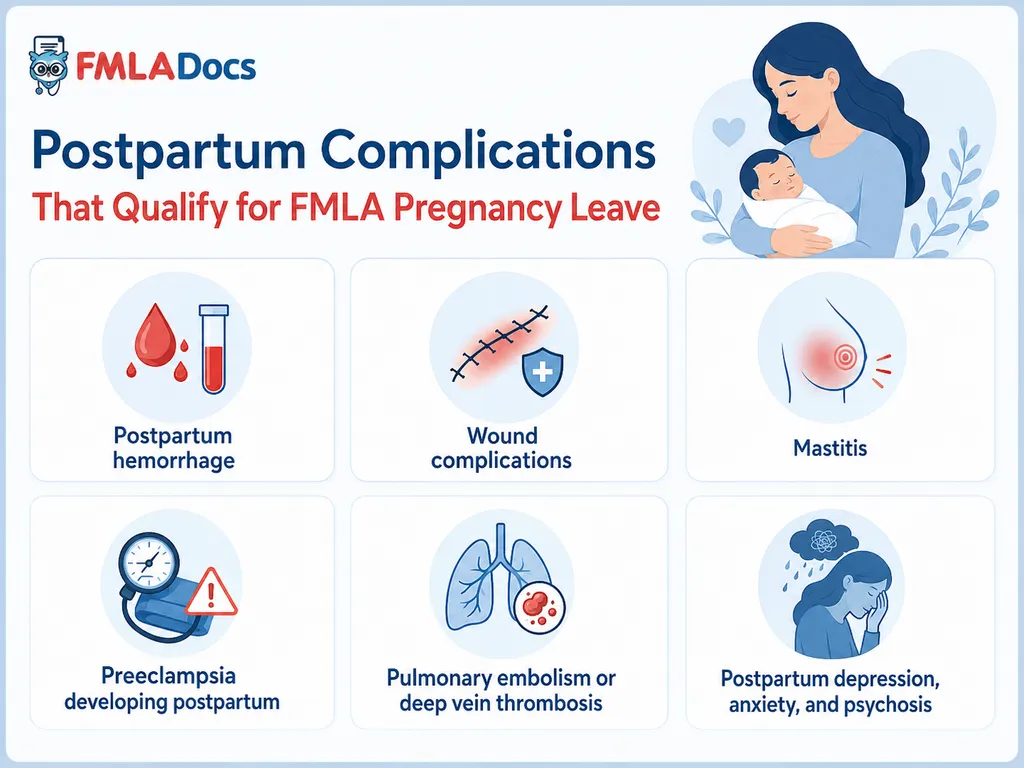
Beyond standard recovery, several postpartum conditions independently qualify for postpartum FMLA leave as serious health conditions:
- Postpartum hemorrhage: Significant blood loss requiring treatment, transfusion, or extended medical care.
- Wound complications: Infection, dehiscence, or other complications from cesarean incision or episiotomy requiring ongoing medical treatment.
- Mastitis: Breast infection requiring antibiotic treatment and causing incapacity.
- Preeclampsia developing postpartum: Can develop within the first few days after delivery and requires medical treatment.
- Pulmonary embolism or deep vein thrombosis: Blood clots are a serious postpartum risk.
- Postpartum depression, anxiety, and psychosis: Qualify when they require inpatient care or continuing treatment by a healthcare provider.
Postpartum Depression and FMLA
Postpartum depression can qualify for postpartum FMLA leave if it meets the serious health condition standard — requiring inpatient care, or ongoing treatment by a healthcare provider plus a period of incapacity. Many cases meet this standard.
In addition to FMLA coverage, postpartum depression may qualify as a disability under the ADA if it greatly limits one or more major life activities. When it qualifies under both, the employer must provide FMLA leave and may also need to offer reasonable ADA accommodations, such as a modified schedule or extra leave beyond 12 weeks — a separate duty under the ADA.
Employees with postpartum depression should work with their doctor or mental health provider to document the condition and how it affects their ability to work. The WH-380E certification should note how long treatment may last and how often appointments occur or when incapacity episodes may happen.
FMLA Bonding Time: What Both Parents Need to Know
FMLA bonding time is a separate category from the birth mother’s medical recovery leave. It is available to both parents and must be completed within 12 months of the child’s birth or placement.
Who Can Take FMLA Bonding Time
The following are entitled to FMLA bonding time for a qualifying birth or placement:
- The birth mother, in addition to her medical recovery leave
- The birth father
- A non-birth parent in a same-sex couple
- An adoptive parent
- A foster parent accepting a new child placement
The bonding entitlement does not depend on gender, marital status, or biological relationship. Any employee who is the legal parent of a child newly born or placed in the home qualifies for FMLA bonding time on equal terms.
The Same-Employer Rule
When both parents work for the same employer, the FMLA limits their combined bonding leave to 12 weeks total — they cannot each take 12 weeks. This limit applies only to bonding leave; it does not affect the birth mother’s medical recovery leave, which is based on her own serious health condition.
Example: Both parents work for the same employer. The birth mother takes 8 weeks of medical recovery leave after a cesarean section, plus wants 4 weeks of bonding leave. The father wants 6 weeks of bonding leave. Together they want 10 weeks of bonding leave, which fits within the combined 12-week bonding limit. The mother’s 8-week recovery does not count toward this limit.
Bonding Leave Does Not Require Medical Certification
Employers may not ask for medical certification for bonding leave. A birth certificate or court document meets the family relationship requirement. Employers can require reasonable advance notice and documentation of the birth or placement event itself, but they cannot require a healthcare provider to complete a medical certification for healthy newborn bonding leave. Requiring a WH-380E for bonding leave for a healthy newborn is an FMLA interference violation.
Employer Consent for Bonding Leave Scheduling
Unlike medical recovery leave, FMLA bonding time needs your employer’s approval if you want to take it intermittently or on a reduced schedule. An employer does not have to allow bonding leave in separate hours or days — the employer may require a continuous block unless it agrees otherwise.
An employee whose postpartum recovery requires intermittent care can take that leave intermittently without employer consent. An employee who wants to take bonding leave in a pattern of Fridays off or alternating weeks must get the employer to agree to that schedule.
The 12-Month Deadline for Bonding Leave
All FMLA bonding time must be completed within 12 months of the child’s birth or placement. Leave not used within this window is forfeited. This 12-month clock is firm and does not pause for any reason. Employees may take bonding leave in segments — for example, returning to work before taking more bonding leave — but must use all bonding leave before the 12-month anniversary.
Pregnancy Certification: What Your Provider Must Complete
Pregnancy certification is the medical documentation that supports your FMLA leave request. Employers have the right to require certification from a licensed healthcare provider before approving FMLA maternity leave for any medical reason. An incomplete certification can result in denial of FMLA protection even when your underlying medical need is genuine.
Which Form to Use
| Situation | Correct Form |
|---|---|
| Birth mother’s own pregnancy, childbirth, recovery, or complications | WH-380E: Certification of Health Care Provider for Employee’s Serious Health Condition |
| Leave to care for a spouse or partner with pregnancy-related serious health condition | WH-380F: Certification of Health Care Provider for Family Member’s Serious Health Condition |
| Bonding leave for a healthy newborn (no certification required) | Proof of birth or placement only (birth certificate, hospital record, or placement documents) |
| Bonding leave for adoption or foster placement | Proof of placement. No medical certification required. |
What the WH-380E Must Include for Pregnancy
The pregnancy certification on Form WH-380E must include all of the following to be considered complete and sufficient:
- The date the serious health condition began (for pregnancy, typically the date of first pregnancy-related incapacity or prenatal need)
- The probable duration of the condition (through at least the estimated postpartum recovery period)
- Whether the condition involves inpatient care or continuing treatment by a healthcare provider
- A statement of the medical necessity of leave
- For intermittent prenatal leave: the expected frequency of episodes and duration of each episode
- The healthcare provider’s name, type of practice, and contact information
- The healthcare provider’s signature
The 15-Calendar-Day Rule
Once an employer requests pregnancy certification, the employee has at least 15 calendar days to return the completed form. This deadline is firm. If you miss it without a valid reason, your employer can delay or deny FMLA designation. If you are waiting on your OB-GYN or midwife to complete the form, communicate this to your employer in writing before the deadline and request an extension if needed.
FMLADocs connects you with licensed healthcare providers who complete pregnancy certification forms on the same day as the evaluation. For prenatal intermittent leave, the certification includes specific frequency and duration language. For postpartum leave, the estimated recovery duration is documented. For postpartum depression, the treating provider addresses continuing treatment and duration. Start your certification at FMLADocs.
Employer Limitations on Certification Requests
Employers cannot require more information than the WH-380E requests. They cannot contact your healthcare provider directly without following specific FMLA procedures, and cannot ask for your complete medical records, test results, or diagnostic information beyond what the form covers. A request for additional information beyond the WH-380E is a potential FMLA interference violation. For FMLA bonding time for a healthy newborn, employers cannot require any medical certification at all.
Notice Requirements During FMLA Maternity Leave
What You Must Tell Your Employer and When
For foreseeable FMLA maternity leave, including the birth itself, you must give at least 30 days advance notice — notifying your employer of your anticipated leave start date and expected duration, or as soon as is practicable if the leave must begin sooner than 30 days out.
You do not need to say the words “FMLA leave” in your notification. You must provide enough information for your employer to understand the leave may qualify for FMLA. Telling HR that you are expecting and plan to take maternity leave starting in approximately eight weeks is sufficient notice to trigger the employer’s own FMLA obligations.
What Your Employer Must Provide and When
| Notice Type | Employer Deadline |
|---|---|
| Eligibility Notice (WH-381) | Within 5 business days of the leave request |
| Rights and Responsibilities Notice | At the same time as the Eligibility Notice |
| Request for medical certification | Within 5 business days of the leave request |
| Designation Notice (WH-382) | Within 5 business days of receiving sufficient information |
| Notice of FMLA leave used | At request of employee or with Designation Notice |
Job Protection During FMLA Maternity Leave
FMLA maternity leave carries strong job protection rights that apply from the first day of leave through your return.
Right to Return
When your FMLA maternity leave ends, you are entitled to return to the same position you held before leave, or an equivalent position with the same pay, benefits, shift, schedule, and other terms and conditions of employment. Your employer cannot eliminate your position, restructure it to be less favorable, or reassign your duties in a way that reduces your status or compensation because you took FMLA leave.
Health Insurance Continuation
Your employer must maintain your group health insurance coverage during FMLA maternity leave under the same terms as if you had continued working. The employer continues to pay its share of your health insurance premiums while you are on leave. You remain responsible for paying your own share, and your employer can terminate coverage if you fail to make your payment. Coverage for your child’s birth is included under your existing health plan terms during FMLA leave.
Benefits Preservation
Benefits that accrued before your FMLA maternity leave began are preserved. Your employer cannot reset your seniority, PTO accruals, or retirement contributions because of FMLA leave. However, benefits do not necessarily continue to accrue during FMLA leave unless the employer’s policy provides for accrual during other comparable leave (such as paid sick leave). Paid leave that runs concurrently with FMLA is typically treated as active employment for benefits purposes.
The Pregnant Workers Fairness Act: Protections Beyond FMLA
The Pregnant Workers Fairness Act (PWFA), which took effect June 27, 2023 and reached full implementation in 2024, fills gaps that the FMLA does not cover. While the FMLA provides leave rights, the PWFA provides accommodation rights. The two laws work together to provide overlapping protections during pregnancy and the postpartum period.
What the PWFA Requires
According to EEOC guidance on the Pregnant Workers Fairness Act, covered employers with 15 or more employees must provide reasonable accommodations to a worker’s known limitations related to pregnancy, childbirth, or related medical conditions, unless the accommodation would cause undue hardship.
Examples of possible reasonable accommodations include:
- Temporary reassignment or light duty
- Schedule changes for health care appointments
- Additional or more flexible breaks to drink water, eat, rest, or use the restroom
- Providing a stool to sit on or a way to do work while standing
- Leave to recover from childbirth or other medical conditions related to pregnancy or childbirth
The PWFA’s most important expansion over the FMLA is that it covers employers with as few as 15 employees, applies from the first day of employment (no 12-month requirement), and covers conditions that may not rise to the level of a serious health condition under the FMLA. An employee with mild morning sickness who cannot qualify for prenatal care FMLA leave may still be entitled to accommodations under the PWFA.
How PWFA and FMLA Interact
The PWFA and FMLA pregnancy protections run concurrently in many cases. When an employee takes FMLA leave for a pregnancy-related serious health condition, the PWFA accommodation obligation also applies to that period. When leave ends and the employee returns, the PWFA may require additional accommodations such as modified duties or a phased return that the FMLA does not independently mandate. The practical result is that a pregnant employee at a covered employer has four federal protections working simultaneously: the FMLA for leave rights, the PWFA for accommodation rights, Title VII for pregnancy discrimination protections, and the ADA for disability accommodation if a pregnancy-related condition qualifies.
The PUMP Act (Providing Urgent Maternal Protections for Nursing Mothers Act) adds another layer: employers must provide nursing employees with reasonable break time and a private space (not a bathroom) to express breast milk for one year after the birth. This applies during and after FMLA maternity leave and cannot be conditioned on whether the employee took FMLA leave. The PUMP Act covers most employees under the Fair Labor Standards Act and requires no minimum hours or tenure. An employer cannot reduce an employee’s compensation for time spent pumping during a break provided for that purpose.
How to Plan Your FMLA Maternity Leave Strategically
Getting the most out of your FMLA maternity leave requires planning before the third trimester.
Before Week 30: Understand Your Full Entitlement
- Confirm which method your employer uses to measure the 12-month FMLA period
- Calculate whether you have taken any FMLA leave in the past 12 months that reduces your current entitlement
- Check your state’s leave law and whether it provides paid benefits during leave
- Review your employer’s paid leave policy and confirm whether PTO or sick leave runs concurrently with FMLA
- Find out whether your partner qualifies for FMLA bonding leave and at which employer
Weeks 30 to 34: Give Notice and Start Certification
- Notify HR of your expected leave start date and return date, in writing
- Receive the Eligibility Notice (WH-381) and Rights and Responsibilities Notice from your employer
- Begin the pregnancy certification process — FMLADocs can complete your WH-380E same-day, for both continuous postpartum leave and intermittent prenatal leave if applicable
- Submit the completed WH-380E to your employer within 15 calendar days of the request
- Receive your Designation Notice (WH-382) confirming FMLA approval
Structuring Your 12 Weeks
The most common FMLA maternity leave allocation for birth mothers is:
| Leave Period | Typical Duration |
|---|---|
| Prenatal intermittent (appointments) | 0 to 3 weeks equivalent, taken in hours not days |
| Prenatal continuous (complications, bed rest) | 0 to 4 weeks depending on complications |
| Childbirth and immediate recovery | Begins at delivery |
| Postpartum physical recovery (vaginal) | 6 weeks from delivery |
| Postpartum physical recovery (cesarean) | 8 weeks or more from delivery |
| Bonding leave (remaining weeks) | Whatever is left after prenatal and recovery leave |
| Total | 12 weeks maximum under federal FMLA |
A birth mother who has a straightforward pregnancy with minimal prenatal leave usage can typically allocate 8 to 10 weeks to postpartum recovery and bonding. A birth mother with significant prenatal complications may have fewer weeks remaining. Planning this allocation early, with your OB-GYN’s guidance on expected recovery duration, prevents surprises at return-to-work time.
Conclusion
FMLA maternity leave is one of the most comprehensive employment protections in federal law for expecting and new parents. The 12-week entitlement covers prenatal care FMLA, childbirth, postpartum FMLA leave, and FMLA bonding time, all drawing from the same bank. Understanding how to allocate those weeks, how to coordinate with your partner’s leave rights, and how to get your pregnancy certification completed correctly is the difference between a protected leave and one that creates unnecessary risk.
The Pregnant Workers Fairness Act and state paid leave laws add important protections beyond what the FMLA provides, particularly for employees who may not meet the FMLA’s eligibility thresholds. Knowing which laws apply to your situation ensures you claim every protection available.
A vague or incomplete WH-380E is the most common reason FMLA maternity leave requests are disputed. FMLADocs connects you with licensed healthcare providers who complete your certification with the right frequency and duration language, on time, in the format your employer’s HR team needs. Start your FMLA maternity leave certification at FMLADocs.
Frequently Asked Questions
Can I use FMLA maternity leave before my baby is born?
Yes, you can use FMLA for pregnancy before delivery. Your 12-week maternity leave can start when you need it most. Many women take time off for pregnancy complications or severe morning sickness. You can split your leave between prenatal care and postpartum recovery. However, the total time can't exceed 12 weeks in a year. Talk to your doctor about when to start your leave.
What happens if my employer denies my FMLA maternity leave request?
First, check if you meet all FMLA eligibility requirements. You need 12 months of service and 1,250 hours worked. Your employer must have 50 or more workers within 75 miles. If you qualify but get denied, ask for the reason in writing. You can file a complaint with the Department of Labor. They can investigate violations of maternity leave rights. You may also have state-level protections to explore.
Do I get paid during my 12-week maternity leave under FMLA?
No, FMLA maternity leave is unpaid by federal law. However, you can use accrued paid time off during your leave. This includes vacation days, sick leave, or personal days. Some employers offer paid maternity benefits separately. Check if your state has paid family leave programs. California, New York, and several other states provide wage replacement. You can also look into short-term disability insurance for partial income.
How do I get FMLA medical certification for pregnancy approved quickly?
Your doctor must complete the medical certification form your employer provides. This form confirms your pregnancy and expected delivery date. It also states why you need time off work. Schedule an appointment early to avoid delays. Some services like FMLADocs connect you with licensed doctors online. They complete your FMLA medical certification pregnancy paperwork without office visits. Submit your completed form within 15 days of your employer's request.
Can my employer fire me while I'm on job-protected maternity leave?
No, your employer can't fire you for taking FMLA maternity leave. Job protection means your position stays secure during your time off. However, you can be let go for reasons unrelated to your leave. This includes company layoffs or performance issues from before your leave. Your employer must prove the firing would have happened anyway. Document everything if you suspect discrimination. Contact the Department of Labor if you believe your rights were broken.
What's the difference between FMLA maternity leave and short-term disability?
FMLA provides job-protected time off but no pay. Short-term disability offers partial wage replacement during recovery. You can use both at the same time for maximum benefit. Disability typically covers six to eight weeks after delivery. FMLA covers 12 weeks total for any pregnancy-related reason. Not all employers offer disability insurance. Check your benefits package to see what's available. Some states require employers to provide disability coverage.
When should I notify my employer about my FMLA leave timeline for pregnancy?
You should give your employer 30 days' notice when possible. This helps them plan for your absence. Tell them your expected delivery date and when you want leave to start. You should also say when you plan to return. If complications arise, notify them right away. You don't need to wait 30 days for emergencies. Put your request in writing and keep copies. Follow your company's specific notification process for leave requests.
Meet the author
Nida Hammad
I am a professional writer with over five years of experience creating clear, engaging, and well-researched content. I specialize in healthcare topics, helping readers understand complex information in simple wording. Currently, I write for FMLA DOC, where I focus on producing accurate and trusted guides for people seeking support with FMLA and medical needs.
Get Your FMLA Certification Online in Minutes