

FMLA vs State Family Leave: Which One Actually Protects You?
 by Tayyaba Amir
 Last updated:
When you have a serious health problem or need to care for a family member, you may wonder if your job is protected while you take time off. The answer depends on where you live, where you work, and how many employees your company has. That is why it is important to understand the difference between FMLA and state family leave before you request leave from work.
The federal Family and Medical Leave Act has protected workers since 1993. However, the law has some limits. It does not cover every employer, it does not provide paid leave, and it does not protect every type of family relationship. Many state family leave laws were created to give workers extra protection where federal law falls short.
This guide explains both systems in simple language. You will learn who qualifies for each law, what benefits each one provides, how they work together, and what steps you should take to keep your job protected while you are away from work. By the end, you will better understand which protections apply to your situation and how to use them.
What Is FMLA and Who Does It Cover?
The Family and Medical Leave Act, also called FMLA, is a federal law that was passed in 1993. The law was created to help employees balance their work responsibilities with important family and medical needs. Under FMLA, eligible workers can take up to 12 workweeks of unpaid leave during a 12-month period without losing their jobs. This protection can be very important during serious health problems, pregnancy, childbirth, recovery from surgery, or when caring for a close family member with a medical condition.
One of the biggest benefits of FMLA is job protection. While you are on approved leave, your employer cannot legally replace you or remove your position just because you needed time away from work. When your leave ends, you must be allowed to return to the same job or a similar position with the same pay, benefits, and working conditions.
FMLA also protects your health insurance coverage during your leave. If you receive group health insurance through your employer, the company must continue your coverage under the same conditions as if you were still actively working. This can help workers avoid losing important medical coverage during difficult times.
However, FMLA does not apply to every worker or every business. The law covers private employers with 50 or more employees. It also applies to all public agencies, including government employers, as well as public and private elementary and secondary schools, no matter how many employees they have.
According to the U.S. Department of Labor Wage and Hour Division, employees must meet three main requirements to qualify for FMLA leave. These rules decide whether a worker is eligible for job-protected leave under federal law.
| Requirement | Details |
|---|---|
| Employer size | 50 or more employees within 75 miles of your worksite |
| Length of employment | At least 12 months with the same employer |
| Hours worked | At least 1,250 hours in the past 12 months |
| Geographic rule | You must be located within 75 miles of 50 or more coworkers |
You must meet all four requirements to qualify for FMLA leave. If even one condition is missing, you may not be protected under federal law. For example, if your employer has only 45 employees, the Family and Medical Leave Act does not apply to your workplace, even if you have worked there for many years.
FMLA allows employees to take leave for several important reasons. You may qualify if you have a serious health condition that makes you unable to do your job. You may also take leave to care for a spouse, child, or parent who has a serious medical condition. Other covered reasons include the birth of a child, the adoption of a child, or certain situations connected to a family member’s military service.
Under FMLA, a serious health condition usually means an illness, injury, or medical condition that requires hospital care or ongoing treatment from a healthcare provider. This can include surgery recovery, long-term illnesses, pregnancy-related conditions, or other medical problems that prevent a person from working or caring for themselves properly.
One important thing to understand is that FMLA does not guarantee paid leave. The law only protects your job while you are away from work. In some cases, you may be able to use paid sick days, vacation time, or other paid leave during your FMLA leave. However, this depends on your employer’s policies and benefits, not the federal law itself.
What Are State Family Leave Laws?
State family leave laws are different from federal Family and Medical Leave Act rules. Every state creates its own laws about who can qualify for leave, what situations are covered, and whether workers receive paid or unpaid time off. Some states follow rules that are very similar to federal FMLA, while others offer much stronger protections for employees.
One major difference is that many state programs provide partial pay while you are away from work. These programs are often called paid family leave programs. Instead of taking unpaid leave, workers may receive part of their normal wages during their time off.
Many state laws also protect more workers than federal FMLA does. Some states allow employees at smaller companies to qualify for leave benefits. Federal FMLA, however, usually applies only to employers with at least 50 employees. This means workers at small businesses may still qualify for protection and income benefits under state law even if federal FMLA does not cover them.
Another important difference is the definition of family members. Federal FMLA mainly covers leave to care for a spouse, child, or parent. Many state family leave laws expand this list to include domestic partners, siblings, grandparents, grandchildren, in-laws, and sometimes even close personal relationships that are not related by blood or marriage.
Organizations like the National Conference of State Legislatures regularly track changes in state family leave laws as new programs are created and updated.
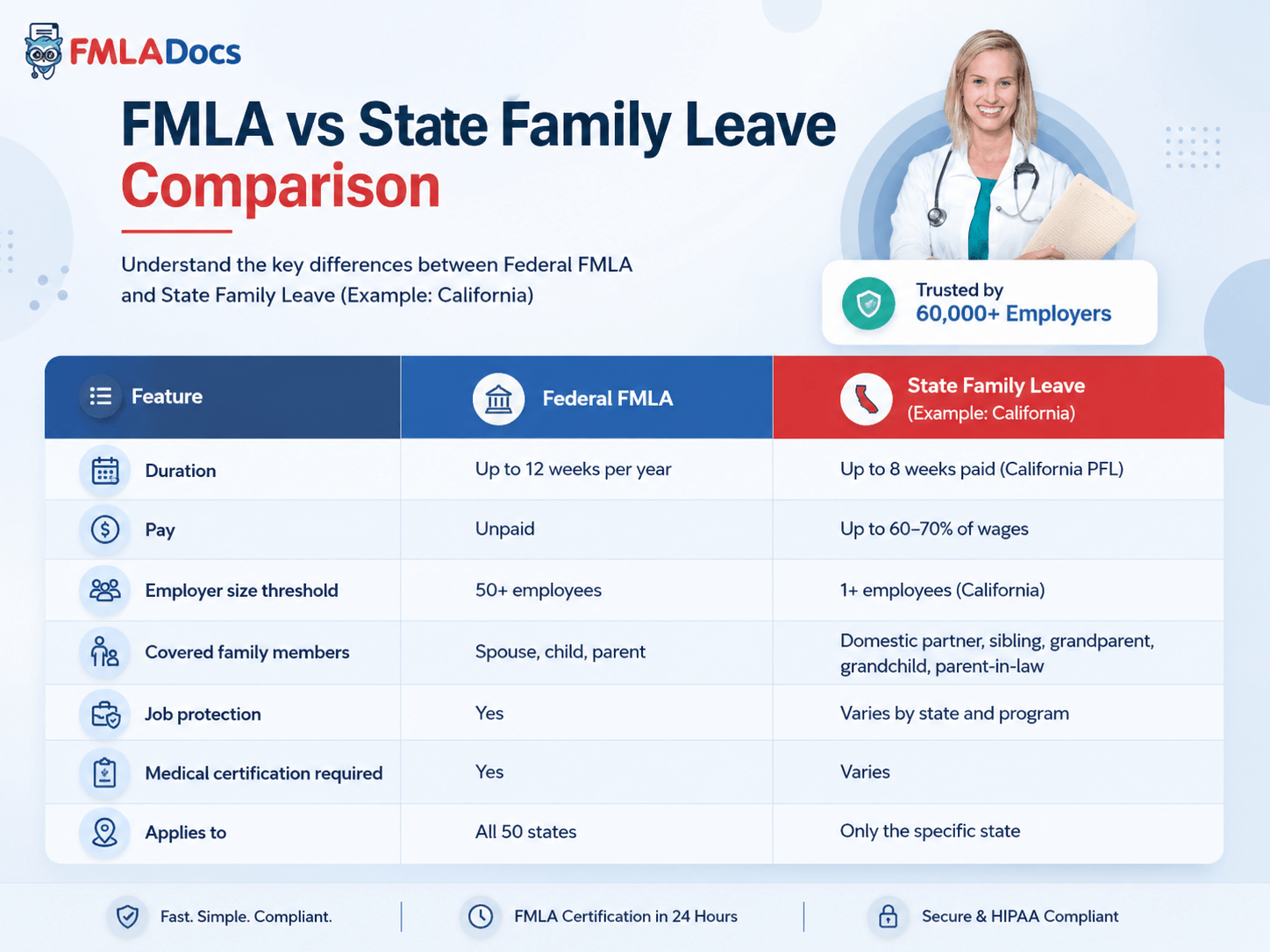
FMLA vs State Family Leave: A Side-by-Side Comparison
The easiest way to understand the difference between federal and state family leave laws is to compare them side by side. While both systems can help workers take time off for medical or family reasons, they do not always provide the same benefits or protections.
One important thing to know is that paid family leave and job protection are not always the same thing. In many states, paid family leave programs give workers money while they are away from work, but they may not protect the employee’s job by themselves.
For example, California has a Paid Family Leave program that provides partial income during leave. However, this program alone does not guarantee that your job will still be there when you return. Job protection comes from a different law called the California Family Rights Act.
When both programs apply together, workers can receive two important benefits at the same time. They can receive income while on leave and also keep their jobs protected. This is why it is so important to understand how federal and state leave laws work together and where they overlap.
How FMLA and State Leave Work Together
When both federal FMLA and your state family leave law apply to your situation, they usually run at the same time. This means the leave you take under your state program is often counted as part of your FMLA leave as well. In most cases, you do not receive 12 weeks of federal leave and then another separate 12 weeks of state leave.
However, there are some situations where workers may qualify for extra leave beyond the normal 12 weeks. This can happen if your state law covers situations that federal FMLA does not cover. For example, federal FMLA does not allow leave to care for a sibling. But some state family leave laws do include siblings as covered family members.
Imagine that you already used your 12 weeks of FMLA leave but still need time to care for your sick brother or sister. If your state law includes siblings in its family leave rules, you may still qualify for additional protected leave under state law even after your federal FMLA leave has ended.
The U.S. Department of Labor explains that when state law gives employees stronger protections than federal FMLA, workers have the right to receive the greater benefit. Employers must follow the law that provides more protection for the employee.
An employer also cannot refuse your state leave simply because you already used your FMLA leave. In the same way, they cannot deny your FMLA leave only because you previously used leave under a state program, as long as both laws apply separately to your situation.
A good step to take is to inform your employer in writing when requesting leave. If both federal and state laws apply to your case, ask your employer to count your leave under both programs at the same time.
Which Workers Are Most at Risk of Being Unprotected?
Not every worker qualifies for protection under the federal Family and Medical Leave Act. Even though FMLA helps many employees take protected time off for medical or family reasons, the law has strict eligibility rules. Because of these rules, many workers across the United States are not covered by federal leave protection.
According to the Bureau of Labor Statistics, a large number of private-sector employees work for businesses with fewer than 50 workers. This is important because federal FMLA usually applies only to employers that meet the 50-employee requirement. As a result, millions of workers across the country have no protection under federal family leave law.
This gap affects workers in many industries, especially people employed by small companies, local businesses, restaurants, retail stores, startups, and family-owned workplaces. Even workers who have been loyal employees for years may still not qualify if their employer does not meet the federal size requirement.
For workers who do not qualify for FMLA, state family leave laws become very important. Some states have created their own programs to protect employees who are left out of federal law. These state programs may offer paid leave, job protection, or both, even for workers at very small businesses.
However, not every state has its own family leave program. Workers living in states without these laws may have little or no legal protection if they need time off for a medical condition, pregnancy, childbirth, or to care for a family member. In many cases, these workers must rely only on company policies, sick leave benefits, vacation time, or whatever support their employer voluntarily provides.
| Worker Type | Why FMLA May Not Apply | Potential Alternative |
|---|---|---|
| Works for employer with fewer than 50 employees | Below employer size threshold | State law may cover smaller employers |
| New employee (less than 12 months) | Does not meet tenure requirement | Some state laws have shorter tenure requirements |
| Part-time worker with fewer than 1,250 hours | Does not meet hours threshold | Some state programs use different hour thresholds |
| Remote worker far from company headquarters | May not meet 75-mile rule | State laws may not include this restriction |
| Works in a state with no leave law | No state protection available | ADA, employer policy, or negotiation may apply |
If you are managing a serious health condition and need help understanding which protections
apply to your situation, you do not have to figure this out alone. FMLADocs connects you with
licensed medical professionals who review your case online and complete your FMLA
certification within 24 to 48 hours. You can get started with your FMLA evaluation and have your documentation ready before your leave begins.
What Qualifies as a Serious Health Condition Under FMLA?
One of the main reasons an FMLA request gets denied is because the medical condition does not meet the legal meaning of a “serious health condition.” Under federal law, this term has a specific definition.
According to FMLA rules, a serious health condition is an illness, injury, or mental or physical condition that requires either hospital care or ongoing treatment from a healthcare provider. Ongoing treatment usually means you visited a doctor at least twice within 30 days after you became unable to work. It can also include long-term conditions that need treatment at least two times each year and may cause symptoms to come and go.
Medical proof is very important. Your healthcare provider must fill out a medical certification form. In most cases, this is Form WH-380-E for your own condition or Form WH-380-F for a family member’s condition. Your employer can ask for this form before approving FMLA leave. If you turn in the form late or leave parts incomplete, your employer may deny your request or treat your absence as unexcused.
Some states also have their own leave programs and may require extra forms in addition to federal FMLA forms. Always check with your employer and your state labor agency to make sure you complete all required paperwork.
How to Request FMLA and State Leave at the Same Time
You do not need to complete two totally different processes to request leave under both FMLA and a state leave program. You just need to follow the correct steps in an organized way.
Step 1: Tell Your Employer Early
If you know about your leave ahead of time, such as for a planned surgery, you should tell your employer at least 30 days before your leave starts if possible. If the leave is unexpected, you should inform your employer as soon as you can. In most cases, this means the same day or the next business day.
Step 2: Ask About FMLA and State Leave Coverage
Ask your employer if your leave can qualify under both FMLA and your state’s leave program. Under FMLA rules, your employer must give you an eligibility notice within five business days. Your state leave program may also have its own rules and deadlines.
Step 3: Complete Your Medical Certification
Your medical certification form is one of the most important parts of the process. A licensed healthcare provider must fill out the form completely and correctly. Your employer usually will not approve FMLA protection until they receive the completed certification. Under FMLA rules, you normally have 15 calendar days to return the form.
Step 4: Apply for State Paid Leave Benefits
Some state leave programs provide paid benefits. In many cases, you must submit a separate application to the state agency that handles the program. This process is often different from the paperwork you give to your employer.
Step 5: Keep Copies of All Records
Save copies of all important documents and messages. Keep records of:
- The date you informed your employer
- The date you submitted medical forms
- Emails, letters, or messages from your employer or state agency
These records can help protect you if there is a problem later. The U.S. Department of Labor’s Wage and Hour Division provides official FMLA forms and helpful guidance for each step of the process.
What Happens If Your Employer Violates Your Leave Rights?
FMLA gives employees legal protection when they take approved medical leave. Your employer cannot punish you for using your FMLA rights.
Retaliation happens when an employer takes negative action against you because you used FMLA leave. This can include firing you, reducing your work hours, demoting you, or treating you unfairly at work. These actions are against federal law if they happen because you used protected leave.
Interference happens when an employer prevents you from using your FMLA rights. For example, an employer may deny your leave without a valid reason, fail to explain your rights, pressure you not to take leave, or refuse to return you to your job after leave. These actions may also violate federal law.
In most cases, you must file within two years of the violation. If the employer knowingly broke the law, you may have up to three years to file a claim.
Some states also have their own paid family leave programs and complaint systems. If your state leave benefits are denied, you may need to contact the state agency that manages the program. Problems related to job protection may also be handled by a state labor or civil rights office.
Keep copies of all records related to your leave request. Save emails, written notices, medical forms, and messages with HR or your manager. These documents may help support your case if there is a disagreement or legal problem later.
Common Mistakes That Cost Workers Their Leave Protection
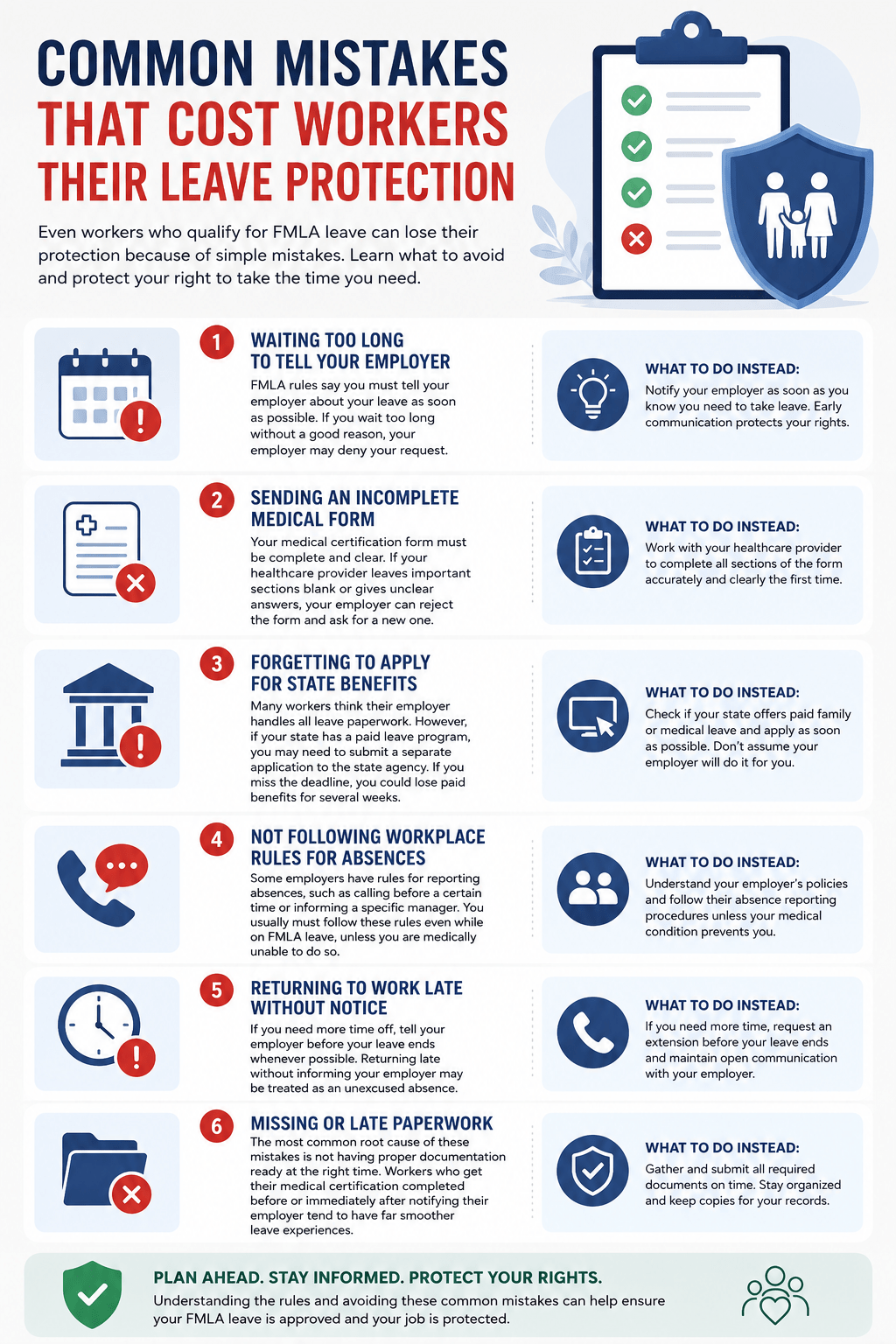
Even workers who qualify for FMLA leave can lose their protection because of simple mistakes. Learning about these mistakes early can help you avoid problems later.
- Waiting Too Long to Tell Your Employer
FMLA rules say you must tell your employer about your leave as soon as possible. If you wait too long without a good reason, your employer may deny your leave request.
- Sending an Incomplete Medical Form
Your medical certification form must be complete and clear. If your healthcare provider leaves important sections blank or gives unclear answers, your employer can reject the form and ask for a new one. This can delay your leave approval.
- Forgetting to Apply for State Benefits
Many workers think their employer handles all leave paperwork. However, if your state has a paid leave program, you may need to submit a separate application to the state agency. If you miss the deadline, you could lose paid benefits for several weeks.
- Not Following Workplace Rules for Absences
Some employers have rules for reporting absences, such as calling before a certain time or informing a specific manager. You usually must follow these rules even while on FMLA leave, unless you are medically unable to do so.
- Returning to Work Late Without Notice
If you need more time off, tell your employer before your leave ends whenever possible. Returning late without informing your employer may be treated as an unexcused absence.
- Missing or late paperwork
The most common root cause of these mistakes is not having proper documentation ready at the
right time. Workers who get their medical certification completed before or immediately after
notifying their employer tend to have far smoother leave experiences.
How FMLADocs Helps You Stay Protected
Managing medical leave paperwork can feel stressful, especially when you are already dealing with a health problem or a family emergency. FMLADocs is designed to make the process easier and reduce the stress of handling documents on your own.
Licensed healthcare providers on the FMLADocs platform review your situation and ask important questions about your condition. They complete your FMLA certification forms correctly and according to federal rules. In many cases, the forms are completed within 24 to 48 hours.
The entire process is online, so you do not need to visit a doctor’s office in person. The platform is also HIPAA-compliant, which helps protect your private medical information.
FMLADocs helps with both federal FMLA forms and state leave paperwork. The platform can also help if you need leave for your own medical condition or to care for a family member.
Some workers are told that their leave is not approved because their paperwork is incomplete or missing. Getting the correct certification quickly can help protect your job. Without proper documents, your job protection may be uncertain.
If you want accurate and employer-ready FMLA paperwork, you can start the process online at FMLADocs. A licensed provider can complete your certification forms without you needing to leave your home.
Special Types of FMLA Leave
Some FMLA situations are different from the normal 12-week leave rules. Federal law includes extra protections for certain family and medical situations.
- Military Family Leave
FMLA provides special leave rights for military families. If your spouse, child, or parent is on active military duty or is called to active duty, you may qualify for up to 12 weeks of leave for certain family needs related to military service. If you are caring for a covered servicemember or veteran with a serious injury or illness, you may qualify for up to 26 weeks of leave during a single 12-month period.
- Pregnancy and Childbirth Leave
The birth of a child qualifies for FMLA leave. Pregnancy-related health problems may also qualify as a serious health condition before the baby is born. Many states provide extra protections for pregnancy leave. Some states also offer paid leave for pregnancy recovery and bonding with a new baby.
- Intermittent FMLA Leave
FMLA does not require you to use all 12 weeks of leave at one time. If you have a medical condition that causes flare-ups, requires regular treatment, or needs ongoing doctor visits, you may take leave in smaller blocks of time. You may also reduce your work schedule if needed.
This type of leave is called intermittent FMLA leave. Intermittent leave can help workers manage long-term health conditions without taking long periods away from work all at once.
Workers with conditions such as migraines, diabetes, anxiety, or autoimmune disorders may use intermittent leave for medical appointments or severe symptoms. Your healthcare provider must explain the need for intermittent leave on your medical certification form.
The Job Accommodation Network also gives guidance about workplace accommodations and intermittent leave.
Conclusion
The difference between FMLA and state family leave is not always simple. The best option depends on your state, your employer, and your personal situation.
For many workers, federal FMLA alone is not enough. Some people work for small employers that are not covered by FMLA. Others live in states that do not offer paid family leave. Some workers also face situations that federal law does not fully cover.
When both federal and state leave laws apply, using them together can give you stronger protection. Federal FMLA helps protect your job while you are away from work. State paid leave programs may replace part of your income during your leave.
Understanding how these laws work together can help you protect both your job and your finances.
One of the most important things you can do is make sure your paperwork is complete before your leave starts. Missing or incomplete medical forms are one of the main reasons workers lose legal protection.
Licensed healthcare providers at FMLADocs review your case and complete your FMLA paperwork online. In many cases, forms are completed within 24 hours.
You can check your eligibility and begin your evaluation now at FMLADos and take the first step toward protecting your job with confidence.
Frequently Asked Questions
Does state family leave pay more than FMLA?
FMLA is unpaid, so it does not give you money while you are on leave. It only protects your job. State family leave programs usually pay part of your salary, often around 60% to 90%, depending on the state. If your state offers paid leave, you may get both income from the state program and job protection from FMLA at the same time.
Can I be fired while on FMLA or state family leave?
FMLA protects you from being fired just because you took approved leave. If you are fired because of your leave, you may have a legal case. State laws also offer similar protection, but rules can be different. However, your employer can still fire you for other reasons, like company layoffs or performance issues, as long as it is not related to your leave.
What if I work for a small employer and do not qualify for FMLA?
First, check if your state has its own family leave law for smaller companies. Many states cover more workers than FMLA does. If you are still not covered, you may be protected under the Americans with Disabilities Act (ADA) if you have a qualifying medical condition. The ADA may also allow you to request reasonable workplace adjustments.
How long do I have to submit my medical certification after my employer requests it?
You usually have 15 calendar days to submit the medical certification after your employer asks for it. If you cannot meet the deadline due to reasons outside your control, you should inform your employer as soon as possible. It is best to complete and return the form quickly to avoid problems with your leave.
Can my employer require a second opinion on my medical certification?
Yes. Your employer can ask for a second medical opinion, but they must pay for it. They can choose the doctor for this second opinion. If the two opinions do not match, a third doctor (agreed on by both you and your employer) can give a final decision.
What happens to my health insurance while I am on leave?
Your employer must keep your health insurance active during FMLA leave, just like when you are working. You still need to pay your part of the insurance cost. If you do not return to work after your leave, your employer may ask you to repay the insurance premiums they paid during your leave.
Do I have to use my vacation or sick time during FMLA leave?
It depends on your employer's rules. Some employers require you to use your paid leave (like vacation or sick days) during FMLA leave. Others may allow you to keep it separate. Some states have different rules, so it is important to check your company policy and your state labor laws
Meet the author
Tayyaba Amir
Hi, I'm Tayyaba Amir, a content writer who helps people understand workplace rights and employee benefits. I aim to make complex information easy to understand so readers can make informed decisions. I focus on helping employees learn about their FMLA rights and how to use them. My goal is to simplify the rules so you can focus on what matters most; your health and your family. In my free time, I enjoy exploring new trends in digital media and finding ways to make everyday life easier.
Get Your FMLA Certification Online in Minutes