

Fired on FMLA Leave? Here's Exactly What Counts as Illegal Retaliation
 by Nida Hammad
 Last updated:
You requested FMLA leave. Your employer approved it. And then, while you were out, you got the call. You were fired. Or you came back and found your job eliminated, your hours cut, or your role reassigned to someone who had not needed medical leave. You are now asking the question that brings most people to this page: is this FMLA retaliation?
The short answer is: it might be, and it is worth knowing exactly what the law says before you decide what to do next. FMLA retaliation and wrongful termination FMLA cases are among the most active enforcement areas for the U.S. Department of Labor. The law is specific, the protections are strong, and employers who violate them face real consequences.
This guide explains exactly what FMLA retaliation is, what it is not, how to recognize it, what your employer is and is not allowed to do while you are on leave, what happens if they cross the line, and what steps to take if you believe your rights have been violated.
Before anything else: if you are currently on FMLA leave and your certification is incomplete or you are concerned your leave is not properly documented, that gap creates risk. FMLADocs connects you with a licensed healthcare provider who can complete your paperwork correctly so your leave is fully protected.
What Is FMLA Retaliation?
FMLA retaliation is any adverse employment action taken against an employee because they requested, used, or attempted to use FMLA leave. It is prohibited by Section 105 of the Family and Medical Leave Act, codified at 29 U.S.C. Section 2615.
According to the DOL Wage and Hour Division’s FMLA Protections (Fact Sheet #77B), employers cannot interfere with, restrain, or deny the exercise of, or the attempt to exercise, any FMLA right. They also cannot discharge or discriminate against any person for opposing or complaining about any unlawful practice under the FMLA.
The law covers two distinct prohibited behaviors: interference and retaliation. Understanding the difference matters because they are treated differently in court and by the DOL.
Interference vs. Retaliation: The Distinction
| FMLA Interference | FMLA Retaliation |
|---|---|
| Blocking an employee from taking approved leave | Firing or demoting an employee for taking approved leave |
| Failing to provide required notices | Denying a bonus because the employee used FMLA leave |
| Pressuring an employee to return before leave ends | Reducing hours after an employee returns from leave |
| Requiring the employee to find their own replacement | Negative performance review tied to FMLA absences |
| Denying FMLA leave for a qualifying condition | Eliminating a position while the employee is on leave to avoid reinstatement |
| Misclassifying FMLA absences as unexcused | Terminating employment shortly after leave ends with no documented prior cause |
Both interference and retaliation are FMLA violations. The difference is timing. Interference typically happens before or during leave. FMLA retaliation typically happens during or after leave. Both can result in the same legal consequences for the employer.
What Your Employer Cannot Do While You Are on FMLA Leave
According to DOL Fact Sheet #28A: Employee Protections under the FMLA, employers are prohibited from discriminating or retaliating against employees who have exercised or attempted to exercise any FMLA right. An employer also cannot use the taking of FMLA leave against an employee in applying negative points or deducting positive points under attendance policies.
Actions That Constitute FMLA Retaliation
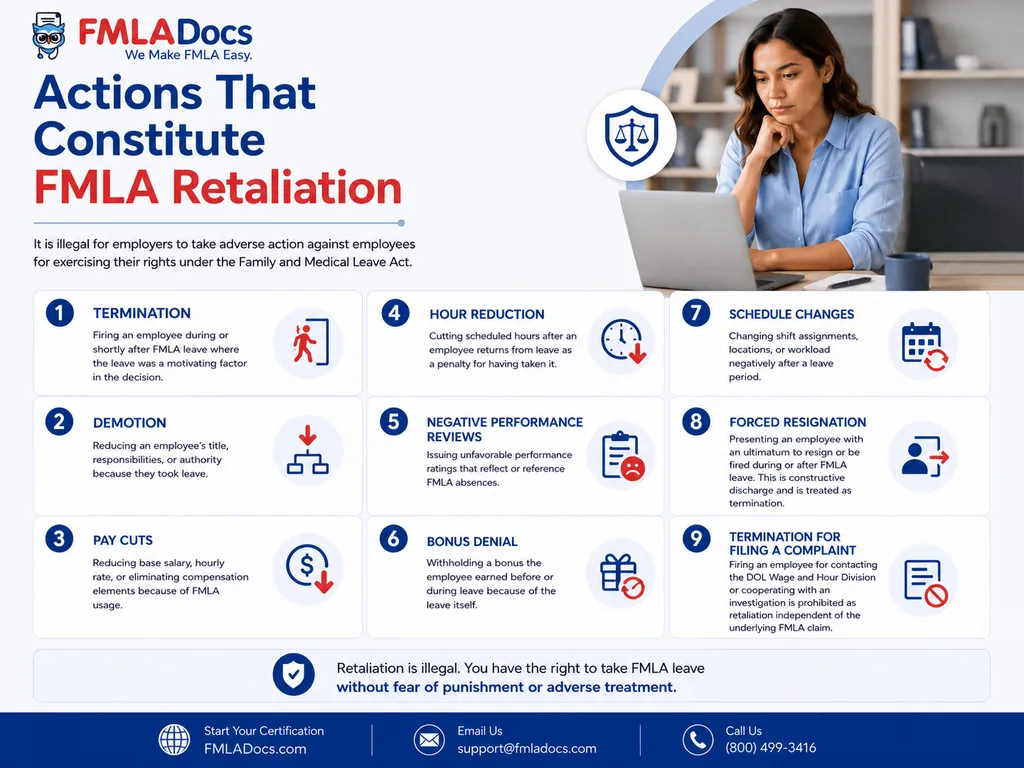
- Termination: Firing an employee during or shortly after FMLA leave where the leave was a motivating factor in the decision.
- Demotion: Reducing an employee’s title, responsibilities, or authority because they took leave.
- Pay cuts: Reducing base salary, hourly rate, or eliminating compensation elements because of FMLA usage.
- Hour reduction: Cutting scheduled hours after an employee returns from leave as a penalty for having taken it.
- Negative performance reviews: Issuing unfavorable performance ratings that reflect or reference FMLA absences.
- Bonus denial: Withholding a bonus the employee earned before or during leave because of the leave itself.
- Schedule changes: Changing shift assignments, locations, or workload negatively after a leave period.
- Forced resignation: Presenting an employee with an ultimatum to resign or be fired during or after FMLA leave. This is constructive discharge and is treated as termination.
- Termination for filing a complaint: Firing an employee for contacting the DOL Wage and Hour Division or cooperating with an investigation is prohibited as retaliation independent of the underlying FMLA claim.
2026 DOL Case: Forced Resignation Is FMLA Retaliation
In a case resolved in 2026, the DOL’s Wage and Hour Division found that the University of Tennessee violated the FMLA when it told an employee on approved intermittent leave to submit a resignation or face termination. The DOL recovered $30,442 in back wages for the employee. The DOL’s position: presenting an employee on approved FMLA leave with a resign-or-be-fired ultimatum is FMLA retaliation, regardless of how the employer frames the choice internally. The employer also failed to provide the employee with complete information about their FMLA rights, which was a separate violation.
Can Your Employer Legally Fire You While on FMLA Leave?
Yes, but only under very specific conditions. Being fired during FMLA leave is not automatically illegal. The FMLA does not give employees absolute protection from all employment decisions. It protects employees from adverse actions that are motivated by or connected to FMLA leave.
The critical legal question in any wrongful termination FMLA case is: would the employer have taken the same action if the employee had not used FMLA leave? If yes, the termination may be lawful. If no, or if the answer is unclear, it may be retaliation.
Situations Where Termination During FMLA May Be Lawful
- Pre-existing performance issues: If an employer has documented performance problems, disciplinary history, or a termination decision that predates the FMLA request, the termination can proceed during leave. The employer must show the decision was made independent of the leave.
- Legitimate layoffs: Workforce reductions, plant closures, or restructuring events that affect multiple positions, including the employee’s, can proceed during FMLA leave. The key is that the employee’s position was eliminated as part of a broader legitimate business decision, not specifically to avoid reinstatement.
- Gross misconduct: An employer can terminate an employee on FMLA leave who engages in clear misconduct, such as theft, fraud, or workplace violence, as long as the same standard would apply to any employee.
- Violation of a uniformly applied policy: If an employee on FMLA leave violates a policy that the employer enforces consistently against all employees, termination may be lawful.
The Documentation Test
Courts and the DOL look at documentation when evaluating whether a fired during FMLA situation is retaliation. Employers who can produce written performance records, prior disciplinary notices, or restructuring plans that predate the FMLA request have a stronger defense. Employers who issue a termination notice with no prior documentation, or who create documentation after the fact, are in significantly weaker legal positions.
Timing is the most powerful indicator. An employee who receives a glowing performance review in January, requests FMLA leave in February, and is terminated in March with vague references to performance issues has a strong basis for questioning whether the termination was retaliatory. Courts have consistently found that close temporal proximity between FMLA leave and an adverse action is meaningful evidence of retaliation.
FMLA Job Protection: Your Right to Return
FMLA job protection means that when your leave ends, you have the right to return to your job. This is not just a preference or a suggestion. It is a legal right that employers must honor unless a specific narrow exception applies.
What the Law Guarantees
Under the FMLA, returning employees are entitled to:
- Same position: Return to the exact job held before leave, with the same title, duties, pay, benefits, and reporting structure.
- Equivalent position: If the same position is not available due to legitimate business reasons, an equivalent position with equivalent pay, benefits, and other terms and conditions of employment. The employer cannot downgrade the position.
- Health benefits continuation: Group health insurance maintained during leave under the same terms as if employment had continued.
- No loss of accrued benefits: Benefits accrued before leave began are preserved. Employers cannot reset seniority, PTO balances, or other benefits because of FMLA leave.
When the Right to Reinstatement Has Exceptions
The FMLA’s reinstatement right has limited exceptions. An employer can deny reinstatement to a salaried employee in the top 10% of earners (a key employee) if reinstatement would cause substantial and grievous economic injury to the employer. This exception has strict procedural requirements: the employer must notify the employee in writing at the time the leave begins that they may not be reinstated, and must give the employee the opportunity to return immediately before denying reinstatement.
This exception is narrow and frequently misapplied. Most employees are not key employees under this definition. Employers who use this exception improperly face the same liability as any other employer retaliation FMLA violation.
How to Recognize FMLA Retaliation: Common Patterns
FMLA retaliation does not always look like a termination letter. It frequently appears in more subtle forms that are equally illegal but harder to identify. Here are the patterns that the DOL and courts have consistently recognized as retaliation.
The Timing Pattern
The most common pattern: an employee requests or returns from FMLA leave and faces adverse action within days or weeks. No prior performance issues. No documented disciplinary history. Just a sudden negative change in their employment situation that closely follows their FMLA activity. Courts treat close temporal proximity between FMLA leave and adverse action as significant circumstantial evidence of retaliation.
The Changed Assignment Pattern
An employee returns from leave and finds their best clients reassigned, their shift changed to less desirable hours, their workspace moved, or their project load restructured in a way that reduces their visibility or earning potential. None of these actions are outright termination, but each represents an adverse employment action tied to employer retaliation FMLA that violates the law.
The Sudden Performance Problem Pattern
An employee who had no documented performance issues before FMLA leave suddenly receives a negative performance review after returning. The review may reference attendance patterns without specifying that FMLA absences are excluded, or it may use vague language like “commitment” or “reliability” that implicitly penalizes protected leave.
The Restructuring Cover Pattern
An employer eliminates a position while the employee is on FMLA leave and does not offer an equivalent position upon return, claiming the role no longer exists. If the restructuring decision was made specifically because the employee was on leave, or if comparable employees who did not take leave were retained while the FMLA-using employee’s position was eliminated, this can constitute wrongful termination FMLA.
The Forced Resignation Pattern
An employer presents an employee returning from or on FMLA leave with a choice: accept a significantly worse position or resign. When the alternative is materially inferior and the pressure to resign is tied to the FMLA leave, this is constructive discharge and is treated as termination for FMLA purposes. The 2026 University of Tennessee DOL case is the most recent confirmed example of this pattern.
What to Do If You Think You Have Been Retaliated Against
If you believe you have experienced FMLA retaliation or wrongful termination FMLA, the steps you take in the days and weeks after the adverse action significantly affect the outcome of any subsequent complaint or legal proceeding.
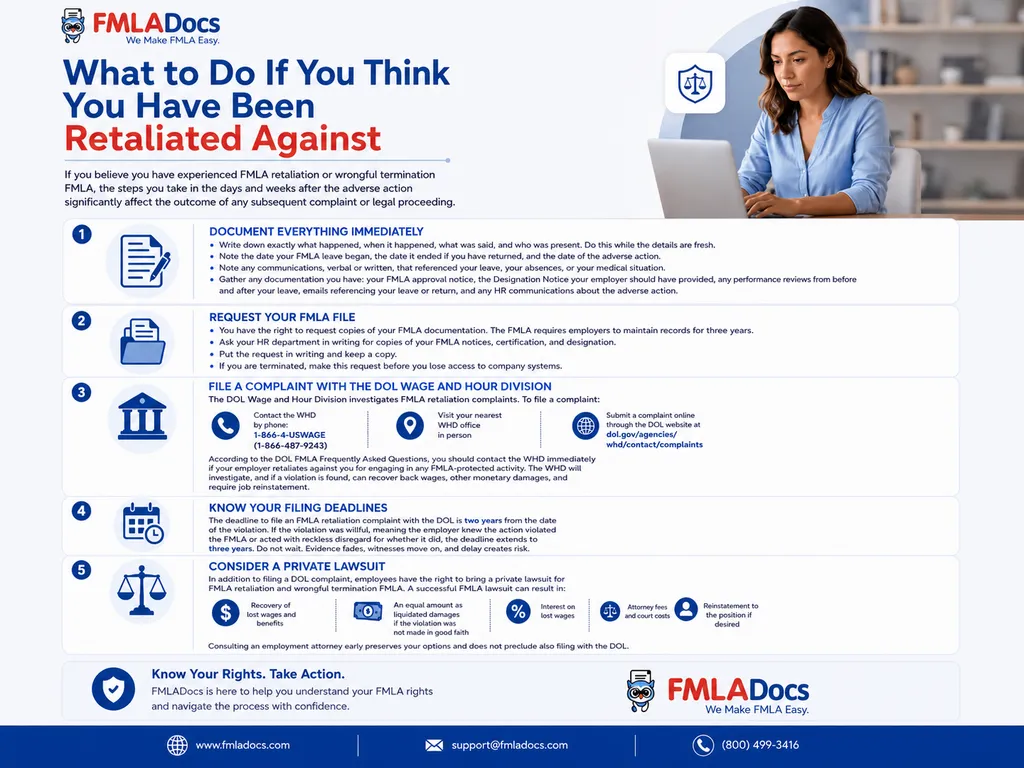
Step 1: Document Everything Immediately
Write down exactly what happened, when it happened, what was said, and who was present. Do this while the details are fresh. Note the date your FMLA leave began, the date it ended if you have returned, and the date of the adverse action. Note any communications, verbal or written, that referenced your leave, your absences, or your medical situation.
Gather any documentation you have: your FMLA approval notice, the Designation Notice your employer should have provided, any performance reviews from before and after your leave, emails referencing your leave or return, and any HR communications about the adverse action.
Step 2: Request Your FMLA File
You have the right to request copies of your FMLA documentation. The FMLA requires employers to maintain records for three years. Ask your HR department in writing for copies of your FMLA notices, certification, and designation. Put the request in writing and keep a copy. If you are terminated, make this request before you lose access to company systems.
Step 3: File a Complaint With the DOL Wage and Hour Division
The DOL Wage and Hour Division investigates FMLA retaliation complaints. To file a complaint:
- Contact the WHD by phone: 1-866-4-USWAGE (1-866-487-9243)
- Visit your nearest WHD office in person
- Submit a complaint online through the DOL website at dol.gov/agencies/whd/contact/complaints
According to the DOL FMLA Frequently Asked Questions, your employer is prohibited from interfering with, restraining, or denying the exercise of FMLA rights, or retaliating against you for filing a complaint and cooperating with the WHD.
Step 4: Know Your Filing Deadlines
The deadline to file an FMLA retaliation complaint with the DOL is two years from the date of the violation. If the violation was willful — meaning the employer knew the action violated the FMLA or acted with reckless disregard for whether it did — the deadline extends to three years. Do not wait. Evidence fades, witnesses move on, and delay creates risk.
Step 5: Consider a Private Lawsuit
In addition to filing a DOL complaint, employees have the right to bring a private lawsuit for FMLA retaliation and wrongful termination FMLA. A successful FMLA lawsuit can result in recovery of:
- Lost wages and benefits
- An equal amount as liquidated damages if the violation was not made in good faith
- Interest on lost wages
- Attorney fees and court costs
- Reinstatement to the position if desired
Consulting an employment attorney early preserves your options and does not preclude also filing with the DOL.
What Employers Must Prove to Defend a Termination During FMLA
When an employee files an FMLA retaliation complaint or lawsuit after being fired during FMLA, the burden of proof matters. Courts and the DOL assess whether the employer can demonstrate that the same employment decision would have been made even if the employee had never taken FMLA leave.
The Same Decision Defense
The employer must show that the termination decision was based on legitimate, pre-existing, documented reasons that had nothing to do with FMLA leave. This means producing performance records, disciplinary documentation, restructuring plans, or other evidence that predates the leave and independently justifies the action.
Employers who cannot produce this documentation, or whose documentation appears to have been created after the leave request, face a strong presumption of retaliation. Courts and DOL investigators are experienced at identifying post-hoc documentation.
The Honest Belief Defense
Some employers attempt to defend a wrongful termination FMLA claim by arguing they honestly believed, even if incorrectly, that the employee had engaged in misconduct. Courts apply an honest belief analysis: if the employer genuinely and reasonably investigated the alleged misconduct before terminating, and the investigation was not pretextual, the termination may survive a retaliation challenge even if the employee was ultimately innocent. This defense requires documented evidence of a real investigation before the termination decision.
What Does Not Work as a Defense
- Claiming the employee was “not a good fit” without documentation
- Vague references to performance issues that appear for the first time after the FMLA request
- Restructuring that conveniently eliminates only the FMLA-using employee’s position
- Claiming the employee would have been laid off anyway when the layoff was announced after the leave
- Asserting that business needs required the employee to be present when medical necessity overrides operational preference
How to Protect Yourself Before and During FMLA Leave
The most effective protection against FMLA retaliation is proper documentation from the start. Here is what to do before and during your leave to ensure your rights are fully protected.
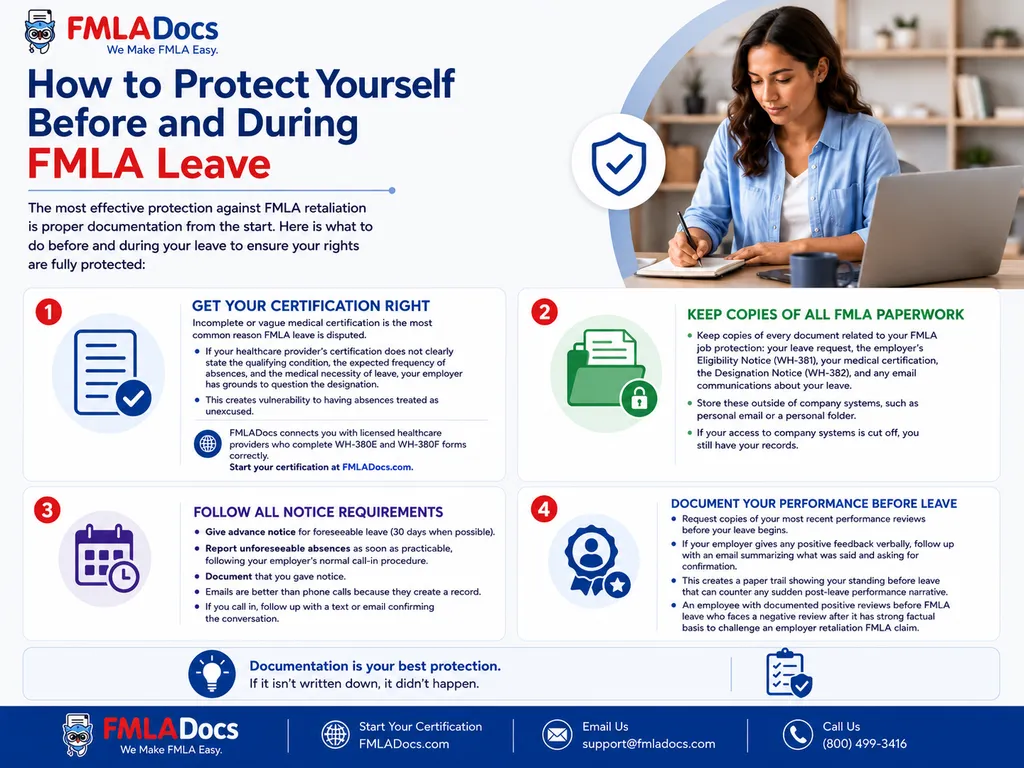
Get Your Certification Right
Incomplete or vague medical certification is the most common reason FMLA leave is disputed. If your healthcare provider’s certification does not clearly state the qualifying condition, the expected frequency of absences, and the medical necessity of leave, your employer has grounds to question the designation. This creates vulnerability to having absences treated as unexcused. FMLADocs connects you with licensed healthcare providers who complete WH-380E and WH-380F forms correctly. Start your certification at FMLADocs.
Keep Copies of All FMLA Paperwork
Keep copies of every document related to your FMLA job protection: your leave request, the employer’s Eligibility Notice (WH-381), your medical certification, the Designation Notice (WH-382), and any email communications about your leave. Store these outside of company systems, such as personal email or a personal folder. If your access to company systems is cut off, you still have your records.
Follow All Notice Requirements
Give advance notice for foreseeable leave (30 days when possible). Report unforeseeable absences as soon as practicable, following your employer’s normal call-in procedure. Document that you gave notice. Emails are better than phone calls because they create a record. If you call in, follow up with a text or email confirming the conversation.
Document Your Performance Before Leave
Request copies of your most recent performance reviews before your leave begins. If your employer gives any positive feedback verbally, follow up with an email summarizing what was said and asking for confirmation. This creates a paper trail showing your standing before leave that can counter any sudden post-leave performance narrative. An employee with documented positive reviews before FMLA leave who faces a negative review after it has strong factual basis to challenge an employer retaliation FMLA claim.
Conclusion
FMLA retaliation is one of the most clearly prohibited employment practices in federal law. The statute is explicit. The DOL enforces it actively. Courts have consistently protected employees who face adverse action tied to their FMLA leave. Being fired during FMLA or facing adverse action after returning is not something you simply have to accept.
The law gives you specific protections, a clear enforcement pathway through the DOL, and the right to bring a private lawsuit. What it cannot do is protect you retroactively from a leave that was not properly certified. A vague, incomplete, or missing certification creates a gap in your protection that your employer may exploit. The time to close that gap is before or at the start of your leave, not after a problem develops.
If your FMLA certification is not complete, or if you are concerned about your FMLA job protection, FMLADocs connects you with licensed healthcare providers who complete your WH-380E or WH-380F correctly and on time. Proper certification is the foundation of every FMLA right discussed in this guide. Start your certification at FMLADocs before your leave begins or before your next intermittent absence.
Frequently Asked Questions
Can I be fired for taking too much FMLA leave?
No, if the leave was properly certified and within your 12-week annual entitlement. An employer cannot fire you for the volume of FMLA absences alone, even if those absences are operationally inconvenient. Once your FMLA entitlement is exhausted, the employer's obligations under the FMLA end, though other laws such as the ADA may still apply. Terminating you specifically for FMLA-protected absences before your entitlement runs out is FMLA retaliation regardless of how frequently you used the leave.
What if my employer says my position was eliminated while I was on FMLA?
Your employer can lawfully eliminate a position during FMLA leave if the elimination is part of a genuine, broader business restructuring. However, if your position was eliminated specifically to avoid reinstating you, or if no equivalent position was offered when comparable positions existed, this can constitute wrongful termination FMLA. The key question is whether you were selected for elimination because of your leave. If others in similar roles retained their positions, that is important evidence.
Can my employer discipline me for attendance issues tied to my FMLA absences?
No. Employers cannot count FMLA-protected absences against employees under attendance or no-fault attendance policies. An employee whose absences are FMLA-certified cannot receive an attendance point, a written warning, or any other disciplinary action specifically for those absences. Applying attendance discipline to FMLA absences is FMLA interference and can also constitute FMLA retaliation if the discipline leads to further adverse action.
What if I was fired after my FMLA leave ended, not during it?
Termination after FMLA leave ends can still be FMLA retaliation if the leave was a motivating factor. Courts look at timing, documentation, and whether comparable employees who did not take FMLA leave were treated differently. An employee fired two weeks after returning from leave with no prior performance documentation faces the same legal analysis as one fired during leave.
Can I sue my employer for FMLA retaliation on my own?
Yes. Employees have the right to bring a private lawsuit for FMLA retaliation and fired during FMLA cases. You do not need to file with the DOL first, though many employees do both. A successful private lawsuit can result in back pay, liquidated damages equal to the back pay amount, and attorney fees. The filing deadline for a private lawsuit is the same as for a DOL complaint: two years for standard violations, three years for willful ones.
What is the difference between FMLA retaliation and ADA retaliation?
The FMLA and the Americans with Disabilities Act both protect employees from retaliation, but they cover different situations. FMLA retaliation applies to adverse actions tied to requesting or using FMLA leave. ADA retaliation applies to adverse actions tied to requesting reasonable accommodations or opposing disability discrimination. The conditions often overlap, and an employee fired after taking medical leave may have claims under both statutes. An employment attorney can help identify which laws apply to a specific situation.
Meet the author
Nida Hammad
I am a professional writer with over five years of experience creating clear, engaging, and well-researched content. I specialize in healthcare topics, helping readers understand complex information in simple wording. Currently, I write for FMLA DOC, where I focus on producing accurate and trusted guides for people seeking support with FMLA and medical needs.
Get Your FMLA Certification Online in Minutes