

Intermittent Leave: What It Is, How It Works, and Who Qualifies
 by Nida Hammad
 Last updated:
You have a serious medical condition. Some days you can work. Some days you cannot. You need time off for treatment, but not all at once. This is exactly what intermittent leave under the Family and Medical Leave Act (FMLA) was designed for.
Intermittent leave allows eligible employees to take protected, job-secured leave in separate, non-consecutive blocks of time rather than in one long absence. A migraine that keeps you home three days this month and two days next month. Chemotherapy every Thursday. A therapy appointment every other Wednesday morning. All of these can be covered under a single approved intermittent leave certification.
This guide covers what you need to know. It explains intermittent leave and who qualifies. It also shows how to request it. It explains what your employer must do. It covers what changed in 2026. It also shows how to complete your certification correctly.
What Is Intermittent Leave?
Intermittent leave is FMLA leave taken in separate blocks of time due to a single qualifying reason. According to 29 CFR Section 825.202, a reduced leave schedule lowers an employee’s usual work hours. It may reduce hours per day or per week. It is often a change from full-time to part-time. Both intermittent leave and a reduced leave schedule are types of FMLA leave. Both count toward the employee’s 12-week yearly entitlement.
The key point is that all of the leave must relate to one qualifying medical or family reason. You cannot combine multiple separate conditions into one intermittent leave period without separate certifications for each.
Three Forms Intermittent Leave Can Take
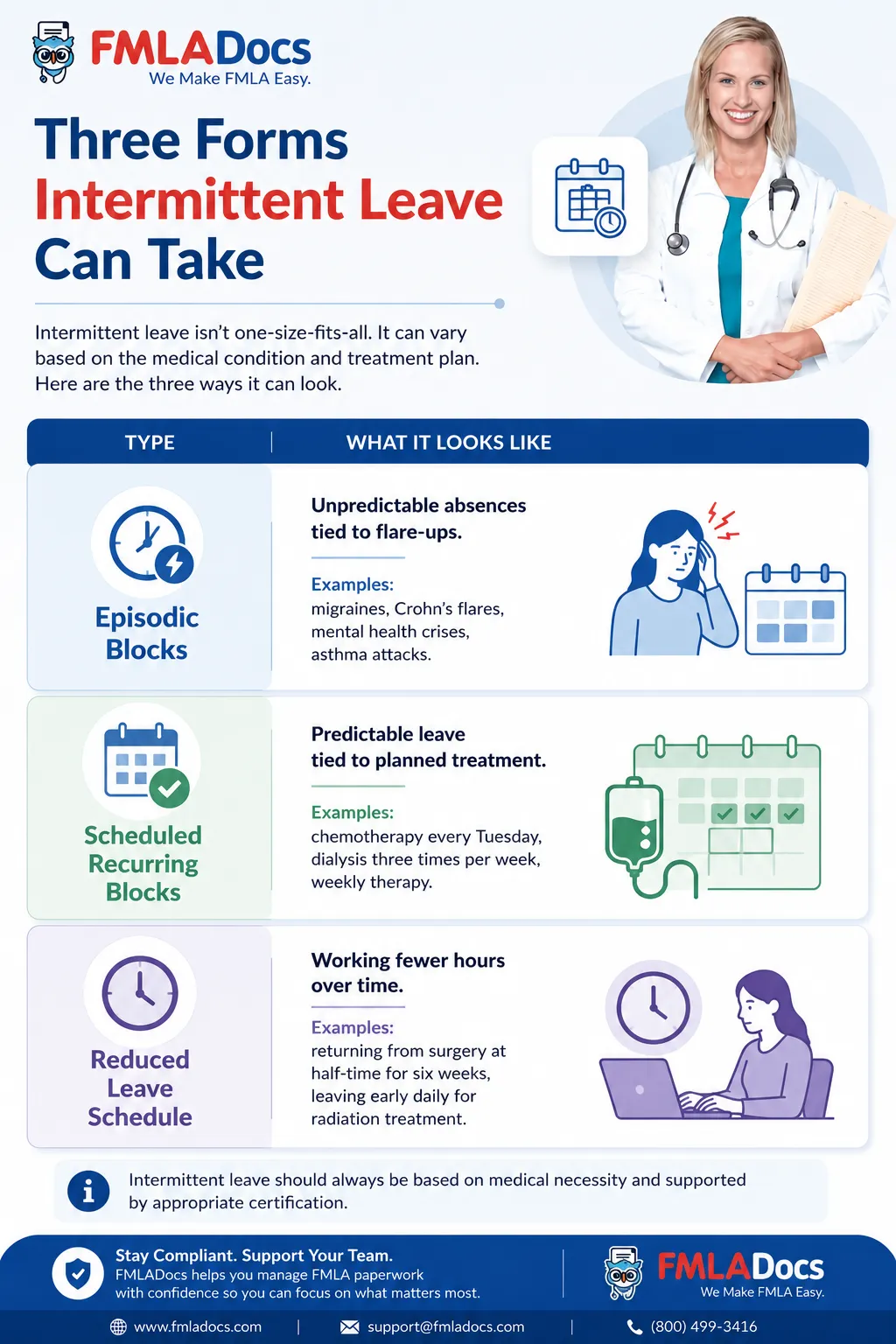
| Type | What It Looks Like |
|---|---|
| Episodic blocks | Unpredictable absences tied to flare-ups. Examples: migraines, Crohn’s flares, mental health crises, asthma attacks. |
| Scheduled recurring blocks | Predictable leave tied to planned treatment. Examples: chemotherapy every Tuesday, dialysis three times per week, weekly therapy. |
| Reduced leave schedule | Working fewer hours over time. Examples: returning from surgery at half-time for six weeks, leaving early daily for radiation treatment. |
All three types count against the employee’s 12-week annual FMLA entitlement. The calculation is proportional. If a standard workweek is 40 hours and the employee uses 4 hours of intermittent leave, that equals 4/40ths of one week’s entitlement.
Who Qualifies for Intermittent Leave
Before intermittent leave can be approved, both the employer and the employee must meet FMLA coverage thresholds. According to DOL Fact Sheet 28: The Family and Medical Leave Act, the requirements are as follows.
Employer Coverage
- Private-sector employers who employ 50 or more employees in 20 or more workweeks in the current or previous calendar year
- All public agencies including federal, state, and local government employers regardless of size
- All public and private elementary and secondary schools regardless of size
Employee Eligibility
- 12 months of employment: Need not be consecutive. Only jobs from the past seven years count. An exception applies if the break was due to military service, a collective bargaining agreement, or a written agreement.
- 1,250 hours in the past 12 months: Only hours actually worked. Paid leave, unpaid leave, and prior FMLA leave are not counted toward this total.
- 50 employees within 75 miles: The employee must work at a location where the employer has at least 50 employees within a 75-mile radius. Remote employees are counted based on the location to which they report or from which their work is assigned.
Both full-time and part-time employees can qualify for intermittent leave if they meet these thresholds. An employee who works 25 hours per week and meets the 1,250-hour annual threshold is eligible.
Which Conditions Qualify for Intermittent Leave
Not every medical or family reason qualifies for intermittent leave. According to the DOL’s Fact Sheet 28F on qualifying reasons for FMLA leave, employees have the right to take intermittent leave when it is medically necessary for their own serious health condition or that of a qualifying family member. Intermittent leave for bonding with a newborn or newly placed child is only available if both the employee and employer agree.
Conditions That Commonly Qualify
- Chronic conditions requiring periodic treatment: diabetes, severe arthritis, Crohn’s disease, asthma, epilepsy
- Mental health conditions with ongoing treatment: depression, anxiety disorders, PTSD, bipolar disorder, OCD
- Cancer requiring chemotherapy, radiation, or surgical treatment
- Migraine disorders when documented by a physician as chronic and incapacitating
- Pregnancy-related conditions including prenatal appointments and morning sickness requiring treatment
- Recovery from surgery when periodic treatment or flare-ups occur
- Caring for a spouse, parent, son, or daughter with any of the above conditions
What Does Not Qualify
Routine illnesses that do not require continuing treatment do not qualify. A common cold, a mild case of the flu, or minor injuries are not serious health conditions under the FMLA. An employee who has an active intermittent leave certification for migraines is not protected when they call in sick with a cold. Each absence must relate to the certified condition.
2026 Update: Travel Time to Medical Appointments Now Counts
The most significant intermittent leave development of 2026 is DOL Opinion Letter FMLA2026-2, issued January 5, 2026. The letter resolves a long-standing question about whether travel time to and from medical appointments is FMLA-protected.
What DOL Opinion Letter FMLA2026-2 Confirmed
- Travel time counts: Employees may use FMLA leave for time spent traveling to and from medical appointments for their own serious health condition or that of a qualifying family member.
- Both directions are covered: The trip to the appointment and the return home are both protected.
- Direct travel only: If the employee stops for personal errands during the trip, FMLA protection does not extend to that portion of the travel.
- No certification change needed: Medical certifications do not need to address travel time. The healthcare provider does not need to estimate travel duration for the certification to be complete and sufficient.
- Applies to family care too: The same rule applies when an employee travels to a qualifying family member’s medical appointment.
The practical impact is significant. An employee whose specialist is 90 minutes away can count the full 3-hour round trip as intermittent leave. Previously, many employers only credited the appointment time itself. This ruling matters most for employees in rural areas who must travel long distances for specialized care. Employers must track travel time as intermittent leave using the same increment rules as any other absence. The full opinion letter is available at DOL.gov.
How to Request Intermittent Leave: Step by Step
Step 1: Notify Your Employer
For foreseeable intermittent leave such as scheduled treatments, give at least 30 days advance notice. For unpredictable leave such as a flare-up, notify your employer as soon as practicable — which the DOL interprets as the same day or the next business day in most cases.
You do not need to say the words “FMLA” to trigger protection. Telling your supervisor you need to leave for a medical appointment is enough if you have an active certification.
Step 2: Receive the Eligibility Notice
Within 5 business days of your leave request, your employer must provide a written Eligibility Notice (DOL Form WH-381). This notice tells you whether you are eligible and what documentation is required. It must be accompanied by a Rights and Responsibilities Notice explaining your obligations.
Step 3: Get Your Certification Completed
Your employer can require medical certification from a licensed healthcare provider. You have at least 15 calendar days to return the completed form. For intermittent leave, the certification must state the expected episode frequency (for example, 1 to 3 times per month) and the expected duration of each episode (for example, 4 to 8 hours). These two fields are critical. A certification that omits them gives the employer grounds to dispute the leave.
FMLADocs connects you with licensed healthcare providers who complete FMLA certification forms correctly, including all frequency and duration fields that employers require. Start your certification at FMLADocs.com.
Step 4: Receive the Designation Notice
Within 5 business days of receiving sufficient information, your employer must provide a written Designation Notice (DOL Form WH-382). This notice tells you whether your leave is approved as FMLA-protected and how much of your entitlement will be counted. If your employer does not provide this notice, your absences may still be protected as FMLA leave even without formal designation.
What Employers Must Do During Intermittent Leave
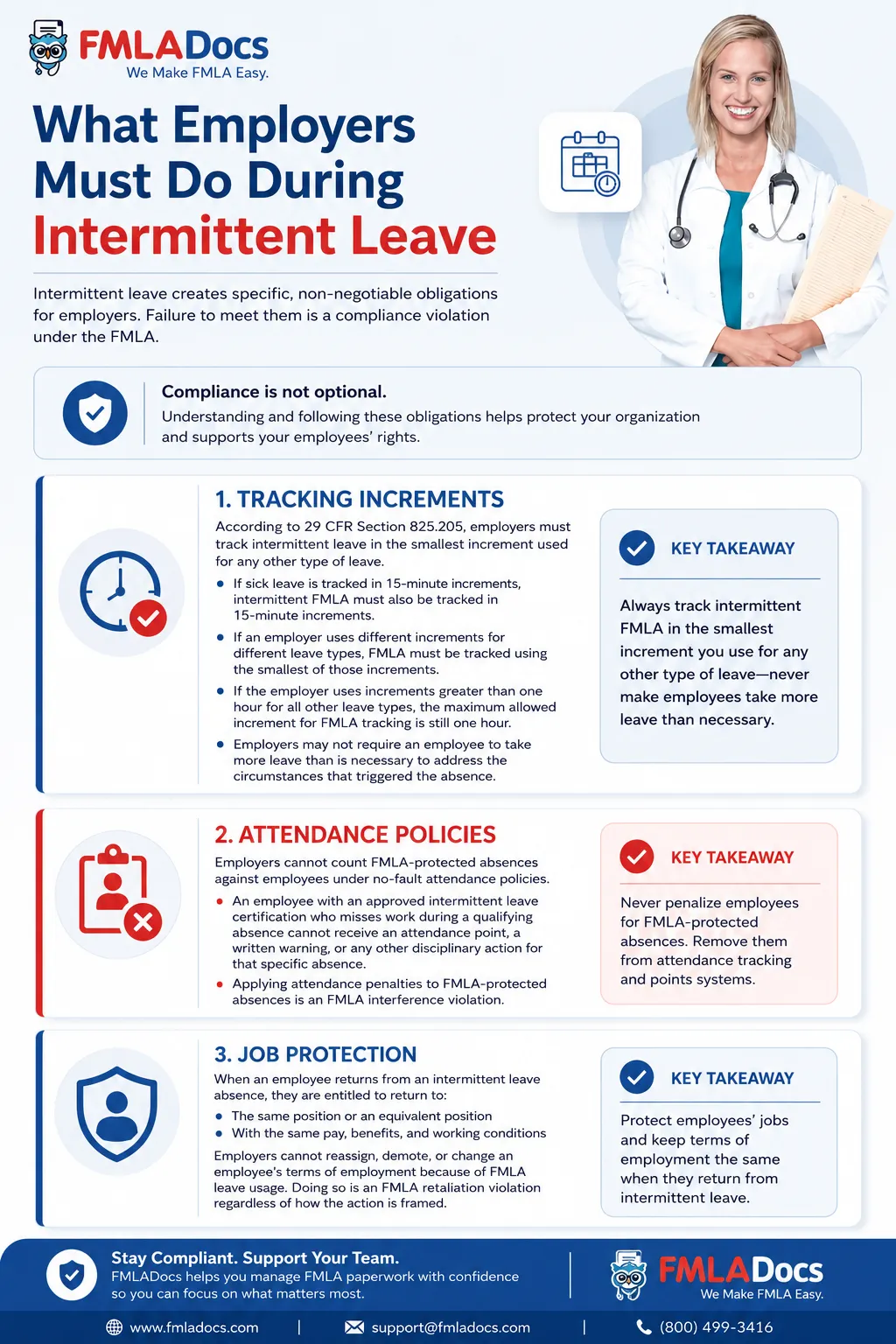
Intermittent leave creates specific, non-negotiable obligations for employers. Failure to meet them is a compliance violation under the FMLA.
Tracking Increments
According to 29 CFR Section 825.205, employers must track intermittent leave in the smallest increment used for any other type of leave. If sick leave is tracked in 15-minute increments, intermittent FMLA must also be tracked in 15-minute increments. If an employer uses different increments for different leave types, FMLA must be tracked using the smallest of those increments.
If the employer uses increments greater than one hour for all other leave types, the maximum allowed increment for FMLA tracking is still one hour. Employers may not require an employee to take more leave than is necessary to address the circumstances that triggered the absence.
Attendance Policies
Employers cannot count FMLA-protected absences against employees under no-fault attendance policies. An employee with approved intermittent leave who misses work for a qualifying absence cannot receive an attendance point, a written warning, or any other discipline for that absence. Applying attendance penalties to FMLA-protected absences is an FMLA interference violation.
Job Protection
When an employee returns from intermittent leave, they may return to the same job or to an equivalent job with the same pay, benefits, and working conditions. Employers cannot reassign, demote, or change an employee’s terms of employment because of FMLA leave usage. Doing so is an FMLA retaliation violation regardless of how the action is framed.
Conclusion
Intermittent leave is one of the most used and most misunderstood provisions of the FMLA. For employees, it is a legal right to manage a serious medical condition without losing job protection. For employers, it requires precise compliance with notice, certification, tracking, and anti-retaliation rules.
The 2026 DOL Opinion Letter FMLA2026-2 expanded coverage to include travel time to and from medical appointments. That ruling is confirmed, in effect, and changes how both employees and employers must account for intermittent leave usage.
Getting your certification completed correctly is the most important step in the entire process. Vague or incomplete certifications are the primary reason intermittent leave requests are disputed or denied. FMLADocs connects you with licensed healthcare providers who complete WH-380E and WH-380F forms correctly, including all frequency and duration fields. Start your FMLA certification at FMLADocs.com and protect your leave today.
Frequently Asked Questions
Can my employer deny intermittent leave if my absences are unpredictable?
No. Unpredictability does not disqualify a condition. The FMLA specifically recognizes that conditions like migraines, Crohn's disease, and mental health crises involve episodic and unpredictable episodes. Intermittent leave must be granted when it is medically necessary for a qualifying serious health condition, regardless of how operationally inconvenient the timing may be for the employer.
Can my employer require a doctor's note for every intermittent absence?
No. Once an intermittent leave certification is in place, employers cannot require a separate medical note for each individual absence that falls within the scope of the certification. They can require employees to follow the normal call-in procedure to report absences, but they cannot require additional medical documentation for each occurrence.
Does travel to a medical appointment count as intermittent leave?
Yes, as of January 5, 2026. DOL Opinion Letter FMLA2026-2 confirmed that travel time to and from medical appointments for a qualifying serious health condition counts as intermittent leave. This applies in both directions. Stops for personal errands during the trip are not covered.
What happens if I miss the 15-day deadline to return my certification?
If you miss the deadline without a valid reason, your employer may delay or deny the intermittent leave designation. If you miss the deadline for reasons outside your control — for example, the healthcare provider delayed completing the form — communicate this to your employer in writing immediately. Extensions may be granted in extenuating circumstances.
Can I use paid leave at the same time as intermittent FMLA leave?
Yes. Employers can require employees to use accrued paid leave such as sick time or PTO concurrently with intermittent leave. The paid leave runs at the same time. It does not extend the total FMLA entitlement. If your employer has a policy requiring use of paid leave for absences, that policy applies to FMLA absences too.
Can my employer transfer me to a different role while I'm using intermittent leave?
In limited circumstances, yes. Employers may temporarily transfer an employee to an equivalent alternative position during periods of intermittent leave if the transfer better accommodates the recurring leave. The alternative position must have equivalent pay and benefits. This is not a punitive transfer. It is a specific FMLA provision designed to reduce operational disruption, and it cannot be used as a pretext for demotion.
Meet the author
Nida Hammad
I am a professional writer with over five years of experience creating clear, engaging, and well-researched content. I specialize in healthcare topics, helping readers understand complex information in simple wording. Currently, I write for FMLA DOC, where I focus on producing accurate and trusted guides for people seeking support with FMLA and medical needs.
Get Your FMLA Certification Online in Minutes