
FMLA vs PFML: Know What Pays You and Protects Your Job
 by Anam Moin
 Last updated:
Current as of 2026. State PFML benefit limits and contribution rates may change annually based on the state average weekly wage and other statutory updates.
FMLA provides eligible employees with federal job-protected leave that may be unpaid, while PFML programs generally provide partial wage replacement under state law.
The two programs can protect the same absence, but they have separate eligibility rules, applications, benefits, and agencies.
Understanding both programs matters because qualifying for one does not automatically mean that you qualify for the other. However, when you qualify for both, they will often run at the same time for the same event.
FMLA vs PFML: Which One Pays You and Which One Protects Your Job?
The central difference in FMLA vs PFML is the role each program plays. FMLA primarily protects qualifying leave and continued group health coverage, while PFML primarily provides state-funded wage replacement and may also offer state job protections.
FMLA comes from one federal law. PFML is an umbrella term for multiple state programs, so there is no single nationwide PFML eligibility test, payment formula, or application.
This distinction creates four questions:
-
Does your employer fall under federal FMLA?
-
Do you satisfy FMLA’s employee eligibility rules?
-
Does your state operate a PFML program?
-
Does your state protect your job, pay benefits, or provide both?
Important: Approval for PFML payments does not automatically prove FMLA eligibility. Likewise, FMLA approval does not automatically qualify you for state wage-replacement benefits.
See the Difference Before You Apply: FMLA vs PFML Side by Side
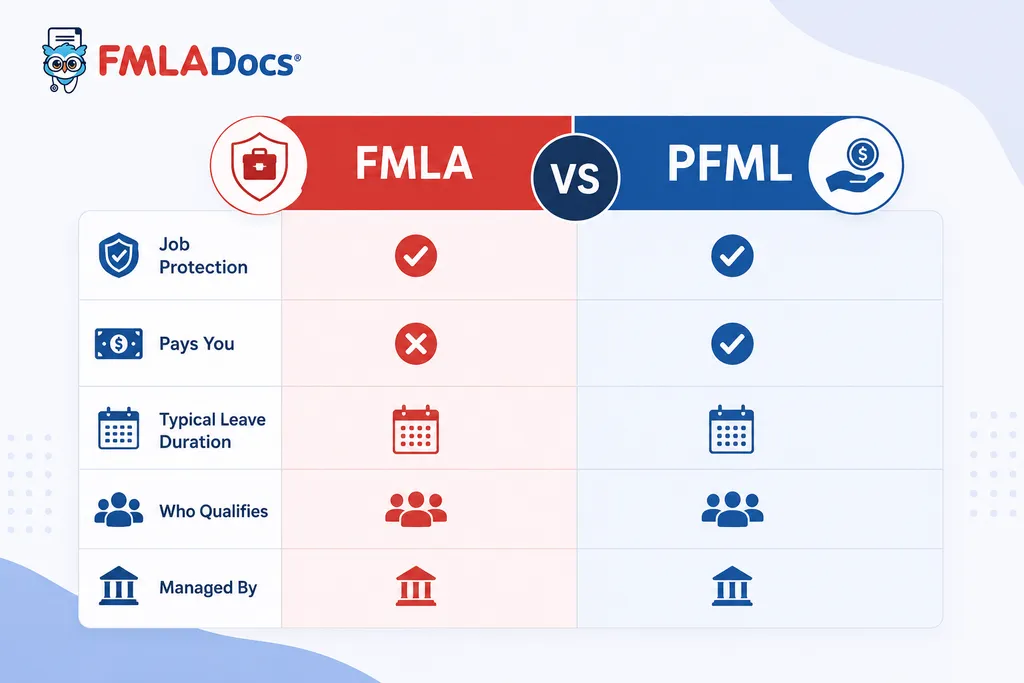
| Feature | Federal FMLA | State PFML |
|---|---|---|
| Type | Federal leave-protection law | State insurance or paid-leave program |
| Reach | Nationwide | Only where enacted |
| Payment | No required wage replacement | Partial wage replacement |
| Employer coverage | Generally private employers with 50+ employees; public agencies and schools | Often reaches smaller employers; rules vary |
| Employee eligibility | 12 months, 1,250 hours, and 50 employees within 75 miles | Often based on state earnings or hours |
| Typical leave | Up to 12 workweeks | Varies by state and leave type |
| Military caregiver leave | Up to 26 workweeks | State-specific |
| Job protection | Yes, when eligible | Conditions vary |
| Health coverage | Continued under the same conditions | Depends on state law |
| Decision maker | Employer or leave administrator | State agency or approved private plan |
| Funding | No dedicated payroll contribution | Employer and/or employee contributions |
What FMLA Gives You When Work and Life Collide
FMLA allows an eligible employee of a covered employer to take up to 12 workweeks of job-protected leave during the employer’s designated 12-month period for most qualifying reasons. It also requires continued group health benefits under the same conditions that applied before leave.
FMLA can cover:
-
Your own serious health condition.
-
Care for a spouse, child, or parent with a serious health condition.
-
Bonding after birth, adoption, or foster placement.
-
Certain needs connected with military deployment.
-
Care for a covered servicemember.
Military caregiver leave may provide up to 26 workweeks during a single 12-month period.
Does FMLA Pay You During Leave?
FMLA does not require wage replacement. You might still receive money through state PFML, employer-paid leave, accrued PTO, short-term disability insurance, or workers’ compensation.
Your employer may require available paid leave to run alongside FMLA when federal rules and company policies allow it. Payment does not necessarily extend your FMLA entitlement.
Can FMLA Protect Your Leave? Pass These 4 Tests
For standard eligibility, you generally must:
-
Work for a covered employer.
-
Have worked there for at least 12 months.
-
Have completed at least 1,250 service hours during the preceding 12 months.
-
Work where the employer has at least 50 employees within 75 miles.
Private employers generally fall under FMLA after employing at least 50 employees during at least 20 workweeks in the current or previous calendar year. Public agencies and public or private elementary and secondary schools follow broader coverage rules.
Do the 12 Months Need to Be Consecutive?
Usually not. Long breaks may affect whether earlier service counts, subject to exceptions such as covered military service or a written reemployment agreement.
How PFML Replaces Part of Your Pay While You Step Away
PFML provides partial wage replacement when you stop working or reduce your schedule for a qualifying reason. Most programs operate like social insurance funded through payroll contributions.
Medical Leave
Medical leave supports you when your own serious health condition prevents you from working.
Family Caregiving Leave
Caregiving leave may let you care for a seriously ill family member. State definitions can be broader than federal FMLA’s spouse, child, and parent categories.
Parental and Bonding Leave
Bonding leave supports time with a child after birth, adoption, or foster placement. A birth parent may use medical leave for recovery and family leave for bonding.
Military-Related Family Leave
Some programs cover qualifying needs related to a family member’s deployment or care for an injured servicemember.
Does Your State Pay PFML Benefits or Leave You With FMLA Alone?
No. PFML does not describe one federal paid-leave benefit available to every worker.
Some jurisdictions operate mandatory programs. Others offer voluntary insurance, employer benefits, paid sick leave, or no comprehensive PFML benefit.
Before applying: Identify where your work and wages count for paid-leave purposes. Remote workers should not assume that their home address alone controls coverage.
Estimate Your PFML Check Before You Plan Your Leave
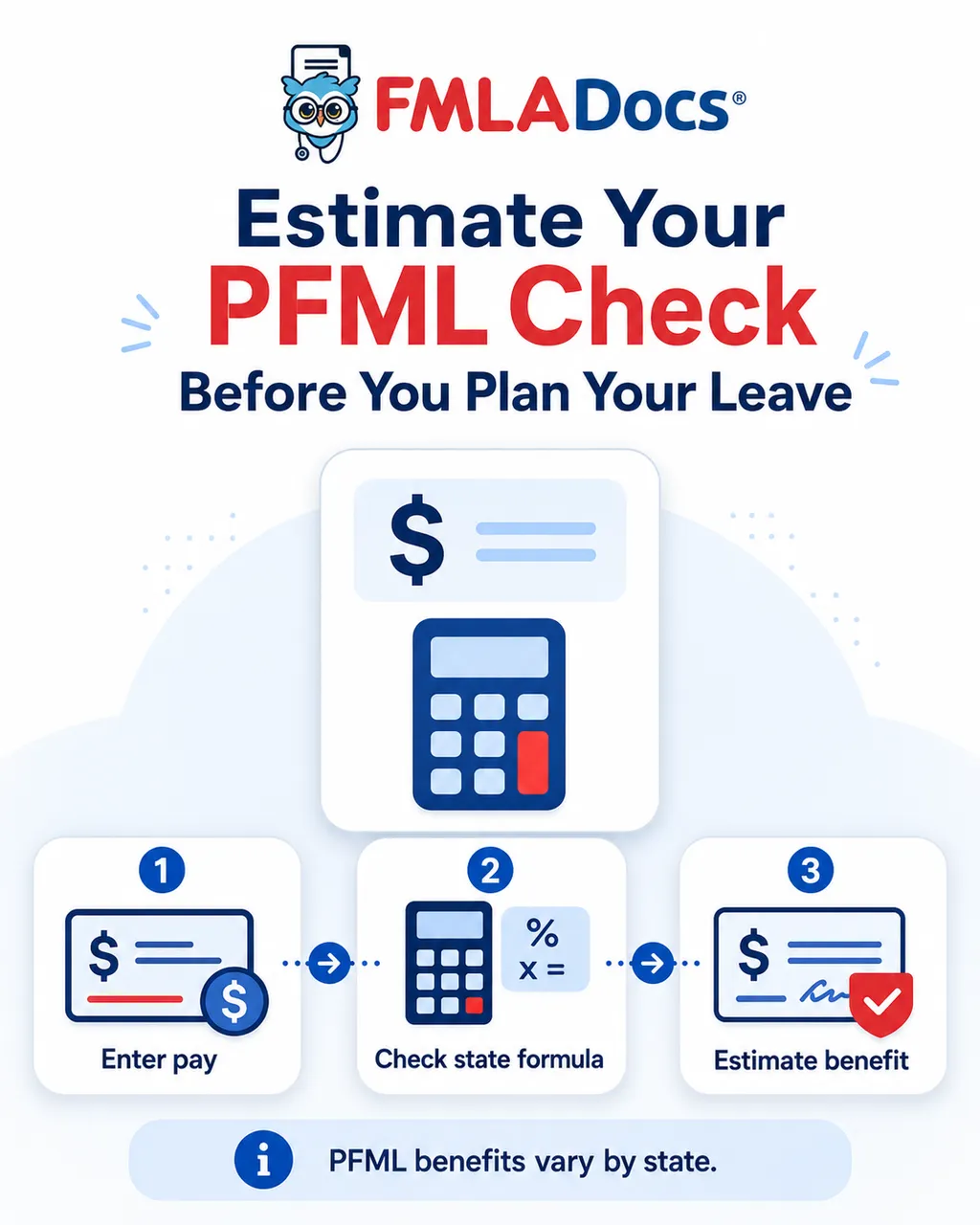
PFML usually replaces a percentage of regular earnings, not full salary. Calculations may consider:
-
Base-period wages.
-
Your individual average weekly wage.
-
The state average weekly wage.
-
A tiered replacement formula.
-
The current statutory cap.
-
Other wages or benefits.
Annual wage updates can change benefit caps.
Massachusetts PFML Benefit Calculation for 2026
Massachusetts compares your individual average weekly wage with the state average weekly wage and applies a tiered formula.
-
State average weekly wage: $1,922.48.
-
Maximum weekly benefit: $1,230.39.
Your actual benefit may be lower. The Department of Family and Medical Leave makes the official determination.
Massachusetts Benefit Example
If your average weekly earnings equal $1,000, Massachusetts does not multiply the entire amount by one flat percentage. It applies its statutory formula to portions of your wages.
Use the official estimator for planning, then wait for the agency’s approved amount.
Washington Paid Leave Benefit Calculation for 2026
Washington can replace up to 90% of typical weekly pay, depending on income.
- Maximum weekly benefit: $1,647.
The Employment Security Department determines the final amount.
Massachusetts PFML vs FMLA: More Paid Time, Different Rules
Massachusetts PFML and federal FMLA cover similar events but remain separate programs. Massachusetts can provide:
-
Up to 20 weeks of medical leave.
-
Up to 12 weeks of family leave.
-
Up to 26 weeks to care for a covered servicemember.
-
No more than 26 combined weeks per benefit year.
Category limits still apply within the combined maximum.
Massachusetts PFML Eligibility
Eligibility generally depends on covered Massachusetts earnings rather than tenure with the current employer. Massachusetts currently identifies a $6,300 prior-12-month earnings threshold plus an applicable earnings relationship test, but applicants should confirm the current standard.
Washington Paid Leave vs FMLA: What Changed for Workers in 2026
Washington workers apply through the Employment Security Department. Eligibility generally requires at least 820 qualifying hours during the applicable qualifying period, which can include work for multiple employers.
Workers may generally receive:
-
Up to 12 weeks of family leave.
-
Up to 12 weeks of medical leave.
-
Up to 16 combined weeks for multiple events.
-
Up to 18 combined weeks in certain pregnancy-related circumstances.
Could Washington Protect Your Job in 2026?
Washington expanded employment protections beginning in 2026. If you return from Paid Leave on or after January 1, 2026, you generally qualify for state job protection when your employer has at least 25 employees and you have worked for that employer for at least 180 calendar days before taking leave.
The 180-day requirement does not demand a minimum number of hours. Washington plans additional employer-size phase-downs after 2026, so check the rule that applies when you return rather than relying on an older article.
Do not rely on summaries that always require 50 employees, 12 months, and 1,250 hours for Washington PFML restoration. Those figures resemble the federal FMLA test and Washington’s former rule, but they do not state the complete 2026 PFML standard.
PFML Without FMLA: How You Could Get Paid but Lack Federal Protection
Yes. State programs often use broader employer coverage and earnings-based eligibility.
You could qualify for Massachusetts PFML after only six months with your current employer while remaining ineligible for federal FMLA. However, investigate job restoration separately.
FMLA Without PFML: How You Could Keep Your Job but Lose Your Pay
Yes. You may qualify for FMLA while working in a state without PFML, or you may fall outside a state program because of excluded employment, insufficient earnings, or work-location rules.
One program may protect your position while another supplies income.
How to Use FMLA and PFML Together Without Losing Extra Weeks
Concurrent leave means one absence counts under two programs at the same time. It does not provide twice as many weeks.
If 12 weeks of bonding leave qualifies under both laws, state benefits may pay you while the same 12 weeks reduce your FMLA balance.
Concurrency may provide:
-
PFML wage replacement.
-
Federal FMLA job protection.
-
Additional state protections.
-
Recognition of the same qualifying event.
Request written confirmation of the dates and programs involved.
Can You Stack FMLA and PFML for More Time Off?
Sometimes, but not automatically. It may occur when one program covers an event the other does not, a state recognizes more family relationships, state benefits outlast FMLA, measurement periods differ, or state law provides longer leave.
Ask your employer to explain every leave balance in writing.
Protect the Job, Not Just the Paycheck: What Each Law Really Covers
FMLA generally entitles an eligible employee to return to the same or a virtually identical position. It also prohibits interference and retaliation.
State PFML protection varies by jurisdiction, employer size, tenure, and other conditions.
Keep Health Coverage From Becoming a Surprise During Leave
During FMLA, employers must maintain group health coverage under the same conditions. You generally remain responsible for your usual employee premium share.
If PFML continues beyond FMLA, ask whether state law, company policy, COBRA, or another rule will maintain coverage.
Apply Once, Coordinate Twice: Your 5-Step Leave Plan
Step 1: Notify Your Employer
Give notice as soon as possible and follow normal leave procedures unless an emergency prevents it.
Step 2: Request Federal FMLA Information
Review the eligibility, rights-and-responsibilities, and certification notices. For certification support, explore getting FMLA certified online.
Step 3: Open a State PFML Claim
Apply through the official state agency or approved private-plan administrator. State medical documentation may differ from federal forms.
Step 4: Coordinate the Dates
Give consistent dates and specify whether leave will be continuous, reduced-schedule, or intermittent.
Step 5: Track Every Decision
Keep notices, forms, confirmations, payment records, and employer communications. Review correction or appeal deadlines immediately after a denial.
Build Your Leave File Before a Missing Document Delays You
-
Employer and work-location information.
-
Employment start date and schedule.
-
Wage information.
-
Expected leave dates.
-
Provider information.
-
Federal and state certifications.
-
Proof of a qualifying family event.
-
Military documentation when relevant.
-
Employer leave policies.
Avoid These 7 Mistakes That Delay Pay or Weaken Protection
-
Applying only to the state: State approval may not complete the employer’s FMLA process.
-
Applying only through work: Employer approval may not create state payments.
-
Expecting full salary: PFML usually replaces only part of wages.
-
Using outdated caps: Maximum payments can change annually.
-
Assuming payment guarantees reinstatement: Job protection may require another test.
-
Ignoring deadlines: Late or incomplete documents can delay leave.
-
Expecting consecutive entitlements: Concurrent leave reduces both balances together.
Know What Pays, Protect What Matters with FMLADocs
The safest approach to FMLA vs PFML is to separate payment, leave entitlement, medical certification, and job protection before coordinating them.
At FMLADocs, we help eligible employees connect with licensed healthcare providers for online FMLA medical certification. Your employer decides FMLA eligibility, and the appropriate state agency decides PFML benefit claims.
If you need federal FMLA medical certification anywhere in the United States, start your FMLA certification online
Frequently Asked Questions
Is Massachusetts PFML the same as FMLA?
No. Massachusetts PFML is a state paid-leave program, while FMLA is a federal job-protection law.
Can I receive Massachusetts PFML if my employer has fewer than 50 employees?
Possibly. Massachusetts PFML can reach workers whose employers are too small for federal FMLA, subject to state requirements.
How much does Washington Paid Leave pay in 2026?
Washington can replace up to 90% of typical weekly wages. The 2026 maximum is $1,647 per week.
Does Washington Paid Leave automatically protect my job?
Not always. Protection depends on current state rules, employer size, employment history, and leave dates.
Can Massachusetts or Washington PFML run at the same time as FMLA?
Yes. The programs commonly run concurrently when the same absence qualifies under both.
Can I get PFML if I am not eligible for FMLA?
You may qualify because state programs often use earnings or hours rather than federal tenure and employer-size tests.
Meet the author
Anam Moin
I'm Anam Moin, and my work at FMLADocs focuses on workplace leave and FMLA education. I cover certification, documentation, employee rights, and leave-related questions to provide readers with useful information when they need it most.
Get Your FMLA Certification Online in Minutes