

Can You Get FMLA for Burnout? What the Law Actually Says
 by Nida Hammad
 Last updated:
If you have been feeling completely empty at work, you are not imagining it.
FMLA for burnout is one of the most searched workplace leave topics in the United States right now, and for good reason. Millions of workers are hitting a wall that rest, weekends, and coffee cannot fix. Many people wake up feeling tired before the workday even begins. Some struggle to focus during meetings, answer emails, or complete simple tasks that once felt easy.
Burnout is no longer just a temporary feeling after a difficult week. For many workers, it has become a serious problem that affects mental health, physical health, job performance, and daily life. The question most of them are asking is whether the law actually protects them.
Workers often worry about losing their jobs if they ask for time off because of stress, anxiety, or emotional exhaustion. Some employees are afraid their managers will not take burnout seriously and this causes many people to continue working even when their health is getting worse.
The short answer is: it can. But it depends on what your burnout has done to your health. Burnout by itself is not always enough to qualify for leave under the Family and Medical Leave Act. However, if burnout has caused a serious mental or physical health condition, you may still qualify for protected time away from work.
This guide explains what the Family and Medical Leave Act (FMLA) covers and how it may help people dealing with burnout. It also explains what information a doctor must provide and the steps you can take to apply for leave. In addition, the guide covers common mistakes people make when requesting FMLA leave and how to avoid delays or problems during the approval process.
What FMLA Actually Covers: The Serious Health Condition Standard
The Family and Medical Leave Act does not list specific diagnoses. It does not say “depression qualifies” or “burnout does not qualify.” Instead, the law uses a broader legal standard called a
serious health condition.
According to the U.S. Department of Labor, a serious health condition is an illness, injury, impairment, or physical or mental condition that involves either inpatient care or continuing treatment by a healthcare provider. That second part, continuing treatment, is where burnout cases typically find their legal footing.
Continuing treatment means a health condition that keeps you unable to work or do normal activities for more than three full days in a row. You must also visit a doctor at least two times within 30 days, or receive ongoing treatment or care. It can also include long-term health conditions that sometimes make you unable to work, even if each time lasts less than three days.
This matters for burnout because burnout rarely shows up alone. It tends to travel with anxiety disorders, major depressive episodes, sleep disorders, and other diagnosable conditions. When a licensed physician documents those conditions, the FMLA door opens.
| FMLA Concept | What It Means | Burnout Relevance |
|---|---|---|
| Serious health condition | Illness requiring inpatient care or continuing treatment | Burnout with a clinical diagnosis often qualifies |
| Continuing treatment | 3+ days incapacitated plus 2+ provider visits in 30 days | Documented burnout-related conditions typically meet this standard |
| Chronic condition | Requires periodic treatment, can cause occasional incapacity | Ongoing anxiety or depression tied to burnout can qualify |
| Incapacity | Unable to work, attend school, or perform daily activities | Severe burnout affecting job performance can meet this threshold |
Is Burnout Itself a Medical Diagnosis?
The World Health Organization (WHO) recognizes burnout as a problem related to work. It describes burnout as a condition caused by long-term job stress that has not been managed well. Burnout usually includes three main signs: feeling very exhausted, feeling disconnected from work, and feeling less effective at your job.
The WHO also explains that burnout is not officially considered a medical illness. Instead, it is seen as a work-related condition that affects health. This means burnout by itself may not qualify for FMLA leave. However, burnout can lead to medical conditions such as anxiety, depression, or heart problems, and these conditions may qualify for FMLA protection.
The Centers for Disease Control and Prevention (CDC) says that workplace stress is connected to higher rates of anxiety, depression, and heart disease. When burnout becomes serious enough to cause a diagnosed mental health condition, employees may be able to receive FMLA leave.
An important step is getting evaluated by a licensed doctor. The doctor can diagnose the condition, explain the symptoms, and document how the condition affects the person’s ability to work.
How to Use FMLA for Burnout: The Step-by-Step Process
Knowing how to use FMLA for burnout is as important as knowing whether you qualify. The process has clear steps, and skipping any one of them can delay or derail your leave request.
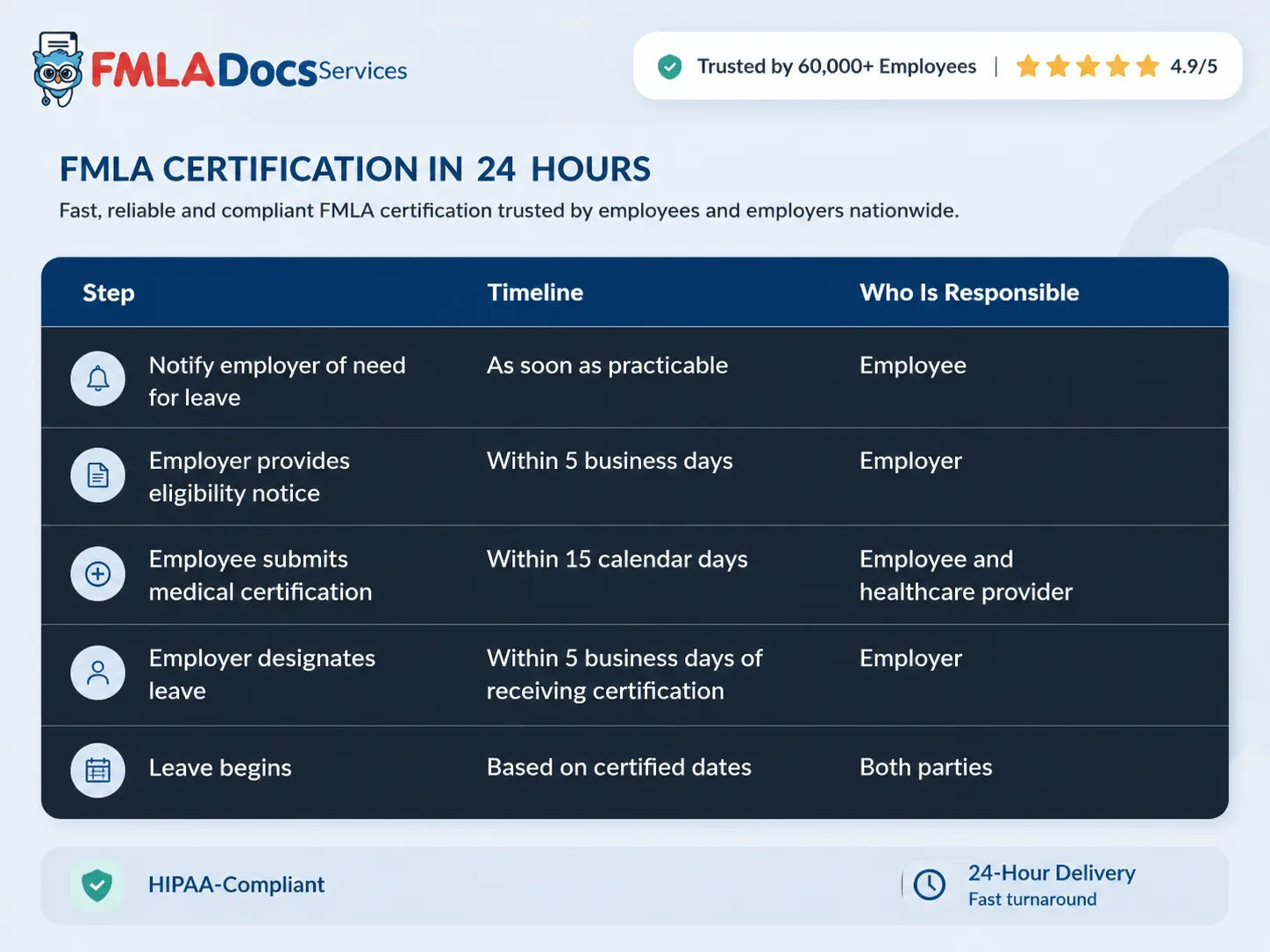
Step 1: Notify your employer
You must tell your employer that you need leave for a medical reason. You do not need to use the words “FMLA” or disclose your specific diagnosis. You just need to give enough information that a reasonable employer would understand leave may be FMLA-qualifying.
Step 2: Your employer provides the paperwork
Once you notify your employer, they have five business days to give you the FMLA Notice of
Eligibility and Rights form. This tells you whether you meet the basic employment requirements and outlines what documentation you will need to submit.
Step 3: Get medical certification
Your employer can require you to provide a completed medical certification from a licensed healthcare provider. According to the Department of Labor, you have 15 calendar days to return the completed form. A physician must complete the DOL Form WH-380-E for your own serious health condition.
Step 4: Employer approves or denies
After receiving your completed certification, your employer has five business days to notify you of your leave designation. If they deny your request, they must tell you why in writing.
Step 5: Take your leave with job protection
Once approved, you are entitled to take your leave without fear of losing your job or your group health benefits. Your employer must restore you to the same or an equivalent position when you return.
Who Qualifies for FMLA: The Basic Employment Requirements
Not every employee is automatically covered by the Family and Medical Leave Act. Before you focus on whether burnout qualifies, you need to confirm that you meet the basic eligibility requirements.
The Department of Labor has four rules that you must meet:
-
You must work for a covered employer. This usually means a private company with 50 or more employees, or a government office or public school.
-
You must have worked for that employer for at least 12 months.
-
You must have worked at least 1,250 hours in the 12 months before your leave starts.
-
Your workplace must have at least 50 employees within 75 miles.
If your employer is smaller, you may still get help from your state. Many states have their own family and medical leave laws. These laws can help workers in small companies and may also give paid leave. Some states like California, New York, Washington, Oregon, and Colorado give extra protection.
It is also worth noting that the 12 months of employment do not need to be consecutive. If you left and returned to the same employer, those earlier months may still count toward your eligibility.
What Burnout Symptoms Can Support an FMLA Claim
When a doctor checks your burnout symptoms for FMLA, they look for signs that your condition is serious enough to affect your health. Just saying you feel tired or unmotivated is usually not enough.
The National Institute of Mental Health says that conditions like depression, anxiety, and severe stress are often linked with burnout. If your symptoms match these conditions, a doctor can record them for FMLA.
Common burnout symptoms include:
-
Feeling very tired all the time, even after rest
-
Trouble focusing or thinking clearly
-
Ongoing stress or constant worrying that affects daily life
-
Physical problems like headaches, stomach pain, or chest tightness
-
Poor sleep for weeks or months
-
Avoiding work or social activities
-
Feeling hopeless or having low self-worth
The doctor does not only write your symptoms. They also check how these symptoms affect your ability to do your job. They decide if you need time off for treatment or recovery.
If you have had these symptoms for a long time, it is important to see a licensed doctor. A proper medical report is what helps you qualify for FMLA protection.
Ready to get your FMLA certification completed by a licensed physician without leaving home? FMLADocs connects you with board-certified doctors who complete your paperwork online, typically within 24 hours. Start your FMLA evaluation now and get your employer-ready certification delivered fast.
The Role of the Healthcare Provider in FMLA Certification
Your doctor does more than just write a note that says you need time off. They must fill out an official government form called DOL Form WH-380-E. This form gives detailed medical information to support your FMLA request.
The form asks the doctor to explain your medical condition and why you need leave. This includes when your condition started, how long it may last, whether it affects your ability to do important parts of your job, and if you will need ongoing treatment or care.
For burnout-related conditions, the doctor may include the diagnosis, your treatment plan (such as rest, therapy, or medicine), and how often your symptoms may come back if you take leave in small parts instead of all at once.
The American Psychological Association has reported that workplace burnout is becoming more common and is often linked with mental health conditions like anxiety and depression. Doctors who treat burnout understand this and can write reports that meet FMLA rules.
One important point: your employer may ask for a second medical opinion from another doctor. Sometimes they may even ask for a third opinion. However, your employer must pay for these extra medical checks.
Types of FMLA Leave Available for Burnout Conditions
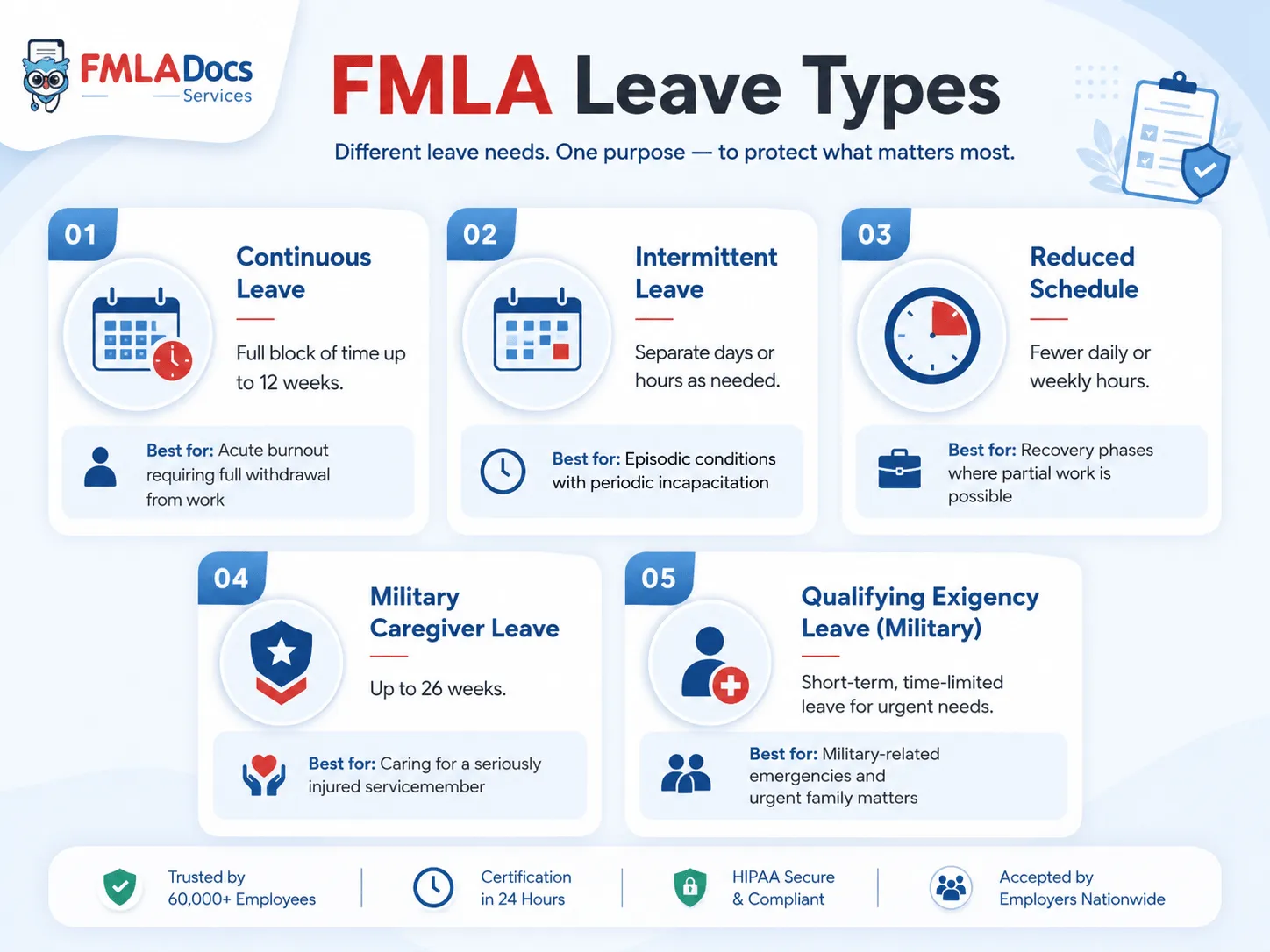
One of the most underused features of the FMLA is its flexibility. Many people assume leave must be taken all at once. That is not the case.
- Continuous leave:
This is the most straightforward option. You take a block of time off, up to 12 weeks total in a 12-month period, to treat and recover from your condition. This is appropriate when your physician determines you cannot work at all during that period.
- Intermittent leave:
This allows you to take leave in separate blocks of time for a single qualifying condition. If your burnout-related anxiety or depression causes periodic episodes where you cannot function at work, your physician can certify a pattern of intermittent need. You might take one day here, a half-day there, as your condition requires.
- Reduced schedule leave
This lets you work fewer hours per day or fewer days per week while managing your condition. This can be appropriate during a recovery phase when full-time work remains medically inadvisable but part-time work is possible.
What Your Employer Can and Cannot Do
Many employees feel afraid to ask for FMLA leave because they worry about losing their job or being punished. Knowing your rights can help reduce this fear and make you more confident.
Your employer is not allowed to stop you from using your FMLA rights. They cannot refuse your request, punish you, or interfere with your leave. They also cannot fire or discipline you for taking approved FMLA leave. They cannot count your FMLA absences under strict attendance rules. They are also not allowed to lower your pay, demote you, or threaten you for asking for or using FMLA leave.
Your employer may require you to use your paid leave, such as vacation days, sick leave, or personal days, at the same time as your FMLA leave. This means you may still get paid during your time off, but your total leave time does not increase.
Your employer can contact your doctor only to confirm or clarify the medical form. However, they cannot ask for extra medical details beyond what the official FMLA form requires.
If your employer breaks FMLA rules, you can file a complaint with the U.S. Department of Labor Wage and Hour Division or take legal action. FMLA violations are taken seriously, and employers may face penalties, as explained in the Department of Labor’s FMLA guidance.
State Laws That May Provide Additional Protection
Federal FMLA sets a floor, not a ceiling. Many states have enacted laws that expand protections well beyond the federal baseline, and some of those expansions are especially relevant for burnout-related leave.
California’s Family Rights Act applies to employers with as few as five employees. In New York, the Paid Family Leave program gives workers partial pay while they are on approved leave. Washington State also offers paid family and medical leave benefits during approved time off.
Some states also more clearly include burnout, stress, and mental health conditions as qualifying health conditions for leave. Depending on your state, you may be able to get paid leave, take a longer leave, or qualify even if you work for a smaller employer that is not covered by federal law.
It is worth reviewing your state’s specific program before assuming that federal FMLA is your only option. Your state’s labor department or department of health services can provide guidance on what programs exist and how to apply.
Common Mistakes That Get FMLA Burnout Claims Denied
Most denied FMLA claims for burnout-related conditions share a few common problems. Knowing what they are helps you avoid them.
- Failing to get a clinical diagnosis:
If your doctor documents only “stress” or “feeling overwhelmed” without connecting those symptoms to a diagnosable condition, the certification may not satisfy the serious health condition standard. You need a licensed physician who understands FMLA requirements and can properly document your clinical picture.
- Waiting too long to notify your employer:
If the need for leave is foreseeable, such as a planned treatment program, you are expected to provide at least 30 days notice when possible. For unforeseeable leave, you must notify your employer as soon as practicable, generally the same day or the next business day.
- Returning Incomplete Paperwork:
The Department of Labor (DOL) medical certification form must be completed carefully and thoroughly by your healthcare provider. Missing information, incomplete sections, or vague answers can give your employer a reason to request re-certification or even deny your leave request. Always review the form before submitting it to make sure all required sections are fully completed.
- Assuming Your Employer Will Handle Everything:
Many HR departments are not fully familiar with the details of FMLA administration. Because of this, employees often need to take an active role in the process. Be proactive by requesting the correct forms, keeping track of deadlines, and following up to ensure you receive your designation notice within the required timeframe.
Getting your certification completed by a physician who understands FMLA requirements is one of the most effective ways to avoid these common pitfalls. FMLADocs connects you with boardcertified licensed physicians who complete DOL-compliant certification forms for your specific condition.
How FMLADocs Makes the Process Simple
Most people dealing with severe burnout do not have the energy to navigate a complicated medical system. Scheduling an appointment, waiting weeks to be seen, explaining everything to a new doctor, and then hoping the paperwork gets done correctly is a lot to manage when you are already running on empty.
FMLADocs was built to remove those barriers. The process is entirely online, HIPAA-compliant,
and designed to move fast. You start by completing a straightforward intake process that captures your situation, your symptoms, and your leave needs. A board-certified licensed physician then reviews your information for medical accuracy and FMLA compliance. Once approved, you receive a signed, employer-ready FMLA certification form, typically within 24 hours.
The certification is accepted by employers nationwide. It meets DOL requirements and is completed by a licensed healthcare provider, which is exactly what your employer is legally required to accept. There are no in-person visits, no long waits, and no confusing back-and-forth with HR about whether the form is filled out correctly.
FMLADocs is trusted by more than 100,000 patients across all 50 states, maintains a 4.9 out of 5 rating, and offers an approval or money-back guarantee. For employees dealing with burnout, having a fast, reliable way to get proper documentation is often the difference between getting protected leave and going without it.
Conclusion
FMLA for burnout is not a simple yes or no. The law protects employees whose burnout has led to a serious health condition, and for millions of workers that threshold is within reach. The FMLA gives you up to 12 weeks of job-protected leave, continued health coverage, and the legal right to return to your position, all without your employer being able to penalize you for using it.
What matters most is having a licensed physician properly evaluate your symptoms, provide an appropriate clinical diagnosis, and complete the DOL medical certification form with the accuracy and specificity that FMLA requires. That documentation is the foundation of your protected leave.
Knowing how to use FMLA for burnout means understanding both the law and the process. It means notifying your employer on time, submitting complete paperwork within the 15-day window, and working with a healthcare provider who understands what FMLA certification requires.
Frequently Asked Questions
Can you get FMLA for burnout if you have never been diagnosed with anything?
You need a licensed healthcare provider to certify a serious health condition. If your burnout has not yet led to a clinical diagnosis, a physician evaluation is the first step. Many burnout cases involve anxiety, depression, or exhaustion disorders that do qualify once properly assessed. The evaluation itself can be the starting point.
How long can you take FMLA leave for burnout-related conditions?
Eligible employees may take up to 12 workweeks of FMLA leave in a 12-month period. Leave can be taken continuously, intermittently, or on a reduced schedule, depending on what your physician certifies and what your condition requires. Intermittent leave has no fixed schedule and is used as your condition demands.
Will my employer know why I am taking FMLA leave?
Your employer is entitled to know the general nature of your condition and how it affects your ability to work. They are not entitled to a specific diagnosis. The medical certification form provides functional information without requiring you to disclose more than the law requires.
Does FMLA leave have to be paid?
No. FMLA is a federal law that provides job protection, but it does not require your employer to pay you during leave. However, your employer may require you to use any accrued paid time off concurrently. If your state has a paid family or medical leave program, you may receive wage replacement benefits during your absence.
Can my employer fire me while I am on FMLA leave?
Not for exercising your FMLA rights. Your employer must restore you to the same or an equivalent position when you return from leave. If you are fired during FMLA leave, you have the right to file a complaint with the DOLWage and Hour Division or pursue legal action.
What if my employer says burnout does not qualify for FMLA?
Your employer does not make the determination about whether your condition qualifies. That determination is made based on what your licensed healthcare provider certifies. If your provider properly documents a serious health condition connected to your burnout symptoms, your employer must process your FMLA request according to the law.
Can I take FMLA leave for stress alone?
Stress alone, without a documented health condition meeting the serious health condition standard, generally does not qualify. But chronic stress that has led to a diagnosable condition such as generalized anxiety disorder, adjustment disorder with anxiety, or major depressive disorder typically can qualify. A physician evaluation will determine what your clinical picture looks like.
How do I know if my employer is covered by FMLA?
Private employers with 50 or more employees within 75 miles of your worksite are covered. All public agencies and all public elementary and secondary schools are covered regardless of size. If you are unsure about your employer's status, the DOLWage and Hour Division can help you verify coverage.
Meet the author
Nida Hammad
I am a professional writer with over five years of experience creating clear, engaging, and well-researched content. I specialize in healthcare topics, helping readers understand complex information in simple wording. Currently, I write for FMLA DOC, where I focus on producing accurate and trusted guides for people seeking support with FMLA and medical needs.
Get Your FMLA Certification Online in Minutes