

How to Get FMLA Leave for PTSD
 by Alisha Shabbir
 Last updated:
If you’ve been living with PTSD, you already know that bad days don’t announce themselves in advance. A flashback during a meeting. A week where leaving the house feels impossible. Nights that bleed into mornings with almost no sleep, and then a workday you somehow have to get through anyway. At some point, you may have wondered whether you’re actually entitled to protected time off for this, or whether your PTSD is somehow “not enough” to qualify.
It is enough. PTSD qualifies for FMLA, and the law is clear on this. This guide covers what you actually need to know: whether your specific symptoms meet the legal threshold, how continuous and intermittent leave work differently, what to say to your employer and what you’re not required to share, and how to get certified without the weeks-long runaround that comes with trying to do it through a traditional doctor’s office.
Does PTSD Qualify for FMLA?
Post-traumatic stress disorder qualifies for FMLA when it meets the federal definition of a “serious health condition.” For most people actively managing PTSD, it does. Under the Family and Medical Leave Act, a serious health condition is one that involves either inpatient care or continuing treatment by a healthcare provider. PTSD qualifies on the continuing treatment path, which the Department of Labor’s Fact Sheet 28O explicitly confirms for mental health conditions.
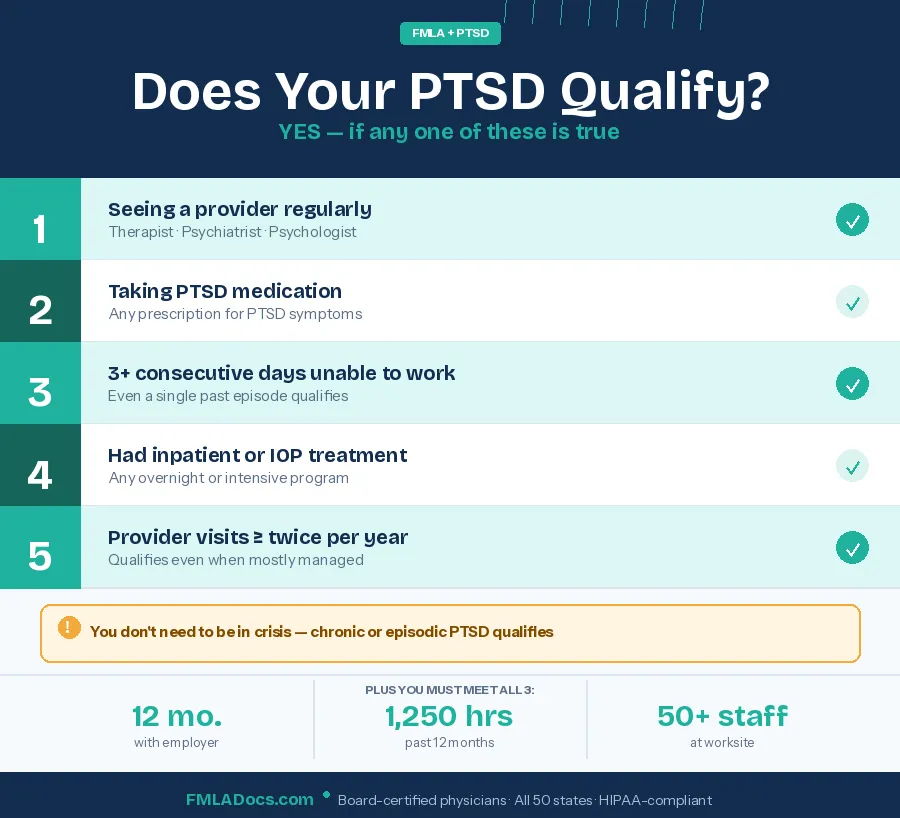
Understanding qualifying conditions for FMLA leave is important because the threshold is more accessible than most people expect. Your PTSD very likely qualifies if any of the following are true:
-
You see a therapist, psychiatrist, or psychologist on a regular basis
-
You take medication prescribed for PTSD or its symptoms
-
Your symptoms have ever made you unable to work or function normally for three or more consecutive days
-
You’ve had an inpatient or intensive outpatient treatment stay
-
Your provider visits occur at least twice a year for an ongoing condition
That last point is worth noting for people whose PTSD is mostly managed but occasionally flares. You don’t have to be in active crisis to qualify. Chronic PTSD that causes episodic incapacity, even periodic bad days requiring occasional time off, qualifies under FMLA’s chronic condition standard.
Important Note: PTSD is also not only a veteran’s condition, which is a misconception that keeps a lot of people from even asking the question. First responders, ER workers, survivors of accidents, assault, or abuse, frontline workers who went through the pandemic, any traumatic experience can result in PTSD. According to the National Institute of Mental Health, an estimated 3.6% of U.S. adults experience PTSD in a given year, making it one of the most common reasons employees seek mental health FMLA certification.
Moreover, your FMLA eligibility beyond having a qualifying condition comes down to three things: you need to have worked for your employer for at least 12 months, logged at least 1,250 hours in the past 12 months, and work at a location with 50 or more employees within 75 miles. Meet those criteria and you’re receiving treatment for PTSD, and the qualification question is essentially settled.
Continuous vs. Intermittent FMLA for PTSD - Which One Fits Your Situation?
Most people assume FMLA means taking 12 weeks off in a single block. That’s one option, but it’s not the only one, and for PTSD, it’s often not the right one.
Continuous leave is a single uninterrupted period away from work. It makes sense when symptoms have become severe enough that you genuinely can’t work for an extended stretch, during inpatient or intensive outpatient treatment, following a major triggering event, or when your treatment plan requires stepping away from work entirely while you stabilize.
Intermittent FMLA is the more common fit for people managing PTSD long-term. It lets you take leave in smaller pieces, hours, a single day, a couple of days, rather than disappearing from work for weeks at a time. You can use it for weekly therapy appointments, for days when flashbacks or hypervigilance make it impossible to work, or for recovery time following a triggering event.
The unpredictable nature of PTSD is actually one of the reasons it works so well with intermittent leave. Your certification can reflect episodic incapacity, which means you’re protected even on days you couldn’t have predicted needing off.
| Factor | Continuous FMLA | Intermittent FMLA |
|---|---|---|
| Leave Structure | Single uninterrupted block | Separate hours, days, or periods |
| Best For | Acute episodes, inpatient treatment, extended recovery | Therapy appointments, symptom flare-ups, trigger days |
| Advance Notice Required | 30 days when foreseeable | As soon as practicable |
| Total Time Available | Up to 12 weeks per year | Up to 12 weeks (combined) per year |
| Flexibility | Low | High |
| Common for PTSD? | Less common | Most common |
One thing most people miss: choosing intermittent leave doesn’t reduce the total protected time available to you. You still have up to 12 weeks per year. You’re just using it in pieces that actually fit how PTSD works.
How to Get FMLA Certification for PTSD
Getting FMLA certified for PTSD doesn’t have to take weeks. Here’s how the process works in practice.
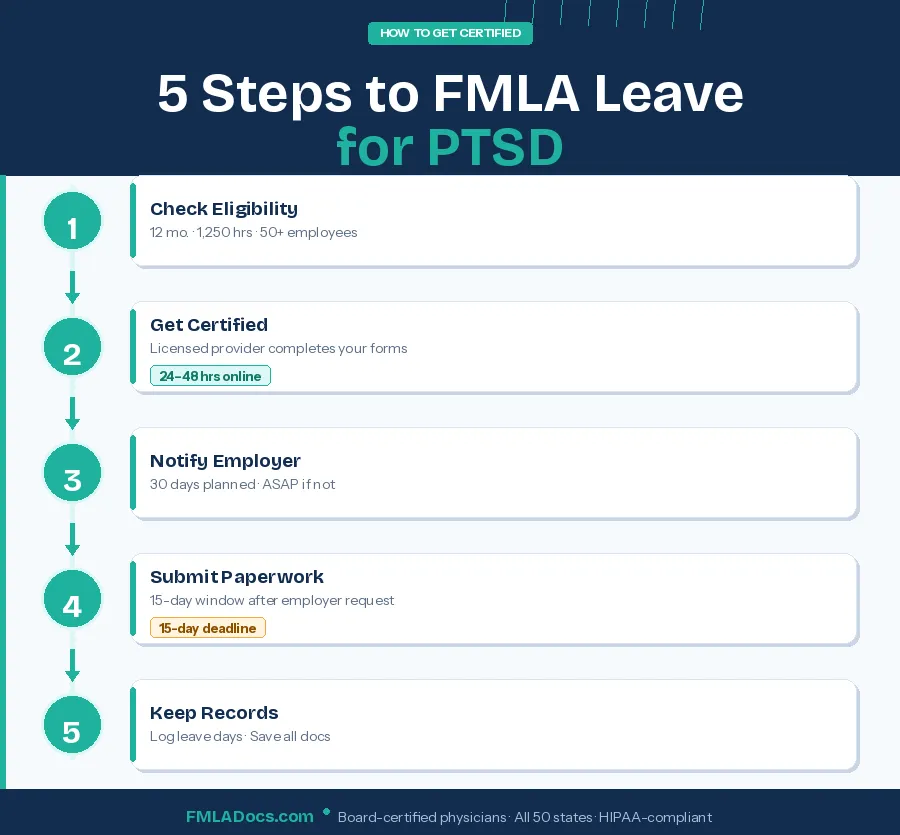
Step 1: Confirm your eligibility.
Before anything else, verify the three criteria: 12 months with your employer, 1,250 hours in the past 12 months, and employer size. If you’re unsure about your hours or status, your HR department is legally required to provide eligibility information once you make a leave request.
Step 2: Get your medical certification completed.
This is the core document your employer will rely on. It must come from a licensed healthcare provider, a physician, psychiatrist, psychologist, or clinical social worker, and it needs to establish that you have a serious health condition and indicate the type and estimated duration of leave you need. Importantly, it does not require your provider to disclose your full diagnosis or treatment history.
This step is where most people get stuck. Primary care offices frequently take two to three weeks to complete FMLA paperwork and many charge additional fees. If you don’t have a current provider, or yours doesn’t specialize in mental health, the traditional path can feel like it creates more stress than it relieves. Online FMLA certification through board-certified psychiatrists and psychologists who specialize in this documentation is a significantly faster option, more on that in the next section.
Step 3: Notify your employer.
For foreseeable leave, give at least 30 days’ notice. For unforeseeable leave, notify your employer as soon as you reasonably can. You don’t have to say “I have PTSD.” You need to give enough information for them to recognize you’re requesting FMLA for a serious health condition.
Step 4: Submit your paperwork and watch the deadlines.
Your employer has five business days to respond to your leave request. After they request your medical certification, you typically have 15 days to submit it. Missing that window can result in denial regardless of whether your condition qualifies. Not submitting the paperwork on time is among the most common FMLA mistakes to avoid.
Step 5: Keep your own records.
Once approved, save copies of everything submitted and received, and log every day and hour of leave you use. If you’re on intermittent leave, track each instance. This protects you if your employer later disputes usage or attempts to count absences against you.
What to Tell Your Employer And What You’re Not Required to Share
A lot of people hesitate to pursue FMLA because they’re worried about what their employer will find out. The privacy protections here are considerably stronger than most people realize, and understanding them tends to make the whole process feel a lot less threatening.
You are not required to tell your employer you have PTSD. You don’t have to hand over therapy notes, psychiatric evaluations, or anything from your treatment history. What you do need to provide is a completed medical certification from your provider. That document confirms you have a serious health condition and explains the general nature and expected duration of your need for leave, but it doesn’t require a specific diagnosis to reach your manager or HR.
Whatever medical information you do provide, your employer is legally required to keep it confidential, stored separately from your regular personnel file. Your manager can be told you’re on approved leave and whether you have work restrictions. They don’t get to know why, and they don’t get access to your documentation.

The retaliation protections are just as firm. Your employer cannot discipline you, pass you over for a promotion, change your schedule punitively, or terminate you because you took approved FMLA leave. Knowing the full scope of your FMLA employee rights matters here because employer pushback on mental health leave is more common than it should be, and knowing exactly where the line is gives you leverage. These are federal protections, and violations carry real legal consequences for employers.
It’s also worth knowing that PTSD may qualify you for separate protections under the Americans with Disabilities Act, which operates independently of FMLA. The EEOC’s guidance on PTSD in the workplace covers your rights to reasonable accommodations under the ADA, including extended leave beyond FMLA’s 12 weeks if your condition meets the disability standard. The two laws can work together, not just separately.
Online FMLA Certification for PTSD — Fast, Private, and Accepted Nationwide
The traditional certification path means getting an appointment with a psychiatrist or PCP, often two to four weeks out, explaining your full situation to a provider who may have little experience with FMLA documentation, waiting for forms to come back, and following up when something’s incomplete. If your PTSD involves anxiety or avoidance of overwhelming processes, which it often does, that entire chain can feel like a wall designed to stop you.
On the other hand, online FMLA certification eliminates that friction. At FMLADocs, board-certified psychiatrists and psychologists who specialize in mental health FMLA documentation complete your certification remotely, typically within 24 to 48 hours. Everything is HIPAA-compliant, handled from home on your schedule, and accepted by employers in all 50 states.
| Factor | Online FMLA Certification (FMLADocs) | Traditional Doctor Visit |
|---|---|---|
| Time to Complete | 24-48 hours | 1-3 weeks |
| Cost | Affordable flat fee | $100-$300+ (plus missed work) |
| Convenience | From home, any time | Office hours only |
| PTSD/Mental Health Specialization | Yes — licensed psychiatrists and psychologists | Varies widely |
| Employer Acceptance | Yes, all 50 states | Yes |
| Privacy | HIPAA-compliant, fully remote | In-person, potential for difficult conversations |
| Follow-up Support | Included | Requires additional appointment |
For PTSD specifically, working with a provider who understands the condition isn’t just about speed. It’s about ensuring your certification accurately reflects whether you need intermittent or continuous leave, and frames your condition in the language that holds up when an employer reviews it.
Conclusion
PTSD is a recognized, serious health condition under federal law, and you have a right to protected leave to manage it. Whether you need a full block of time for intensive treatment or the flexibility to protect yourself on the days when symptoms take over, FMLA has a structure that works for your situation. Your employer doesn’t need your diagnosis. Your privacy is protected. And getting certified for FMLA for PTSD doesn’t require navigating a provider who doesn’t understand your condition or waiting three weeks for paperwork to come back.
Your mental health deserves protection. Get your FMLA certification today with board-certified providers, all 50 states, certifications delivered in 24-48 hours.
Frequently Asked Questions
Can you get FMLA for PTSD?
Yes. PTSD qualifies for FMLA as a serious health condition when it requires ongoing treatment by a licensed healthcare provider, such as regular therapy or psychiatric care, or when it causes periods of incapacity lasting more than three consecutive days. The Department of Labor explicitly recognizes mental health conditions including PTSD as qualifying under FMLA.
Is PTSD a qualifying condition for FMLA?
Yes. PTSD qualifies under the serious health condition standard when it involves continuing treatment, such as therapy or psychiatric medication management, or causes periods of incapacity. Chronic PTSD that causes episodic incapacity and requires treatment at least twice per year also qualifies under FMLA's chronic condition standard, even without a current acute episode.
Does my employer have to know I have PTSD to approve my FMLA?
No. You're not required to disclose your specific diagnosis. You need to provide a medical certification from a licensed provider confirming you have a serious health condition and explaining the general nature and expected duration of your leave needs. Your employer cannot demand psychiatric records or a detailed diagnosis, and any medical information you do provide must be kept confidential and stored separately from your personnel file.
Does FMLA protect you from being fired for PTSD?
FMLA protects you from retaliation for using approved leave. Your employer cannot fire you, demote you, reduce your hours, or discipline you because you took FMLA leave for PTSD. If your leave was properly certified and you followed notification requirements, your job, or a substantially similar one, must be available when you return. Retaliation for FMLA use is a federal violation.
How long can you take FMLA leave for PTSD?
Eligible employees can take up to 12 weeks of unpaid, job-protected leave per 12-month period, either continuously or intermittently. If your PTSD also qualifies as a disability under the ADA, your employer may be required to provide additional leave beyond 12 weeks as a reasonable accommodation even after your FMLA entitlement is exhausted.
Can a virtual doctor fill out FMLA paperwork?
Yes, when the clinician is a licensed healthcare provider and has evaluated you. FMLADocs uses a telehealth evaluation. The provider completes the medical certification only if a serious health condition is documented. Employers accept a complete certification from a licensed provider; they do not require an in-office visit. Approval of leave is the employer's decision.
Can FMLA be denied with a doctor's note?
Yes. A signed certification does not force the employer to approve leave. The employer can ask for a complete form, a second opinion, or deny leave if you are not an eligible employee. FMLADocs provides the medical certification. HR still applies the 12-month / 1,250-hour rules and job-protection rules.
How is FMLA certified?
Your employer gives you the WH-380-E or WH-380-F form. A licensed provider completes the medical facts, dates, and duty limitations. FMLADocs collects your history online and the provider completes the form when a serious health condition is present. Return the form to HR within the deadline they give you.
How long does FMLA certification last?
The certification covers the period the provider documents — a continuous block or intermittent episodes. Employers may request recertification later, often every 30 days for ongoing conditions or when leave use changes. If your condition changes, start a new evaluation so the form matches current limitations.
Where can I get my FMLA paperwork filled out online?
FMLADocs is an online evaluation for FMLA medical certification. You complete intake, a licensed provider reviews whether a serious health condition is documented, and — if so — completes the form. This is not legal advice and not a guarantee that HR will approve leave. Use the certification with your employer's FMLA process.
Why are doctors so hesitant to fill out FMLA paperwork?
Many clinics treat FMLA forms as unpaid paperwork and will not complete them without a visit. Telehealth providers who handle certification as part of the evaluation can complete the form when the medical criteria are met. FMLADocs does that review. The provider will not sign if the record does not support a serious health condition.
Are online FMLA doctors legit?
Online FMLA services can be legitimate when a licensed provider authorized in your state evaluates you and completes the DOL certification form. You complete a medical intake, and the provider decides whether your condition may meet the FMLA's serious health condition standard. Only eligible employees are covered, and qualification is never guaranteed. Start your evaluation below.
Can I be fired if my FMLA is denied?
It can happen. If you are not eligible, or your certification is late or incomplete, your absence may not be FMLA-protected, and normal attendance policies can apply. Employers cannot retaliate against employees for requesting FMLA leave. A licensed provider evaluates whether your condition qualifies, and no outcome is guaranteed. Start your certification below.
Can I be fired while on FMLA leave?
Not because you took leave. Eligible employees on FMLA-protected leave cannot be fired for requesting or using it. However, employers may act on reasons unrelated to leave, such as a layoff that would have happened anyway, and fraudulently obtained leave is not protected. A licensed provider evaluates whether you qualify; no outcome is guaranteed. Start your certification below.
Can I call in sick if I'm not sick?
You shouldn't. Misstating the reason for an absence can violate employer policy and put your job at risk. If a health condition, including a mental health condition, limits your ability to work, eligible employees may qualify for FMLA-protected leave. A licensed provider evaluates your situation, and no outcome is guaranteed. Start your certification below.
Can I Get an FMLA Certification for PTSD Without Seeing a Doctor?
Not without an evaluation. A legitimate note comes from a licensed provider who reviews your medical history and symptoms, often through a secure online visit. For FMLA, eligible employees may need certification, and some conditions require in-person treatment under federal rules. The provider decides whether you qualify, and no outcome is guaranteed. Start your evaluation below.
Can I Take FMLA Leave for PTSD?
Possibly. Stress alone is not a qualifying diagnosis, but anxiety or depression may be a serious health condition when it limits your ability to work and involves continuing treatment. A licensed provider, not only a psychiatrist, can evaluate. Only eligible employees qualify, and no outcome is guaranteed. Start your evaluation below.
How Long Do I Have to Return My FMLA Paperwork for PTSD?
Eligible employees generally have at least 15 calendar days after the employer's request to return certification. If the form is incomplete, your employer generally must allow seven calendar days to correct it. A licensed provider completes the medical sections, and no outcome is guaranteed. Start your certification below.
Will My Employer Accept an Online FMLA Certification for PTSD?
Your employer reviews whether the certification is complete and sufficient. It may request clarification or, in some cases, a second opinion. A licensed provider completes the form after an evaluation, only eligible employees qualify, and no outcome is guaranteed. Start your evaluation below.
Meet the author
Alisha Shabbir
Alisha is a health content specialist with 7 years of experience writing about employee benefits, medical leave, and healthcare access. With a background in healthcare communications, she breaks down complex regulations and medical topics into practical, actionable guidelines. From workplace wellness to preventive health, she helps readers navigate the healthcare system with confidence. When she's not working, she enjoys long walks, baking, and spending time with her pets.
Get Your FMLA Certification Online in Minutes