
FMLA and Short-Term Disability Extension: What to Do Next
 by Areeba Imran
 Last updated:
When 12 weeks of FMLA and short term disability extension planning becomes critical, most employees face a harsh reality. Your FMLA job protection ends before your doctor clears you to work. Short-term disability insurance fills this gap by replacing your income while you finish healing. The two benefits work together, but they protect different things. FMLA holds your job. STD pays your bills.
This guide shows you exactly how extending FMLA with short term disability works in practice. You’ll learn when each benefit starts and stops. You’ll see how to manage medical paperwork for both programs at once. You’ll discover what happens to your job after those 12 weeks expire. Most importantly, you’ll understand the coordination order that maximizes both your income and your job security.
We’ll walk through the core differences between job protection and income replacement. Then we’ll cover the certification overlap that trips up most employees. Finally, you’ll get a clear return-to-work strategy for life after FMLA runs out. By the end, you’ll know exactly how to coordinate FMLA and short term disability extension benefits without losing either one.
What Is the Difference Between STD and FMLA? Understanding FMLA and Short Term Disability Extension
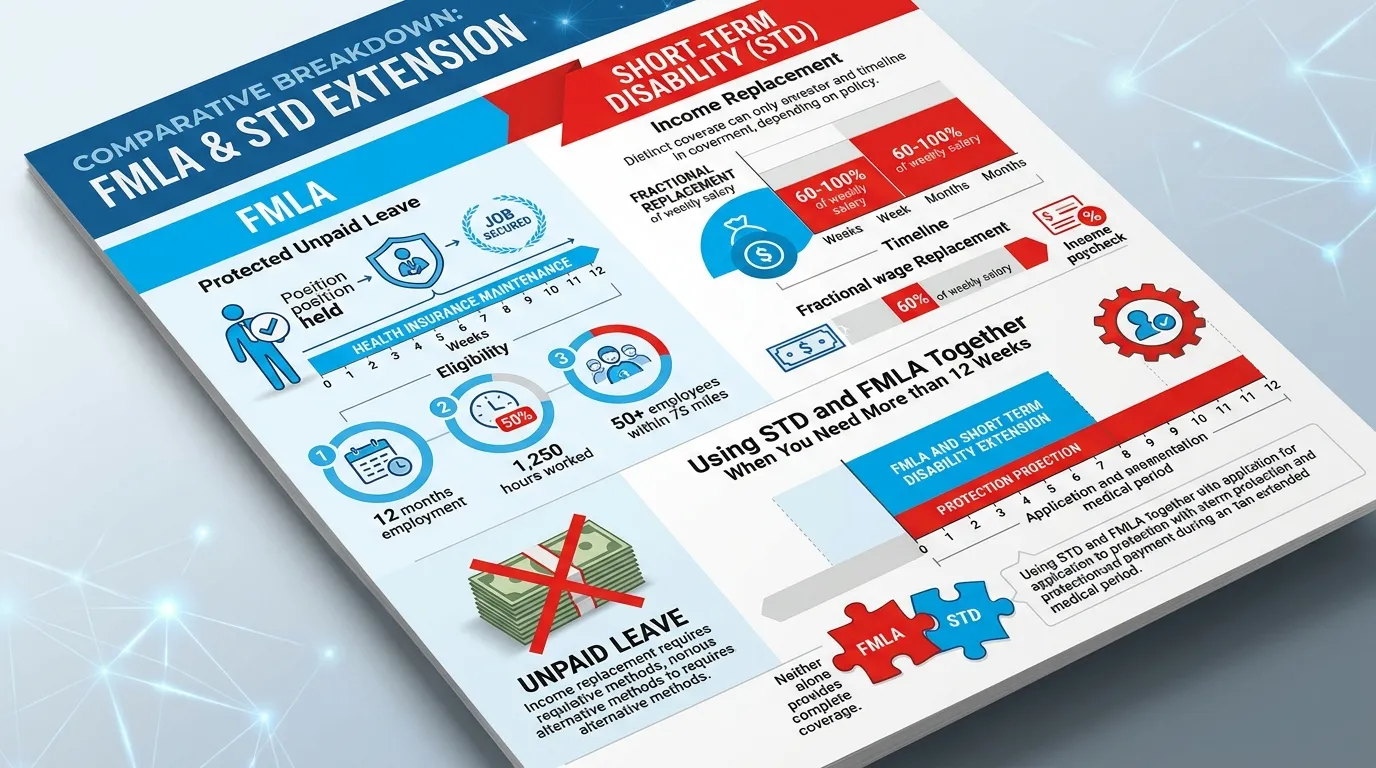
When you face a serious health condition, understanding federal law for medical leave and disability benefits can feel overwhelming. FMLA and short-term disability serve different purposes. One protects your job. The other replaces your income. Neither alone provides complete coverage during extended medical leave.
Many employees assume these programs work the same way. They don’t. You can qualify for one without qualifying for the other. This makes understanding both critical when planning for medical leave beyond 12 weeks.
FMLA: Job Protection Without Pay
FMLA provides up to 12 weeks of job-protected unpaid leave per year. Your employer must hold your position and maintain your health insurance. But you won’t receive a paycheck unless you use accrued PTO or other benefits.
To qualify, you need three things:
-
12 months of employment with your current employer
-
1,250 hours worked in the past 12 months
-
Your employer has 50+ employees within 75 miles of your worksite
FMLA covers serious health conditions that require inpatient care or continuing treatment. This includes surgery recovery, chronic conditions like diabetes or migraines, mental health conditions, pregnancy complications, and caring for a family member with a serious condition.
Your specific position gets protected. When you return, your employer must restore you to the same job or an equivalent one with identical pay, benefits, and working conditions.
Short-Term Disability: Income Without Job Protection
Short-term disability insurance replaces 50-70% of your income during medical leave. Coverage typically lasts 3-6 months. But STD doesn’t guarantee your job will be there when you recover.

Eligibility depends on your situation. Your employer might offer coverage as a benefit. You might have purchased an individual policy. Or you might live in one of five states with mandatory disability insurance.
Those five states are:
-
California
-
New York
-
New Jersey
-
Rhode Island
-
Hawaii
STD covers your own medical conditions only. You can’t use it to care for a family member. The insurance company reviews medical documentation and decides if your condition qualifies. Getting proper STD documentation from a healthcare provider is essential for approval.
Without FMLA protection running concurrently, your employer could legally terminate you while you’re collecting STD benefits.
Why the Distinction Matters for Extended Leave
The difference becomes critical when you need leave beyond 12 weeks. FMLA protection ends after 12 weeks. If you’re still disabled and receiving STD payments, you lose job protection unless your employer provides additional accommodation. This is covered in detail in federal law for medical leave.
Using FMLA and STD together gives you both income and job security. You file for both simultaneously. FMLA protects your position while STD replaces your paycheck. This coordination works for the first 12 weeks.
After FMLA expires, you’re in a vulnerable position. You might still be medically unable to work and receiving STD benefits. But your employer no longer has a legal obligation to hold your job. Some employers provide extended leave policies. Others don’t.
This gap catches many employees by surprise. They assume disability benefits include job protection. They don’t. Planning for this scenario before taking leave prevents difficult situations later.
Job Protection vs Income Replacement: How Each Benefit Works
Understanding the difference between FMLA and short-term disability is critical. FMLA protects your job. STD replaces your income. These are two separate benefits that often run at the same time.
Many employees confuse the two. They assume FMLA provides a paycheck. It doesn’t. You need both benefits working together to stay financially stable during medical leave.
What FMLA Job Protection Actually Covers
FMLA guarantees restoration to the same position or equivalent role. Your pay, benefits, and working conditions must remain unchanged. This protection lasts up to 12 weeks per year.
During leave, your employer must maintain your health insurance. The terms stay the same as if you were working. You still pay your premium share, but coverage continues without interruption.
What FMLA doesn’t provide is income. Federal FMLA and STD work together because FMLA handles job security while STD handles paychecks. Without STD or other income sources, you’re taking unpaid time off.
How Short-Term Disability Calculates Your Benefits
Most STD plans replace 50-70% of your gross salary. According to ADP, these benefits are subject to weekly or monthly caps. State disability programs typically pay 55-70% up to a maximum weekly benefit amount.
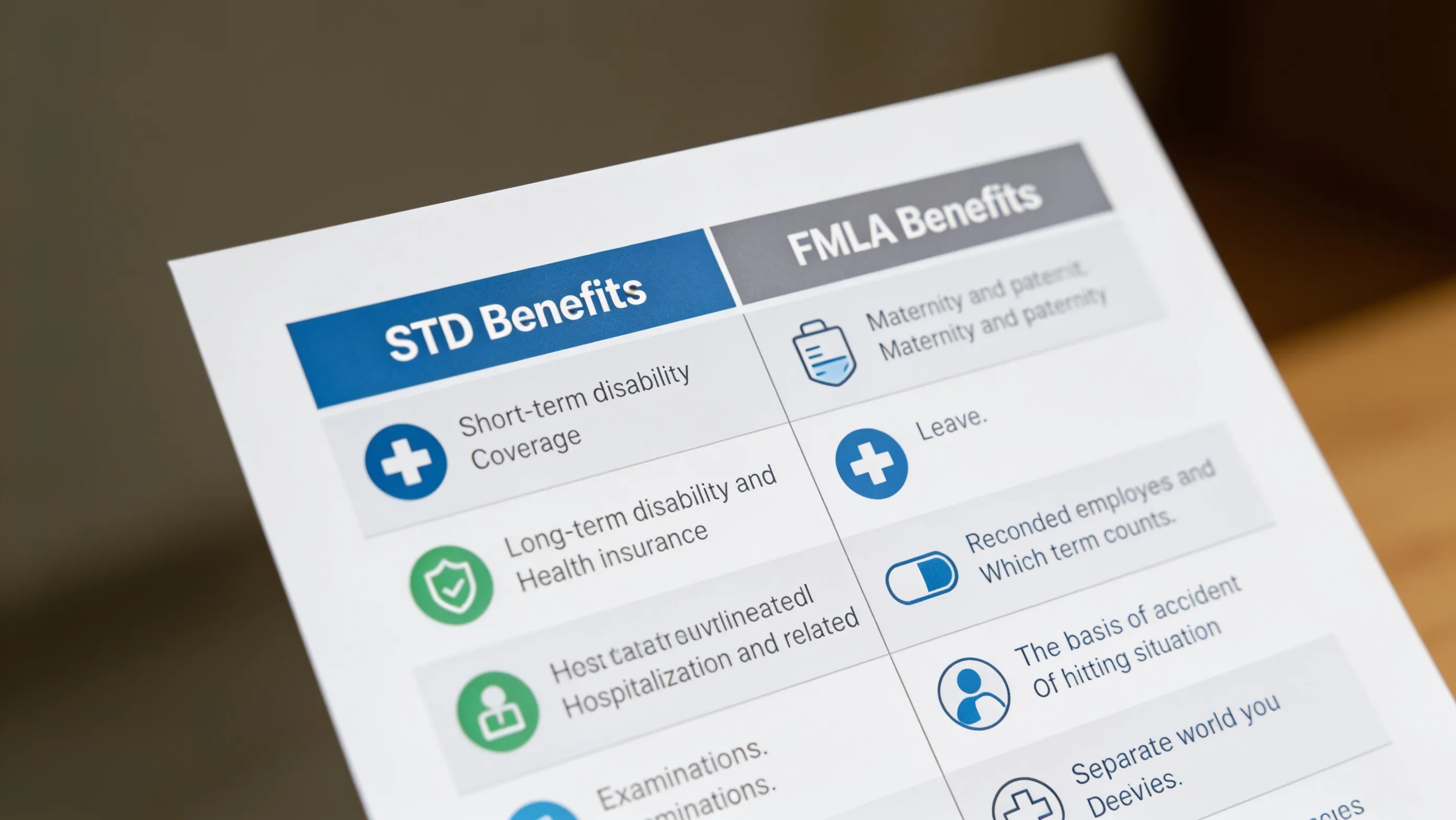
The calculation depends on who paid the premiums. Employer-paid premiums make benefits taxable. Employee-paid premiums mean tax-free benefits. This affects your actual take-home amount during leave.
State programs vary significantly. California’s State Disability Insurance pays 60-70% of wages. New York’s program caps at $170 per week. Check your state’s specific rates before planning your budget.
The Gap Between Protection and Payment
Here’s where employees get caught off guard. You’re still responsible for your portion of health insurance premiums during leave. This comes out of your reduced STD income, not your regular paycheck.
Budget for 30-50% income reduction during disability leave. This prevents financial shock when your first STD payment arrives. Some employers supplement STD with additional pay or allow PTO use to increase income.
The timing creates another gap. FMLA starts immediately when approved. STD often has a waiting period of 7-14 days. You may need to use sick time or PTO to bridge this gap before STD payments begin.
Coordination Order: When STD and FMLA Run Together
When you need both short term disability and FMLA, understanding how they work together prevents confusion. Most employees assume these benefits run one after the other. That’s not how it works. Both programs run concurrently during your leave, meaning they overlap rather than extend each other.
The Concurrent Coverage Period
Your FMLA clock starts ticking the moment your leave begins. STD payments start based on your policy’s waiting period, often after one to two weeks. During the first 12 weeks, you get job protection from FMLA and partial income replacement from STD at the same time.
This concurrent structure means STD doesn’t extend your FMLA entitlement beyond 12 weeks. They’re separate programs with different purposes. FMLA protects your job. STD replaces a portion of your income. Both serve you simultaneously during the overlap period.
What Happens During the First 12 Weeks
You maintain full job protection while receiving STD benefits. Your employer must hold your position and continue your health insurance. You pay your normal premium share. STD typically covers 50-70% of your salary during this time. Read the full breakdown in run concurrently during your leave.
Your employer can require you to use accrued PTO concurrently with both benefits. This means your vacation or sick days run alongside FMLA and STD. Some employees prefer this to maximize income. Others want to save PTO for after STD ends.
Employer Requirements During Overlapping Benefits
Your employer must maintain clear communication about both programs. They should explain how the benefits coordinate and what happens after 12 weeks. Keep HR updated on your expected return date throughout your leave.
After 12 weeks, FMLA job protection ends. STD benefits can continue for several more months if you’re still medically unable to work. Your employer no longer must hold your specific position once FMLA expires. You may have protection under ADA if your condition qualifies as a disability.
Certification Overlap: Managing Medical Documentation for Both Programs
When you need both FMLA and short term disability, you face two separate certification processes. Your doctor must complete different forms for each program. FMLA requires DOL Form WH-380-E for your own condition or WH-380-F for family care. STD carriers use their own proprietary medical forms with different questions and requirements.
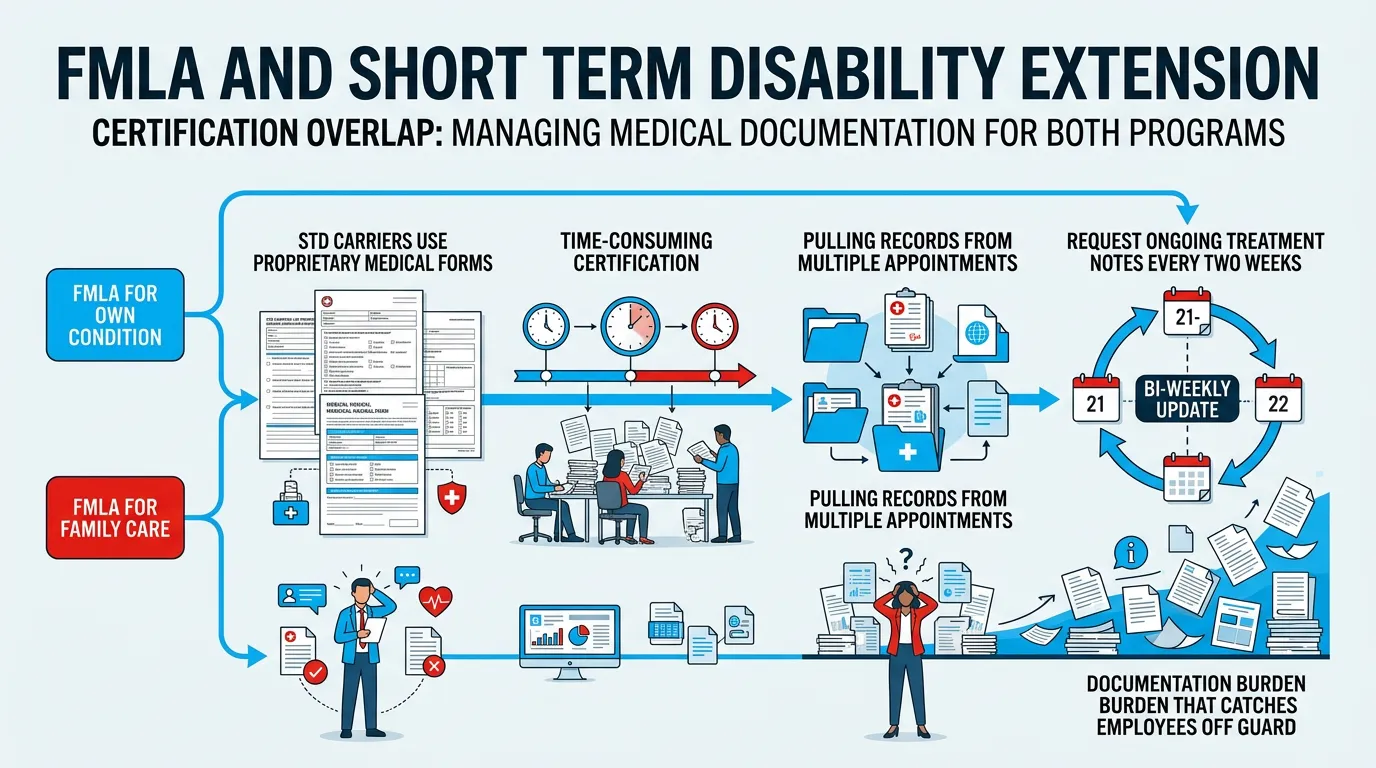
The documentation standards differ significantly between programs. FMLA certification must include your diagnosis, treatment plan, expected duration, and how your condition affects work ability. STD documentation typically requires more detailed clinical information. This includes test results, treatment notes, and prognosis. Carriers want proof you cannot perform your job duties and need income replacement.
Different Forms, Different Requirements
FMLA forms focus on job protection eligibility. They ask about incapacity periods and whether you can perform essential job functions. STD forms dig deeper into medical details. They want to verify you meet the carrier’s definition of disability, which varies by policy.
Most doctors find STD forms more time-consuming to complete. The clinical detail required often means pulling records from multiple appointments. Some carriers request ongoing treatment notes every two weeks. This creates a documentation burden that catches many employees off guard.
Timeline Coordination for Dual Certification
According to HR Certification Institute, FMLA has a strict 15-day certification deadline from when your employer formally requests it. Missing this window can cost you job protection. STD claims often require submission within 30 days of disability start date. However, timelines vary by carrier and some demand faster turnaround.

The challenge is coordinating both deadlines simultaneously. You need to notify HR immediately when you know you’ll need extended leave. Request both sets of paperwork at the same time. This gives your doctor maximum time to complete everything before either deadline expires.
Missing either deadline creates serious problems:
-
FMLA denial leaves you without job protection during absence
-
STD denial means no income replacement while you’re unable to work
-
Both denials put you at risk of termination and financial hardship
Keep copies of all submitted documentation for both programs. If disputes arise or recertification is needed, you’ll have records proving what was submitted and when.
How FMLADocs Streamlines the Process
Many doctors’ offices have two to four week scheduling delays. They often aren’t familiar with FMLA forms, creating certification bottlenecks. This timing problem becomes critical when you’re managing dual certification deadlines.
FMLADocs connects you with licensed physicians who complete FMLA certification within 24 to 48 hours. Our doctors handle these forms daily and know exactly what employers need to see. This ensures you meet critical deadlines for both programs without the usual scheduling stress.
The service is especially valuable when coordinating FMLA and STD together. While you work with your regular doctor on STD paperwork, FMLADocs handles your FMLA certification quickly. This parallel approach prevents one delayed form from derailing your entire leave plan.
Return-to-Work Planning: What Happens After FMLA Expires
Once your 12 weeks of FMLA protection end, your job security changes significantly. Your employer no longer has to hold your specific position. However, you still have options if you need more time to recover.
Understanding what happens after FMLA expires helps you plan ahead. You can protect yourself by knowing your rights and taking action before your leave runs out.
Your Rights When FMLA Protection Ends
After 12 weeks, your FMLA job protection stops. Your employer can fill your position without violating federal law. This doesn’t mean you lose all protection, though.
Some employers offer additional unpaid leave beyond FMLA through company policy. Check your employee handbook for extended leave provisions. Many companies provide 30 to 90 days of extra unpaid time.
You may also qualify for protection under Americans with Disabilities Act protections if your condition meets disability criteria. The ADA requires employers to consider reasonable accommodations, which can include extended leave.
Key differences between FMLA and ADA protection:
-
FMLA guarantees your exact job back within 12 weeks
-
ADA requires employers to provide reasonable accommodations but not necessarily your same position
-
ADA applies when your condition substantially limits major life activities
-
Extended unpaid leave can qualify as a reasonable accommodation under ADA
Continuing on Short-Term Disability Beyond 12 Weeks
Your short-term disability benefits typically continue after FMLA expires. STD payments don’t stop just because job protection ends. Most policies pay benefits for three to six months total.
You’ll keep receiving STD payments until one of these happens:
-
Your doctor clears you to return to work
-
Your benefit period exhausts (usually 90-180 days)
-
You transition to long-term disability if your condition persists
This means you can have income replacement without job protection. You’re still employed and receiving benefits. But your employer isn’t required to hold your position open.
Maintain regular contact with HR about your expected return date. Provide medical updates every two to four weeks. This shows good faith and keeps communication open.
ADA Reasonable Accommodation Requests
Request ADA accommodations in writing before your FMLA expires. Don’t wait until the last day of your 12 weeks. Submit your request at least two weeks early.
Your written request should include these elements:
-
Specific mention that you’re requesting accommodation under the ADA
-
Clear description of your medical condition and how it limits you
-
Specific accommodations you need (extended leave, modified schedule, reduced hours)
-
Expected timeline for when you can return with accommodations
Extended unpaid leave counts as a reasonable accommodation. Courts have ruled that employers must consider additional leave beyond FMLA if it doesn’t cause undue hardship.
Document every interaction with your employer. Save all emails to a personal account. Take notes after phone calls with dates, times, and what was discussed. If your condition extends beyond six months, consider applying for Social Security Disability Insurance while continuing to work with your employer on accommodation options.
Conclusion
You now understand how FMLA and short-term disability work together during extended medical leave. FMLA protects your job for 12 weeks. STD replaces your income for three to six months. Both programs run at the same time during your first 12 weeks off work.
The key is managing two separate certification processes correctly. You need different medical documentation for each program. Missing a deadline can cost you either job protection or income replacement. Plan ahead for what happens when your FMLA protection ends but you still need recovery time.
Start your paperwork early. Keep your employer informed throughout your leave. Track all deadlines for both programs carefully. This approach helps you maximize both benefits during your recovery period.
When you’re coordinating FMLA and short term disability extension, proper medical certification makes all the difference. FMLADocs connects you with licensed physicians who complete your documentation within 24 to 48 hours. Get started today to protect both your job and your income while you focus on getting better.
Frequently Asked Questions
What happens to my job protection after FMLA runs out if I'm still on short-term disability?
Your job protection ends after 12 weeks of FMLA. If you're still disabled and collecting STD payments, you lose job protection unless your employer provides additional coverage. FMLA holds your position for 12 weeks maximum. STD continues paying 50-70% of your income for 3-6 months. But STD doesn't guarantee your job stays open. Your employer could legally terminate you while you collect disability benefits once FMLA expires. This gap makes coordination critical for extended medical leave.
Can I use short-term disability to extend my leave beyond the 12 weeks FMLA provides?
Yes, STD can extend your income replacement beyond 12 weeks, but it won't extend job protection. FMLA provides job-protected unpaid leave for 12 weeks. STD typically lasts 3-6 months and replaces 50-70% of your income. The two benefits work together but protect different things. FMLA holds your job. STD pays your bills. After FMLA ends, you can still receive STD payments if your doctor hasn't cleared you to work. However, your employer isn't required to hold your position once those 12 weeks expire.
Do I need to qualify separately for FMLA and short-term disability benefits?
Yes, you can qualify for one without qualifying for the other. FMLA requires 12 months of employment, 1,250 hours worked in the past year, and your employer must have 50+ employees within 75 miles. STD eligibility depends on whether your employer offers coverage, if you bought an individual policy, or if you live in California, New York, New Jersey, Rhode Island, or Hawaii. FMLA covers serious health conditions requiring inpatient care or continuing treatment. STD covers only your own medical conditions, not family care situations.
How does FMLA protect my specific job compared to what short-term disability offers?
FMLA protects your specific position and requires restoration to the same job or an equivalent one. When you return from FMLA leave, your employer must give you identical pay, benefits, and working conditions. Your employer also maintains your health insurance during those 12 weeks. STD provides no job protection at all. It only replaces 50-70% of your income during medical leave. Without FMLA running concurrently, your employer could terminate you while you collect STD benefits. This makes FMLA critical for job security during extended medical leave.
What medical conditions qualify for both FMLA and short-term disability coverage?
FMLA covers serious health conditions requiring inpatient care or continuing treatment. This includes surgery recovery, chronic conditions like diabetes or migraines, mental health conditions, and pregnancy complications. You can also use FMLA to care for a family member with a serious condition. STD covers only your own medical conditions, not family care. The insurance company reviews medical documentation to decide if your condition qualifies. Both programs require proper certification from your healthcare provider. Getting documentation right for both programs at once prevents approval delays.
Why do most employees struggle with the certification overlap between FMLA and STD?
Managing medical paperwork for both programs at once trips up most employees. FMLA requires certification of a serious health condition from your doctor. STD requires separate medical documentation that the insurance company reviews for approval. You need to coordinate both sets of paperwork simultaneously. Each program has different forms, timelines, and approval processes. Missing deadlines or submitting incomplete documentation can delay or deny benefits. Understanding the coordination order maximizes both your income and job security. This overlap creates confusion about which forms to submit when and to whom.

Meet the author
Areeba Imran
I am a healthcare professional and seasoned medical writer with 13+ years of experience across health, wellness, and clinical content. My work focuses on delivering trustworthy, evidence-based information that empowers readers to make informed decisions. With a keen interest in innovation and evolving areas of patient care, I bring a modern perspective to today's healthcare setup.
Get Your FMLA Certification Online in Minutes