Can You Extend FMLA After 12 Weeks? What a New Leave Year Means
 by Areeba Imran
 Last updated:
Can you extend FMLA after 12 weeks? Federal law says no, but you’re not out of options. Most employees don’t know that state programs, the ADA, and employer policies can provide job-protected time beyond the standard 12-week limit. This guide shows you exactly how to request extended medical leave when your FMLA runs out, which protections apply to your situation, and the specific steps to take before your leave expires. You’ll learn how state family leave programs work, when the ADA requires reasonable accommodation extended leave, and how to navigate your employer’s policies to protect your job while you recover.
When your 12 weeks end but you still can’t return to work, timing matters. The difference between keeping your job and losing it often comes down to knowing which law applies and making your request correctly. We’ll walk through FMLA leave year reset rules, what happens when FMLA runs out, and how to combine multiple protections for maximum coverage. By the end, you’ll have a clear action plan tailored to your state and medical condition.
Understanding FMLA’s 12-Week Limit and Leave Year Reset: Can You Extend FMLA After 12 Weeks?
Federal FMLA provides exactly 12 weeks of job-protected leave per 12-month period. No federal extension provision exists. This means once you use your 12 weeks, your job protection ends until your leave year resets.
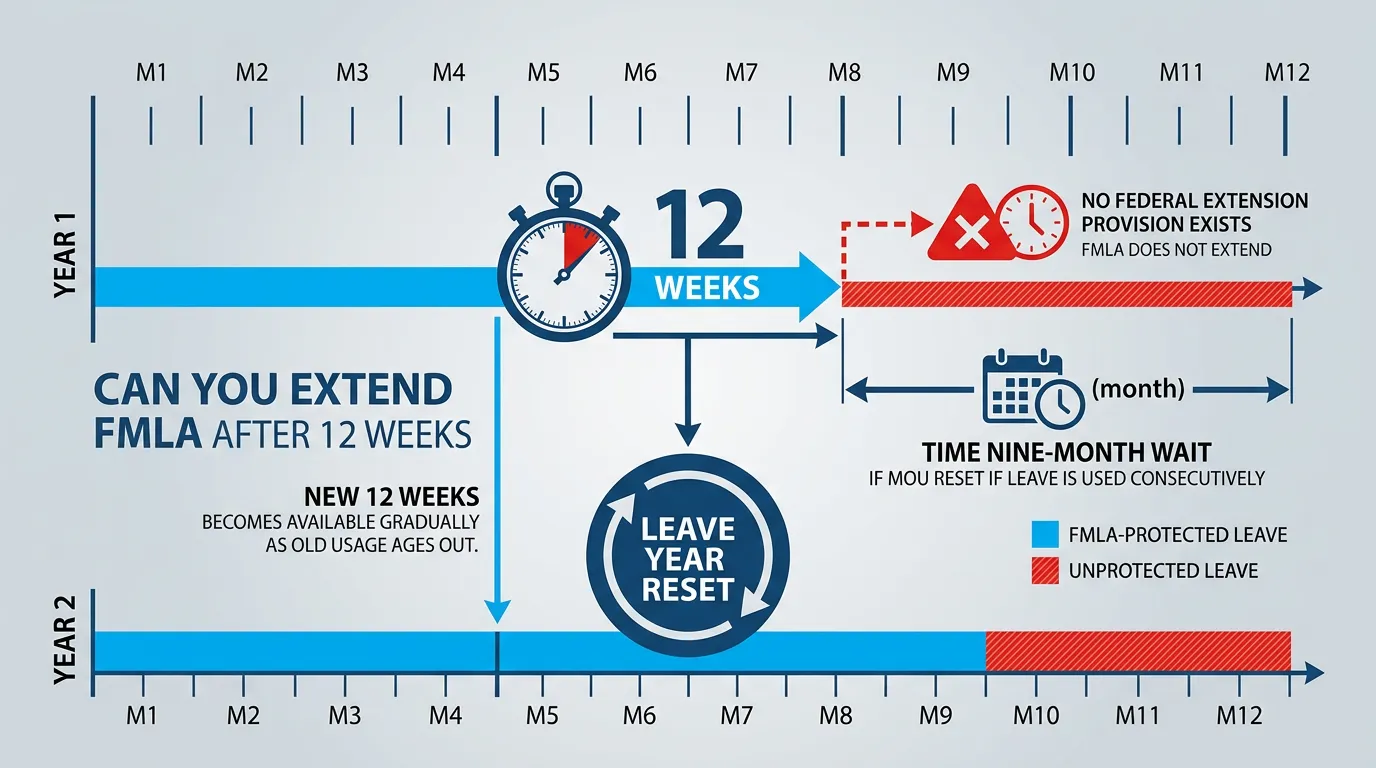
Understanding when and how your leave renews is critical. Many employees assume their 12 weeks reset on January 1st. That’s not always true. Your employer chooses one of four calculation methods, and each affects when new leave becomes available.
How the FMLA Leave Year Works
According to the Department of Labor, employers can use four different methods to calculate your 12-month leave year. The method your employer selects determines when your 12 weeks renew.
The four methods are calendar year, fixed 12-month period, rolling 12-month backward, and rolling 12-month forward. Each creates different availability patterns. The rolling backward method is most common in private sector companies.
Your employer must inform you which method they use in your eligibility notice. This notice arrives within five business days of your leave request. If you don’t receive it, ask HR immediately.
When Your 12 Weeks Renew
With a calendar year method, your 12 weeks reset every January 1st. If you exhausted leave in March 2026, you won’t get new leave until January 2027. That’s a nine-month wait.
The rolling backward method looks at the previous 12 months from today. If you used 12 weeks starting March 2026, those weeks drop off your count in March 2027. Your leave becomes available gradually as old usage ages out.
This creates a moving window. You might have zero weeks available in June 2026 but four weeks available by September 2026 as some March usage drops off. FMLADocs helps you understand exactly when your leave renews based on your employer’s method.
Tracking Your Available Balance
You’re responsible for tracking how much leave you’ve used. Employers must provide designation notices showing approved leave amounts. Save every notice you receive.
Calculate your remaining balance by subtracting used hours from 480 total hours. If you took three weeks for surgery, you used 120 hours. You have 360 hours remaining for the rest of your leave year.
For intermittent leave, tracking gets complex. Each absence chips away at your total. A four-hour migraine uses four hours. A two-day flare-up uses 16 hours. Keep detailed records of every absence to avoid exceeding your entitlement.
Can Federal FMLA Be Extended Beyond 12 Weeks?
Federal FMLA cannot be extended beyond 12 weeks for standard qualifying reasons. Your own health condition, family care, and bonding time all max out at 12 weeks per year. There’s no provision in the statute allowing extensions, regardless of medical severity or documentation.
Many employees mistakenly believe a doctor’s note recommending more time automatically extends FMLA. It doesn’t. Once your 12 weeks expire, federal FMLA job protection ends unless you qualify under a different law.
What Federal Law Allows
The FMLA statute is clear about the 12-week limit. No matter how serious your condition or how strongly your doctor recommends continued leave, federal law doesn’t provide extensions. Your employer isn’t required to hold your position beyond 12 weeks under federal FMLA alone.
That said, other protections may apply after FMLA runs out. The Americans with Disabilities Act may require reasonable accommodation, including extended leave in some cases. Understanding the difference between FMLA Vs STD helps you plan for coverage gaps. State family leave programs in California, New York, and other states sometimes offer additional weeks beyond federal FMLA.
The One Exception: Military Caregiver Leave
Military caregiver leave is the only exception to the 12-week rule. This provision provides up to 26 weeks in a single 12-month period to care for a covered servicemember. The servicemember must have a serious injury or illness incurred in the line of duty.
This extended protection recognizes the unique needs of military families. If you’re caring for a veteran or active-duty servicemember, you may qualify for double the standard FMLA entitlement. For other medical situations requiring income replacement, STD benefits may bridge the gap after FMLA expires.
State Paid Family and Medical Leave Programs That Extend Beyond FMLA
Several states provide job-protected leave beyond the federal 12-week FMLA limit through their own family and medical leave laws. These programs can extend your total available leave time significantly. If you live in one of these states, you may have more protection than you realize.
According to state family leave laws, multiple jurisdictions now offer expanded protections. California’s CFRA provides 12 weeks for your own serious health condition. It also includes separate pregnancy disability leave up to four months. You can then take 12 weeks of bonding leave after birth. That’s potentially seven months of combined protection.
States With Extended Leave Protections
Washington State provides 12 weeks of medical leave and 12 weeks of family leave. In some cases, you can combine these for up to 16 weeks total. New York’s Paid Family Leave provides up to 12 weeks of paid leave. It runs concurrently with FMLA but may extend protections beyond federal requirements.
Other states with programs include:
-
Oregon offers up to 12 weeks of paid leave for medical or family reasons
-
Massachusetts provides up to 26 weeks combined for medical and family leave
-
Connecticut offers 12 weeks of paid family and medical leave
-
Colorado provides up to 12 weeks of paid leave starting in 2026
-
Rhode Island and Maryland have established paid leave programs with varying provisions
How State and Federal Leave Interact
State leave often runs concurrently with federal FMLA. This means the weeks count toward both entitlements at the same time. However, some state programs may provide additional weeks beyond the federal 12-week limit. They may also cover different qualifying reasons or apply to smaller employers.
Check your state’s specific program to understand total available leave time. Some states extend protections to employers with fewer than 50 employees. Others include qualifying reasons not covered by federal FMLA. The interaction between state and federal leave can be complex but often works in your favor.
Using the Americans with Disabilities Act (ADA) for Extended Leave
If you can extend FMLA after 12 weeks depends partly on the ADA. This federal law offers a different path to job-protected leave. It applies when FMLA runs out but your disability continues.
When ADA Reasonable Accommodation Applies
The ADA requires employers with 15 or more employees to provide reasonable accommodations. This applies to qualified individuals with disabilities. A disability means a physical or mental impairment that substantially limits major life activities.
Extended leave beyond FMLA can qualify as a reasonable accommodation. Your condition must meet the ADA’s disability definition. Major depression, chronic pain, cancer treatment, and severe anxiety often qualify. The key is proving your impairment substantially limits activities like working, concentrating, or caring for yourself.
Unlike FMLA’s fixed 12-week entitlement, ADA leave is determined case by case. Courts evaluate whether the accommodation is reasonable. They also consider if it causes undue hardship to the employer. According to ADA leave as accommodation guidance, extensions of several weeks to several months can be reasonable depending on circumstances.
How to Request ADA Leave Extension
Request ADA accommodation in writing before your FMLA expires. State clearly you’re requesting extended leave as a disability accommodation. Don’t wait until your last FMLA day.
You must provide medical documentation showing three things:
-
Your disability and how it limits major life activities
-
Expected return date or timeline for reassessment
-
Why additional leave will enable you to perform essential job functions
Be specific about your expected return. Vague statements like “indefinite leave” rarely succeed. Employers need a reasonable timeframe. A note saying “four additional weeks with follow-up evaluation” works better.
ADA vs. FMLA: Key Differences
FMLA and ADA protect different situations. FMLA provides 12 weeks for serious health conditions. It’s an entitlement if you meet eligibility requirements. The ADA has no fixed time limit. Protection continues as long as the accommodation remains reasonable.
FMLA covers temporary conditions that don’t qualify as disabilities. The ADA requires a disability but offers flexible duration. FMLA applies to employers with 50 or more employees. The ADA threshold is just 15 employees.
You can use both laws sequentially. Take your 12 FMLA weeks first. Then request ADA accommodation for additional time. This strategy maximizes your job protection when recovery takes longer than expected.
Employer Leave Policies That Go Beyond FMLA Requirements
Federal FMLA provides 12 weeks of job-protected leave. But many employers offer more. These extended benefits come through company policies, union contracts, or employee handbooks. They can add months of protection beyond the federal minimum.
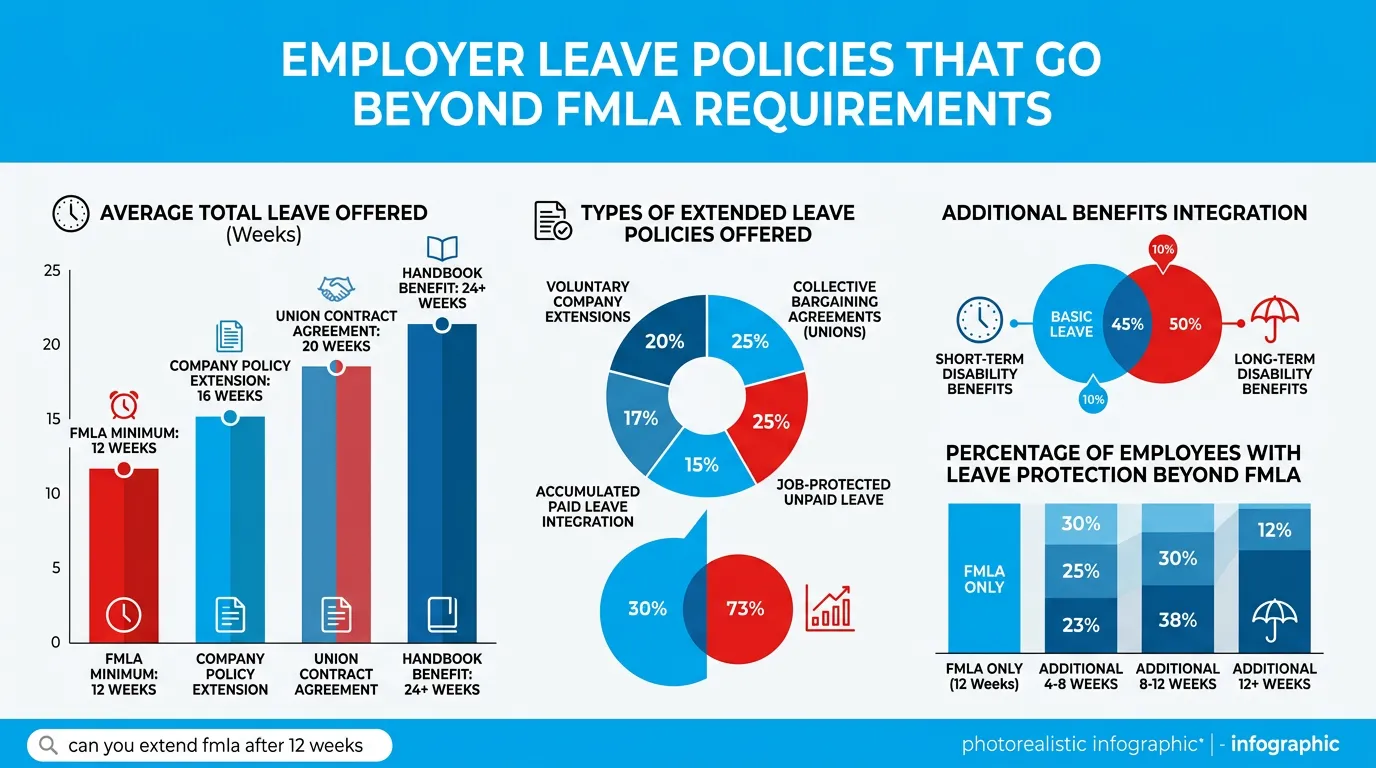
Understanding what your employer offers matters. You might have options you don’t know about. These programs can bridge the gap when 12 weeks isn’t enough.
Company-Specific Extended Leave Policies
Some employers voluntarily extend leave beyond FMLA. They offer three to six additional months with continued job protection. These policies vary widely by company size and industry.
Large corporations often provide the most generous programs. Tech companies, healthcare systems, and financial institutions frequently offer extended medical leave. Smaller businesses may have limited options or none at all.
Check your employee handbook first. Look for sections on medical leave, extended leave, or leave of absence programs. Some companies require you to exhaust FMLA before accessing extended leave. Others let you use both concurrently.
Union contracts may include extended leave provisions too. Review your collective bargaining agreement if you’re covered by one. These agreements often provide stronger protections than company policy alone.
Short-Term and Long-Term Disability Benefits
Disability insurance provides income replacement when you can’t work. It doesn’t guarantee job protection, but it helps financially. Many employers offer both short-term and long-term options.
Short-term disability typically covers three to six months. It pays 60-70% of your salary during recovery. STD often runs concurrently with FMLA, so you get both income and job protection. Some policies extend beyond your 12-week FMLA period.
Long-term disability kicks in after STD expires. This usually happens around six months. LTD can continue for years or until retirement age. However, job protection varies significantly. According to guidance on coordinating FMLA and ADA, employers may need to provide reasonable accommodation even after FMLA expires if you have a qualifying disability.
Review your benefits summary carefully. Note eligibility requirements, waiting periods, and documentation standards. These often differ from FMLA rules. Some employers require separate applications for each program. Others coordinate everything through HR.
Application procedures matter too. Missing a disability claim deadline can cost you months of income. Start the process early, ideally before your FMLA leave begins.
How to Request Extended Leave When Your 12 Weeks Run Out
When your FMLA runs out, you need to act fast. Don’t wait until your last day to start the process. Planning ahead gives you the best chance at approval.
Timing Your Extension Request
Start your extension request at least two to three weeks before your 12 weeks expire. This gives HR time to review your case. It also shows you’re taking the process seriously.
Early notice helps your employer plan coverage. It also gives you time to fix any issues with your paperwork. Waiting until the last minute puts your job at risk.
Required Documentation and Medical Certification
You need updated medical certification from your healthcare provider. This isn’t the same form you used for FMLA. Your doctor must explain why you still can’t work.
For ADA requests, documentation must prove you have a disability. According to the EEOC leave guidance, your provider must explain how additional leave will help you return to work. Include your expected return date and current treatment plan.
Your certification should cover these points:
-
Specific diagnosis and how it limits your ability to work
-
Expected recovery timeline with a target return date
-
Current treatment plan and frequency of medical appointments
-
Whether you can perform any job duties remotely during recovery
What to Include in Your Written Request
Submit your request in writing to HR. State clearly that you’re requesting extended leave beyond FMLA. Specify which policy you’re requesting under: ADA, state family leave law, or company policy.
Your written request should include the amount of additional time you need and why you can’t return after 12 weeks. Attach your updated medical certification. Reference any relevant company policies that allow extended leave.
Follow up if you don’t hear back within five to seven business days. Keep copies of everything you submit. Save all emails and responses from HR in a personal folder.
Conclusion
Federal FMLA stops at 12 weeks. But you have options when that time runs out. State programs in California, Washington, New York, and five other states offer additional protected leave. The ADA requires reasonable accommodations for disabilities, including extended time off. Many employers provide voluntary leave policies that go beyond federal requirements.
The key is acting before your 12 weeks expire. Request extended leave in writing. Include detailed medical documentation with expected return dates. Reference the specific law or policy that applies to your situation. This protects your rights and gives your employer clear information.
So can you extend FMLA after 12 weeks? Not the federal program itself. But state family leave programs, ADA protections, and employer policies create pathways to additional time. You need proper documentation and timely requests to access these options.
Don’t wait until your last day of leave to explore your options. Contact FMLADocs to work with licensed healthcare professionals who understand medical certification requirements for FMLA, ADA accommodations, and state programs. Our physicians provide the detailed documentation you need to request extended leave and protect your job while you recover.
Frequently Asked Questions
Can you extend FMLA after 12 weeks under federal law?
No, federal FMLA cannot be extended beyond 12 weeks. The law provides exactly 12 weeks of job-protected leave per 12-month period with no extension provision. Once you use your 12 weeks, your job protection ends until your leave year resets. However, you're not out of options. State programs, the ADA, and employer policies can provide job-protected time beyond the standard limit. The key is knowing which protections apply to your situation and making your request correctly before your leave expires.
How is the FMLA leave year calculated by employers?
Employers choose one of four methods to calculate your 12-month leave year. The options are calendar year, fixed 12-month period, rolling 12-month backward, and rolling 12-month forward. Each method creates different availability patterns for when your 12 weeks renew. The rolling backward method is most common in private sector companies. Your employer must inform you which method they use in your eligibility notice, which arrives within five business days of your leave request. If you don't receive it, ask HR immediately.
When does FMLA reset with a calendar year method?
With a calendar year method, your 12 weeks reset every January 1st. If you exhausted leave in March 2026, you won't get new leave until January 2027. That's a nine-month wait. This method is straightforward but can create long gaps without coverage. The timing of when you use your leave matters significantly. If you need extended time off, understanding your employer's calculation method helps you plan when to start your leave to maximize available coverage.
How does the rolling 12-month FMLA method work?
The rolling backward method looks at the previous 12 months from today. If you used 12 weeks starting March 2026, those weeks drop off your count in March 2027. Your leave becomes available gradually as old usage ages out. This creates a moving window. You might have zero weeks available in June 2026 but four weeks available by September 2026 as some March usage drops off. This method provides more flexibility than calendar year because leave renews continuously rather than all at once.
What happens when FMLA runs out and I still can't return to work?
When your 12 weeks end but you still can't return to work, timing matters. The difference between keeping your job and losing it often comes down to knowing which law applies and making your request correctly. You can explore state family leave programs, request reasonable accommodation extended leave under the ADA if you have a disability, or check your employer's policies for additional leave options. You must act before your leave expires to protect your job while you recover.
How do I track my remaining FMLA balance?
You're responsible for tracking how much leave you've used. Calculate your remaining balance by subtracting used hours from 480 total hours. If you took three weeks for surgery, you used 120 hours and have 360 hours remaining. For intermittent leave, tracking gets complex because each absence chips away at your total. A four-hour migraine uses four hours. A two-day flare-up uses 16 hours. Keep detailed records of every absence to avoid exceeding your entitlement. Save every designation notice from your employer showing approved leave amounts.

Meet the author
Areeba Imran
I am a healthcare professional and seasoned medical writer with 13+ years of experience across health, wellness, and clinical content. My work focuses on delivering trustworthy, evidence-based information that empowers readers to make informed decisions. With a keen interest in innovation and evolving areas of patient care, I bring a modern perspective to today's healthcare setup.
Get Your FMLA Certification Online in Minutes