

Find an FMLA Doctor Near Me and Get Forms Completed
 by Nida Hammad
 Last updated:
You need FMLA certification, but your regular doctor won’t return calls. Or they charge $150 just for paperwork. Or they have a three-week wait for appointments. Meanwhile, your 15-day certification deadline is ticking down. Finding an FMLA doctor near me who will complete forms quickly and affordably is one of the biggest obstacles employees face when requesting protected leave.
Finding the right provider is important because an incomplete or unclear FMLA certification can delay your leave request. Before booking, ask whether the provider completes FMLA forms, how much the service costs, how quickly the paperwork can be completed, and whether an appointment is required. If your regular doctor has a long wait time or does not complete FMLA paperwork, you may have other options.
This guide shows you precisely where to get FMLA paperwork filled out in your area. You’ll learn which providers accept these forms, what questions to ask before scheduling, typical FMLA certification costs to expect, and faster alternatives when traditional options won’t work. We cover primary care providers, urgent care centers, specialists, and telehealth FMLA certification options that let you complete the process from home.
Why Finding an FMLA Doctor Near Me Is Harder Than It Should Be
When you need FMLA certification, time matters. You have just 15 days to get medical paperwork completed and submitted. That tight window turns what should be straightforward into a frustrating obstacle course. Many employees discover too late that finding an FMLA doctor near me who will actually complete the forms is far more difficult than expected.
The problem isn’t your health condition. It’s the system itself. Primary care offices refuse FMLA paperwork. Scheduling delays eat up your deadline. Administrative fees pile on. And incomplete forms restart the entire process.
Providers Who Refuse FMLA Paperwork Entirely
Many primary care offices have explicit policies against completing FMLA forms. You call to schedule an appointment for certification. The receptionist tells you they don’t do FMLA paperwork. No exceptions.
This refusal happens more often than most employees realize. Doctors cite time constraints as the main reason. DOL Form WH-380 requires detailed medical information that takes 20-30 minutes to complete properly. That’s time they can’t bill insurance for.
Some practices worry about liability exposure. They fear saying the wrong thing or providing information that could be used against them later. Others simply lack familiarity with FMLA requirements and don’t want to risk making mistakes.
The result? You waste days calling offices only to hear “we don’t do that here.” Your 15-day clock keeps ticking while you search for a provider who will help.
Administrative Burden and Liability Concerns
Even providers who agree to complete FMLA forms often charge separate fees. These administrative charges range from $50 to $200 per form. Insurance doesn’t cover them because form completion isn’t a billable medical service.
According to the Department of Labor, the certification must include specific details about your condition, treatment plan, and functional limitations. Providers must document the date your condition began, expected duration, whether inpatient care was required, and how your condition affects your ability to work.
That level of detail creates risk. Providers worry about writing too much or too little. They fear legal consequences if their documentation is challenged. Many simply aren’t comfortable with the FMLA approval timeline pressure and detailed requirements.
Providers unfamiliar with FMLA often leave sections blank or provide vague answers. They write “ongoing” instead of specific durations. They list diagnoses without explaining functional impact. These incomplete forms get rejected, forcing you to start over.
The Scheduling Bottleneck Problem
Even when you find a willing provider, scheduling delays can kill your application. Average wait times for established patient appointments range from 10 to 21 days. That consumes most or all of your 15-day certification window.
New patient appointments take even longer. If your regular doctor won’t complete FMLA forms, you need to find a new provider. New patient slots often book three to four weeks out. By the time you get seen, your deadline has passed.
Urgent care clinics seem like a solution. But many urgent care facilities also refuse FMLA paperwork. They focus on immediate medical needs, not administrative documentation. The ones that do complete forms often lack access to your full medical history, making certification more difficult.
This scheduling bottleneck creates impossible situations. You notify your employer on day one. You start calling providers immediately. But between refusals and wait times, you can’t get an appointment before day 15. Your leave request gets denied through no fault of your own.
FMLADocs solves this problem directly. Our board-certified physicians complete FMLA certifications within 24-48 hours. No scheduling delays. No refusals. No administrative runaround. Just fast, professional certification that meets DOL requirements the first time.
Questions to Ask Before Scheduling an FMLA Doctor Near Me
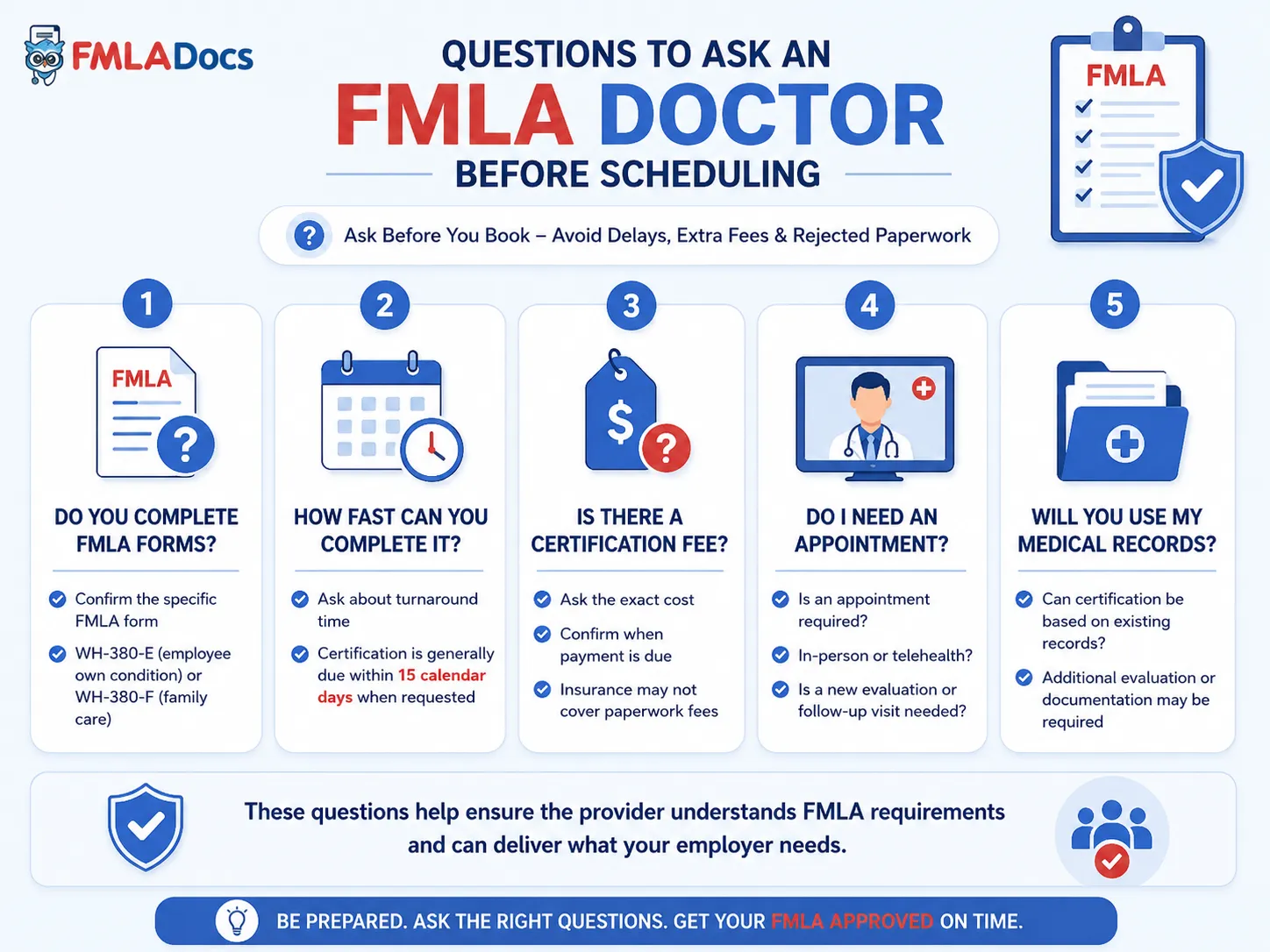
Before scheduling an appointment with an FMLA doctor near me, call the provider’s office and confirm that they actually complete FMLA medical certification forms. Not every primary care provider offers this service, and some doctors only complete paperwork for patients they have personally evaluated or treated. Asking a few questions in advance can help you avoid wasted time, unexpected fees, and delays with your FMLA request.
Does the Doctor Complete FMLA Forms?
Ask whether the provider completes the specific FMLA form your employer requested, such as DOL Form WH-380-E for an employee’s own serious health condition or WH-380-F for caring for a family member. Some offices may complete FMLA paperwork but use a different certification process. Confirm exactly what forms they accept before making an appointment.
How Quickly Can the FMLA Paperwork Be Completed?
Ask the office for its expected FMLA paperwork turnaround time. Some providers may complete the certification during your appointment, while others may take several business days. This matters because your employer generally gives you at least 15 calendar days to return requested medical certification. A provider with a long processing time could make it harder to meet your deadline.
How Much Does FMLA Certification Cost?
Ask about the provider’s FMLA certification fee before scheduling. Doctors’ offices may charge a separate fee for completing medical forms, and this service may not be covered by your health insurance. The cost can vary by provider, so confirm the exact amount and when payment is required. This helps you compare your options and avoid unexpected charges.
Do I Need an Appointment?
Find out whether you must schedule an appointment before the doctor can complete your FMLA certification. Some providers require an examination or follow-up visit, while others may complete paperwork using information already documented in your medical records. If an appointment is required, ask whether it can be completed through telehealth or must be in person.
Will the Doctor Complete the Form Based on My Medical Records?
Ask whether the provider can certify your condition using your existing medical records or whether you need a new evaluation. FMLA certification requires sufficient medical information to support the need for leave. If your records do not contain enough information, the provider may need to examine you or request additional documentation before completing the form.
These questions reveal whether the provider understands FMLA requirements. Providers who complete these forms regularly know what employers need to see. They understand qualifying conditions and certification standards that meet DOL requirements.
Your Primary Care Provider: The First Place to Find an FMLA Doctor Near Me
When you need an FMLA doctor near me, your primary care provider is often the best first call. They already know your medical history. They’ve documented your ongoing conditions. This familiarity makes the certification process faster and more accurate than starting fresh with a new provider.
Your PCP has records of your visits, treatments, and diagnoses. They can connect current symptoms to documented patterns. This context helps them complete DOL forms with the specific detail employers need to see.
When Your PCP Is the Right Choice
Your PCP works best for FMLA certification in specific situations. If you have an established relationship spanning months or years, they know your case. If your condition requires ongoing treatment they’ve been managing, they can document it thoroughly.
PCPs handle these cases well:
-
Chronic conditions they’ve been treating (diabetes, hypertension, arthritis)
-
Mental health conditions with documented visits and treatment plans
-
Pregnancy complications they’ve been monitoring
-
Recovery from surgery they referred you for
-
Conditions requiring regular follow-up appointments
However, your PCP may not be ideal if you haven’t seen them recently. If your last visit was over a year ago, they lack current documentation. If they’ve never treated your qualifying condition, they can’t certify based on direct knowledge.
Urgent Care Centers for FMLA Certification
When you need FMLA paperwork fast, urgent care centers offer walk-in access without scheduling delays. Major chains like Care Now, Med Express, and Next Care often complete FMLA forms for acute conditions. But not all locations handle this paperwork. Call ahead to confirm the specific site processes FMLA requests before you drive there.
Which Urgent Care Chains Handle FMLA
Some urgent care chains may provide FMLA certification services, but availability depends on the individual clinic. National and regional urgent care providers such as CareNow, MedExpress, NextCare, AFC Urgent Care, and FastMed may offer FMLA paperwork services at participating locations. However, not every clinic within a chain follows the same policy.
Before choosing an urgent care FMLA doctor near me, contact the specific location and ask whether a provider can complete your FMLA certification. Confirm whether you need an appointment, whether the clinic requires an existing patient relationship, how much the paperwork costs, and how long completion usually takes.
Keep in mind that urgent care providers may not be able to complete FMLA forms for every situation. FMLA certification requires medical information about your condition and may involve ongoing care, so a provider who knows your medical history may be better positioned to complete the paperwork accurately. If you need intermittent or extended leave, ask whether the urgent care provider can provide the level of documentation your employer requires.
Cost Expectations and Insurance Coverage
The cost of getting FMLA certification can vary based on the provider, location, and whether you need an in-person evaluation. Urgent care visits for FMLA paperwork may cost around $100 to $200 without insurance, while some clinics may charge a separate $25 to $75 form completion fee. Paperwork fees are often not covered by health insurance because they are administrative services rather than treatment.
If you use insurance for the medical visit, your usual urgent care copay may apply. Copays commonly range from $30 to $75, depending on your insurance plan. However, you may still need to pay the FMLA paperwork fee separately. Before scheduling with an FMLA doctor near me, ask about the total cost, insurance coverage, and whether payment is required upfront.
For a more convenient option, FMLADocs allows eligible patients to connect with licensed physicians for FMLA certification remotely. This can help reduce travel, waiting room time, and uncertainty about the paperwork process while providing upfront pricing.
What Conditions Urgent Care Can Certify
Urgent care centers work best for new injuries and acute illnesses requiring immediate documentation. They can certify conditions like:
-
Recent injuries (sprains, fractures, back strain)
-
Acute infections (pneumonia, severe flu, kidney infections)
-
New-onset conditions needing immediate treatment
-
Post-surgical complications requiring urgent evaluation
These facilities handle conditions they can diagnose and treat during a single visit. They’re less suitable for chronic mental health conditions like depression or anxiety. Complex ongoing treatment requiring specialist knowledge falls outside their scope.
Urgent care doctors may not have your complete medical history. This limits their ability to certify chronic conditions requiring long-term documentation. For ongoing conditions like fibromyalgia, migraines, or PTSD, your regular provider or a specialist offers better certification support.
Specialists and Mental Health Providers
Many FMLA conditions need specialist certification. Pregnancy complications, chronic pain, or autoimmune disorders often fall outside a primary care doctor’s scope. Your PCP might refer you to an OB-GYN, rheumatologist, or pain management specialist. These providers have the clinical expertise to document your functional limitations accurately.
The challenge? Specialist appointments typically have wait times of three to six weeks. That timeline can blow past your 15-day certification deadline before you even get seen. Start the referral process the moment you notify HR about your leave. Don’t wait for the formal certification request to arrive.
When You Need a Specialist for Certification
Your primary care doctor can certify many conditions. But some situations require specialist documentation. Pregnancy complications like hyperemesis gravidarum or preeclampsia need an OB-GYN’s signature. Chronic pain from herniated discs or spinal stenosis often requires a pain specialist or orthopedist. Autoimmune conditions like lupus or rheumatoid arthritis need a rheumatologist who tracks disease activity.
The specialist treating your condition knows your functional limitations best. They’ve monitored your flare-ups, adjusted medications, and documented treatment responses. That clinical history makes their certification more detailed and harder to challenge. If multiple providers treat you, choose the one most familiar with how your condition affects your ability to work.
Finding Mental Health Providers Who Complete FMLA
Mental health conditions qualify for FMLA protection. Depression, anxiety disorders, PTSD, and bipolar disorder all meet the serious health condition standard. But not every mental health provider can certify your leave. Only licensed physicians can complete the medical certification forms.
Psychiatrists and psychiatric nurse practitioners can certify FMLA leave. They’re licensed to diagnose and prescribe medication. Therapists, counselors, and social workers cannot certify FMLA, even if they’ve treated you for years. This catches many employees off guard when their therapist explains they can’t complete the paperwork.
The Psychology Today directory lets you filter by providers who handle FMLA paperwork. Search for psychiatrists in your area and check their profiles for FMLA experience. Many list it explicitly. You can also ask your current therapist for a psychiatrist referral who works with FMLA cases. Some practices have psychiatrists on staff specifically for medication management and certification needs.
If you need intermittent FMLA for recurring mental health episodes, your psychiatrist must document frequency and duration. How often do panic attacks occur? How long do depressive episodes last? What triggers make symptoms worse? This detail supports your intermittent leave schedule and protects you when you need to leave work unexpectedly.
Coordinating Between Multiple Providers
Many chronic conditions involve multiple specialists. You might see a rheumatologist for lupus, a nephrologist for kidney involvement, and a pain specialist for joint pain. Or a cardiologist for heart issues, an endocrinologist for diabetes, and a primary care doctor for overall management. Who should complete your FMLA certification?
Choose the provider who sees you most often and knows your functional limitations best. That’s usually the specialist managing your primary condition. They track your symptoms, adjust treatment, and document how the condition affects your daily life. Their certification carries more weight than a provider who sees you once or twice a year.
If your condition requires input from multiple specialists, one provider can still complete the certification. They can reference other specialists’ findings in the form. Some employers accept supplemental letters from additional providers, though the main certification must come from one licensed physician.
Communication between providers matters too. Make sure your certifying doctor has recent records from other specialists. Bring copies of lab results, imaging reports, or treatment notes to your FMLA appointment. This documentation helps them complete the certification with specific clinical details that support your leave request.
What to Bring to Your FMLA Doctor Near Me Appointment
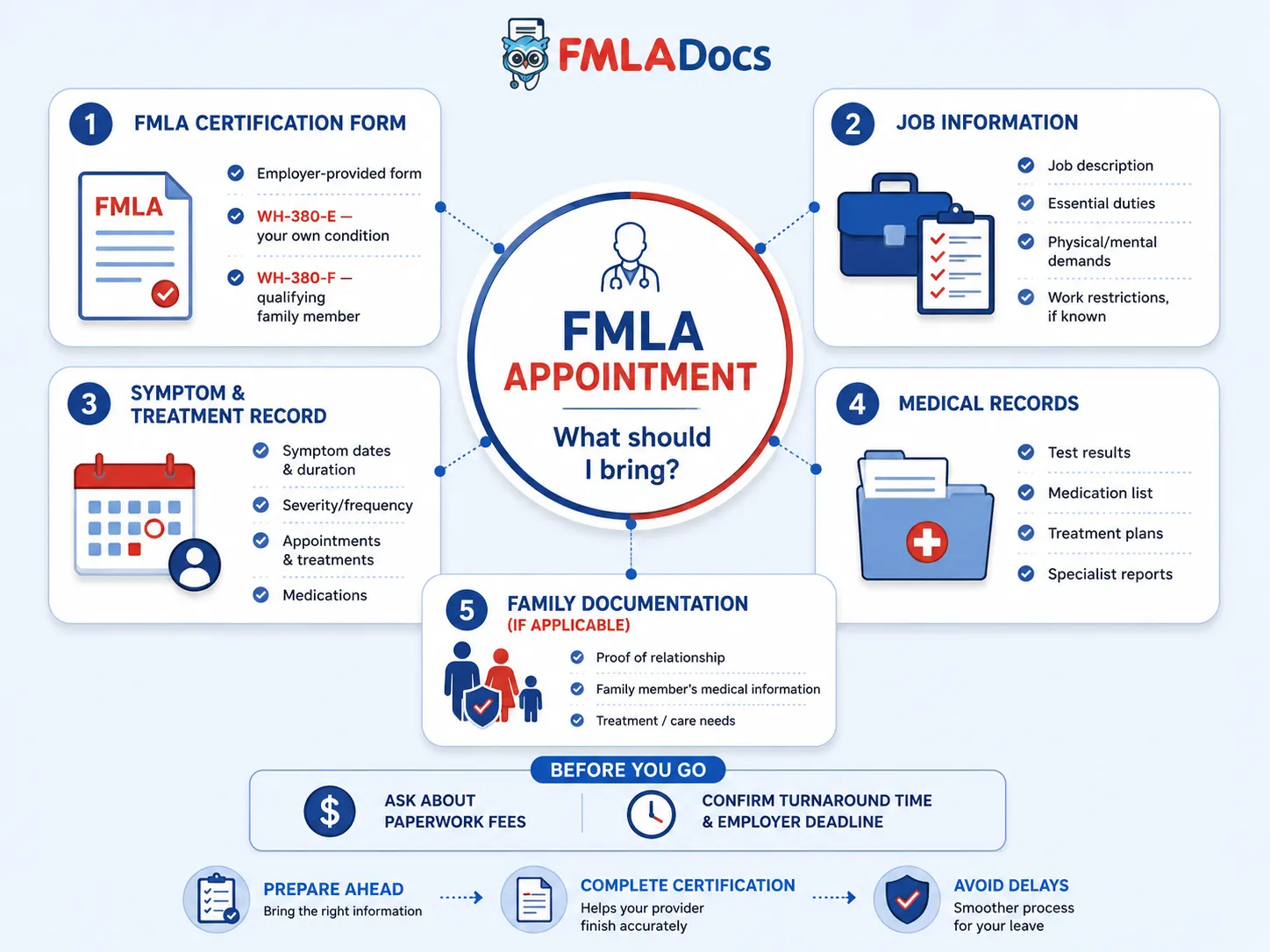
Before visiting an FMLA doctor near me, prepare all the documents and information your healthcare provider may need to complete your medical certification. Arriving prepared can make the appointment more efficient and reduce the risk of incomplete answers, follow-up requests, or delays with your FMLA leave. Your provider needs enough information to explain your medical condition, treatment needs, expected duration of incapacity, and how the condition may affect your ability to work or require intermittent leave.
1. Correct FMLA Form
Bring the blank FMLA certification form provided by your employer. If you are requesting leave for your own serious health condition, your employer may provide Form WH-380-E. If you need leave to care for a qualifying family member, the appropriate form is generally WH-380-F. Using the correct form helps your provider address the specific information required for FMLA certification. Do not rely on a basic doctor’s note when your employer has specifically requested FMLA certification.
2. Your Job Description
Your FMLA doctor near me needs to understand what your job requires to accurately describe any work restrictions or limitations. Bring your official job description if you have one. If you do not have it, prepare a detailed list of your regular duties, such as lifting, standing, walking, driving, operating equipment, working specific shifts, or performing physically or mentally demanding tasks. This information can help your provider determine how your medical condition affects your ability to perform essential job duties.
3. Symptom and Treatment Record
A symptom log can help your provider give more accurate information, especially when you are requesting intermittent FMLA leave. Record the dates your symptoms occur, how long they last, how severe they are, and whether they prevent you from working or require medical treatment. Also note appointments, procedures, medications, and other treatments related to your condition. Specific information is more useful than trying to remember every detail during your appointment.
4. Relevant Medical Records
Take relevant medical records, test results, medication lists, treatment plans, or specialist reports that may help your provider understand your condition. If another healthcare provider diagnosed or treated you, those records can give your FMLA doctor a clearer picture of your medical history and current treatment needs.
5. Family Relationship Documentation When Needed
If you are requesting FMLA leave to care for a qualifying family member, be prepared to provide information showing your relationship when required. Depending on the situation, this may include a birth certificate, marriage certificate, or other appropriate documentation. You should also bring relevant medical information about your family member’s condition, treatment, and expected care needs so the provider can complete the certification accurately.
Ask About Paperwork Fees and Turnaround Time
Before or during your appointment, ask the provider how much they charge for completing FMLA paperwork and how long the certification will take. Some offices may charge a separate administrative fee for forms. Knowing the cost and expected turnaround time in advance can help you avoid unexpected expenses and make sure you receive the completed certification before your employer’s deadline.
Telehealth Options for FMLA Certification
Finding an FMLA doctor near me doesn’t mean you need to visit a physical office. Licensed telehealth providers can legally complete FMLA certification in most states. This option saves time and gets you the paperwork you need faster than traditional appointments.
Services like FMLADocs connect you with board-certified physicians who specialize in FMLA cases. These doctors understand exactly what employers need to see on certification forms. They complete every required field correctly the first time.
How Telehealth FMLA Services Work
The process starts with an online intake form. You describe your condition, symptoms, and how they affect your ability to work. This takes about 10-15 minutes to complete.
Next, you’re matched with a licensed physician in your state. The doctor reviews your medical history and conducts a virtual consultation. This happens via secure video call or phone, depending on the platform.
During the consultation, the physician asks detailed questions about your condition. They need to understand frequency, duration, and functional limitations. This information goes directly onto your DOL WH-380 form.
After the consultation, the doctor completes your certification. Typical turnaround is 24-48 hours compared to weeks for traditional appointments. You receive the completed forms electronically, ready to submit to your employer.
Comparing Telehealth Costs to In-Person Visits
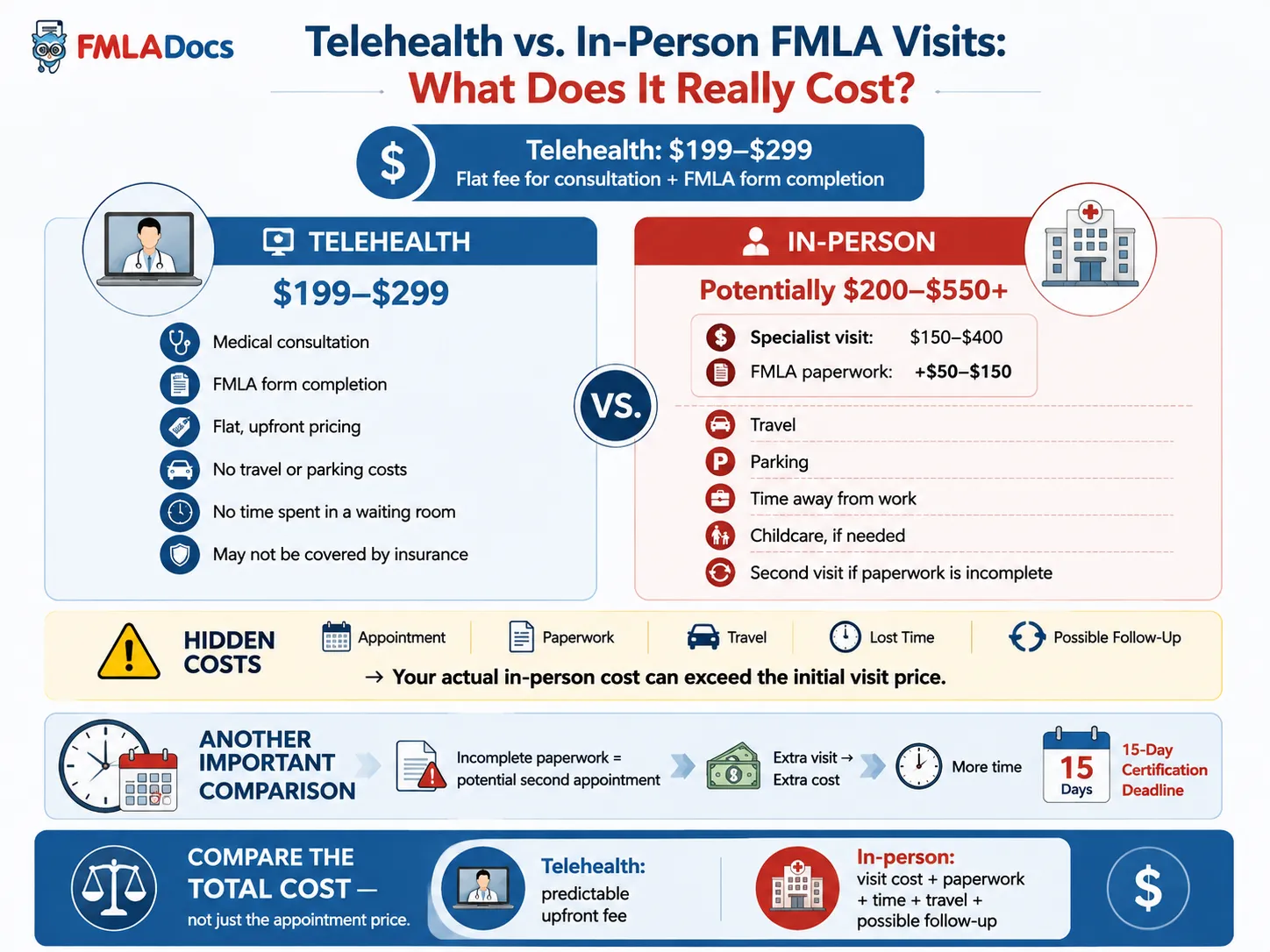
Costs range from $199-299 for the complete service including medical consultation and form completion. This is a flat fee covering everything you need for FMLA certification.
In-person visits often cost more when you factor in all expenses. A specialist appointment might run $150-400 depending on your insurance. Many providers charge an additional $50-150 just to complete FMLA paperwork.
Then there’s the time cost. Taking half a day off work for an appointment means lost wages. Add travel time, parking fees, and potential childcare expenses. The total quickly exceeds telehealth pricing.
Telehealth also eliminates the risk of incomplete forms. When your in-person doctor leaves sections blank, you pay for a second appointment to fix it. That doubles your out-of-pocket cost and burns through your 15-day certification deadline.
Most telehealth FMLA services don’t accept insurance. But the flat fee structure means you know exactly what you’ll pay upfront. No surprise bills. No insurance denials. No fighting with your provider’s billing department.
How Much Does FMLA Certification Cost?
Understanding FMLA certification costs helps you budget for the process. Most people face two separate charges: the medical visit itself and the form completion fee. These costs vary widely based on your provider type and insurance coverage.
The total expense can range from $20 to $500 or more. That’s a huge spread. Knowing what to expect prevents surprise bills when you’re already dealing with a health condition.
Insurance Coverage for FMLA Appointments
Your health insurance typically covers the medical visit portion. You’ll pay your standard copay or coinsurance. That’s the same amount you’d pay for any regular appointment with that provider type.
However, insurance rarely covers the administrative work of completing FMLA forms. According to medical certification costs research, providers charge separately for paperwork completion. This fee is your responsibility even with excellent insurance.
Some employers offer reimbursement through FSA or HSA accounts. Check with your HR department before your appointment. This can offset the form completion charge you’ll pay out of pocket.
Different providers charge different rates. Here’s what you can expect:
| Provider Type | Visit Cost | Form Fee | Total Range |
|---|---|---|---|
| Primary care physician | $20-50 copay | $0-100 | $20-150 |
| Urgent care | $100-200 | $50-150 | $150-350 |
| Specialist | $30-75 copay | $75-200 | $105-275 |
| Telehealth FMLA service | Included | Included | $199-299 |
Telehealth FMLA services like FMLADocs offer all-inclusive pricing. You pay one flat fee with no surprise charges. This often costs less than urgent care while providing faster turnaround and guaranteed form completion.
Hidden Fees to Watch For When Choosing an FMLA Doctor Near Me
When searching for an FMLA doctor near me, do not focus only on the advertised appointment price. Some providers may charge additional fees for services related to FMLA paperwork. Depending on the office, you may encounter rush processing fees, form completion fees, follow-up appointment charges, or fees for correcting incomplete paperwork. Ask the provider to explain every possible charge before your appointment so you know the total expected cost.
You may also pay another fee if your provider needs you to return for an additional evaluation before completing the certification. If your employer requests clarification or your provider needs to correct missing information, ask whether the office charges for revisions. FMLA recertification may also involve additional medical visits or administrative fees depending on your provider and circumstances.
Before scheduling, ask these simple questions:
-
Is there a separate FMLA paperwork fee?
-
Is there an extra charge for rush processing?
-
How much does a follow-up visit cost?
-
Are form corrections or revisions included?
-
Will I receive the completed form to review?
Getting clear answers upfront can help you avoid unexpected expenses and paperwork delays.
Red Flags to Watch for When Choosing an FMLA Doctor Near Me
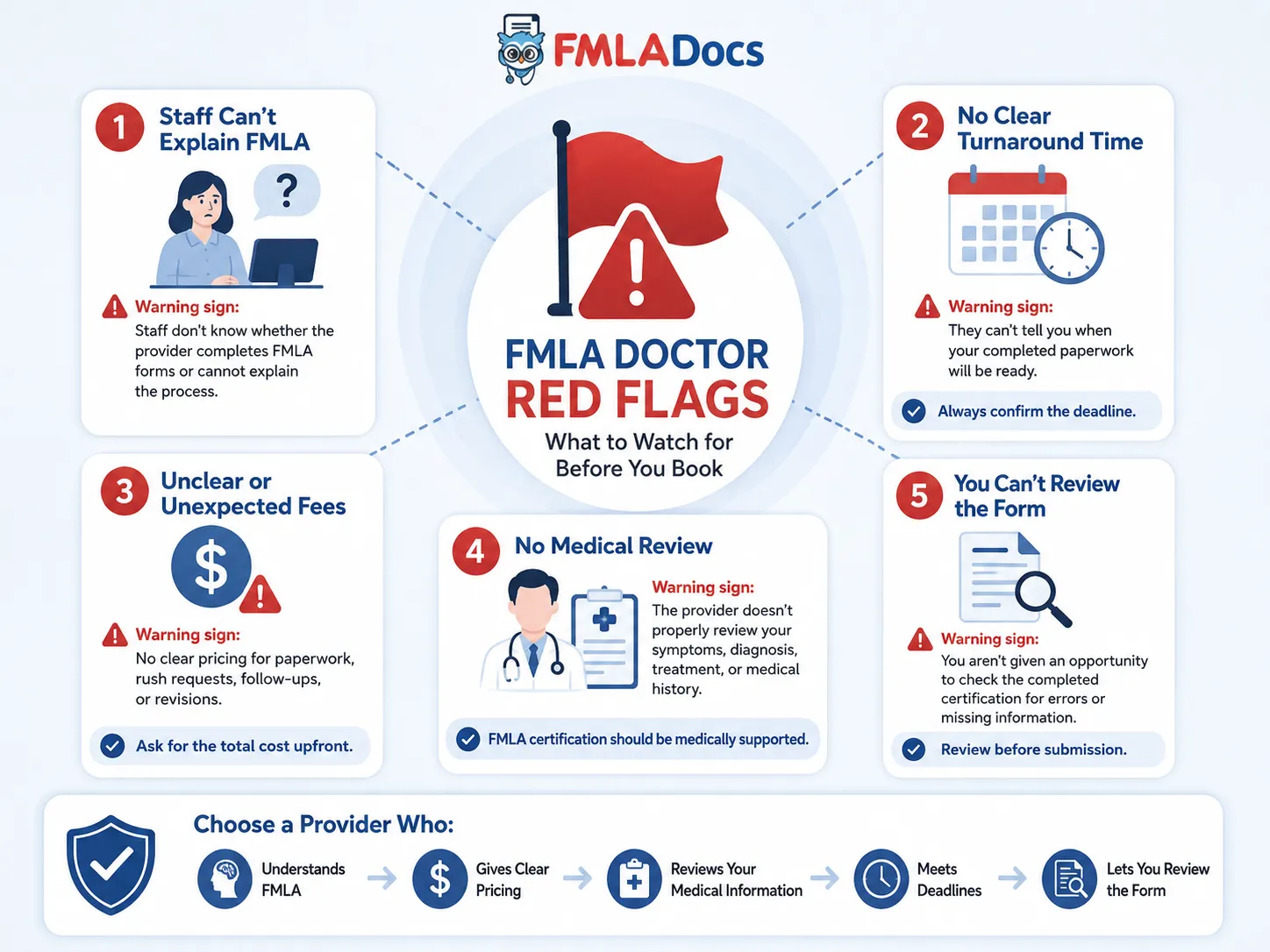
Staff Cannot Explain the FMLA Process
If the office staff is unfamiliar with FMLA certification forms or cannot tell you whether the provider completes them, consider this a warning sign. FMLA paperwork requires specific medical information, so the provider should understand what the certification involves.
No Clear Paperwork Turnaround Time
Avoid providers who cannot give you a reasonable estimate for when your completed FMLA form will be ready. Ask about the expected turnaround time before scheduling, especially if you have an employer deadline.
Unexpected or Unclear Fees
Ask about the total cost before your appointment. Watch for offices that do not clearly explain FMLA paperwork fees, rush charges, follow-up costs, or revision fees. Knowing the full cost upfront can help you avoid unexpected expenses.
Provider Does Not Review Your Medical Information
A proper FMLA certification should be based on your medical condition and the provider’s knowledge of your care. Be cautious if an office appears willing to complete your paperwork without properly reviewing your symptoms, diagnosis, treatment, or medical history.
You Cannot Review the Completed Form
Ask how you will receive the completed certification before it is submitted to your employer. Having an opportunity to review the form can help you identify missing or incorrect information and request corrections promptly.
Common Reasons Your FMLA Certification May Be Delayed
When searching for an FMLA doctor near me, choosing a provider who understands FMLA paperwork can help prevent unnecessary delays. Your certification may take longer if the provider needs more medical information, the form is incomplete, or the office has a long processing time. Knowing the common causes of delays can help you prepare before your appointment.
Choosing an FMLA Doctor Near Me Without Checking Turnaround Time
Some providers may take several days to complete FMLA paperwork. Before booking your appointment, ask how long the provider usually needs to complete the form and whether rush processing is available.
How to avoid it: Confirm the expected turnaround time before scheduling and compare it with your employer’s certification deadline.
Arriving Without the Correct FMLA Form
Bringing the wrong form or relying on a basic doctor’s note can slow down the process. Your employer may provide a specific FMLA certification form based on your situation.
How to avoid it: Bring the exact form provided by your employer, such as WH-380-E for your own serious health condition or WH-380-F for a qualifying family member’s condition.
Missing Medical Information
An FMLA doctor near me may need additional information about your diagnosis, symptoms, treatment, limitations, or expected recovery before completing the certification.
How to avoid it: Bring relevant medical records, test results, medication information, treatment plans, and a clear summary of your symptoms.
Incomplete or Incorrect FMLA Forms
Blank sections, unclear answers, missing dates, or inconsistent information can result in additional questions and corrections.
How to avoid it: Review the completed certification with your provider before submitting it. Make sure the required sections are complete and the information accurately reflects your medical situation.
Not Explaining Your Job Duties
Your provider may need information about your work duties to explain why your condition affects your ability to work or requires intermittent leave.
How to avoid it: Bring your job description or a detailed list of your regular duties, including physical or scheduling requirements.
Waiting Too Long to Find an FMLA Doctor Near Me
Waiting until the last few days can create problems if your preferred provider has no appointments or needs additional information.
How to avoid it: Start looking for an FMLA doctor near me as soon as your employer requests certification. Schedule your appointment early enough to allow time for paperwork completion and corrections.
Choosing a Provider Who Does Not Complete FMLA Paperwork
Not every doctor or clinic handles FMLA certification. Discovering this after your appointment can waste valuable time.
How to avoid it: Call before booking and ask directly, “Does your provider complete FMLA certification forms?” Also confirm which forms they accept and how you will receive the completed paperwork.
Form Fees or Processing Policies Cause Delays
Some offices process FMLA forms only after payment of an administrative fee or may have specific paperwork procedures. Delays can occur if you are unaware of these requirements.
How to avoid it: Ask your FMLA doctor near me about the total cost, payment requirements, processing time, and how completed forms will be delivered before your appointment.
Conclusion
Finding an FMLA doctor near me doesn’t have to derail your leave plans. Start with your primary care provider if you have time. Check urgent care centers for walk-in access. Consider specialists for complex conditions. And explore telehealth when traditional routes hit scheduling roadblocks.
The 15-day certification deadline creates real pressure. Your job protection depends on getting paperwork completed fast. When local providers can’t accommodate your timeline, you need backup options that work.
You’ve learned where to get FMLA paperwork filled out and what to ask before scheduling. You know the costs involved and which providers handle these forms. Most importantly, you understand your options when time runs short.
Don’t let provider access issues threaten your FMLA protection. FMLADocs connects you with licensed physicians who complete certifications in 24-48 hours. Start your certification today and protect your job while you focus on what matters most.
Frequently Asked Questions
How much does FMLA certification cost at most doctors' offices?
Most providers charge between $50 and $200 per form for FMLA certification. Insurance doesn't cover these fees because form completion isn't a billable medical service. Your regular doctor may charge $150 just for paperwork on top of any office visit fees. These administrative charges exist because completing DOL Form WH-380 takes 20-30 minutes of provider time that can't be billed to insurance. The fees vary widely by practice and location, so ask about costs before scheduling your appointment.
Why do so many primary care doctors refuse to complete FMLA forms?
Primary care offices refuse FMLA paperwork for three main reasons. First, completing the forms takes 20-30 minutes of unbillable time. Second, many providers worry about liability exposure and fear saying something that could be used against them later. Third, doctors unfamiliar with FMLA requirements don't want to risk making mistakes on the detailed documentation. The DOL form requires specific information about your condition, treatment plan, functional limitations, and expected duration. This level of detail creates risk and time pressure that many practices simply won't accept.
What happens if my doctor leaves sections blank on my FMLA form?
Incomplete FMLA forms get rejected and force you to start the entire process over. Providers unfamiliar with FMLA often leave sections blank or provide vague answers. They might write "ongoing" instead of specific durations or list diagnoses without explaining functional impact. When your employer receives an incomplete form, they can reject it and require you to get proper certification. This wastes precious time from your 15-day deadline. You'll need to schedule another appointment and pay additional fees to get the form completed correctly.
Can I use urgent care centers to get FMLA paperwork completed?
Yes, urgent care centers can complete FMLA forms, but they work best for acute conditions rather than ongoing health issues. These facilities see you without appointments and can provide same-day certification. However, urgent care doctors may not have your complete medical history or understand chronic conditions as well as your regular provider. They can document immediate health problems and functional limitations but might struggle with long-term prognosis details. Urgent care works when you need fast certification and your regular doctor won't help within your deadline.
How long do I have to submit completed FMLA certification to my employer?
You have just 15 days to get medical paperwork completed and submitted after your employer requests certification. This tight deadline creates serious pressure when providers refuse forms, charge high fees, or have long wait times for appointments. The clock starts ticking the moment your employer asks for documentation. If you miss this deadline without good reason, your employer can deny your FMLA request. That's why finding a provider who will complete forms quickly matters so much. Every day you spend searching for a willing doctor eats into your submission window.
What specific medical details must appear on FMLA certification forms?
The DOL Form WH-380 requires detailed information about your condition, treatment plan, and functional limitations. Your provider must document when your condition began, expected duration, whether you needed inpatient care, and how your condition affects your ability to work. They can't just list a diagnosis. They must explain your functional impact and limitations. The form needs specific dates and durations, not vague terms like "ongoing." This level of detail is why many providers refuse FMLA paperwork or charge high administrative fees to complete it properly.
How long does it take for a doctor to complete FMLA paperwork?
The time varies by doctor and the complexity of your medical condition. Some doctors complete FMLA paperwork during an appointment, while others may take several business days to review your records and finish the form. Ask the provider about their turnaround time before submitting your paperwork, and do not wait until the deadline. When an employer requests FMLA medical certification, you generally have at least 15 calendar days to provide it, unless you cannot meet the deadline despite making diligent, good-faith efforts.
Can a doctor refuse to fill out FMLA paperwork?
Yes, a doctor can refuse to complete FMLA paperwork if they cannot medically support the information requested or do not provide this type of certification. The provider may also need to evaluate your condition or review your medical records before completing the form. If your doctor declines, ask whether another qualified healthcare provider involved in your care can complete the certification, and check with your employer about its requirements and submission deadline.
Meet the author
Nida Hammad
I am a professional writer with over five years of experience creating clear, engaging, and well-researched content. I specialize in healthcare topics, helping readers understand complex information in simple wording. Currently, I write for FMLA DOC, where I focus on producing accurate and trusted guides for people seeking support with FMLA and medical needs.
Get Your FMLA Certification Online in Minutes