

Doctor Won't My Sign FMLA: What To Do Next?
 by Nida Hammad
 Last updated:
You’ve scheduled the appointment, explained your situation, and handed over the FMLA formsonly to have your doctor refuse to sign them. This happens thousands of times each year when a doctor won’t sign FMLA paperwork, leaving employees scrambling to protect their jobs while dealing with serious health conditions. The refusal often stems from liability concerns, time constraints, or misunderstandings about the certification processnot doubts about your medical need.
When your doctor declines, you’re caught between medical necessity and employment protection. Your 15-day certification deadline doesn’t pause while you figure out alternatives, and your job security hangs in the balance. But you have options most people don’t know about.
This guide shows you why doctors decline FMLA certification, what steps to take immediately, and which alternative FMLA certification providers can help. You’ll learn about qualified healthcare professionals who can complete your paperwork, what medical information you need ready, and how telemedicine FMLA doctors provide backup certification when traditional routes fail. We’ll cover specific actions to protect your deadline and common mistakes that derail applications.
Medical Reasons a Doctor Won’t Sign FMLA Forms
When a doctor won’t sign FMLA paperwork, the reason often has nothing to do with your condition. Many physicians decline these requests because of administrative concerns, liability fears, or simple unfamiliarity with the process. Understanding why providers refuse helps you find a path forward when you need job protection.
Lack of Familiarity With FMLA Requirements
Most primary care doctors see FMLA forms infrequently. They don’t encounter the specific documentation standards or legal definitions that determine what qualifies for FMLA leave regularly enough to feel confident. The DOL defines “serious health condition” in precise legal terms. Many providers aren’t familiar with these criteria.
Your doctor might treat your condition effectively but still hesitate to certify it for FMLA. They may not know whether your migraines, anxiety, or back pain meets the continuing treatment standard. This knowledge gap leads to declined requests even when your condition clearly qualifies.
Concerns About Legal Liability
Physicians worry about potential legal exposure when they sign FMLA certifications. If an employer challenges the certification, the doctor could face scrutiny. Some fear being subpoenaed to testify about their medical opinion in a dispute.
This liability concern grows when providers certify conditions outside their specialty area. A family medicine doctor might treat your depression effectively but feel uncomfortable certifying it for FMLA. They worry about defending their assessment if questioned. These fears drive blanket refusal policies at some practices.
Administrative Burden and Time Constraints
Medical practices face real costs for completing third-party paperwork. Staff time, provider review, and documentation all require resources. Insurance doesn’t reimburse for form completion. Many offices charge patients directly, while others simply refuse.
Some providers adopt blanket policies against completing any third-party paperwork. This avoids selective treatment of patients and eliminates the administrative burden entirely. Your relationship with the doctor doesn’t matter. The policy applies to everyone. These practices leave patients scrambling to find alternative certification options when they need FMLA protection.
Steps to Take When a Doctor Won’t Sign FMLA
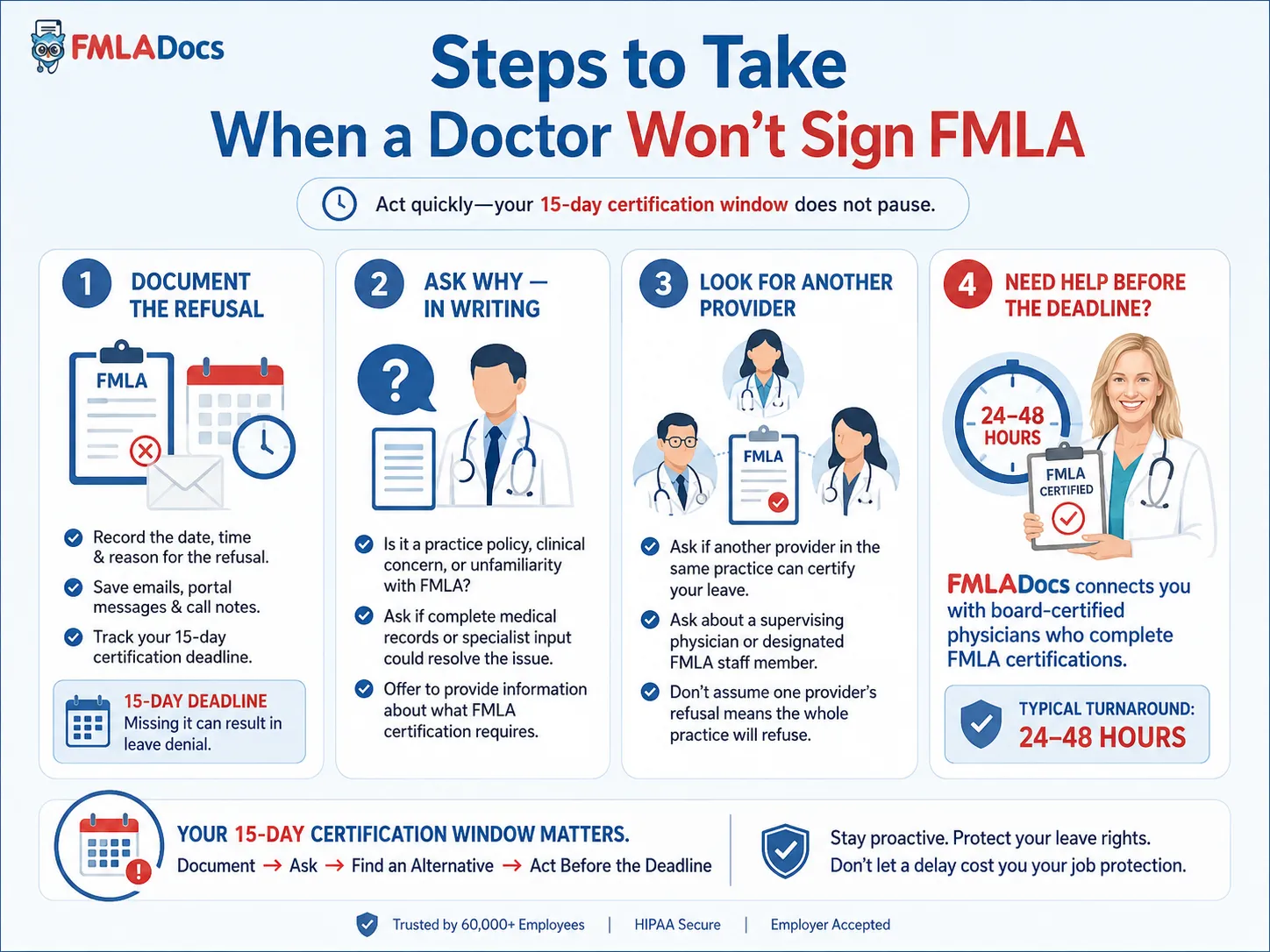
When a doctor won’t sign FMLA paperwork, you need to act fast. Your 15-day certification window doesn’t pause while you figure out next steps. Here’s how to protect your leave rights when your provider declines.
Document the Refusal and Your Deadline
Write down the exact date, time, and reason your doctor gave for refusing. This record protects you if you need to explain delays to your employer or file a complaint later. Don’t rely on memory when your job protection is at stake.
Calculate how many days remain in your 15-day certification window. Mark the deadline on your calendar and phone. Missing this deadline can result in leave denial, even if the refusal wasn’t your fault.
Keep copies of all communication with your provider’s office. Save emails, take notes after phone calls, and screenshot portal messages. This documentation becomes critical if disputes arise about what was said or when you made requests.
Request a Clear Explanation
Ask your provider to explain in writing why they’re declining. Is it a policy issue? A clinical disagreement about whether your condition qualifies? Unfamiliarity with FMLA forms? You can’t fix the problem without knowing what it is.
Many providers refuse because they don’t understand what qualifies as a serious health condition under FMLA. If that’s the case, offer to provide DOL guidance documents. Explain what information the form needs. Sometimes education solves the issue.
If the refusal is based on incomplete medical records, ask if they’d reconsider after reviewing your complete history. Some providers need to consult with specialists before completing certification. Ask if that’s an option and how long it would take.
Ask About Alternative Solutions Within the Practice
Request whether another provider in the same practice can review your case. Many medical offices have multiple doctors or nurse practitioners who handle FMLA paperwork. One provider’s refusal doesn’t mean the entire practice will decline.
If your regular doctor is uncomfortable with the forms, ask if a supervising physician can complete them instead. Some practices have designated staff who handle all FMLA certifications. Find out who that person is and request an appointment.
When time is running out and your provider can’t help, FMLADocs connects you with board-certified physicians who complete FMLA certifications daily. Turnaround is typically 24-48 hours, which can save your leave when your deadline is approaching.
Qualified Providers Who Can Complete FMLA Certification
You have the right to seek FMLA certification from any licensed healthcare provider qualified to treat your condition. Your regular doctor isn’t the only option. If your doctor won’t sign FMLA, you can go elsewhere.
Qualified providers include MDs, DOs, nurse practitioners, clinical psychologists, physician assistants, clinical social workers, and other licensed professionals. The specific provider type depends on your condition. Mental health conditions can be certified by psychiatrists, psychologists, or licensed clinical social workers.
Specialists Who Treat Your Specific Condition
If you see a specialist for your condition, they can certify FMLA. A psychiatrist treating your depression can complete the forms. An orthopedist managing your back injury can sign off. A cardiologist treating your heart condition has the authority.
Specialists often handle FMLA paperwork better than generalists. They see these conditions daily. They understand the functional limitations better. They know what employers need to see on certification forms.
Your employer cannot require certification from a specific provider. They cannot reject valid certification because it came from someone other than your primary care doctor. The law protects your right to choose any qualified provider.
Nurse Practitioners and Physician Assistants
Nurse practitioners and physician assistants can complete FMLA certification in most states. They’re licensed healthcare providers under federal FMLA regulations. Many employees don’t realize this option exists.
These providers often have shorter wait times than physicians. They can evaluate your condition and complete forms faster. If your regular doctor has a three-week wait, an NP or PA might see you this week.
Check your state’s specific rules. Most states allow NPs and PAs to certify FMLA independently. A few require physician supervision. Your HR department can confirm what your employer accepts.
Telemedicine FMLA Services
Services like FMLADocs connect you with licensed physicians who complete FMLA certifications daily. These doctors understand exactly what employers need. They know how to document functional limitations properly.
Turnaround is typically 24-48 hours. That matters when your 15-day certification deadline is running. Traditional providers often take weeks to schedule appointments. Then more weeks to complete paperwork.
Online FMLA certification services eliminate scheduling delays and incomplete forms. Board-certified physicians evaluate your condition through telehealth visits. They complete every required field the first time. No back-and-forth corrections that burn through your deadline.
This option works especially well when your regular provider refuses to sign. Or when they’re unfamiliar with FMLA requirements. Or when you simply can’t get an appointment fast enough to meet your deadline.
Medical Information Required for FMLA Certification
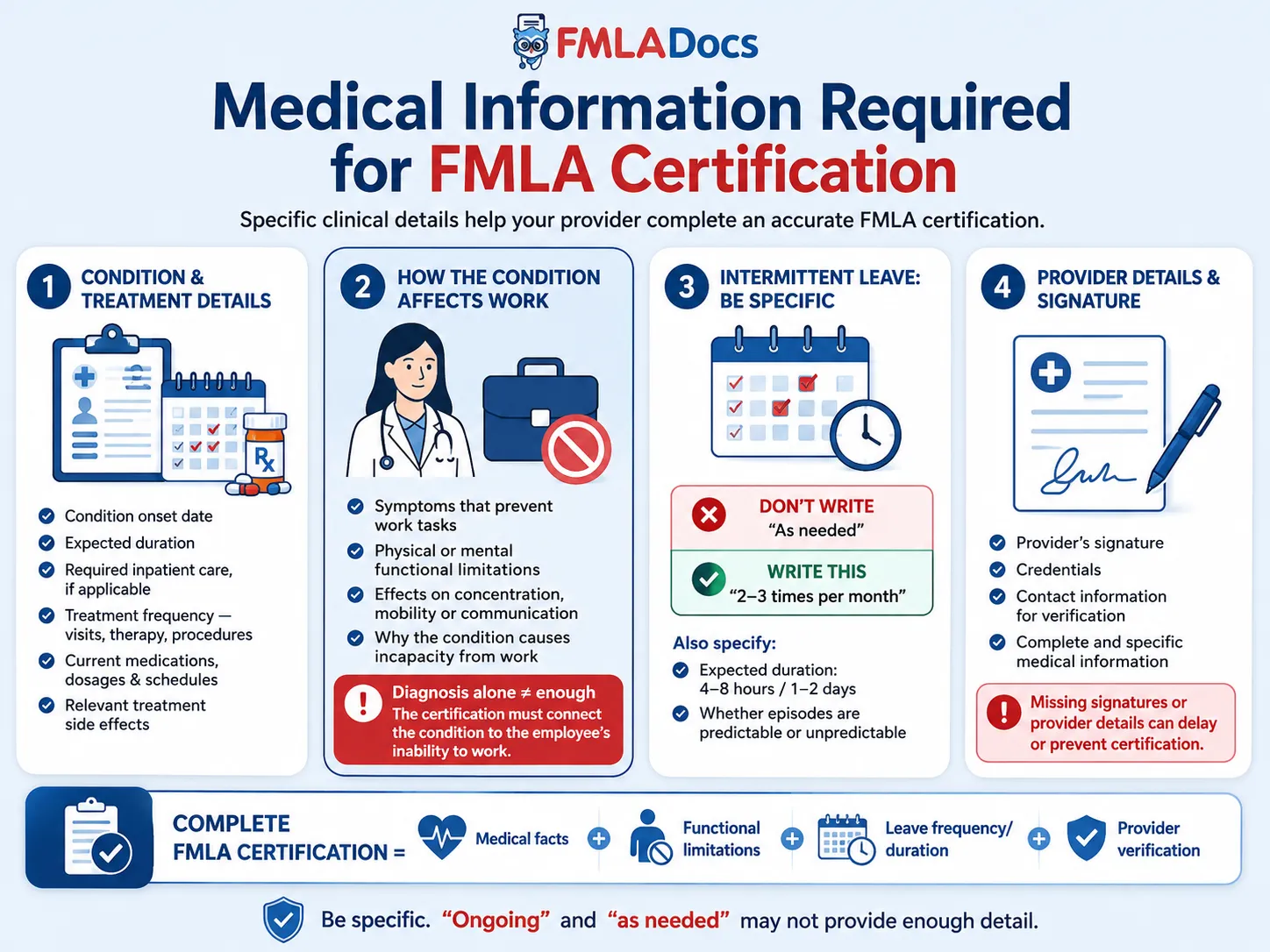
When your doctor won’t sign FMLA paperwork, the problem often stems from incomplete or vague medical information. Certification forms need specific clinical details that meet federal standards. Understanding what’s required helps you guide the conversation with your provider.
Diagnosis and Treatment Plan Details
Your certification must include the date your condition began. It also needs the expected duration of your condition. Writing “ongoing” instead of a specific timeframe gets forms rejected.
According to the Department of Labor, providers must document all inpatient care was required. They must also state whether continuing treatment is needed and how often. This includes frequency of appointments, therapy sessions, or medical procedures.
The form asks about medications, dosages, and treatment schedules. Your provider should list current prescriptions and their purpose. They should note any side effects that affect your work capacity.
Functional Limitations and Work Impact
The provider must explain how your condition affects your ability to perform job functions. Simply listing a diagnosis isn’t enough. The certification needs to show why you can’t work during episodes.
For panic disorder, that means describing episodes occurring two to three times weekly. Each episode lasts 30-60 minutes. Symptoms include racing heart, difficulty breathing, and inability to concentrate.
For chronic migraines, certification should note episodes four to six times monthly. Each lasts 8-24 hours. Severe pain, light sensitivity, and nausea make sustained work impossible.
-
Describe specific symptoms that prevent work tasks
-
Explain physical or mental limitations during episodes
-
Note how symptoms affect concentration, mobility, or communication
Frequency and Duration for Intermittent Leave
For intermittent leave, certification must include estimated frequency of episodes. Write “2-3 times per month” instead of “as needed.” The latter doesn’t establish a valid intermittent leave schedule.
Expected duration of each episode matters too. Specify “4-8 hours” or “1-2 days” per episode. This helps employers plan coverage and track your FMLA usage accurately.
The provider must state whether episodes are predictable or unpredictable. Predictable episodes follow a pattern. Unpredictable ones occur without warning. Both qualify, but the distinction affects how you request time off.
The provider must sign the form and include their credentials. They need to add their contact information for verification. Missing signatures or incomplete provider details cause immediate rejection.
Obtaining FMLA Certification When a Doctor Won’t Sign
When a doctor won’t sign FMLA paperwork, you’re not out of options. The refusal often stems from misunderstandings about liability, time constraints, or unfamiliarity with the forms. Understanding why providers decline and how to address their concerns can turn a rejection into approval.
Addressing Provider Concerns Directly
Many doctors hesitate because they think signing FMLA forms exposes them to legal risk. That’s not how it works. FMLA certification requires only factual medical information. Your provider documents your diagnosis, treatment plan, and functional limitations. They don’t make a legal judgment about whether you deserve leave.
Federal law shields providers from liability when they complete certification in good faith based on clinical assessment. If your doctor worries about legal exposure, share this fact directly. You can also offer to pay any reasonable administrative fee for form completion. Many practices charge $25 to $75, which is legal and often resolves the objection immediately.
Another common barrier is time. Doctors see the multi-page form and assume it will take 30 minutes they don’t have. Provide the blank form in advance so they can review it before your appointment. This reduces the time burden during your visit and shows you respect their schedule.
Seeking a Second Medical Opinion
If your doctor’s refusal is based on clinical judgment that your condition doesn’t meet FMLA’s threshold, seek a second opinion. Another qualified provider can independently evaluate whether your condition meets the legal standard. This isn’t doctor shopping. It’s getting a fresh clinical assessment from someone who may have different expertise or perspective.
Bring documentation to the new provider. Include work absence records, symptom logs, and functional limitations. This helps them understand the full picture of how your condition affects your ability to work. The more complete your documentation, the better positioned they are to make an informed assessment.
Understanding doctor’s note requirements for FMLA certification helps you prepare the right information for any provider evaluation.
Understanding the ‘Serious Health Condition’ Standard
The Department of Labor defines serious health conditions specifically. They include conditions requiring inpatient care, continuing treatment causing three or more days of incapacity with two or more provider visits, chronic conditions requiring periodic visits, pregnancy, or conditions requiring multiple treatments like chemotherapy.
If your condition meets any of these criteria, it qualifies. Many employees assume their anxiety, migraines, or chronic pain isn’t serious enough. But episodic conditions that cause periodic incapacity absolutely qualify under federal standards.
When seeking a second opinion, ask the new provider to evaluate your condition against these specific DOL criteria. Frame the question clinically: Does my condition meet the continuing treatment standard? Does it cause periodic incapacity? This focuses the conversation on objective medical facts rather than subjective judgments about severity.
Telehealth Evaluation for FMLA Medical Certification
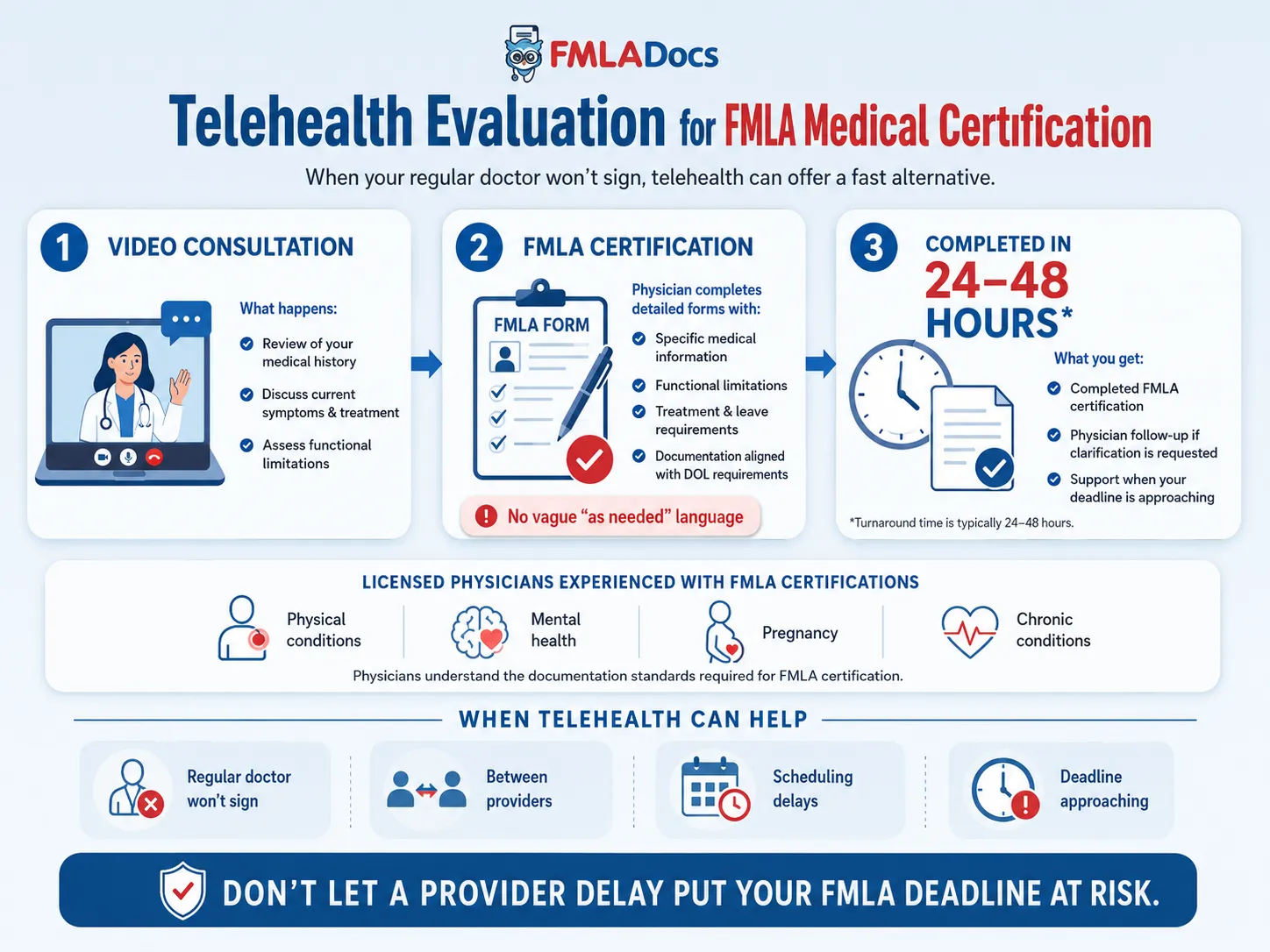
When your doctor won’t sign FMLA forms, telehealth offers a fast alternative. FMLADocs connects you with board-certified doctors who complete FMLA certifications daily. These physicians understand precisely what documentation employers require.
How Telemedicine FMLA Services Work
The process takes 24-48 hours from consultation to completed forms. You’ll have a video consultation where the physician reviews your medical history. They’ll assess your current symptoms, treatment plan, and functional limitations.
Forms get completed with specific, detailed information that meets DOL requirements. No vague language that gets rejected. If your employer requests clarification, the physician handles follow-up communications directly.
Licensed Physicians Who Specialize in FMLA Cases
All physicians are licensed to practice telemedicine. They’re qualified to certify the full range of FMLA-eligible conditions. This includes physical health, mental health, pregnancy, and chronic conditions.
These doctors complete FMLA certifications as a core part of their practice. They know the documentation standards inside and out. You get expertise that many primary care doctors lack.
Fast Turnaround When Deadlines Are Tight
The 24-48 hour turnaround can save your certification when the 15-day deadline approaches. This service proves valuable in several situations. Use it when your regular doctor won’t sign or when you’re between providers.
It also helps when scheduling delays would blow your deadline. Or when you need certification for a condition your PCP doesn’t feel comfortable addressing. You get qualified medical certification without the wait.
Medical Records Needed for Telehealth Evaluation
Having the right medical records ready makes your FMLA evaluation faster and more accurate. These documents help healthcare providers complete your certification without delays.
Documentation of Your Condition
Start with records that show your diagnosis and when it began. Include any test results, imaging reports, or lab work that confirms your condition.
Get copies of treatment plans from your providers. These show what care you’re receiving and why it’s necessary.
Prescription records prove you’re actively treating your condition. List all medications, dosages, and how long you’ve taken them.
Treatment History and Provider Notes
Collect notes from recent doctor visits related to your condition. These document your symptoms and how they’ve changed over time.
For mental health conditions, therapy notes or psychiatric records establish ongoing treatment. They show you meet FMLA’s continuing treatment requirement.
Emergency room visits, hospitalizations, or urgent care records demonstrate severity. Get copies of discharge summaries and treatment notes.
Work Impact Records
Document when symptoms affect your job performance. Track dates you left early, called in sick, or needed workplace accommodations.
Note symptom patternswhen episodes occur, how long they last, and what triggers them. This helps providers understand your functional limitations.
Keep a simple log of how your condition affects daily tasks. Specific examples help doctors complete certification forms accurately.
Next Steps After a Doctor Won’t Certify FMLA Leave
When your doctor refuses to sign FMLA paperwork, you need to act fast. Don’t wait until your deadline passes to tell your employer what happened.
Notifying HR About Certification Delays
Contact HR right away when you hit a roadblock with your provider. Explain the specific problem you’re facing.
Tell them: “My doctor declined to complete the forms and I’m seeking certification from another provider.” Or say: “My specialist has a three-week appointment wait.”
Be specific about what’s causing the delay. HR can’t help if they don’t know what’s happening.
Requesting Deadline Extensions
Ask for a deadline extension in writing. Document your good-faith efforts to get certification.
Employers can grant reasonable extensions when you show you’re actively working on the problem. They have discretion to do this, but you need to prove you’re trying.
Explain the reasons for delay beyond your control. Show them you’re not just ignoring the requirement.
Protecting Your Job During the Process
Send updates every few days showing progress. Say: “I have an appointment scheduled for [date]” or “I’m working with a telemedicine provider who will complete forms by [date].”
Keep copies of all communications with HR. This proves you notified them promptly and made continuous efforts to fix the issue.
Save all emails with HR to a personal account, not just work email. Take notes after phone conversations documenting date, time, who you spoke with, and what was said.
This paper trail protects you if your employer later claims you didn’t communicate about the delay.
Common FMLA Certification Mistakes to Avoid
Incomplete paperwork delays more FMLA applications than any other issue. Employers reject certifications with missing information and request corrections. This burns through your limited time.
Incomplete Medical Certification
Before submitting, confirm your certification includes specific details. You need an onset date and duration. You need treatment frequency and functional impact on job duties.
Your provider’s signature and credentials must appear on the form. Missing any of these triggers rejection. Double-check every field before submission.
Being Too Vague About Your Condition
Vague language gets forms bounced back immediately. Terms like “ongoing” or “as needed” don’t meet DOL standards. Ask your provider to describe how your condition manifests functionally.
Writing “anxiety” with no symptom description isn’t enough. Listing “back pain” without frequency or treatment plan doesn’t establish a serious condition. Include specific work limitations, frequency, and duration.
Your provider should explain what you can’t do at work. They should note how often symptoms occur. They should describe treatment plans and expected recovery time.
Missing the 15-Day Deadline
The 15-day certification window catches most employees off guard. Once your employer formally requests medical certification, you have just 15 calendar days. That’s not business daysit’s total days including weekends.
Contact your provider the same day you notify HR. Ask directly whether they’re comfortable completing DOL WH-380 forms. Hand over the blank form in advance.
Don’t assume your condition isn’t serious enough. Chronic migraines, anxiety disorders, depression, and diabetes commonly qualify under DOL regulations. Many conditions you think won’t qualify actually do.
Why Telemedicine Solves the Provider Refusal Problem
When your regular doctor won’t sign and your 15-day deadline approaches, telemedicine FMLA services provide a backup solution. This option works within your time constraints.
FMLADocs physicians complete FMLA certifications daily. They understand what employers need to see. No learning curve exists. The 24-48 hour turnaround from consultation to completed forms can make the difference between approval and denial. Traditional provider scheduling would blow your deadline.
Complete, Accurate Certification the First Time
Board-certified doctors are licensed to practice telemedicine. They can certify the full range of FMLA-eligible conditionsphysical health, mental health, pregnancy, chronic conditions.
Forms get completed with specific, detailed information that meets DOL requirements. Your application won’t bounce back for corrections.
If your employer requests clarification or additional information, physicians handle follow-up communications directly. You don’t manage back-and-forth exchanges.
Getting Started With FMLADocs
This service works in several situations. Your regular doctor won’t sign. You’re between providers. Scheduling delays would blow your deadline. You need certification for a condition your PCP doesn’t feel comfortable addressing.
You’ll be matched with a certified doctor who understands FMLA cases. The entire process happens from home.
The consultation includes time for recovery, postpartum care, and supporting a partner during and after delivery. You get job-protected time off, up to 12 weeks, so you can focus fully on getting better.
Conclusion
When your doctor won’t sign FMLA paperwork, you have options. This guide covered why providers refuse, your legal rights to alternative certification, and backup solutions that protect your job. You learned about qualified providers beyond your regular doctor. You saw what medical information employers need. You discovered how telehealth solves provider refusal problems fast.
The 15-day certification deadline doesn’t wait for scheduling conflicts. Taking action now prevents denials that cost you job protection. You can seek certification from any qualified provider. You can use telemedicine for faster evaluations. You can avoid common mistakes that delay approval.
Don’t let provider issues block leave you’re legally entitled to. If you’re facing FMLA certification refused and your deadline approaches, FMLADocs connects you with licensed physicians who complete certifications correctly. Our board-certified doctors specialize in cases where a doctor won’t sign FMLA forms. Start your consultation today and get certified within 48 hours.
Frequently Asked Questions
Why would my doctor refuse to sign my FMLA paperwork even though I have a real medical condition?
Your doctor's refusal often has nothing to do with doubting your condition. Most primary care doctors see FMLA forms rarely and don't know the specific legal definitions the DOL uses. They worry about legal liability if an employer challenges their certification. Some practices adopt blanket policies against completing any third-party paperwork because insurance doesn't reimburse them for the time and staff resources required. Your relationship with the doctor doesn't override these policies.
What should I do first when my doctor declines to sign my FMLA certification?
Act immediately because your 15-day certification deadline doesn't pause. Ask your doctor to explain their specific reason for declining. If they cite unfamiliarity with FMLA requirements, offer to provide the DOL's certification guidelines. If they have a blanket policy against third-party forms, ask for a referral to another provider who can review your medical records and complete the certification. Document this conversation in writing to show your employer you're making good faith efforts to meet the deadline.
Can I get FMLA certification from a different doctor if my primary care physician won't sign?
Yes, you can seek certification from other qualified healthcare professionals. The FMLA allows nurse practitioners, physician assistants, clinical psychologists, and clinical social workers to complete certifications for conditions within their scope of practice. Telemedicine FMLA doctors provide backup certification when traditional routes fail. These providers review your medical records and current symptoms to determine if your condition meets FMLA standards. You don't need to stay with a doctor who refuses to complete your paperwork.
How much time do I have to get FMLA certification after my doctor refuses?
You have 15 calendar days from when your employer requests certification to submit completed paperwork. This deadline doesn't extend because your doctor declined. If you can't meet the deadline, request an extension in writing before it expires. Explain that your provider refused and you're seeking alternative certification. Most employers grant reasonable extensions when you show good faith efforts. Missing the deadline without communication can result in denial of your FMLA leave request and potential job loss.
Does my doctor's refusal to sign FMLA forms mean my condition doesn't qualify for leave?
No, a doctor's refusal doesn't mean your condition fails to meet FMLA standards. Physicians decline for administrative reasons, liability concerns, or unfamiliarity with FMLA requirements. They might treat your migraines, anxiety, or back pain effectively but feel uncomfortable certifying it legally. The DOL defines serious health conditions in precise legal terms many doctors don't encounter regularly. Your condition may clearly qualify even when your doctor won't complete the paperwork. Seek certification from providers who understand FMLA standards.
What medical information do I need ready when finding an alternative provider for FMLA certification?
Gather your complete medical records showing diagnosis, treatment history, and ongoing care for your condition. Include test results, prescription records, and notes from recent appointments. Document how your condition affects your ability to work and what limitations you experience. List all medications you take and any specialists treating you. Alternative providers need this information to assess whether your condition meets FMLA's continuing treatment standard. Having organized records speeds up the certification process and helps you meet your deadline.
Can my employer deny FMLA leave if my doctor refuses to complete the certification?
A doctor's refusal does not automatically mean you are ineligible for FMLA. You generally need to provide a complete and sufficient certification from an appropriate health care provider within the required timeframe.
Can a nurse practitioner or physician assistant complete my FMLA certification?
Yes. FMLA rules recognize several qualified health care providers beyond physicians, including nurse practitioners, physician assistants, clinical social workers, and certain other licensed providers, provided they meet the applicable requirements.
Meet the author
Nida Hammad
I am a professional writer with over five years of experience creating clear, engaging, and well-researched content. I specialize in healthcare topics, helping readers understand complex information in simple wording. Currently, I write for FMLA DOC, where I focus on producing accurate and trusted guides for people seeking support with FMLA and medical needs.
Get Your FMLA Certification Online in Minutes