FMLA Recertification: Timing, Forms, and Your Employee Rights
 by Areeba Imran
 Last updated:
Your employer just requested FMLA recertification for your ongoing medical leave. You wonder if this is legal and what happens if you miss the deadline. The answer is yes, they can ask for updated medical documentation, but strict federal rules limit when and how often.
FMLA recertification confirms your condition still requires job-protected leave. Many employees don’t realize employers can request updated forms during ongoing leave. Others miss critical deadlines because they don’t understand the timing rules or struggle to get healthcare providers to complete paperwork quickly enough. Missing a recertification deadline can jeopardize your job protection, even if your medical condition remains serious.
This guide explains exactly when employers can request FMLA recertification, what documentation you must provide, and your legal rights during the process. You’ll learn the specific FMLA recertification requirements, how to meet deadlines, what information must appear on recertification forms, and how to protect yourself from improper employer requests. We’ll also cover common mistakes that put your leave at risk and how to avoid them.
Let’s start with what FMLA recertification actually means and why employers request it.
What FMLA Recertification Actually Means for Your Leave
FMLA recertification is updated medical documentation that confirms your condition still requires job-protected leave. It’s not a new application. It’s proof that your qualifying health issue continues to affect your ability to work. Employers use this process to verify ongoing medical necessity for intermittent or extended leave periods.
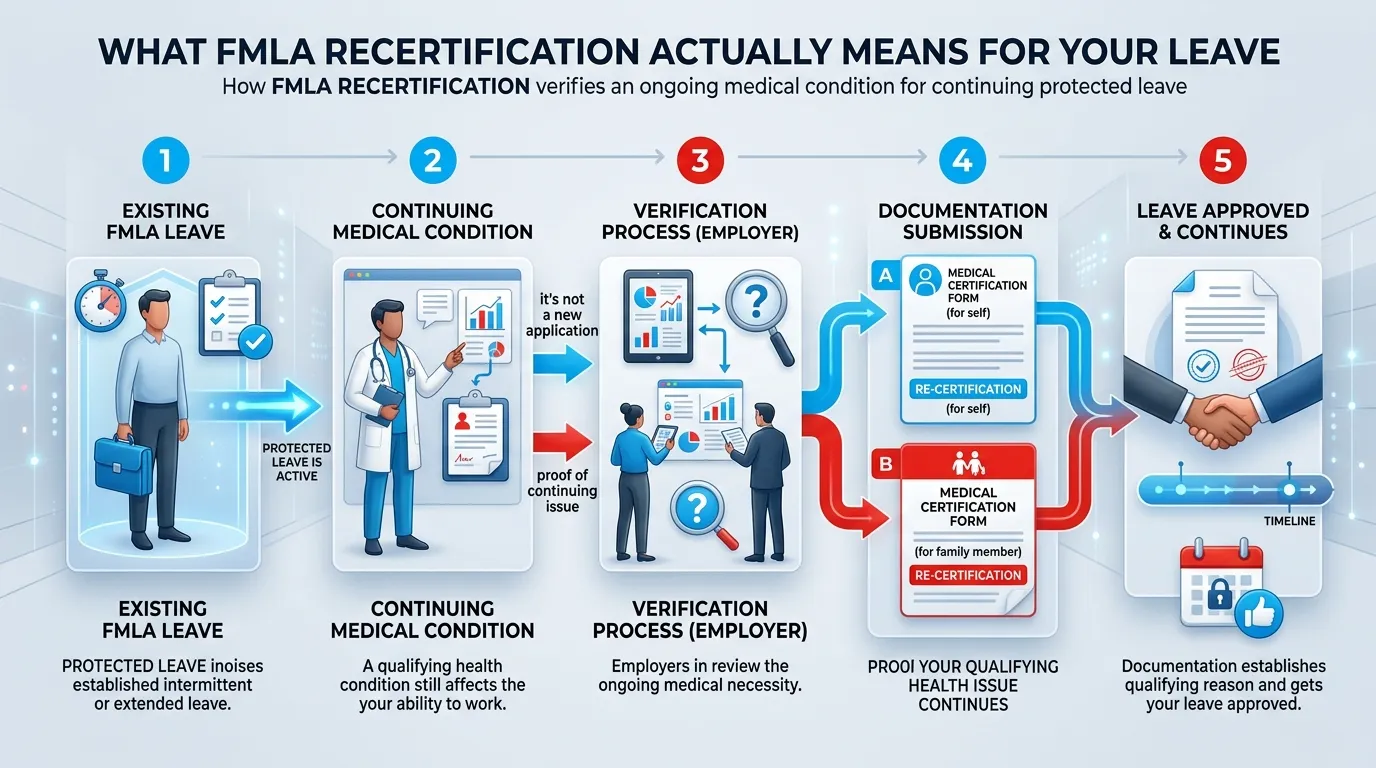
Think of it this way. Initial certification establishes that you have a qualifying condition. Recertification proves that the condition hasn’t resolved. Both use the same Department of Labor forms. Both require detailed medical information. The key difference is timing and purpose.
The Difference Between Initial Certification and Recertification
Initial certification happens when you first request FMLA leave. Your healthcare provider completes Form WH-380-E for your own condition or Form WH-380-F for a family member’s condition. This documentation establishes your qualifying reason and gets your leave approved.
Recertification addresses your current status. It doesn’t just repeat your original diagnosis. According to the Department of Labor, it must show how your condition affects you now. Has it improved? Worsened? Remained the same? What treatment are you receiving currently?
For chronic conditions like migraines or anxiety, recertification confirms episodes still occur at a similar frequency. For recovery situations like surgery, it shows you still need time to heal. The form asks about recent treatment dates and current functional limitations.
Why Employers Request Updated Medical Documentation
Employers can request recertification every 30 days for ongoing conditions. This isn’t about doubting you. It’s about maintaining accurate records and ensuring leave protection aligns with medical necessity. For intermittent leave, especially, patterns can change over months.
Your employer needs to know if your condition has stabilized or if you need different accommodations. They also verify you’re receiving continuing treatment as originally certified. Without updated documentation, they can’t confirm your leave remains protected under federal law.
Common recertification triggers include:
-
Minimum 30-day intervals for chronic conditions requiring intermittent leave
-
When you request an extension beyond your original certification period
-
If your absence pattern changes significantly from what was approved
-
When your initial certification expires, and you still need to leave
The same forms apply. The same 15-day deadline applies. The same level of detail is required. Many employees who handle initial certification smoothly stumble on recertification because they assume it’s simpler. It’s not. It requires the same attention to detail and provider cooperation.
If you’re managing a condition covered under FMLA conditions, staying ahead of recertification deadlines protects your job. Missing a recertification request can leave you vulnerable to discipline for absences that would otherwise be protected. Track your certification expiration dates and start the renewal process early.
When Your Employer Can Legally Request Recertification
Federal law protects you from excessive FMLA recertification requests. But employers can ask for updated medical documentation under specific conditions. Understanding these rules helps you know when a request is legitimate and when it crosses the line.
The timing and frequency of recertification requests follow strict federal guidelines. Most employees don’t realize these protections exist until they face repeated demands for paperwork.
The 30-Day Minimum Rule
According to federal regulations on recertification, employers cannot request FMLA recertification more than once every 30 days for ongoing conditions. This 30-day period starts from the date of your previous certification, not when you submitted it or when your employer received it.
The rule applies to all continuing treatment situations. Your employer can’t demand new paperwork every week or after each absence. The 30-day minimum gives you breathing room between certification cycles.
For example, if you submitted certification on June 1st for chronic migraines, your employer can’t request recertification until July 1st at the earliest. Even if you have multiple migraine episodes during June, the 30-day clock protects you from repeated requests.
Exceptions That Allow More Frequent Requests
Three specific circumstances allow employers to request recertification before 30 days pass. These exceptions exist to address changing situations or questionable claims.
First, your employer can request a new certification if your circumstances change significantly. This includes requesting an extension beyond your original leave estimate or changing the frequency or duration of intermittent leave.
Second, they can ask for recertification if they receive information that casts doubt on your stated reason for leave. This might include reports of you working elsewhere during leave or social media posts contradicting your medical restrictions.
Third, if the minimum duration of your certification expires, your employer can request updated documentation. Research from Triage Cancer explains that these exceptions require reasonable grounds, not just suspicion.
Your employer must have legitimate reasons to invoke these exceptions. They can’t use them as loopholes to harass you with constant paperwork demands.
State Laws That May Provide Additional Protections
Some states impose stricter limits on FMLA recertification frequency than federal law requires. California, New York, and Washington have state family leave laws with additional employee protections.
These state laws may extend the minimum period between recertification requests or limit the circumstances under which employers can ask for updates. They might also require employers to provide more detailed justification before requesting early recertification.
Check your state’s labor department website to see if additional protections apply. When state and federal laws differ, you get the protection that’s most favorable to you.
The Recertification Timeline and Deadline Requirements
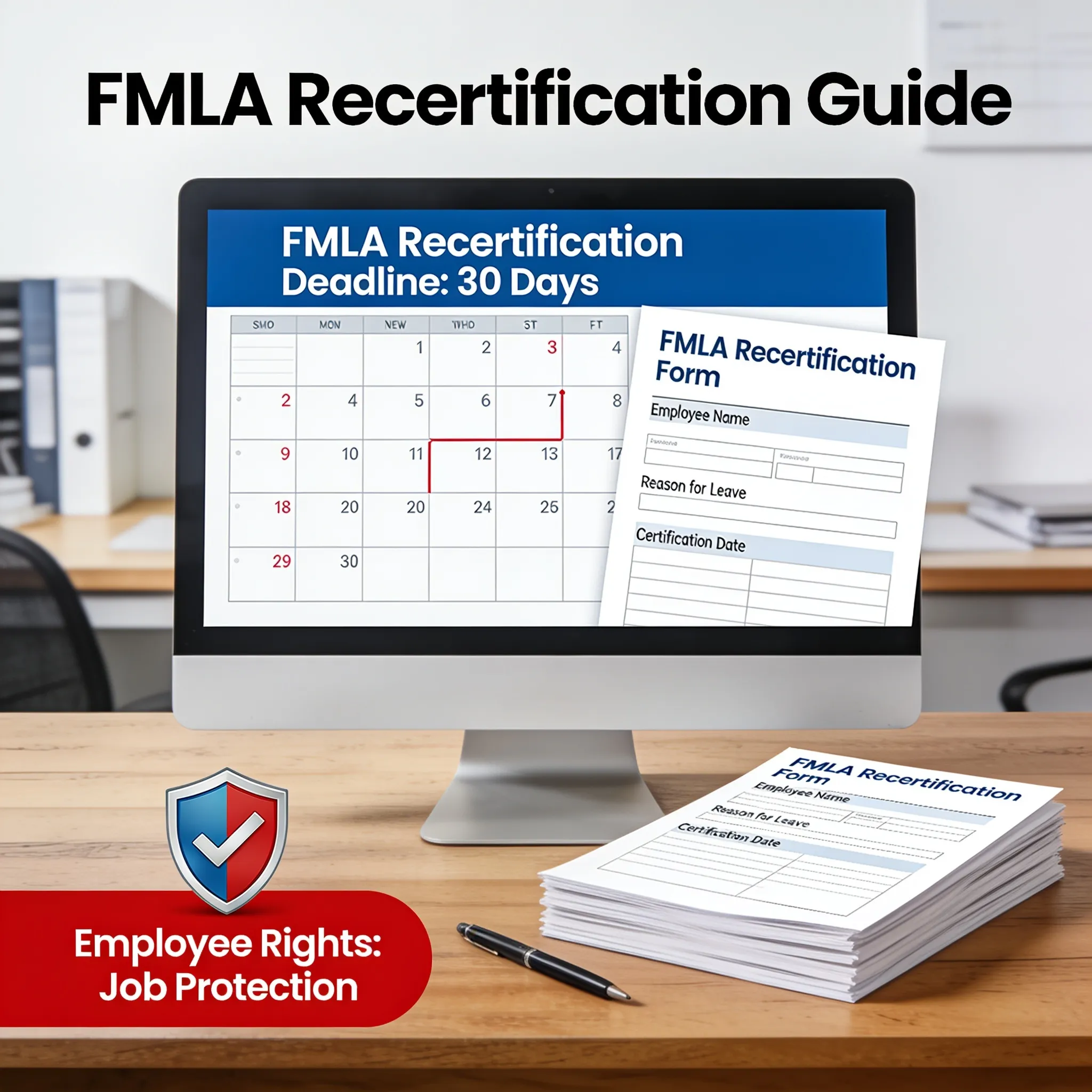
When your employer requests FMLA recertification, the clock starts immediately. You have exactly 15 calendar days to submit completed forms. This isn’t 15 business days. Weekends and holidays count toward your deadline.
The 15-day window begins when your employer formally requests recertification in writing. That might be an email, a letter, or a form handed to you directly. The date you receive that request is day one.
How Much Time Do You Have to Submit Forms
According to the Office of Personnel Management, the 15-day deadline applies to all FMLA recertification requests. This timeline is strict. If day 15 falls on a Saturday, your deadline is still Saturday.
Many employees underestimate how long it takes to get forms completed. Your doctor’s office might need a week to schedule you. The provider might take another three to five days to complete paperwork. That leaves little margin for error.
If your healthcare provider needs more time, tell HR immediately. Don’t wait until day 14 to mention scheduling problems. Extensions may be granted for circumstances beyond your control, but they aren’t guaranteed. You need to show that you acted promptly, and the delay wasn’t your fault.
FMLADocs can help you meet tight deadlines. Our board-certified physicians complete FMLA Certification forms within 24-48 hours. That turnaround can save your life when time is running out.
What Happens If You Miss the Deadline
Missing the recertification deadline has serious consequences. Your employer can deny continued FMLA protection. That means your absences are no longer job-protected. You could face discipline or termination for missing work.
Some employers grant brief extensions if you communicate proactively. Others enforce the deadline strictly. Don’t assume you’ll get extra time. The safest approach is to treat the 15-day window as absolute.
If you miss the deadline, your employer isn’t required to restore your FMLA rights. You might need to reapply from scratch. That creates a gap in protection that could cost you your job.
What Information Must Be Included in Recertification Forms
FMLA recertification forms require specific medical details that go beyond your initial certification. Your employer needs current information to confirm your condition still qualifies for job-protected leave. Vague statements won’t cut it.
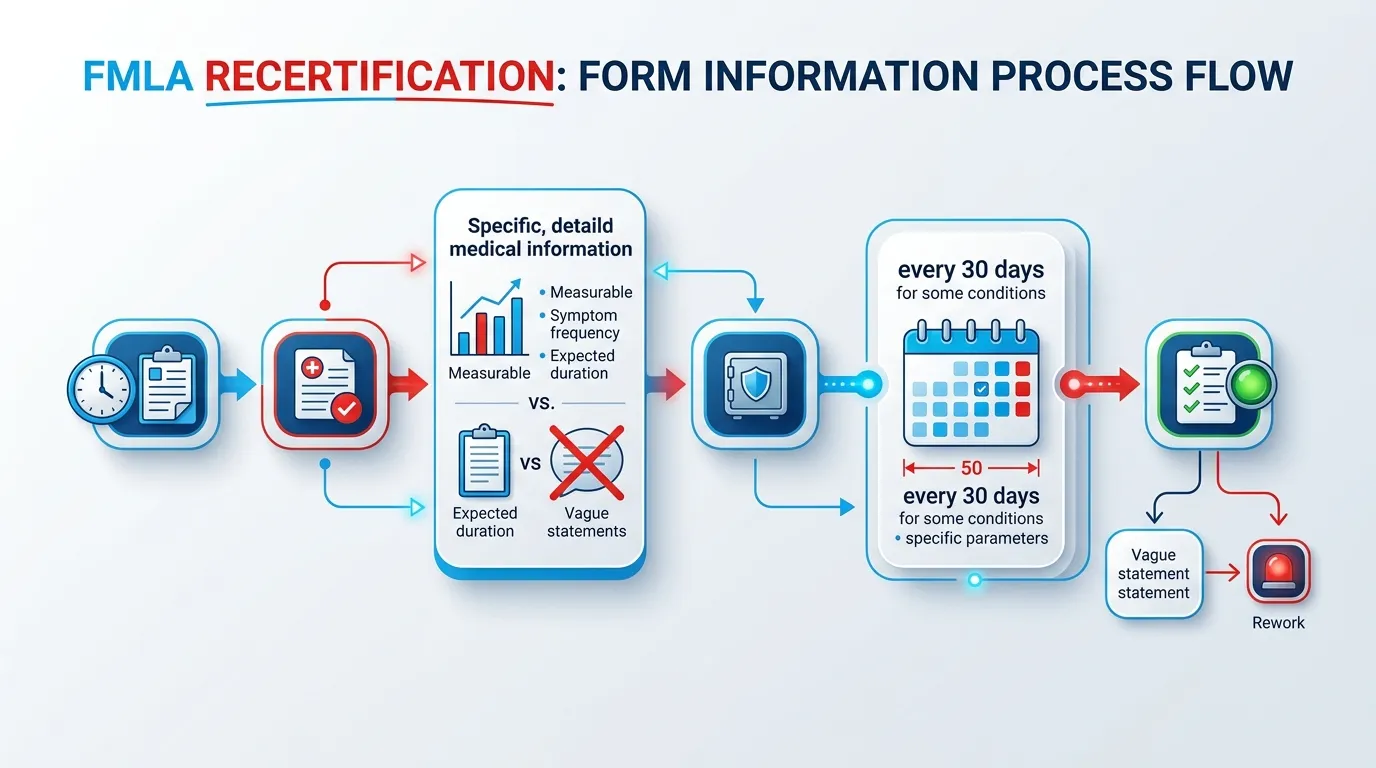
Your healthcare provider must document the current status of your condition. Has it improved, worsened, or stayed the same? This comparison to your initial certification helps employers understand whether continued leave remains necessary.
Required Medical Details for Ongoing Conditions
The recertification must include an updated treatment plan. This means listing current medications, therapy frequency, and appointment schedules. Your provider should specify how often you see them for this condition.
For intermittent leave, frequency and duration updates are critical. If your initial certification estimated two migraine episodes monthly, but you’re now experiencing four, the recertification must reflect this change. Each episode’s expected duration also needs documentation.
Your provider must explain why continued leave remains medically necessary. Writing “condition ongoing” without specifics will get your form rejected. Instead, they should describe current symptoms, functional limitations, and how these affect your ability to work.
If your employer included specific questions in their recertification request, your provider must address each one. Ignoring employer questions is grounds for denial. Many employees work with FMLA Docs to ensure their recertification forms include every required detail the first time.
How Recertification Differs from Initial Certification
Initial certification establishes that you have a qualifying serious health condition. Recertification proves your condition still requires ongoing leave protection. The focus shifts from diagnosis to current status.
Recertification forms ask for updates, not repetition. Your provider shouldn’t copy answers from your initial certification. They need to document what’s changed or why your condition continues to prevent you from working.
The timeline matters too. Initial certification covers your leave start date and estimated duration. Recertification extends that protection by showing your condition hasn’t resolved as expected. Your provider must give a revised estimate of how long you’ll need continued leave.
Understanding Employee Rights during the recertification process helps you avoid common mistakes. Your employer can request recertification every 30 days for some conditions, but they must follow specific rules about timing and frequency.
Your Rights During the Recertification Process
Understanding your rights during FMLA recertification protects you from improper employer requests. Federal law sets clear boundaries on what employers can and cannot do. These protections ensure your medical privacy stays intact while maintaining job security.
What Employers Cannot Do?
Employers face strict limits when requesting FMLA recertification. They cannot contact your healthcare provider directly without your written authorization. This protects your medical privacy and prevents unauthorized information sharing.
They cannot request your complete medical records or diagnosis details beyond what’s on the form. The certification form asks specific questions. Employers must accept those answers without demanding additional documentation.
According to common employer recertification mistakes, companies often overstep by requesting excessive medical information. This violates employee rights under federal law.
Employers cannot retaliate against you for taking time to complete recertification. You have 15 calendar days to submit forms. Taking that full time doesn’t justify discipline or negative treatment.
You have the right to use a different healthcare provider for recertification than for initial certification. Your medical care choices remain yours. Employers must accept properly completed forms from any licensed provider.
Employers must continue FMLA protections while waiting for recertification unless you’ve exceeded 15 days. Your job protection doesn’t lapse during the submission window. This prevents gaps in coverage during legitimate processing time.
When to Challenge an Improper Recertification Request
If recertification is denied, employers must explain the specific deficiency in writing. Vague rejections like “insufficient information” don’t meet legal standards. You deserve clear guidance on what’s missing.
You can challenge improper recertification requests through the DOL Wage and Hour Division. File a complaint if your employer requests recertification more frequently than allowed. The standard is every six months for most conditions.
Challenge requests that demand information beyond form requirements. Your Paperwork Guide shows exactly what employers can legally request. Anything beyond those boundaries violates your rights.
Document every interaction about recertification. Save emails, take notes after phone calls, and keep copies of all submitted forms. This evidence becomes critical if you need to file a complaint.
Conclusion
FMLA recertification protects your job when medical conditions require extended leave. You now understand the 30-day minimum rule between requests. You know the 15-day deadline for submitting completed forms. You’ve learned what information doctors must include to meet DOL standards.
Most FMLA recertification problems come from incomplete paperwork or missed deadlines. Your healthcare provider might not understand specific employer requirements. They may lack time to complete forms before your deadline expires.
Don’t risk your job protection because of timing issues. Act before your FMLA recertification deadline approaches. Get your forms completed the first time correctly.
FMLADocsconnects you with board-certified physicians who complete FMLA recertification requirements within 24-48 hours. Our doctors know exactly what employers need to see. They fill out every required field correctly. You get proper documentation without scheduling delays or incomplete forms.
Frequently Asked Questions
How often can my employer request FMLA recertification for my ongoing medical condition?
Your employer can request FMLA recertification every 30 days for ongoing conditions. This is the minimum interval allowed under federal law. For chronic conditions requiring intermittent leave, this means you might need updated medical documentation monthly. The 30-day rule applies to conditions that continue beyond your initial certification period. Your employer can't request recertification more frequently than every 30 days unless your situation changes significantly. This frequency limit protects you from excessive paperwork demands while letting employers verify ongoing medical necessity.
What is the difference between initial FMLA certification and recertification?
Initial certification establishes you have a qualifying condition when you first request leave. Recertification proves that condition hasn't resolved and still requires job protection. Both use the same Department of Labor forms. Initial certification gets your leave approved. Recertification addresses your current status and shows how your condition affects you now. It must demonstrate whether your condition improved, worsened, or remained the same. For chronic conditions, recertification confirms episodes still occur at similar frequency. For recovery situations, it shows you still need time to heal. The form asks about recent treatment dates and current functional limitations.
When can an employer legally request FMLA recertification during my leave?
Employers can request recertification at minimum 30-day intervals for chronic conditions. They can also request it when you request an extension beyond your original certification period. If your absence pattern changes significantly from what was approved, that triggers recertification rights. When your initial certification expires and you still need leave, your employer can request updated documentation. These timing rules are set by federal law. Your employer must follow strict guidelines about when and how often they ask. They can't request recertification more frequently than every 30 days unless your circumstances change substantially.
What happens if I miss the FMLA recertification deadline?
Missing a recertification deadline can jeopardize your job protection, even if your medical condition remains serious. The standard deadline is 15 days from when your employer requests updated documentation. Without timely recertification, your employer can't confirm your leave remains protected under federal law. This puts your job at risk. Many employees miss deadlines because they don't understand timing rules or struggle to get healthcare providers to complete paperwork quickly. To protect yourself, respond immediately when your employer requests recertification. Contact your healthcare provider right away to ensure forms get completed before the deadline expires.
Why does my employer need updated medical documentation if my condition hasn't changed?
Your employer needs recertification to maintain accurate records and ensure leave protection aligns with medical necessity. For intermittent leave especially, patterns can change over months. They need to know if your condition has stabilized or if you need different accommodations. Recertification also verifies you're receiving continuing treatment as originally certified. Without updated documentation, they can't confirm your leave remains protected under federal law. This isn't about doubting you. It's about verifying ongoing medical necessity. For chronic conditions, recertification confirms episodes still occur at similar frequency and that your functional limitations continue.
Do I use the same forms for FMLA recertification as I did for initial certification?
Yes, recertification uses the same Department of Labor forms as initial certification. Your healthcare provider completes Form WH-380-E for your own condition or Form WH-380-F for a family member's condition. The same forms apply for both processes. The same 15-day deadline applies. The same level of detail is required. However, recertification doesn't just repeat your original diagnosis. It must show how your condition affects you now and document recent treatment dates. The form addresses your current status rather than simply restating information from your initial application. Both require detailed medical information from your healthcare provider.

Meet the author
Areeba Imran
I am a healthcare professional and seasoned medical writer with 13+ years of experience across health, wellness, and clinical content. My work focuses on delivering trustworthy, evidence-based information that empowers readers to make informed decisions. With a keen interest in innovation and evolving areas of patient care, I bring a modern perspective to today's healthcare setup.
Get Your FMLA Certification Online in Minutes