

Return to Work After FMLA: Fitness-for-Duty Forms Explained
 by Anam Moin
 Last updated:
Returning from medical leave should feel like progress not another paperwork emergency.
However, your employer may ask for a fitness-for-duty certification before allowing you to return. That request can create urgent questions: What must your doctor write? Can you return with restrictions? What happens if the note arrives late?
Under federal FMLA rules, an employer may require this certification in specific circumstances. The policy must apply uniformly to similarly situated employees, and your employer generally must notify you of the requirement in advance.
This guide explains the return to work after the FMLA process, including basic and essential-functions certifications, modified duty, timing, intermittent leave, and what to do if you are not medically ready.
What Is a Fitness-for-Duty Certification?
A fitness-for-duty certification is a statement from your health care provider confirming that you can resume work after medical leave.
People often call it a return-to-work note, work clearance letter, or fit-for-duty form. Federal FMLA regulations do not require one universal Department of Labor form for this purpose, so your employer may supply its own form or accept an appropriate provider statement.
The certification concerns the health condition that caused your FMLA leave. It should not become a broad review of unrelated diagnoses or your complete medical history.
When Can an Employer Require Fitness-for-Duty Clearance?
For a return to work after FMLA, an employer may require clearance when your leave resulted from your own serious health condition and that condition made you unable to perform your job.
The employer also needs a uniformly applied policy or practice. In other words, it should require the same type of clearance from similarly situated employees, such as workers in the same occupation who took leave for comparable conditions.
The Requirement Must Appear in Your Designation Notice
Your employer generally must tell you about the fitness-for-duty requirement in the designation notice that confirms your leave as FMLA-protected.
Review your designation notice early instead of waiting until your final day of leave. Look for language stating:
-
Whether you must provide return-to-work certification.
-
Whether your provider must address essential job functions.
-
Where you should send the completed document.
-
When your employer expects to receive it.
If your employer failed to give the required notice, federal FMLA rules may limit its ability to delay your reinstatement based on the missing certification.
Basic vs. Enhanced Fitness-for-Duty Certification
The information your provider must supply depends on what your employer requested, and when it made that request.
| Certification type | What the provider addresses | What the employer must do |
|---|---|---|
| Basic certification | Confirms that you can resume work following the condition that caused your leave | Give advance notice that fitness-for-duty certification will be required |
| Essential-functions certification | Confirms whether you can perform the identified essential duties of your position | Provide the essential-functions list no later than the designation notice and state that the certification must address it |
An employer cannot wait until your planned return date to introduce an essential-functions review if it did not provide the required information on time.
What Must Your Doctor State?
At minimum, your health care provider must certify that you can resume work. The statement should connect to the condition that caused your FMLA absence without disclosing unrelated medical details.
A useful certification may identify:
-
Your anticipated return date.
-
Whether you can resume your regular duties.
-
Any medically necessary restrictions.
-
How long those restrictions may last.
-
Whether you can perform listed essential functions, if properly requested.
-
Whether follow-up treatment could affect your schedule.
What Are Essential Job Functions?
Essential functions are the fundamental duties of your position, not every minor task that you might occasionally perform.
For example, essential functions could include lifting a stated amount, driving, standing for prolonged periods, operating machinery, concentrating on safety-sensitive work, or communicating with customers.
Your provider needs accurate information about these duties to offer a meaningful medical opinion.
Bring the Actual Job-Duty List to Your Appointment
Do not ask your provider to guess what your job requires.
Bring the employer’s form, designation notice, job description, essential-functions list, and a short description of your normal workday. If you are recovering from an operation, reviewing the FMLA surgery and recovery information may also help you organize questions about functional limitations.
When Should You Request Your Return-to-Work Note?
Start before your expected return date. Provider schedules, incomplete forms, missing job descriptions, and follow-up questions can all cause delays.
A practical timeline looks like this:
-
Review your designation notice two or more weeks before returning.
-
Ask HR which form or statement it requires.
-
Obtain the essential-functions list, if applicable.
-
Schedule your medical review with enough time for corrections.
-
Send the completed certification through the employer’s approved method.
-
Keep a copy and confirm that HR received it.
Can Your Employer Delay Your Return?
If your employer gave proper notice and lawfully requires the certification, it may delay reinstatement until you provide it.
If you neither submit the required certification nor request additional qualifying leave, you may eventually lose the FMLA right to reinstatement. That makes early communication especially important when an appointment, administrative delay, or medical setback prevents timely submission.
Once you provide certification, your employer may contact your provider to authenticate or clarify it under the applicable process.
The employer may not delay your return while making that contact, and it cannot demand second or third opinions on the fitness-for-duty certification.
What If You Are Not Ready to Return After FMLA?
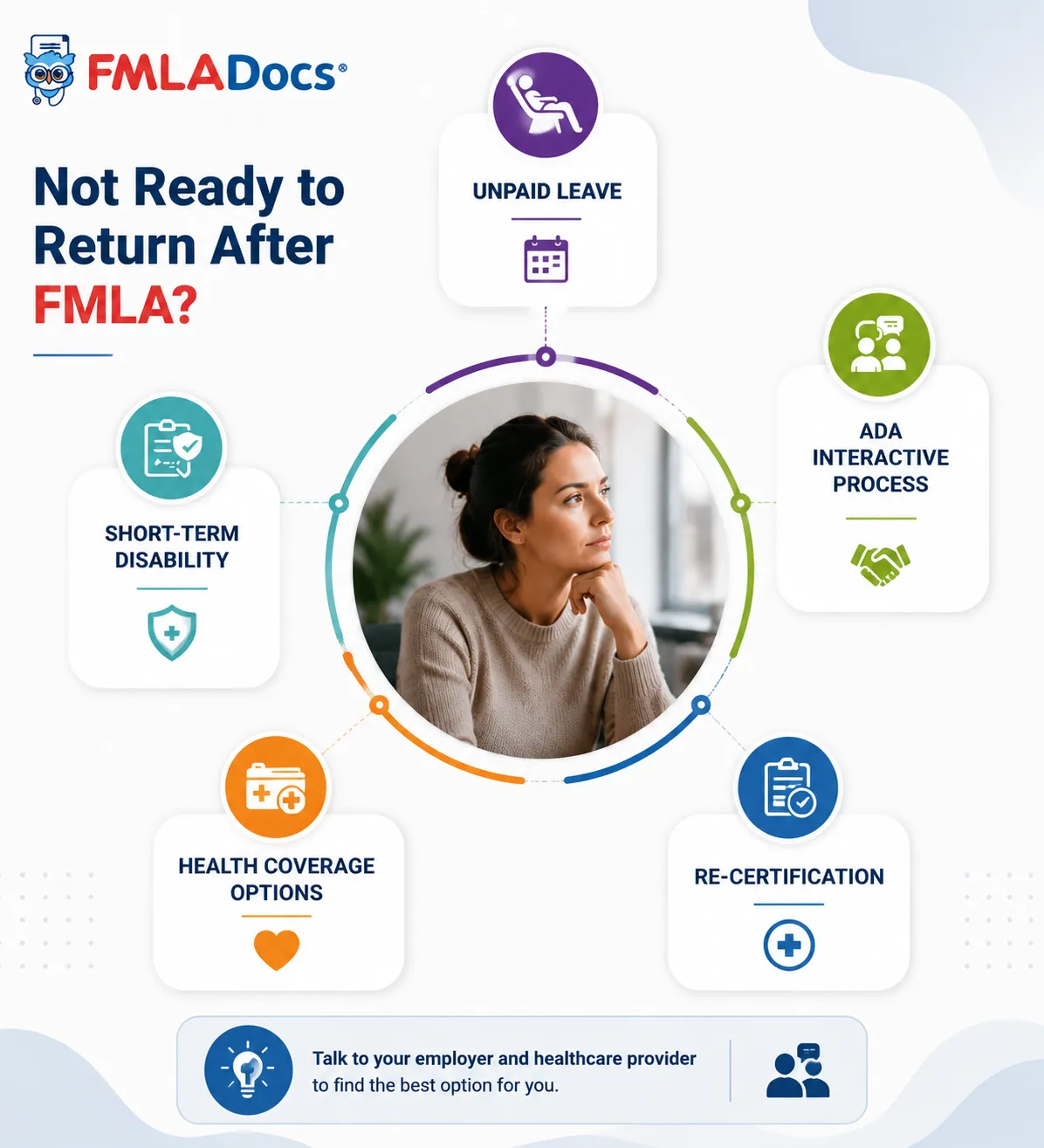
Do not ask your provider to clear you for duties that you cannot safely perform. Contact your health care provider and employer before your scheduled return date instead.
Depending on your circumstances, you may need to discuss:
-
Additional available FMLA leave.
-
A reduced or intermittent schedule.
-
Employer-provided medical or personal leave.
-
Unpaid leave as a possible ADA accommodation.
-
Temporary workplace modifications.
-
State or local leave protections.
-
Rights under a collective bargaining agreement.
Extra leave or modified duty is not automatically approved. Your employer may need medical information about the expected duration and functional reason for the request, and different laws use different eligibility standards.
Does the Rule Apply to Intermittent FMLA Leave?
An employer generally cannot demand a fitness-for-duty certification after every intermittent or reduced-schedule absence.
An exception may apply when reasonable safety concerns exist because of the condition for which you took leave.
Federal regulations define this as a reasonable belief that your return could create a significant risk of harm to you or another person.
In that situation, the employer may require certification no more often than once every 30 days and must provide advance notice. It also may not terminate your employment merely because it is waiting for that intermittent-leave certification.
How to Prepare for a Smoother Return
Good preparation helps your provider give a specific answer and helps HR understand your medical restrictions without receiving unnecessary details.
Before the appointment, gather:
-
The fitness-for-duty form from HR.
-
Your designation notice.
-
The employer’s essential-functions list.
-
Your expected return date.
-
A list of current symptoms affecting work.
-
Proposed restrictions and their expected duration.
-
Dates of upcoming treatment or follow-up visits.
Do not alter a provider’s statement or submit incomplete information. If HR identifies a problem, ask what specific item needs clarification and send that request to your provider promptly.
Return With Clarity: Your Next Step With FMLADocs
A successful return to work after FMLA depends on timely notice, accurate medical documentation, and a clear understanding of your essential job duties.
At FMLADocs, we connect people across the United States with licensed medical professionals who review health information and prepare appropriate FMLA documentation when clinically supported.
We do not guarantee certification, employer acceptance, accommodations, or a particular employment outcome.
If you need medical certification support, start your certification. You can also get the free FMLA guide before discussing your return with your provider and employer.
Frequently Asked Questions
What is a letter confirming return to work after sickness?
It is a statement from a health care provider confirming that you can resume work after an illness or injury. It may include a return date, restrictions, and an opinion about specific job functions.
What is considered not fit for duty?
You may be considered not fit for duty when your medical condition prevents you from safely or reliably performing essential job functions, even with available accommodations. Your provider should base that decision on your current condition and actual work demands.
What are the rules about returning after maternity leave?
A fitness-for-duty requirement under FMLA generally relates to leave taken for your own serious health condition, not leave used only for bonding with a healthy child. Pregnancy-related conditions, childbirth recovery, the PWFA, the ADA, state laws, and employer policies may affect your situation.
How do you return to work after a leave of absence?
Review the employer’s return requirements, contact HR, schedule a provider visit if clearance is required, and submit the documentation before your planned return. Ask about accommodations promptly if restrictions remain.
Can an employer require fitness-for-duty certification for every FMLA absence?
No. The general rule does not permit certification after every intermittent absence. A limited exception applies when reasonable safety concerns exist, and the employer may require it no more than once every 30 days.
Who pays for a fitness-for-duty certification?
Under federal FMLA regulations, the employee generally bears the certification cost, including related time and travel expenses. Different rules may apply if the employer orders its own examination after your return.
Can an employer contact your doctor?
An authorized employer representative may contact your provider to authenticate or clarify the certification under FMLA procedures. Your direct supervisor may not contact the provider for this purpose, and the inquiry must remain limited to the relevant condition.
What happens if you cannot provide certification on time?
Tell HR immediately, explain the delay, and provide a realistic submission date. If the employer properly requires certification, it may delay reinstatement until you submit it; additional leave or another accommodation may require a separate request.

Meet the author
Anam Moin
I'm Anam Moin, and my work at FMLADocs focuses on workplace leave and FMLA education. I cover certification, documentation, employee rights, and leave-related questions to provide readers with useful information when they need it most.
Get Your FMLA Certification Online in Minutes