

Phased Return to Work After FMLA: How to Request a Gradual Schedule
 by Anam Moin
 Last updated:
Do you feel ready to return after medical leave without feeling ready for a full workload on your first day back.
A phased return to work after FMLA can let you rebuild your schedule gradually. You might work fewer hours, shorter shifts, or fewer days while continuing treatment and adjusting to your regular duties.
However, federal law does not automatically guarantee every phased-return plan. Your options depend on
-
Whether you have FMLA leave remaining
-
Whether a reduced schedule is medically necessary
-
Whether another workplace protection applies
This guide explains how phased returns work, what your provider may need to document, how to approach HR, and what happens to your pay and benefits.
Can You Request a Phased Return to Work After FMLA?
You can request a phased return to work after FMLA, but whether FMLA protects the arrangement depends mainly on your remaining leave.
When medically necessary, eligible employees may use FMLA in separate blocks or reduce the hours they work each day or week. This arrangement is called intermittent or reduced-schedule FMLA leave.
For example, instead of returning immediately to five eight-hour shifts, your provider may recommend four-hour shifts for two weeks, followed by six-hour shifts before you resume your regular schedule.
When You Still Have FMLA Leave Available
If you have unused FMLA time, your employer may count the hours you do not work against that remaining balance. The reduced schedule must relate to a qualifying reason and generally must have medical support.
Your employer may require updated certification that explains:
-
Why a reduced schedule is medically necessary.
-
The number of hours or days you can currently work.
-
The expected duration of the reduced schedule.
-
Relevant treatment or follow-up appointments.
-
When your provider expects to reassess your capacity.
When You Have Exhausted Your FMLA Leave
Once you use all available FMLA leave, the law no longer provides additional FMLA time simply because you want a gradual return.
However, your employer may offer a phased-return program under its own policies. The Americans with Disabilities Act may also require a covered employer to consider a modified schedule or additional unpaid leave as a reasonable accommodation for an eligible employee with a disability.
Approval depends on your individual circumstances. An employer may consider whether you can perform the essential functions of your position and whether the requested change would create an undue hardship.
Reduced-Schedule FMLA vs. a Workplace Accommodation
These arrangements may look similar on your calendar, but they arise from different legal and workplace processes.
| Issue | Reduced-schedule FMLA | Workplace accommodation |
|---|---|---|
| Main purpose | Uses available FMLA leave in smaller increments | Changes how or when you perform work |
| Eligibility | Requires FMLA eligibility and remaining entitlement | May apply when a qualifying disability or pregnancy-related limitation exists |
| Medical support | Usually requires FMLA certification | Employer may request reasonable supporting documentation |
| Missed work time | Generally counts against your FMLA balance | Depends on the approved accommodation |
| Approval standard | Must meet FMLA requirements | Depends on effectiveness and potential undue hardship |
| Duration | Limited by available FMLA entitlement | Based on individual need and applicable law |
A phased return may involve both processes. For example, FMLA may protect the hours you miss while a workplace accommodation changes certain duties during the hours you work.
What Can a Phased Return Schedule Include?
A gradual return should address the medical barrier preventing you from immediately resuming your regular schedule.
Common arrangements include:
-
Shorter workdays such as four- or six-hour shifts.
-
Fewer workdays such as working Monday, Wednesday, and Friday.
-
Later start times when medication or morning symptoms affect functioning.
-
Additional rest breaks during physically or mentally demanding work.
-
Remote or hybrid work when job duties can support it.
-
Temporary lifting or movement restrictions following surgery or injury.
-
Time for treatment such as therapy, rehabilitation, or follow-up visits.
If you are recovering from an operation, the surgery and recovery condition guide can help you identify functional issues to discuss with your provider.
Phased Return Schedule Example
Your schedule should reflect your provider’s medical judgment, not a generic timeline.
| Period | Possible schedule | Review goal |
|---|---|---|
| Week 1 | Four hours per day, three days | Assess fatigue and symptom control |
| Week 2 | Four hours per day, five days | Assess consistency across the week |
| Week 3 | Six hours per day, five days | Increase workload gradually |
| Week 4 | Regular schedule, if medically appropriate | Confirm sustainable return |
This example does not create a recommended medical plan. Your condition, treatment, occupation, and recovery rate should guide the actual schedule.
Do You Need a Doctor’s Note for a Reduced Schedule?
Your employer will commonly require medical certification when you ask to use FMLA on a reduced schedule.
The documentation should explain why full-time work is not currently medically appropriate and how the proposed schedule supports your recovery. Your provider does not need to give HR your entire medical record.
What Should the Certification Include?
A clear certification may include:
-
Your current medical limitations.
-
The reduced hours or schedule you need.
-
The medical necessity for that schedule.
-
The estimated start and end dates.
-
Any restrictions affecting essential duties.
-
A date for follow-up or reevaluation.
Avoid relying only on phrases such as “reduced schedule recommended” or “light duty required.” Those statements may not give HR enough information to evaluate the request.
Ask HR for the Essential Job Functions
Give your provider an accurate job description and any essential-functions list supplied by HR. This helps the provider evaluate whether you can perform your core duties during the proposed schedule.
Your provider should focus on function. For example, the documentation may state that you can work four hours daily but should temporarily avoid lifting more than 20 pounds.
How Should You Ask HR for a Phased Return?
Contact HR before your expected return date. Early notice gives everyone time to review your available leave, request medical information, and clarify how the arrangement will work.
You do not need to write a long or emotional explanation. Keep your request practical and specific.
HR Conversation Script
You can adapt the following message:
Hello [HR representative],
My health care provider expects that I can return to work on [date], but recommends a temporary reduced schedule because of my medical condition. I would like to request [proposed hours and days] from [start date] through [review date].
Please confirm whether I have FMLA leave remaining and whether the reduced hours can be designated as reduced-schedule FMLA leave. Please also send me any certification, fitness-for-duty, or accommodation forms my provider needs to complete.
I would appreciate information about how the temporary schedule may affect my pay, benefits, and available paid leave. Thank you.
Questions to Ask Before You Return
Your conversation with HR should resolve several practical issues:
-
How much FMLA leave remains?
-
How will the employer calculate reduced-schedule hours?
-
Which medical form does the provider need to complete?
-
Will you use paid leave during the unworked hours?
-
How will you report scheduled and unscheduled absences?
-
Will your job duties change temporarily?
-
When will HR review the arrangement?
Keep copies of your request, medical documentation, HR’s response, and the final schedule.
How Does a Phased Return Affect Your FMLA Balance?
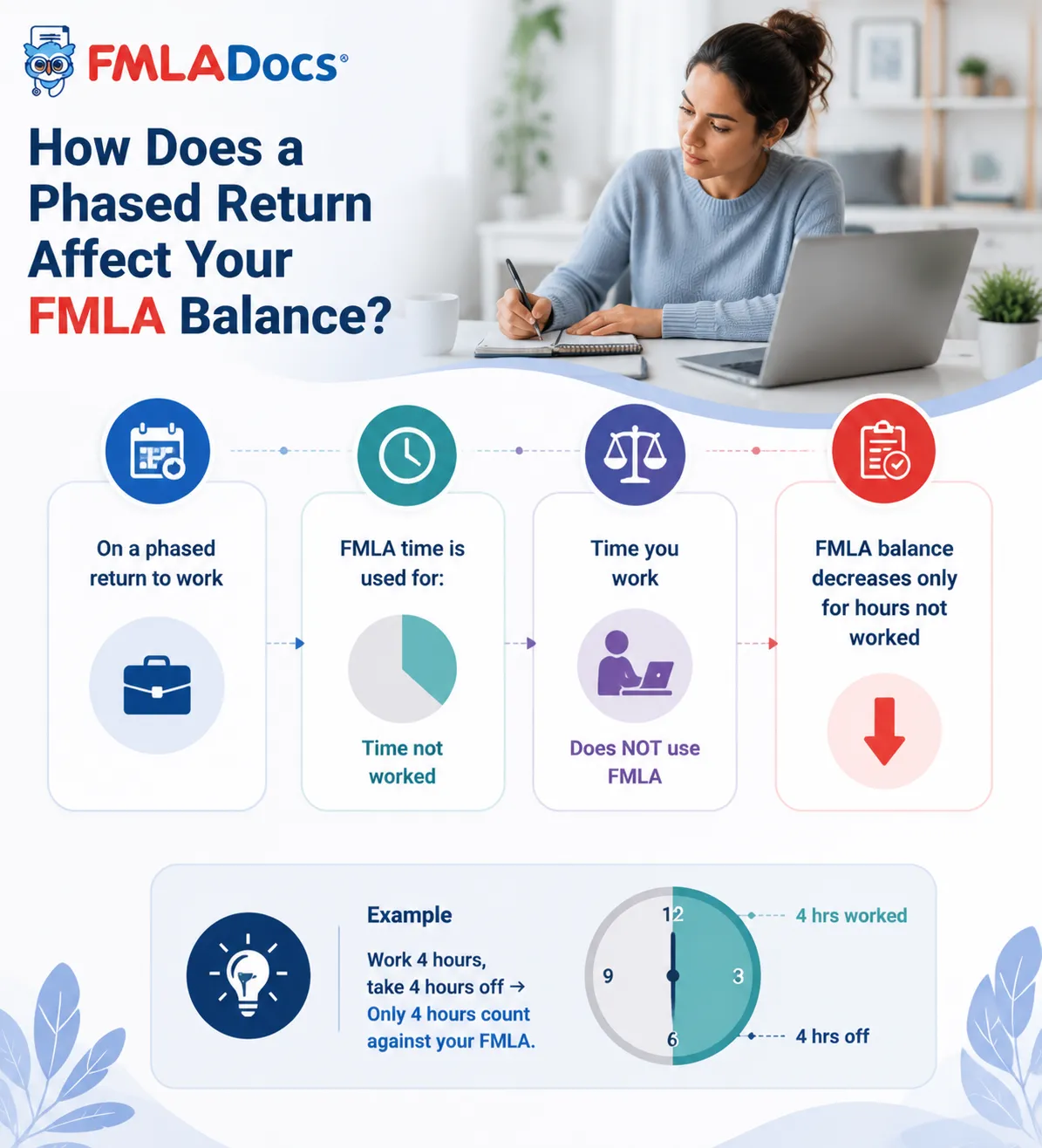
Reduced-schedule FMLA generally uses only the amount of leave you actually take.
If your normal schedule contains 40 hours and you temporarily work 20 hours, the other 20 hours may count as FMLA leave. Employers must calculate leave using an increment no greater than the shortest increment they use for other forms of leave, subject to federal requirements.
Ask HR for your remaining balance in hours. That figure makes it easier to estimate how long a medically necessary reduced schedule could continue.
Do You Receive Full Pay During a Phased Return?
FMLA provides job-protected leave, but it does not require your employer to pay you for hours you do not work.
You generally receive wages for the hours you work. The unworked portion may remain unpaid unless another benefit applies.
Potential income sources may include:
-
Accrued sick leave.
-
Vacation or paid time off.
-
Short-term disability benefits.
-
State paid family or medical leave.
-
An employer-sponsored salary continuation program.
Your employer may require you to use available paid leave at the same time as FMLA if its policy allows that practice. Ask HR for a written explanation of your pay before agreeing to the schedule.
Do You Have to Use Annual Leave?
Federal FMLA rules do not create a universal requirement called “annual leave.” However, an employer may require you to substitute qualifying accrued paid leave for unpaid FMLA leave under its normal policies.
Using paid time may preserve part of your income, but it also reduces your available paid-leave balance. Review the tradeoff before choosing how to cover reduced hours.
How Long Can a Phased Return Last?
FMLA does not set one standard duration for a phased return.
When you use the remaining FMLA, the arrangement may continue while medical necessity exists and leave remains available.
If another law or employer program supports the plan, its duration will depend on your medical needs and the arrangement’s reasonableness.
Set a review date rather than leaving the schedule open-ended. Your provider can then assess your progress and recommend whether you should:
-
Return to your regular schedule.
-
Continue the current arrangement.
-
Increase your hours gradually.
-
Request different restrictions.
-
Take additional medically necessary leave.
Move Back to Work With a Plan From FMLADocs
A phased return to work after FMLA can create a manageable bridge between full medical leave and your regular schedule, especially when you still have FMLA entitlement and clear medical support.
At FMLADocs, we connect employees throughout the United States with licensed health care professionals who evaluate their circumstances and prepare appropriate FMLA documentation when medically supported. We cannot guarantee certification, employer approval, leave protection, or a specific workplace arrangement.
If you need help with qualifying medical documentation, start your certification. You can also get the free FMLA guide to prepare for your HR conversation.
Frequently Asked Questions
What is a phased return back to work?
A phased return allows you to resume work gradually through shorter days, fewer shifts, modified duties, or another temporary schedule. The arrangement may use remaining FMLA leave or operate under a separate employer or accommodation process.
How long can you stay on a phased return?
No single federal duration applies. The schedule may continue while it remains medically necessary, leave remains available, and the arrangement satisfies the applicable workplace rules.
What must an employer do when you return from FMLA?
An employer generally must restore you to the same position or a virtually identical position with equivalent pay, benefits, and working conditions. Limited exceptions may apply.
Can you return from FMLA with restrictions?
Yes, but FMLA itself does not require an employer to create permanent light duty. The ADA, PWFA, state law, a union agreement, or employer policy may require consideration of reasonable changes.
Do you receive full pay during a phased return?
Usually, you receive wages for hours worked. Paid leave, disability benefits, state programs, or employer policies may provide income for some unworked hours.
Do you have to use annual leave for a phased return?
An employer may require you to use qualifying accrued paid leave concurrently with unpaid FMLA under its normal policy. Ask HR how the rule applies to your available leave.
How do you calculate pay during a phased return?
Multiply your hourly rate by the hours worked, then add any approved paid leave or benefit payments. Salaried employees should ask payroll how reduced leave affects their salary.
How do you plan a phased return schedule?
Ask your provider to identify your functional limitations, propose realistic work hours, and set a review date. Then confirm leave usage, pay, benefits, duties, and reporting procedures with HR.

Meet the author
Anam Moin
I'm Anam Moin, and my work at FMLADocs focuses on workplace leave and FMLA education. I cover certification, documentation, employee rights, and leave-related questions to provide readers with useful information when they need it most.
Get Your FMLA Certification Online in Minutes