

Online vs. In-Person FMLA Certification: Which Option Is Right for You?
 by Sahar Mustafa
Last updated:
You need FMLA certification. Choosing online vs in-person FMLA certification affects your deadline. Your choice can help or hurt your timeline. Your employer asks for FMLA certification. You have 15 calendar days to submit it. Your medical paperwork must be complete. The method you pick determines whether you meet that window or watch your leave approval slip away.
Most employees waste days trying to book in-person appointments with providers who have three-week wait times. Some employees worry that telehealth FMLA certification won’t work. Federal law says employers must accept complete certifications. The format does not matter. Confusion about FMLA rules slows you down when time matters. You don’t know the costs or which path fits. Different medical cases need different approaches.
This guide breaks down online vs in-person FMLA certification across every factor that matters. You’ll learn what makes any certification legally sufficient under DOL regulations, how FMLA certification turnaround time differs between formats, what you’ll actually pay for each option, and which providers understand FMLA forms. We’ll also cover employer requirements and which format works best for your specific medical condition. By the end, you’ll know precisely how to get FMLA certified online or in person based on your situation.
What Makes FMLA Certification Legally Sufficient Under Federal Law for Online vs In-Person FMLA Certification
The FMLA focuses on whether the certification is complete and sufficient, and the DOL recognizes certain telemedicine visits when applicable criteria are met. What matters is the content of your FMLA certification documentation, not how you got it. The Department of Labor’s regulations (29 CFR 825.306-307) define certification requirements based on what information appears on the form. Delivery method isn’t mentioned anywhere in the federal standard.
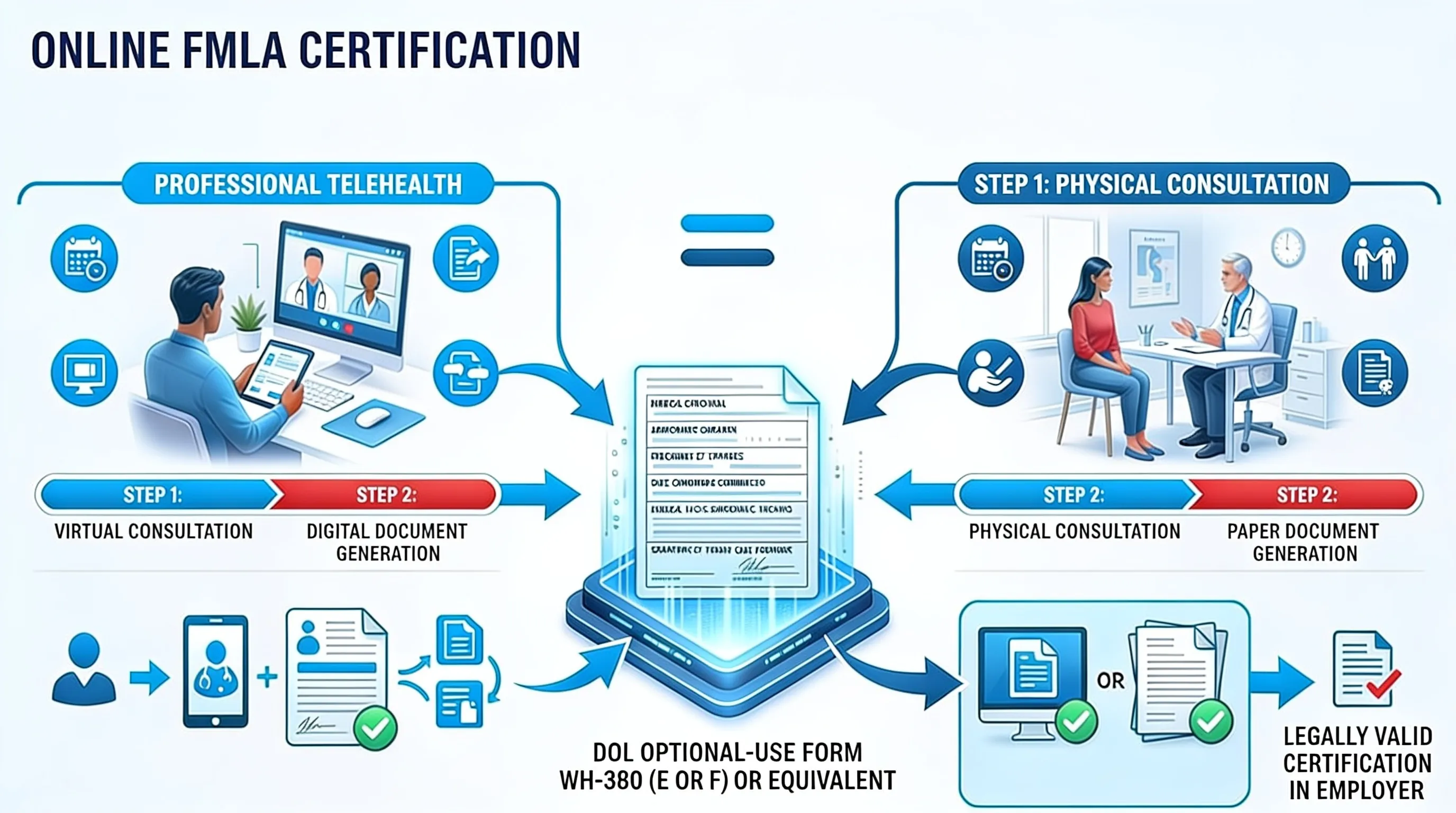
Online and in-person providers must provide a complete and sufficient certification containing the information required by the FMLA regulations. The DOL’s certification guidance explains what makes a certification complete and sufficient. The DOL’s WH-380-E and WH-380-F are optional-use forms. Employers can use their own forms. A certification can use another format. It must contain all required info.
DOL Requirements Apply to Both Formats Equally
Your certification must include specific medical details. The diagnosis date comes first. Then the expected duration of your condition. Treatment frequency matters too. So do functional limitations that affect your ability to work.
Provider credentials are also required, and the DOL recognizes several categories of health care providers who may provide FMLA certification. The DOL’s health care provider guidance explains which providers may complete FMLA certifications. State medical boards regulate telehealth the same way they regulate traditional office visits.
Here’s what every sufficient certification contains:
-
Date your condition began and how long it’s expected to last
-
Whether you need inpatient care or continuing treatment
-
Frequency and duration of intermittent or reduced-schedule absences, when applicable
-
How your condition prevents you from performing job functions
-
Provider’s signature, credentials, and contact information
Employers can’t reject a complete certification just because you didn’t sit in a waiting room. If the form meets DOL standards, it’s legally sufficient. Period.
What Employers Can and Cannot Require
Your employer can request medical certification. They can ask for clarification if information is incomplete. They can require recertification for ongoing conditions. Your employer cannot reject a full and correct certification. They cannot do this just because of the format.
That said, they can’t demand you see a specific doctor. Your employer cannot reject a full and correct certification. This holds true even if the doctor visit was remote. Your employer must accept it if telemedicine rules apply. A telemedicine visit can support FMLA paperwork. It must meet the DOL’s rules. Federal law protects your choice of provider and consultation format.
If your employer questions your online certification, they must identify specific deficiencies in the documentation itself. “We don’t accept telehealth” isn’t a valid reason. “The form doesn’t specify treatment frequency” is valid. The difference matters when you complete FMLA paperwork online through licensed providers.
Employers can request a second opinion at their expense. A second or third opinion may be required when permitted under the FMLA, and the applicable provider and telemedicine requirements still apply. The second opinion must address documentation gaps, not consultation format.
Documentation Standards That Protect Your Certification
Specificity protects you. Vague language gets forms rejected. Writing “ongoing” instead of “expected to last 6-8 weeks” creates problems. Noting “frequent episodes” instead of “2-3 times per month” leaves room for denial. FMLA certification goes into more depth on this.
For intermittent leave, precision becomes even more critical. Your certification must state how often episodes occur and how long each one lasts. For intermittent leave, the provider should give the best informed estimate possible of how often episodes may occur and how long they may last.
Functional impact separates sufficient certifications from rejected ones. Your provider must explain how your condition affects your ability to work. For anxiety, that might mean “panic attacks lasting 30-60 minutes, causing inability to concentrate or interact with coworkers.” For back pain, “inability to sit for more than 20 minutes or lift objects over 10 pounds.”
Both online and in-person providers can document these details. The consultation format doesn’t limit the specificity of medical information. What matters is whether your provider understands FMLA requirements and completes every section thoroughly.
When you work with providers experienced in FMLA cases, you get documentation that meets federal standards the first time. A provider who knows FMLA rules helps you submit full documentation. Your paperwork will meet what your employer needs.
FMLA Certification Turnaround Time: How Fast Can You Get Certified?
When your employer requests FMLA certification, speed matters. You generally have at least 15 calendar days to return a complete and sufficient certification after your employer requests it. If you make diligent, good-faith efforts but cannot meet the deadline for reasons beyond your control, you may be allowed additional time.
The difference between online vs in-person FMLA certification often comes down to one thing: time. Traditional doctor visits create scheduling bottlenecks that eat through your deadline. Telehealth services may reduce scheduling and paperwork delays, depending on provider availability.
In-Person Scheduling Realities in 2026
Getting an appointment with your primary care doctor takes longer than most people expect. Appointment availability varies widely by provider and location, and some patients may face weeks-long waits for routine appointments.
That timeline alone can consume your entire 15-day FMLA certification deadline window. Then add travel time to the office. Factor in waiting room delays. Account for potential rescheduling if your provider runs behind schedule.
Here’s what the in-person process typically involves:
-
Call to schedule: 1-3 days to reach scheduling staff
-
Wait for appointment: 18-24 days on average
-
Travel and waiting room time: 1-2 hours per visit
-
Form completion delays: 3-7 days after your appointment
-
Potential follow-up if forms are incomplete: another 7-14 days
Emergency situations make this worse. Sudden illness or unexpected surgery leaves no time for a three-week scheduling wait. You need certification fast, but traditional healthcare systems aren’t built for that urgency.
Online Certification Turnaround Times
Telehealth FMLA certification works differently. Services like FMLADocs connect you with licensed physicians who complete certifications daily. They understand exactly what employers need to see on DOL forms.
Turnaround times vary by online FMLA provider. FMLADocs states that its physicians typically complete certifications within 24-48 hours. Consultations happen at scheduled times without travel. Evening and weekend slots are often available.
The process is as follows:
-
Schedule online consultation: same day or next day
-
Video visit with licensed physician: 15-30 minutes
-
Completed certification: typically 24-48 hours with FMLADocs
-
Forms sent directly to you: ready to submit
No waiting rooms. No travel time. No wondering if your doctor will complete the forms correctly. The physician handles every required field with specific detail that meets employer standards.
What Happens When Your Certification Deadline Is Approaching
When your employer formally requests medical certification, you generally have at least 15 calendar days to provide it. Calendar days count toward your deadline, not business days.
Missing this deadline gives your employer the right to delay your leave approval. In some cases, they can deny the request entirely. Understanding how long FMLA approval takes helps you plan accordingly.
If you’re making a good-faith effort to get certification, employers may grant extensions. But “good faith” means you started the process immediately. It means you contacted providers right away. It means you documented your attempts.
What counts as good faith:
-
Contacting your provider the same day you receive the request
-
Following up persistently if they don’t respond
-
Documenting all communication attempts
-
Notifying HR if you’re having trouble getting an appointment
What doesn’t count:
-
Waiting a week before calling your doctor
-
Assuming you have plenty of time
-
Not following up when providers don’t return calls
-
Failing to communicate delays to HR
Speed becomes critical when deadlines approach. Traditional scheduling can’t accommodate tight timelines. Online certification services can. That difference often determines whether your leave gets approved on time or gets delayed for weeks.
Cost Analysis: What You’ll Actually Pay for Each Format
Understanding the true cost of online vs in-person FMLA certification goes beyond the initial appointment fee. You need to factor in time, travel, and hidden charges that add up fast.
In-Person Visit Costs and Insurance Coverage
An in-person visit may cost roughly $150-300 without insurance, while insured patients may pay a copay depending on their plan and provider.
However, many insurance plans don’t cover FMLA form completion as a separate service. Some providers also charge separate paperwork or administrative fees, which may add roughly $50-150 to the cost. This catches people off guard when they get the bill.
A separate paperwork fee may apply even when insurance covers the medical visit itself, so check the provider’s fee policy before scheduling. The form completion is billed separately as a non-covered service.
Online Certification Pricing Models
Online FMLA certification services like FMLADocs charge flat fees of $199-299. This includes the consultation and completed forms. No surprise bills. No separate administrative fees.
The pricing is transparent from the start. You know exactly what you’ll pay before booking your appointment. Most services complete everything within 24-48 hours. For a deeper look, see qualifying conditions.
Hidden Costs That Add Up Quickly
In-person visits require transportation costs you might not consider upfront. Gas, parking fees, and tolls can add $20-50 to your total. Public transit takes longer but still costs money.
Then there’s lost wages. Missing work for a two-hour in-person appointment costs you actual income. Compare that to a 20-minute video call during your lunch break.
Some employers may reimburse FMLA certification costs. Check your HR policy before paying out of pocket. This benefit exists at many companies but goes unused because employees don’t ask.
The time value matters when comparing formats. Two hours away from work versus 20 minutes makes a real difference. When comparing total costs, consider the certification fee, paperwork charges, travel expenses, and time away from work.
Provider Expertise: Who Understands FMLA Documentation Requirements
Your relationship with your regular doctor doesn’t guarantee they understand FMLA forms. Most primary care providers complete these certifications occasionally, not daily. This leads to incomplete or vague documentation that gets rejected.
The problem isn’t your doctor’s medical knowledge. It’s their unfamiliarity with what employers and the Department of Labor need to see on these specific forms.
Why Your Regular Doctor May Struggle With FMLA Forms
Primary care physicians see dozens of patients weekly for routine care. FMLA certifications represent a tiny fraction of their workload. Some primary care providers may complete FMLA paperwork only occasionally.
This infrequency creates predictable problems. Common documentation problems include incomplete sections, vague duration estimates, and insufficient information about functional limitations.
Your doctor might write “back pain” without describing how often episodes occur. They might note “anxiety” without explaining how it affects your ability to concentrate at work. They might list a diagnosis but skip the section about treatment frequency.
These gaps aren’t intentional. Your provider simply doesn’t complete enough FMLA forms to know what language employers require for approval.
How Online FMLA Services Specialize in Certification
Online FMLA services employ physicians who focus specifically on occupational health documentation. These doctors complete dozens of certifications weekly, not monthly.
Frequent experience with FMLA paperwork may help a provider become more familiar with the documentation requirements. Specialized providers know exactly what the Department of Labor requires in medical certifications. They are familiar with the information that needs to be documented to support a complete and sufficient certification.
They write specific episode frequencies like “2-4 times per month” instead of vague terms like “as needed.” They describe functional limitations in concrete terms employers can evaluate. They include treatment plans with exact visit schedules.
Online services also review completed forms before submission. This catches errors that would otherwise restart your certification timeline.
What Happens When Forms Come Back Incomplete
If an employer finds a certification incomplete or insufficient, it must generally identify what additional information is needed and provide an opportunity to cure the deficiency. Your employer sends the form back requesting corrections. This burns through your 15-day deadline.
You contact your doctor’s office again. They schedule another appointment two weeks out. By then, your deadline has passed. Your leave request gets denied because you missed the certification window.
Even minor omissions cause rejection. A missing signature. A blank duration field. A vague description of functional impact. The employer may ask you to give the missing info. You must do this before the cert counts as done.
This cycle can cost you weeks of delays. Some employees miss their FMLA deadline entirely because their provider couldn’t complete the form correctly on the first attempt.
Specialized online providers prevent this problem by getting documentation right the first time. Their turnaround is typically 24-48 hours, which protects your deadline even when time is tight.
Employer Requirements and Questions About Certification
Your employer must accept a complete and sufficient medical certification regardless of whether you get it online or in person. The format doesn’t matter. What matters is the content.
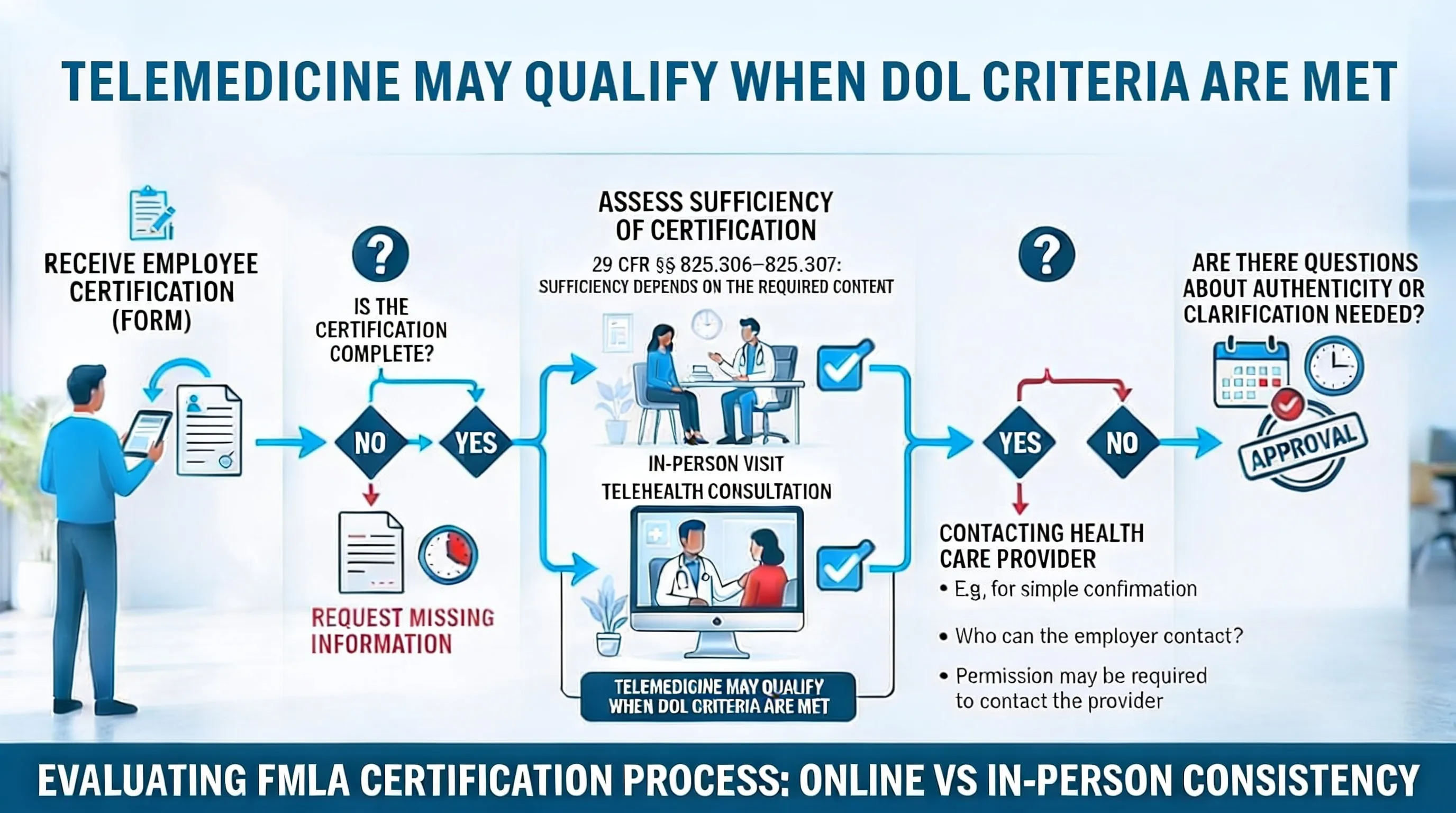
Federal law protects your right to use telehealth for FMLA certification. Most HR departments in 2026 routinely accept telehealth certifications as standard practice.
What Employers Can Legally Ask About Your Certification
Your employer can verify provider credentials and contact information. They can ask for clarification about incomplete sections. They can request additional information if the form is vague.
However, they can’t demand a specific certification method. They can’t require you to see a doctor in person. They can’t reject a properly completed form just because it came from a telehealth visit.
The DOL’s telemedicine guidance recognizes certain telemedicine visits as satisfying the in-person treatment requirement when applicable criteria are met. The consultation format is irrelevant to the form’s validity.
How to Respond When HR Questions Online Documentation
Some employers unfamiliar with telehealth may initially question online certifications. This doesn’t make them invalid. It just means HR needs education.
If your employer questions your online certification, reference 29 CFR 825.307. This regulation defines sufficiency by content, not format. The law doesn’t distinguish between in-person and telehealth consultations.
Document any employer resistance in writing. Send an email restating your rights. If concerns continue, consult the DOL Wage and Hour Division.
Legitimate online services provide complete provider credentials and contact information. Your employer can verify these details just like they would for an in-person visit.
Federal Standards That Apply to Telehealth Certifications
The same DOL standards apply to all certifications. Online or in-person makes no difference. The form must include diagnosis date, expected duration, treatment frequency, and functional impact.
Your provider must hold a valid license. They must have the skills to treat your condition. They must sign the form and include their credentials. They must be available for employer verification if needed.
Telehealth certifications meet these standards when completed by licensed healthcare professionals. The consultation method doesn’t affect the certification’s legal standing or your FMLA protection.
Which Format Works Best for Your Specific Medical Condition
Choosing between online vs in-person FMLA certification depends on your specific medical situation. Some conditions need physical exams. Others work well with telehealth. Your existing medical records often make the biggest difference.
Conditions That May Benefit From In-Person Evaluation
New diagnoses requiring physical examination work better in person. Undiagnosed chronic pain needs a provider to assess range of motion. New neurological symptoms require hands-on testing.
If you don’t have a diagnosis yet, start with an in-person visit. Your provider can run tests and document findings. Then you can pursue FMLA certification with clear medical evidence.
That said, once you have a diagnosis, online certification often works fine. The initial physical exam is what matters most.
Conditions Well-Suited to Online Certification
Established conditions with documented treatment histories may be easier to evaluate through telehealth, but a condition must still meet the FMLA’s definition of a serious health condition. Mental health conditions may certify more easily online due to reduced stigma.
Pregnancy-related conditions may qualify for FMLA leave when the applicable serious-health-condition requirements are met and the provider can support the need for leave. Hyperemesis, preeclampsia, or gestational diabetes all work well with telehealth FMLA certification.
Surgical procedures and cancer treatment may support FMLA certification when the applicable requirements are met and sufficient medical documentation is available. You just need to provide operative reports or treatment plans. The documentation already exists.
Chronic conditions requiring intermittent leave benefit from providers experienced with episodic documentation. Crohn’s, fibromyalgia, and PTSD all fall into this category. Online services often have doctors who handle these cases daily.
When Your Existing Medical Records Make the Difference
If you already see a specialist who knows your condition, in-person certification with them may provide more detailed functional assessment. They understand your history and limitations.
However, turnaround times vary by provider. FMLADocs states that its physicians typically complete certifications within 24-48 hours.
Online services work well when you have existing medical records to share during consultation. Upload your diagnosis, treatment notes, and test results. The online provider reviews everything and completes your certification.
The key is having documentation. Without it, you may need in-person evaluation first. With it, online certification saves time and gets you approved faster.
Conclusion
Your employer must accept complete medical certification whether you get it online or in person. The format doesn’t matter. What matters is getting specific, thorough documentation before your deadline expires.
We covered what makes certification legally sufficient under federal law. We looked at turnaround times and how fast each option delivers finished forms. We broke down the real costs beyond appointment fees. We showed which providers understand FMLA documentation requirements. We explained what employers can and can’t question about your certification. We matched medical conditions to the format that works best.
The choice between online vs in-person FMLA certification comes down to your deadline, your condition, and your provider’s FMLA expertise. Most employees facing tight FMLA certification deadlines benefit from online services that deliver faster results with specialized knowledge.
If you can’t get a timely in-person appointment, FMLADocs connects you with board-certified physicians who complete certifications daily. Our providers deliver finished documentation within 24-48 hours. Start your consultation today and get the documentation you need before time runs out.
Frequently Asked Questions
Can my employer reject FMLA certification just because I got it through telehealth instead of an office visit?
No. Federal law doesn't allow employers to reject complete certification based on consultation format. The Department of Labor's regulations focus on documentation content, not delivery method. Your employer must accept telehealth certifications that meet DOL standards. They can only reject forms with specific documentation gaps like missing treatment frequency or incomplete provider credentials. "We don't accept telehealth" isn't a valid reason under 29 CFR 825.306-307. If your online certification includes all required medical details and proper provider signatures, it's legally sufficient.
What specific information must appear on my FMLA certification form regardless of whether I see a doctor online or in person?
Every sufficient certification needs five core elements. First, the date your condition began and expected duration. Second, whether you need inpatient care or continuing treatment. Third, specific treatment frequency with actual numbers, not vague terms like "as needed." Fourth, how your condition prevents you from doing your job functions. Fifth, your provider's signature, credentials, and contact information. Both online and in-person consultations must produce identical documentation on official DOL Form WH-380-E for your condition or WH-380-F for family member care.
How much time do I have to submit FMLA certification after my employer requests it?
You generally have at least 15 calendar days to provide a complete and sufficient certification after your employer requests it. The same certification deadline applies regardless of whether you obtain the certification online or in person. Missing this window can cause your leave approval to fall through. Most employees waste days booking in-person appointments with providers who have three-week wait times. Online options often help you meet the deadline faster since you can schedule consultations within 24-48 hours instead of waiting weeks for available office appointments.
Do online FMLA doctors need the same credentials as in-person providers?
Yes. Provider credentials work identically for both formats. Your doctor must hold an active license to practice in your state. State medical boards regulate telehealth consultations the same way they regulate traditional office visits. The certification form requires provider credentials regardless of consultation method. Online platforms should verify that their doctors maintain proper state licensing. If a provider can legally treat patients in your state through telehealth, they can complete your FMLA certification. The format doesn't change licensing requirements at all.
What happens if my employer says the FMLA certification I got online is incomplete?
Your employer must identify specific documentation gaps. They can't reject forms just because you used telehealth. Valid reasons include missing treatment frequency, unclear functional limitations, or incomplete provider information. Invalid reasons include "we prefer in-person visits" or "telehealth doesn't count." If your employer requests clarification, you typically get seven days to provide additional information. Review their specific concerns. Contact your online provider to address actual documentation deficiencies. Federal law protects complete certifications regardless of consultation format.
Can I use any online doctor for FMLA certification or do they need special training?
The doctor needs proper state licensing and understanding of FMLA forms, not special certification. Many general practitioners don't regularly complete FMLA paperwork and may struggle with documentation requirements. Look for online providers who specifically mention FMLA services. They should know DOL Form WH-380-E and WH-380-F requirements. The provider must document treatment frequency, functional limitations, and expected duration correctly. Generic telehealth platforms might connect you with doctors unfamiliar with FMLA standards. Specialized FMLA telehealth services typically train their providers on proper documentation.
How long does it take to get FMLA certification through online consultation compared to scheduling an in-person appointment?
Online consultations typically happen within 24-48 hours of booking. You schedule a video call, meet with the provider, and receive completed forms often the same day. In-person appointments usually require three weeks or more due to provider availability. You call for an appointment, wait weeks for an opening, take time off work for the visit, then wait for paperwork processing. The 15-day certification deadline makes this difference critical. Online options help you meet deadlines that in-person scheduling often can't accommodate.
Does the DOL specify whether online or in-person FMLA certification is better for certain medical conditions?
No. DOL regulations don't distinguish between consultation formats based on condition type. The law focuses on documentation completeness, not how you obtained it. Both mental health conditions and physical injuries can be certified through either format. What matters is whether the provider can properly document your functional limitations and treatment needs. Some conditions requiring hands-on examination might benefit from in-person visits. Others like anxiety, depression, or chronic conditions with established treatment work fine through telehealth. Choose based on your access to qualified providers, not DOL preferences.

Meet the author
Sahar Mustafa
Hi, I'm Sahar. At FMLADocs, I write about FMLA eligibility, medical certification, intermittent leave, workplace documentation, and the steps employees may need to take when requesting leave. FMLA paperwork often shows up at a time when someone is already dealing with a health or family situation, so I try to make the information feel manageable instead of overwhelming. I enjoy breaking down forms, deadlines, and common questions into practical guidance.
Get Your FMLA Certification Online in Minutes