

Not Ready When FMLA Ends? Options Employees Often Consider
 by Anam Moin
 Last updated:
You can see the end of your FMLA leave approaching, but your body, mind, or family situation may not be ready for your return. That gap can create a frightening question: What happens if I can’t return to work after FMLA?
The direct answer is that your FMLA job-restoration protection generally ends when you exhaust your available leave.
However, you may still have options under the Americans with Disabilities Act (ADA), state leave laws, workers’ compensation rules, your employer’s policies, or a disability benefits plan.
The outcome depends on why you need more time, whether your condition qualifies for another protection, and how quickly you communicate with your employer.
This guide explains the possibilities without replacing advice from an employment attorney, benefits professional, or government agency.
What Happens If I Can’t Return to Work After FMLA?
If you ask, “What happens if I can’t return to work after FMLA?”, the most accurate answer is that FMLA protection may end, but your employer should consider whether another law or workplace policy applies.
Once you exhaust your available FMLA leave, the FMLA itself generally no longer guarantees restoration to the same or an equivalent position.
If you remain absent without approval under another policy or law, your employer may apply its usual attendance rules.
That does not mean termination must automatically happen on day one after FMLA. If your medical condition may qualify as a disability, the employer may need to discuss reasonable accommodations with you before making a final employment decision.
Important: FMLA exhaustion and employment termination are not the same event. FMLA may stop protecting the absence even though the ADA, a state law, workers’ compensation rules, or company leave policies still require consideration.
What Changes When Your FMLA Leave Ends?
FMLA provides eligible employees with limited, unpaid, job-protected leave. It also requires continued group health coverage under the same conditions that would apply if you remained at work.
When that protected period ends, several things can change:
-
Your employer may no longer have an FMLA obligation to hold your position.
-
Your continued absence may require approval under a different leave policy.
-
Your employer may request return-to-work or fitness-for-duty documentation.
-
Your group health coverage may change if you lose employment or experience a reduction in hours.
-
You may need to request ADA accommodation for your own qualifying disability.
Your employer’s FMLA calendar also matters.
Exhausting 12 weeks does not necessarily mean that a new 12-week entitlement begins on January 1. Employers can use different federally permitted methods to establish the applicable 12-month period.
Your Main Options After FMLA Runs Out
You should review every potentially applicable option instead of assuming FMLA represents your only protection.
| Possible option | What it may provide | What to verify |
|---|---|---|
| Employer-approved unpaid leave | More recovery time | Duration, approval rules, and job status |
| ADA accommodation | Added leave or a workable return arrangement | Disability coverage, essential duties, and undue hardship |
| State or local leave law | Additional leave or broader eligibility | Rules in your work state and locality |
| Workers’ compensation | Medical and wage benefits for a work-related condition | State-specific benefits and restoration rules |
| Short-term disability | Partial income replacement | Benefit duration and whether employment continues |
| Modified return to work | Reduced hours or temporary adjustments | Medical restrictions and essential job functions |
1. Request Additional Unpaid Leave
Your employer may voluntarily offer a personal or medical leave that extends beyond FMLA. Check your handbook, collective bargaining agreement, benefits portal, and prior HR notices.
If your condition qualifies as a disability under the ADA, additional unpaid leave may also function as a reasonable accommodation.
The EEOC explains that an employer generally must consider disability-related leave unless it would create an undue hardship or another effective accommodation would allow you to work.
Why a Specific Return Date Matters
A request such as “I need four more weeks and expect to return on September 8” gives the employer something concrete to evaluate. A request for leave with no estimated duration can prove much harder to approve.
Your healthcare provider should offer a medically supportable estimate rather than guaranteeing an outcome. Recovery timelines can change, but the employer usually needs enough information to assess the request.
2. Start the ADA Interactive Process
The ADA interactive process involves a practical conversation between you and your employer about your limitations and possible accommodations.
You do not need to use a perfect legal phrase to request help, but clearly stating that a medical condition affects your work can reduce confusion.
Potential accommodations may include:
-
A temporary reduced schedule
-
Adjusted start or end times
-
Additional rest or treatment breaks
-
Remote or hybrid work when compatible with the position
-
Temporary changes in how nonessential duties occur
-
Assistive equipment or an accessible workspace
-
A finite period of additional unpaid leave
-
Reassignment to a vacant position in appropriate circumstances
An employer does not have to remove an essential job function, create a new position, or accept an accommodation that causes undue hardship.
However, the employer should assess your circumstances individually instead of relying only on an automatic maximum-leave rule.
3. Explore a Modified Return to Work
You may not need complete leave if you can perform your essential duties with temporary support. A gradual return can create a middle path between full-time work and continued absence.
For example, your provider might recommend four-hour shifts for two weeks after surgery. Someone managing migraines or an anxiety-related condition might need schedule flexibility for treatment while remaining able to complete the position’s essential work.
Ask your provider to describe functional restrictions instead of sending a vague note that says only “light duty.” HR needs to understand what you can do, what you cannot currently do, and how long the restrictions may last.
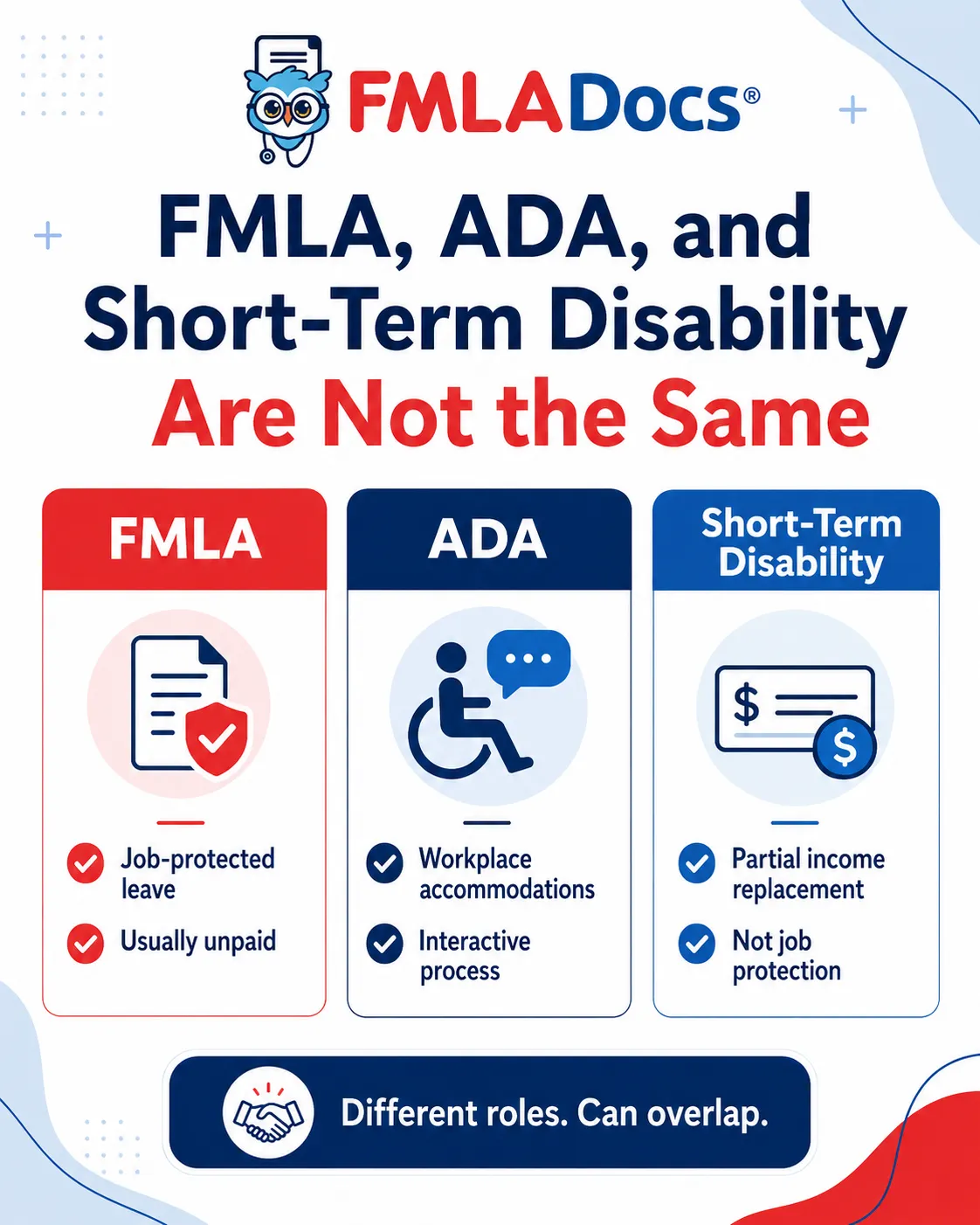
Employees often treat these programs as interchangeable, but each one serves a different purpose.
| Program | Primary purpose | Pays wages? | May protect the job? |
|---|---|---|---|
| FMLA | Protected family or medical leave | No, unless paid leave runs concurrently | Yes, during available protected leave |
| ADA | Equal employment opportunity and reasonable accommodation | Not generally | Potentially, depending on the accommodation |
| Short-term disability | Partial income replacement during disability | Usually | Not by itself |
| Workers’ compensation | Benefits for work-related injury or illness | Often | Depends on applicable state law |
What If Short-Term Disability Continues After FMLA?
Your short-term disability benefits may continue after you exhaust FMLA because the benefit plan and FMLA use separate eligibility rules. Receiving disability payments does not automatically extend FMLA or require your employer to reserve your job.
Review the policy’s maximum benefit period, medical-update requirements, offsets, and return-to-work rules. You should also ask HR which employment status applies while you continue receiving benefits.
Do You Need Recertification or Updated Medical Documentation?
An updated note does not automatically create more FMLA leave after you have exhausted your available entitlement. However, current medical documentation may support an ADA accommodation, personal leave request, workers’ compensation matter, or a new FMLA request when you become eligible for additional leave in a new leave year.
Useful documentation may address:
-
Your current functional limitations
-
Why you cannot perform particular job duties
-
The expected duration of those limitations
-
A medically estimated return date
-
Whether a reduced schedule could support an earlier return
-
Accommodations that may help you perform essential duties
Your employer may request reasonable information about the disability and need for accommodation when these points are not obvious. It generally does not need your complete medical record.
For more context, review what your employer can and cannot ask about medical certification.
Can Your Employer Require a Fitness-for-Duty Note?
Your employer may require a fitness-for-duty certification before restoring you if your FMLA leave involves your serious health condition. The employer generally must notify you of that requirement in advance and apply it under a consistent policy.
If the employer properly requires the certification, it may delay restoration until you provide it.
A fitness-for-duty note usually addresses your ability to resume work, while an accommodation document may describe restrictions and adjustments that could support your return.
What Should You Do Before Your Scheduled Return Date?
Waiting until your first missed shift can limit your choices. Take the following steps as soon as you believe you will need more time:
-
Notify HR in writing. Explain that you may not be medically ready to return on the scheduled date.
-
Ask which options apply. Request information about unpaid leave, accommodations, disability benefits, and state programs.
-
Contact your provider. Obtain updated information about restrictions and the expected duration.
-
Suggest workable accommodations. Explain whether a reduced schedule or another change could help you return.
-
Review your benefits. Confirm short-term disability, health insurance, COBRA, and premium-payment rules.
-
Keep complete records. Save emails, forms, medical notes, leave balances, and HR decisions.
-
Avoid resigning impulsively. Understand the consequences for benefits and employment protections first.
If HR denies your request, ask for the reason in writing and whether the employer considered an alternative accommodation.
What If You Do Not Plan to Return?
Clearly telling your employer that you will not return can end certain FMLA restoration and benefits obligations. It may also affect health coverage, disability benefits, unemployment eligibility, or repayment of the employer-paid portion of health premiums.
Do not disappear or rely on an informal conversation with a supervisor.
Give clear written notice and ask for information about final pay, benefits, insurance continuation, and any claimed premium repayment.
When Should You Seek Additional Help?
Medical leave situations become especially complex when multiple laws overlap. Consider contacting the U.S. Department of Labor, the EEOC, your state labor agency, your union, or an employment attorney if:
-
Your employer refuses to discuss disability-related accommodation.
-
You face discipline despite providing timely medical information.
-
HR automatically terminates every employee who reaches a fixed leave limit.
-
You believe your employer retaliated against you for requesting protected leave.
-
Workers’ compensation, pregnancy accommodation, or state leave rights may apply.
You can also review the FMLADocs employer-interaction guide before preparing questions for HR.
Your FMLA Clock Ended: Your Next Conversation Starts Now
Act before your return date: notify HR, update your medical documentation, request specific options, and confirm your benefits.
At FMLADocs, we connect employees with licensed healthcare providers who evaluate their circumstances and, when medically appropriate, complete employer-ready FMLA certification through a secure online process.
Certification supports a leave request, but it does not guarantee employer approval, extend exhausted FMLA entitlement, or replace legal advice.
Start my certification or get the FREE FMLA updates from FMLADocs, serving eligible employees nationwide.
Frequently Asked Questions
What happens if your FMLA is exhausted?
FMLA job-restoration protection generally ends after you use your available entitlement. You can still request employer-approved leave, ADA accommodation, or protection under another applicable law.
What happens if someone does not return after maternity leave?
The result depends on whether the person has remaining protected leave, pregnancy-related accommodation, additional state leave, or employer-approved time off. Resigning or failing to return may also affect benefits and premium repayment.
Do I have to repay FMLA benefits if I do not return?
An employer may sometimes recover its share of health-plan premiums if you do not return after unpaid FMLA leave. Exceptions can apply when a continuing serious health condition or circumstances beyond your control prevent your return.
What is the three-day rule for FMLA?
There is no general rule that every three-day absence automatically qualifies. One FMLA definition of continuing treatment can involve incapacity lasting more than three consecutive full calendar days plus qualifying treatment, but other definitions also exist.
Can I get additional unpaid leave after FMLA?
Possibly. An employer may approve leave under its policy, and the ADA may require consideration of finite additional leave for a qualifying disability unless it would cause undue hardship.
Can my employer fire me when FMLA ends?
Your employer may take action if your protected leave has ended and no other law, accommodation, or policy protects the absence. It should still consider applicable disability and state-law obligations.
Does a doctor's note extend FMLA automatically?
No. A note does not create leave beyond your legal entitlement. It may support an accommodation, another leave program, or certification for a later period when you regain FMLA eligibility.
Can I return with medical restrictions?
Potentially. If you can perform the essential functions with reasonable accommodation, the ADA may require your employer to evaluate options such as schedule changes, equipment, or another effective adjustment.

Meet the author
Anam Moin
I'm Anam Moin, and my work at FMLADocs focuses on workplace leave and FMLA education. I cover certification, documentation, employee rights, and leave-related questions to provide readers with useful information when they need it most.
Get Your FMLA Certification Online in Minutes