

Recurring Mental Health Episodes and FMLA Recertification
 by Anam Moin
 Last updated:
You already explained your anxiety, depression, PTSD, or another recurring condition, so why is HR asking for updated paperwork?
FMLA recertification mental health rules let an employer request updated medical information in defined situations. However, an employer cannot demand unlimited updates, require your complete therapy file, or use your supervisor to question your provider.
This guide explains recertification timing, therapy appointment patterns, privacy protections, and the information your provider may need to update.
Does a Mental Health Condition Qualify for FMLA?
A mental health condition may qualify when it meets the FMLA definition of a serious health condition. Qualifying situations may involve inpatient care or continuing treatment.
A chronic condition such as anxiety, depression, PTSD, bipolar disorder, or a dissociative disorder may qualify when it causes episodic incapacity and requires ongoing care from a health care provider.
Basic Eligibility Still Applies
You generally must work for a covered employer, have 12 months of employment, complete 1,250 service hours during the prior 12 months, and work where the employer has 50 employees within 75 miles.
Eligible employees may receive up to 12 workweeks of job-protected leave during the employer’s applicable 12-month period.
When Is FMLA Recertification for Mental Health Allowed?
FMLA recertification for mental health does not restart after every therapy visit or symptom flare. Timing depends on the duration stated in the medical certification and whether circumstances have changed.
| Situation | General Recertification Timing |
|---|---|
| Certification covers 30 days or less | No more often than every 30 days, with an absence |
| Certification states a longer minimum duration | After that duration ends |
| Long-term or indefinite condition | Every six months, with an absence |
| You request an extension | An earlier request may be allowed |
| The absence pattern changes significantly | An earlier request may be allowed |
What Counts as a Significant Change?
A significant change may mean episodes occur much more often, last much longer, or follow a materially different pattern than your provider estimated. A major change in symptoms, treatment, or work limitations may also support an update.
Repeated absences far beyond the provider’s estimate may prompt HR to request recertification.
What If the Employer Doubts an Absence?
An employer may request early recertification after receiving information that casts doubt on the reason for leave or the certification’s continued validity.
It cannot use this exception to punish you for taking protected leave.
Keep HR notices, appointment confirmations, submitted forms, and proof of delivery. Written records help connect each absence to the certified condition.
How Should Therapy Appointment Patterns Be Documented?
Recurring therapy often fits intermittent FMLA because treatment occurs in separate blocks. The Department of Labor confirms that eligible employees may use leave for treatment visits and therapy sessions for a qualifying mental health condition.
Your provider should estimate:
- The frequency and length of scheduled therapy.
- Travel or recovery time connected to treatment.
- The likely frequency of unpredictable episodes.
- The usual duration of each episode.
- Expected medication-management or follow-up visits.
Scheduled Visits and Unpredictable Episodes
A monthly therapy session creates a predictable pattern. Panic attacks, depressive episodes, PTSD symptoms, or medication side effects may create a separate pattern of incapacity.
A clear certification distinguishes both needs. It might estimate one scheduled appointment each month plus occasional episodic absences, based on the provider’s clinical judgment.
Use a Reasonable Estimate
Mental health symptoms do not always follow a calendar. Your provider should give the best reasonable estimate rather than promise exact dates or numbers the condition cannot support.
You should still follow normal call-in procedures unless an emergency prevents it. Intermittent leave protects qualifying absences but does not remove reasonable notice duties.
What Information Can Recertification Include?
The form may include provider contact details, the condition’s expected duration, appropriate medical facts, functional limitations, and the estimated frequency and duration of intermittent leave.
A diagnosis generally is not required.
Review the mental health FMLA condition resource for more information about continuing treatment and recurring incapacity.
What Your Employer Usually Does Not Need
Your employer generally does not need complete therapy notes, your full medical history, unrelated diagnoses, or detailed accounts of private conversations.
Certification supports the need for leave. It does not open your entire treatment record.
See what employers can and cannot ask on FMLA paperwork for additional boundaries.
How Does FMLA Protect Mental Health Privacy?
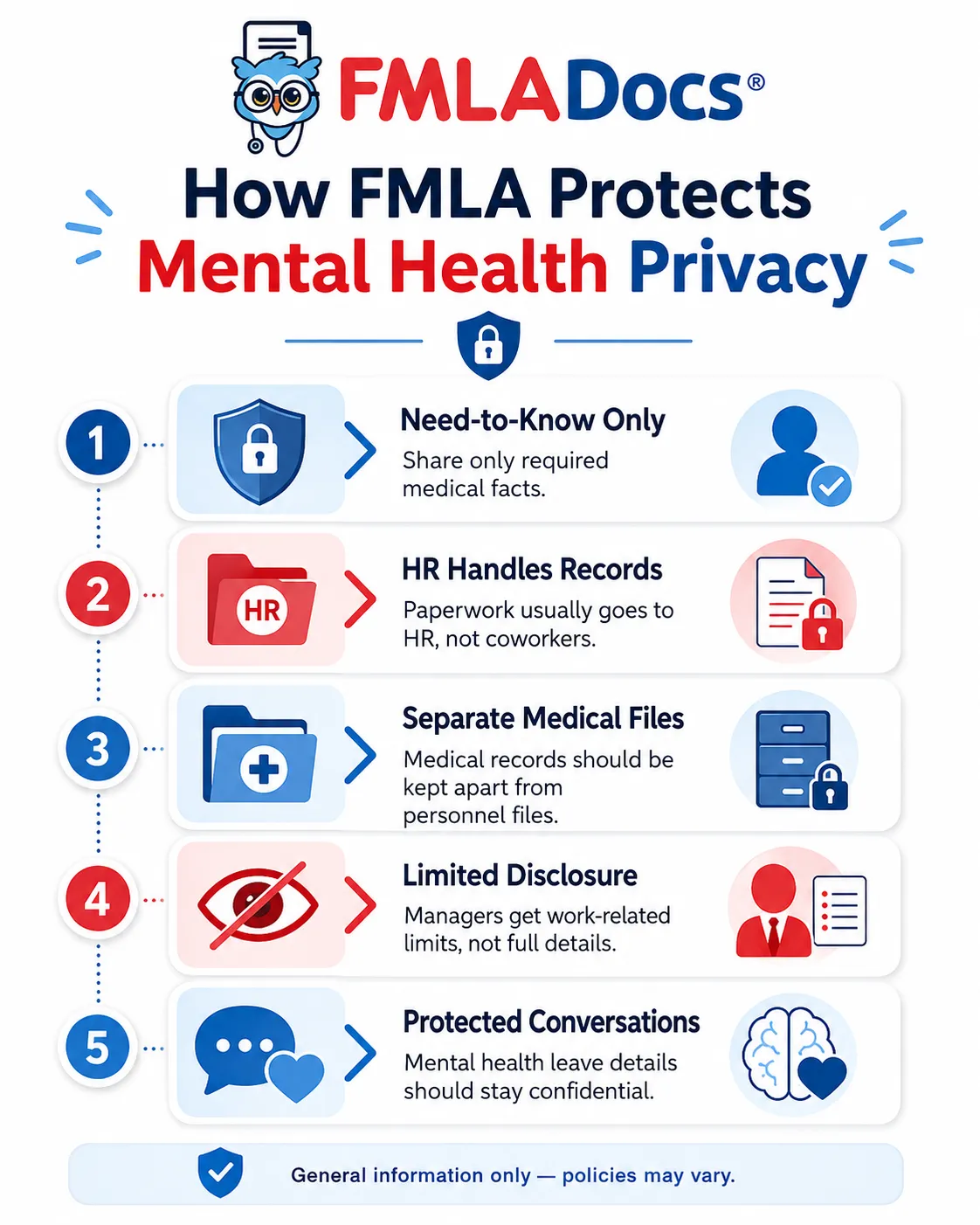
FMLA medical records must remain confidential and separate from routine personnel files. Managers may learn that you need leave, schedule changes, restrictions, or accommodations, but they do not need your complete medical story.
A direct supervisor may not contact your provider. Authorized HR or leave-administration personnel may seek limited authentication or clarification under FMLA procedures and applicable privacy rules.
How Should You Respond to a Recertification Request?
Read the written request and confirm the deadline. Employers generally must allow at least 15 calendar days. More time may be appropriate when diligent, good-faith efforts cannot overcome a provider delay.
Take these steps:
- Send the form to your provider immediately.
- Share your recent absences and upcoming treatment schedule.
- Ask for clear frequency, duration, and limitation estimates.
- Return the form through the approved channel.
- Keep copies and proof of submission.
You generally pay the recertification cost. An employer cannot require second or third opinions for recertification.
Coordinate With Mental Health FMLA Resources
Your recertification should match your treatment plan and actual leave pattern.
Use the FMLA mental health resource hub for condition-focused education and the FMLA service hub to review documentation pathways.
FMLADocs Helps Turn Recurring Needs Into Clear Documentation
FMLA recertification mental health requests become easier when the form clearly explains treatment frequency, episodic incapacity, expected duration, and work limitations without unnecessary disclosure.
At FMLADocs, we connect employees across the United States with licensed health care professionals who review information and prepare employer-ready certification documents through a secure online process.
Clinical eligibility, complete information, provider availability, and employer requirements affect each outcome. Approval is not guaranteed.
Frequently Asked Questions
What should I say to get FMLA for depression?
Tell your employer you need leave for a serious health condition and follow its normal request process. Give your provider honest information about symptoms, treatment, incapacity, and work limitations.
Is anxiety a serious health condition under FMLA?
It can be. Anxiety may qualify when it involves inpatient care or continuing treatment and meets the serious-health-condition standard.
How long can I take mental health leave?
An eligible employee may use up to 12 workweeks in the applicable 12-month period. Leave may be continuous, intermittent, or taken through a medically necessary reduced schedule.
Can I use FMLA for psychotherapy appointments?
Yes, when the condition qualifies and the appointments are medically necessary treatment supported by certification.
How bad must depression be to qualify?
FMLA does not use a symptom score. The condition must meet the serious-health-condition standard and create a qualifying need for leave.
Can my employer request recertification every month?
Sometimes. Requests generally cannot occur more often than every 30 days and must connect to an absence, subject to longer-duration rules and exceptions.
Must recertification name my diagnosis?
Generally, no. Medical facts, treatment information, functional limits, and leave estimates may support the request without naming the diagnosis.
Can my employer contact my therapist?
Your direct supervisor cannot. Authorized personnel may seek limited authentication or clarification under FMLA procedures and applicable privacy rules.

Meet the author
Anam Moin
I'm Anam Moin, and my work at FMLADocs focuses on workplace leave and FMLA education. I cover certification, documentation, employee rights, and leave-related questions to provide readers with useful information when they need it most.
Get Your FMLA Certification Online in Minutes