

FMLA Eligibility Guide: Who Qualifies for FMLA Leave in 2026?
 by Nida Hammad
 Last updated:
Understanding FMLA Eligibility: Your Complete Guide to Who Qualifies for FMLA.
You don’t need to guess whether you’re covered under the Family and Medical Leave Act. FMLA eligibility comes down to four specific, checkable facts about your job: who you work for, how long you’ve worked there, how many hours you’ve logged, and how many coworkers are within reach of your worksite. Once you know where you stand on each one, you know exactly where you stand with your employer, before a health crisis forces the question.
This guide walks through each of the four requirements the Department of Labor uses to determine eligibility, in plain terms, with real numbers and real scenarios you can apply to your own job. You’ll also see what happens if you fall short on one requirement, because a no on federal FMLA does not always mean a no on job-protected leave. For the full picture of how FMLA works end to end, explore different guides for more helpful information.
If you’ve confirmed you meet the requirements below and now need the medical side handled, FMLADocs connects you with licensed physicians who complete the DOL certification form your employer requires, typically within 24 to 48 hours. Learn how FMLA certification works.
The Four FMLA Eligibility Requirements
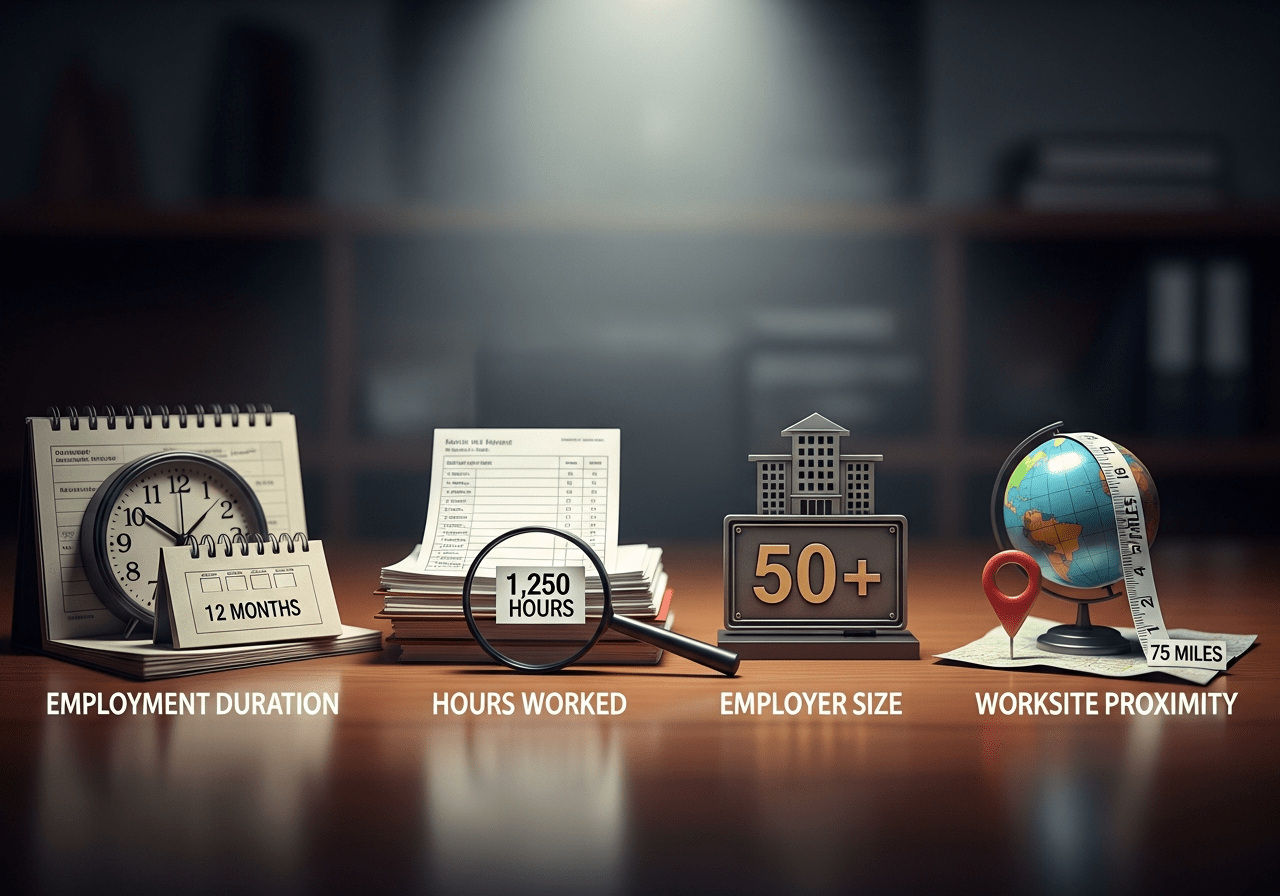
To qualify for FMLA leave, you must meet ALL four of the following requirements. Missing even one requirement means you’re not eligible for FMLA protections under federal law (though you may have rights under state law). Once eligible, you can get FMLA certification online.
Requirement #1: Work for a Covered Employer
Your employer must be subject to FMLA regulations. We’ll explore this in detail in the next section, but generally:
- Private employers with 50+ employees
- All public agencies (federal, state, local)
- All public and private elementary and secondary schools
Requirement #2: Have Worked for Your Employer for 12 Months
You must have been employed by your current employer for at least 12 months. These months don’t have to be consecutive, and you generally count employment within the past seven years.
Requirement #3: Have Worked at Least 1,250 Hours in the Past 12 Months
You must have worked at least 1,250 hours during the 12-month period immediately before your FMLA leave begins. This averages to about 24 hours per week.
Requirement #4: Work at a Location with 50+ Employees Within 75 Miles
At least 50 employees must work for your employer within a 75-mile radius of your worksite. This is calculated using surface roads or waterways.
Quick Eligibility Checklist:
- My employer has 50+ employees OR is a public agency/school
- I’ve worked for my employer for 12 months (total)
- I’ve worked 1,250+ hours in the past year
- 50+ employees work within 75 miles of my location
If you checked all four boxes, you likely meet the FMLA eligibility requirements. See exactly how these criteria apply to your situation before you request leave, so there are no surprises once you file. If you’re managing a mental health condition, a chronic illness, or another condition that’s limiting your ability to work, confirming eligibility first is what protects your job while you get certification handled. Once you’ve confirmed eligibility, notify your employer and follow these steps on how to apply for FMLA.
Employer Coverage Under FMLA

Not all employers are required to provide FMLA leave. Understanding whether your employer is “covered” under FMLA is essential to determining your eligibility.
Private Sector Employers
Coverage Rule: Private employers are covered if they employed 50 or more employees for at least 20 workweeks in the current or preceding calendar year.
What This Means:
- The 50 employees don’t all have to work at the same location
- Count all employees on the payroll during the workweek
- Include part-time employees in the count
- The 20 workweeks don’t have to be consecutive
- Once covered, employers remain covered until they fall below 50 employees for 20 workweeks in both the current and preceding year
Example: ABC Company employed 52 people in 2024 for 25 weeks, then reduced to 48 employees. In 2025, they still have 48 employees. ABC Company is still covered by FMLA in 2025 because they had 50+ employees for 20 weeks in 2024.
Public Agencies
All public agencies are covered regardless of size:
- Federal government agencies
- State government agencies
- Local government agencies (cities, counties, municipalities)
- Special districts (water, fire, school districts)
Important Note: Even if a public agency has fewer than 50 employees total, it’s still a covered employer. However, individual employees still need to meet the other three eligibility requirements, including working at a location with 50 employees within 75 miles.
Public and Private Elementary and Secondary Schools
All schools are covered regardless of size:
- Public elementary schools
- Public secondary schools
- Private elementary schools
- Private secondary schools
Like public agencies, schools are covered employers even with fewer than 50 employees, but employees must still meet all four individual eligibility requirements.
Who Is NOT Covered?
- Small businesses with fewer than 50 employees (private sector only)
- Independent contractors
- Self-employed individuals
- Certain federal employees with specialized FMLA provisions (FAA, TSA, etc.)
If you work for a small business with fewer than 50 employees, federal FMLA doesn’t apply, but check your state’s family leave laws. Some states have lower employee thresholds. If you need medical leave for conditions like migraines or chronic conditions, state law might still protect you.
The 12-Month Employment Requirement
To qualify for FMLA leave, you must have been employed by your current employer for at least 12 months. Understanding how these months are calculated is crucial.
How the 12 Months Are Counted
Key Points:
- The 12 months of employment do NOT need to be consecutive
- Generally, only employment within the past seven years counts
- Breaks in employment may be bridged in certain circumstances
- Time counts from first day of employment, not from when you became benefits-eligible
What Counts as Employment:
- Full-time work
- Part-time work
- Temporary work
- Seasonal work
- Periods on paid leave (vacation, sick leave)
- Periods on unpaid leave (in most cases)
What Does NOT Count:
- Time before you were hired
- Independent contractor work (unless you were actually an employee)
- Volunteer work
- Internships (unless you were a paid employee)
Calculating Your 12 Months
Simple Calculation: Count backward 7 years from today. Add up all the months you were employed by your current employer during that period. If the total is 12 months or more, you meet this requirement.
Example 1: Continuous Employment
- Hired: January 15, 2024
- Today’s Date: February 1, 2025
- Months Employed: 12 months ✓ QUALIFIES
Example 2: Employment with Break
- First Employment Period: January 2022 – June 2023 (18 months)
- Break in Employment: July 2023 – December 2023 (6 months)
- Second Employment Period: January 2024 – Present (13 months)
- Total Months: 31 months (18 + 13) ✓ QUALIFIES
Example 3: Too Short
- Hired: June 1, 2024
- Today’s Date: February 1, 2025
- Months Employed: 8 months ✗ DOES NOT QUALIFY
The Seven-Year Lookback Rule
General Rule: Only employment within the past seven years counts toward your 12 months.
Exceptions – Breaks Due To:
-
Military Service:
- Time spent fulfilling military obligations bridges the gap
- Military service time may count toward the 12 months
- Protected by USERRA (Uniformed Services Employment and Reemployment Rights Act)
-
Written Agreement:
- If you have a written agreement with your employer
- Collective bargaining agreements may address this
- Employment agreements may specify terms
Example of Military Exception:
- Worked for employer: January 2016 – December 2017 (24 months)
- Called to active duty: January 2018 – December 2020 (36 months)
- Returned to employer: January 2021
- Requesting FMLA: February 2025
- The break was due to military service, so the prior 24 months count ✓ QUALIFIES
Special Situations
Rehired Employees: If you left voluntarily or were terminated and later rehired, your previous employment typically counts toward the 12 months (subject to the seven-year rule).
Successor Employers: If your employer was acquired or merged with another company, your employment with the predecessor employer usually counts.
Joint Employment: If you’re jointly employed by two employers, the employment with both may count, depending on the circumstances.
Temporary Assignments: If you’re temporarily assigned to a different employer but remain employed by your original employer, that time counts.
If you’ve recently returned to work and are experiencing sleep disorders or other health issues, calculate your employment months carefully to determine if you’ve reached the 12-month threshold.
The 1,250 Hours Requirement

You must have worked at least 1,250 hours during the 12-month period immediately before your FMLA leave begins. This requirement ensures that FMLA benefits those who work substantial hours.
Understanding the 1,250-Hour Rule
What 1,250 Hours Means:
- Averages to approximately 24 hours per week over 52 weeks
- Approximately 104 hours per month over 12 months
- Works out to about 3 days per week for full-time schedules
The Counting Period: The 12-month period is the 12 months immediately preceding the start of your FMLA leave, not a calendar year or fiscal year.
Example: If your FMLA leave starts on March 15, 2025, count your hours from March 15, 2024, through March 14, 2025.
What Hours Count Toward 1,250?
HOURS THAT COUNT:
- All hours actually worked
- Overtime hours
- Hours worked from home or remotely
- Hours during probationary period
- Time worked part-time before becoming full-time
- Hours worked at different company locations
- Hours during temporary assignments
HOURS THAT DO NOT COUNT:
- Paid leave time (vacation, sick leave, holidays, personal days)
- Unpaid leave time (including previous FMLA leave)
- Paid time off (PTO) even if compensated
- Jury duty
- Bereavement leave
- Time suspended from work
- Time on furlough or layoff
Important: Only actual work hours count. Many employees mistakenly think their paid leave hours count toward the 1,250-hour requirement. They don’t.
How to Calculate Your Hours
Method 1: For Salaried Employees with Regular Schedules
If you work a consistent schedule:
- Determine your weekly hours (e.g., 40 hours/week)
- Multiply by 52 weeks = annual hours
- If you’ve worked the full year, you likely exceed 1,250 hours
Example:
- Work 40 hours/week
- 40 × 52 = 2,080 hours per year
- Well above 1,250 ✓ QUALIFIES
Method 2: For Variable or Part-Time Schedules
- Get your work schedule records or time sheets for the past 12 months
- Add up all hours actually worked each week
- Don’t include any paid leave or holidays
- Total must be 1,250 or more
Example:
- Average 25 hours/week for 50 weeks = 1,250 hours ✓ QUALIFIES
- Average 20 hours/week for 52 weeks = 1,040 hours ✗ DOES NOT QUALIFY
Method 3: Request Information from Employer
Your employer should have payroll records showing:
- Hours worked each pay period
- Total hours for the relevant 12-month period
You can request this information from your HR department.
Special Rules for Specific Employee Types
Airline Flight Crew Employees: Special rules apply to airline flight attendants and pilots. They must meet BOTH of these requirements in the 12 months before FMLA leave:
- Worked or been paid for at least 60% of applicable monthly guarantee, AND
- Worked or been paid for at least 504 hours (not including personal commute time or vacation/medical/sick leave)
Educators and School Employees: Same 1,250-hour requirement, but special rules apply to how leave is taken. Hours during school breaks count if you had a reasonable expectation of continuing employment.
Seasonal Employees: Must have worked 1,250 hours during the 12 months before leave, even if that time included off-seasons.
Common Scenarios
Scenario 1: Full-Time to Part-Time Maria worked full-time (40 hours/week) from March 2024 to September 2024 (28 weeks = 1,120 hours). She reduced to part-time (20 hours/week) from October 2024 to March 2025 (24 weeks = 480 hours). Total: 1,120 + 480 = 1,600 hours ✓ QUALIFIES
Scenario 2: Recent Hire Working Overtime James was hired November 1, 2024, and needs FMLA leave March 1, 2025 (4 months later). He worked 50 hours/week every week (50 × 17 weeks = 850 hours). Total: 850 hours ✗ DOES NOT QUALIFY (hasn’t worked 12 months either)
Scenario 3: Leave in Previous Year Sandra worked full-time but took 12 weeks of unpaid personal leave last year. Her actual hours worked: 40 hours × 40 weeks = 1,600 hours. Total: 1,600 hours ✓ QUALIFIES (unpaid leave doesn’t count, but she still has enough hours)
If you’re managing a serious illness or injury and wondering if you qualify, carefully review your hours worked over the past 12 months.
The 50-Employee Proximity Rule

This is often the most confusing FMLA eligibility requirement. You must work at a location where your employer has at least 50 employees within a 75-mile radius of your worksite.
Understanding the 75-Mile Radius
How It’s Measured:
- Use the shortest distance via surface roads or waterways
- NOT “as the crow flies” (straight-line distance)
- Use realistic transportation routes
- Consider actual driving or navigable water routes
Why This Matters: The actual distance by road is usually longer than straight-line distance. A location that appears to be within 75 miles on a map might actually be outside the radius when measured by roads.
Modern Tools: Use GPS navigation apps (Google Maps, MapQuest) to calculate actual driving distance between locations.
How to Count Employees
Count ALL Employees Who:
- Work within 75 miles of your worksite
- Are employed by your employer
- Were on the payroll during the relevant week
Include:
- Full-time employees
- Part-time employees
- Temporary employees
- Employees on paid leave
- Employees on unpaid leave (including FMLA leave)
- Employees at multiple facilities within the 75-mile radius
Do NOT Include:
- Independent contractors
- Employees beyond 75 miles
- Former employees
- Employees of other companies (even if on-site)
Determining Your Worksite
For Traditional Office/Facility Workers: Your worksite is the physical location where you report for work.
For Remote/Telework Employees: Your worksite is generally:
- Your employer’s office that assigns your work, OR
- The office where you report, OR
- Your “home base” for administrative purposes
NOT your home, even if you work from home full-time.
For Field Employees: If you have no fixed worksite (sales reps, repair technicians):
- Your worksite is where you report to receive assignments
- Or where you are “home based” for administrative purposes
- Or the office that supervises your work
For Employees Who Travel: Your worksite is typically your home base, not temporary travel locations.
Common Scenarios
Scenario 1: Main Office with Satellite Locations TechCorp has:
- Main office in downtown: 35 employees
- Satellite office 20 miles away: 18 employees
- Warehouse 40 miles away: 12 employees
- Total within 75 miles: 65 employees ✓ ALL EMPLOYEES QUALIFY
Scenario 2: Remote Rural Location Sarah works at a retail store in a small town. The store has 15 employees. The nearest other company location is 90 miles away (200 employees). Total within 75 miles: 15 employees ✗ DOES NOT QUALIFY
Scenario 3: Home-Based Employee Michael works from home in Portland. His employer’s office is in Seattle (175 miles away). For administrative purposes, Michael reports to the Seattle office. His worksite is Seattle. He must count employees within 75 miles of Seattle, not Portland. If there are 50+ employees within 75 miles of Seattle ✓ QUALIFIES
Scenario 4: Multi-Location Company MegaRetail has 500 stores nationwide but each store only has 12 employees. Jennifer works at Store #234. The nearest other MegaRetail locations are:
- 30 miles: Store #235 (12 employees)
- 45 miles: Store #236 (13 employees)
- 60 miles: Store #237 (11 employees)
- Total: 48 employees ✗ DOES NOT QUALIFY (needs 50)
Special Considerations
Corporate Headquarters: Just because your company headquarters has 50+ employees doesn’t mean you qualify if you work at a small remote location.
Customers’ Locations: If you work at a customer’s site, your worksite is still your employer’s location that assigns you, not the customer’s location.
Temporary Assignments: If temporarily assigned to a different location, your home base worksite is still used for the 50-employee calculation.
Acquisitions and Mergers: If your company acquires another company, employees of the acquired company count toward the 50-employee threshold if they’re within 75 miles.
If you’re dealing with family care responsibilities and need FMLA leave, but work at a small or remote location, carefully map out all employees within 75 miles to determine if you meet this requirement.
Special Eligibility Situations
Several special situations affect FMLA eligibility in unique ways. Understanding these exceptions and special rules can help you determine your rights.
Joint Employment Situations
What Is Joint Employment? You may be jointly employed if:
- A staffing agency places you at a client company
- You work for two related companies simultaneously
- Your employer uses a professional employer organization (PEO)
How It Affects Eligibility:
- BOTH employers may be responsible for FMLA compliance
- Your hours with both employers may count toward 1,250
- The employee count includes employees of both companies
- One employer is typically the “primary” employer
Example: TempStaff Agency places you at ClientCo. You work 40 hours/week. Both companies may have FMLA obligations, and you count ClientCo employees when determining the 50-employee rule.
Returning Service members (USERRA)
Special Credit for Military Service: If you’re returning from military service covered by USERRA:
- 12-Month Requirement: Military service counts toward the 12-month employment requirement
- 1,250-Hour Requirement: You receive credit for the hours you would have worked if not for military service
How to Calculate:
- Count actual hours worked before military service
- Estimate hours you would have worked during military service based on pre-service schedule
- Add actual hours worked after returning
- Total must be 1,250 or more
Example:
- Worked 900 hours before deployment
- Deployed for 6 months (would have worked ~520 hours based on schedule)
- Worked 100 hours after returning
- Total: 900 + 520 + 100 = 1,520 hours ✓ QUALIFIES
Educators and School Employees
Special Rules Apply To:
- Teachers
- Instructional employees
- Administrators
- Support staff at educational institutions
Eligibility Considerations:
- 12 Months: Time during summer break counts if reasonable expectation of continued employment
- 1,250 Hours: Hours during school year count; no requirement to work during breaks
- Special Leave Rules: Different rules for when and how leave can be taken (especially intermittent leave)
Successor Employers
If Your Employer Is Sold or Merges:
- Employment with predecessor employer counts toward 12-month requirement
- Hours worked for predecessor count toward 1,250 hours
- You don’t “start over” with the new employer
- The successor employer must honor FMLA obligations
Employees of Foreign Employers
If You Work in the U.S. for a Foreign Company:
- FMLA applies if you work in the U.S. or its territories
- Foreign companies operating in U.S. are covered if they meet the 50-employee threshold
If You Work Abroad:
- FMLA generally does NOT apply to work performed outside the U.S.
- Exception: American employees working overseas for American employers may have some protections
Temporary and Seasonal Employees
Temporary Workers:
- Must still meet all four eligibility requirements
- Hours worked as temp count toward 1,250
- Months employed as temp count toward 12 months
- “Temp” status alone doesn’t disqualify you
Seasonal Workers:
- Subject to same eligibility requirements
- Must work 1,250 hours in preceding 12 months (may be difficult if season is short)
- Off-season months still count toward 12-month employment requirement if reasonable expectation of recall
Part-Time Employees
Part-Time Workers Can Qualify:
- Must still meet all four requirements
- The 1,250-hour requirement is the main challenge
- 1,250 hours ÷ 52 weeks = 24 hours/week average needed
Common Scenario: Working 30 hours/week for 12 months = 1,560 hours ✓ QUALIFIES Working 20 hours/week for 12 months = 1,040 hours ✗ DOES NOT QUALIFY
If you’re a part-time employee dealing with parental leave needs, make sure you’ve worked enough hours to qualify.
How to Verify Your FMLA Eligibility
Once you understand the requirements, you need to verify whether you actually meet them. Here’s how to confirm your FMLA eligibility step-by-step.
Step 1: Check Employer Coverage
Questions to Ask:
- Does my employer have 50 or more employees?
- Is my employer a public agency or school?
- Has my employer had 50+ employees for at least 20 weeks this year or last year?
Where to Find Information:
- Employee handbook
- HR department
- Company website “About Us” section
- Annual reports (public companies)
What to Do: Contact your HR department and ask directly: “Is our company covered under the Family and Medical Leave Act?”
Step 2: Calculate Your Employment Duration
Gather Information:
- Your start date(s) with current employer
- Any breaks in employment
- Dates of previous employment with same employer (within 7 years)
Calculate:
- Count total months employed within past 7 years
- Do months total 12 or more? ✓ Yes = Meets requirement
Where to Find Information:
- Offer letter
- Employee personnel file
- Pay stubs
- Tax forms (W-2)
- HR records
Step 3: Calculate Your Work Hours
Gather Information:
- Pay stubs for past 12 months
- Time cards or time tracking records
- Payroll records
Calculate: Go back exactly 12 months from your expected FMLA start date. Add up all hours actually worked (not paid leave).
Request from Employer: Ask HR for a report showing: “Total hours worked from [12 months ago] to [today]”
Verify: Do you have 1,250 or more hours? ✓ Yes = Meets requirement
Step 4: Determine the 50-Employee Count
Identify Your Worksite:
- Where do you physically report to work?
- If remote, where is your administrative home base?
Identify Other Locations:
- What other locations does your employer have?
- How far are they from your worksite?
Map the Distance:
- Use Google Maps or similar tool
- Calculate driving distance (not straight-line)
- Identify all locations within 75-mile radius
Count Employees:
- Ask HR: “How many employees work within 75 miles of [your worksite]?”
- Include all locations within the radius
Verify: Are there 50 or more employees within 75 miles? ✓ Yes = Meets requirement
Step 5: Request Formal Eligibility Determination
Best Practice: Don’t rely on your own calculations alone. Request an official eligibility determination from your employer.
How to Request: Send a written request (email is fine):
“Dear [HR Contact],
I am planning to request FMLA leave beginning on [date]. Please provide me with a written determination of my FMLA eligibility status.
Specifically, please confirm:
- Whether [Company Name] is a covered employer under FMLA
- Whether I meet the 12-month employment requirement
- Whether I meet the 1,250-hour work requirement
- Whether I work at a location with 50+ employees within 75 miles
Thank you, [Your Name]”
Employer’s Obligation: When you request FMLA leave, your employer must provide eligibility notice within 5 business days stating whether you’re eligible and, if not, at least one reason why.
Once your employer confirms you’re eligible, your certification paperwork is on the clock. Keep proper check about FMLA paperwork and deadlines for exactly what’s due, and when.
Documentation to Keep
Create an FMLA Eligibility File:
- Copy of employee handbook FMLA section
- Your employment start date documentation
- Pay stubs for past 12 months
- Calculation of your work hours
- Company organizational chart or location list
- All correspondence with HR about FMLA
- Employer’s eligibility determination
This documentation will be crucial if there’s ever a dispute about your eligibility.
Need help with the medical certification process? FMLADocs provides fast online evaluations with licensed healthcare providers who can complete your FMLA paperwork efficiently.
What If You Don’t Qualify for FMLA?

If you don’t meet federal FMLA eligibility requirements, you’re not out of options. Several alternatives may provide you with job protection or paid leave.
State Family and Medical Leave Laws
Many states have their own family and medical leave laws that may cover you even if federal FMLA doesn’t.
States with Lower Thresholds:
- California (CFRA): 5+ employees
- Connecticut: 75+ employees for family leave, 1+ for own medical leave
- Maine: 15+ employees (private), 25+ (public)
- Minnesota: 21+ employees (parental leave)
- Oregon: 25+ employees
- Vermont: 10+ employees (parental), 15+ (family/medical)
- Washington: 50+ employees (with exceptions for smaller employers)
- District of Columbia: 20+ employees
State Paid Family Leave Programs: Several states offer paid family leave even if you don’t qualify for FMLA:
- California
- Colorado
- Connecticut
- Delaware (starting 2026)
- Maryland (starting 2026)
- Massachusetts
- New Jersey
- New York
- Oregon
- Rhode Island
- Washington
- District of Columbia
Action Step: Research your state’s labor department website or contact them directly to learn about state-specific leave laws.
Americans with Disabilities Act (ADA)
If you have a disability, you may be entitled to leave as a reasonable accommodation under the ADA.
ADA vs. FMLA Differences:
- ADA: No minimum hours requirement
- ADA: No minimum employer size for private employers (15+ employees)
- ADA: Leave is an “accommodation,” not an entitlement
- ADA: No specific time limit (must be “reasonable”)
How to Request ADA Leave:
- Inform your employer you have a disability
- Request leave as a reasonable accommodation
- Provide medical documentation of disability
- Engage in interactive process with employer
Limitations:
- Leave must not create undue hardship for employer
- You must still be able to perform essential functions (with or without accommodation) after leave
Employer Policies
Many employers offer leave benefits beyond what’s required by law.
Check For:
- Personal leave policies: Some companies allow unpaid personal leave
- Paid parental leave: Separate from FMLA, some companies offer this
- Short-term disability: May cover your own medical conditions
- Extended sick leave: Beyond normal accrual
- Sabbatical programs: For longer leaves
How to Find Out:
- Review employee handbook
- Ask HR about available leave options
- Check your benefits package
Workers’ Compensation
If your condition is work-related:
- You may be entitled to workers’ compensation leave
- This is separate from FMLA
- Provides wage replacement
- Protects your job in most states
Pregnancy Discrimination Act
If you’re pregnant:
- Employers must treat pregnancy like any other temporary medical condition
- You’re entitled to same leave/accommodations as others with similar limitations
- Some states have additional pregnancy accommodation laws
Negotiating with Your Employer
Even without legal protection:
- Many employers will work with you
- Explain your situation honestly
- Propose a specific plan
- Put agreements in writing
- Consider reduced schedule or remote work
Unemployment Benefits
If you must quit due to medical or family reasons:
- Some states allow unemployment benefits for “good cause”
- Medical necessity may qualify
- Requirements vary by state
Financial Assistance Programs
If you need unpaid leave:
- Short-term disability insurance (if you have it)
- Emergency savings
- Family support
- Community resources
- Medical fundraising platforms
Action Steps:
- Research all available options
- Don’t assume you have no rights
- Consult with an employment attorney if needed
- Document everything
- Consider multiple strategies simultaneously
Frequently Asked Questions
How many hours do you need to work for FMLA?
You need at least 1,250 hours actually worked in the 12 months immediately before your leave begins, roughly 24 hours a week on average. Paid time off, holidays, and vacation don't count toward that total. Only hours you were actually on the clock count.
How long must you work at a company before FMLA applies?
At least 12 months with your current employer. Those months don't have to be back-to-back, and in most cases employment from as far back as seven years can count toward the total.
What size employer is covered by FMLA?
Private employers are covered once they've had 50 or more employees on payroll for at least 20 workweeks in the current or preceding calendar year. Public agencies and public or private schools are covered regardless of size.
What reasons qualify for FMLA leave?
A serious health condition of your own, caring for a spouse, child, or parent with a serious health condition, the birth or adoption of a child, or a qualifying need connected to a family member's military service. A condition qualifies based on how it limits your ability to work, not just its name on a chart.
Can part-time employees get FMLA?
Yes, if the hours add up. Part-time employees can meet FMLA eligibility the same way full-time employees do, as long as they clear all four requirements, including the 1,250-hour threshold. That usually means averaging at least 24 hours a week across the year.
What if I changed jobs recently? Am I still eligible?
Generally, not right away. FMLA eligibility is tied to your current employer, so starting a new job resets both the 12-month and 1,250-hour clocks. An exception applies if your new employer is a legal successor to your old one, in which case your prior time may still count.
Is medical certification required to use FMLA leave?
Yes. Once you meet the four eligibility requirements, your employer can require a medical certification from a licensed healthcare provider to support your need for leave. Our FMLA certification guide walks through what that form covers and what your provider needs to document.
Meet the author
Nida Hammad
I am a professional writer with over five years of experience creating clear, engaging, and well-researched content. I specialize in healthcare topics, helping readers understand complex information in simple wording. Currently, I write for FMLA DOC, where I focus on producing accurate and trusted guides for people seeking support with FMLA and medical needs.
Get Your FMLA Certification Online in Minutes