Do You Need a Doctor's Note for FMLA? How to Get Forms Completed (2026)
 by Nida Hammad
 Last updated:
If you are dealing with a serious health condition, caring for a sick family member, or welcoming a new child, you may be wondering: Do you need a doctor’s note for FMLA? The short answer is yes, but it is more involved than a standard note from your physician. Under the Family and Medical Leave Act of 1993, eligible employees are entitled to up to 12 weeks of unpaid, job-protected leave per year. To use this protection, you will typically need to provide your employer with a completed medical certification form, not just a casual doctor’s note. This article explains exactly what is required, who can complete it, how long you have, and how you can make the process as smooth as possible.
What Is FMLA and Who Does It Protect?
The Family and Medical Leave Act (FMLA) is a federal law administered by the U.S. Department of Labor’s Wage and Hour Division. It entitles eligible employees of covered employers to take unpaid, job-protected leave for specified family and medical reasons, with continuation of group health insurance coverage under the same terms and conditions as if the employee had not taken leave.
To be eligible for FMLA leave, you must meet all of the following criteria according to the DOL eligibility requirements:
-
Work for an employer with 50 or more employees, or work for a public agency, elementary school, or secondary school.
-
Have worked for your employer for at least 12 months (not necessarily consecutive).
-
Have worked at least 1,250 hours during the previous 12-month period.
-
Work at a location where your employer has 50 or more employees within 75 miles.
Qualifying reasons for FMLA leave include your own serious health condition, caring for a spouse, child, or parent with a serious health condition, the birth or adoption of a child, or qualifying military exigencies.
Do You Need a Doctor’s Note for FMLA? Note vs. Certification Explained
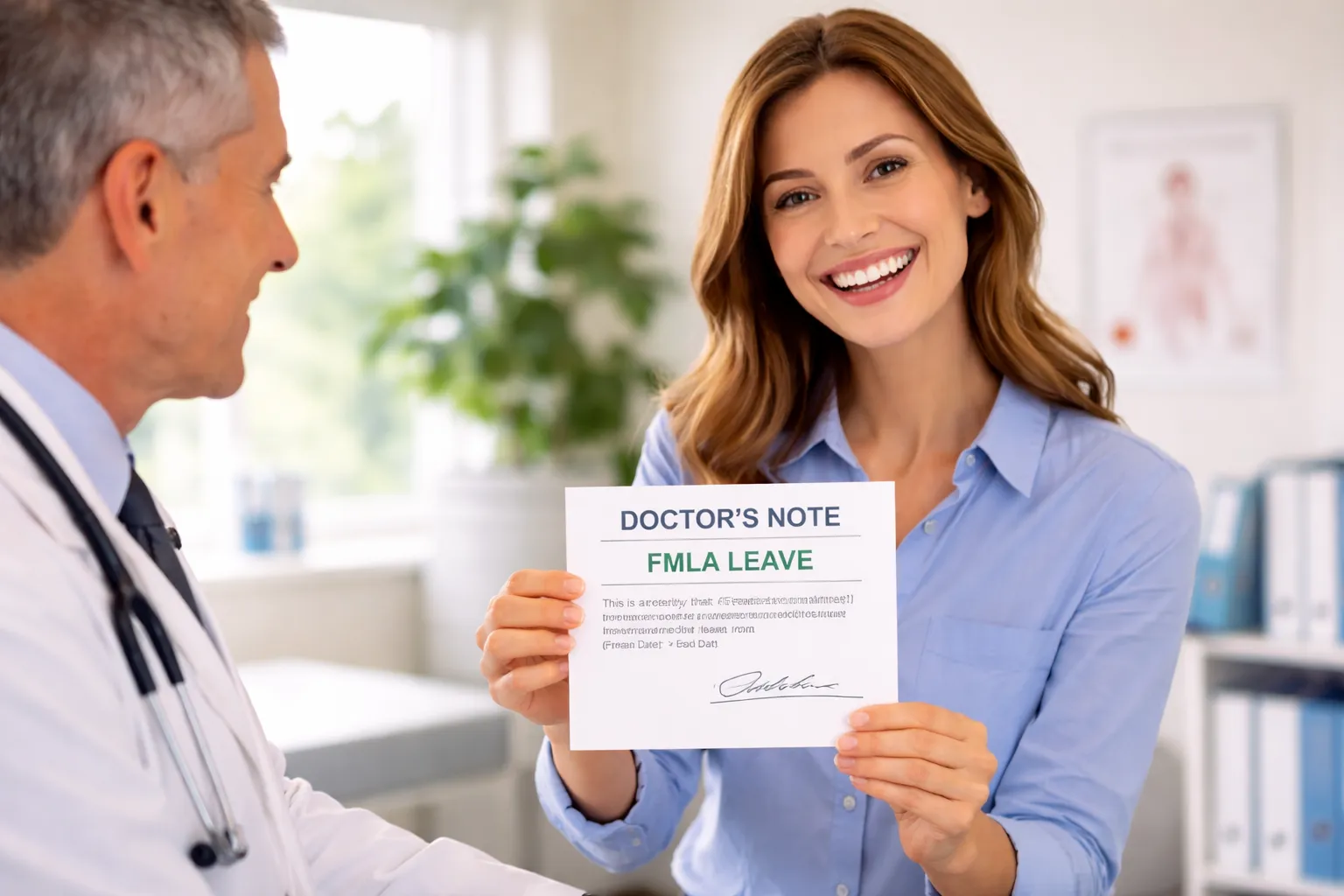
When most people ask, “Do you need a doctor’s note for FMLA?”, they imagine a brief slip of paper from their doctor’s office. While that type of note might suffice for a short absence under your employer’s sick leave policy, FMLA has more specific requirements.
Under the FMLA, your employer may request what is called a medical certification. This is a formal document completed by a licensed healthcare provider that verifies the existence of a serious health condition and the medical necessity for leave. The U.S. Department of Labor has developed optional-use certification forms for this purpose. The most commonly used are:
-
Form WH-380-E: Certification of a healthcare provider for an employee’s serious health condition.
-
Form WH-380-F: Certification of a healthcare provider for a family member’s serious health condition.
You can find all official FMLA certification forms on the DOL . Importantly, your employer must accept any complete and sufficient certification, even if it is not on their standard form. A signed letter on a healthcare provider’s letterhead that includes all required information is also acceptable.
Certification is just one piece of the FMLA paperwork puzzle. For every form, deadline, and requirement in one place, see the complete guide to FMLA paperwork requirements.
What the Medical Certification for FMLA Must Include
A complete FMLA medical certification is not just a signature. It must contain specific clinical information. For an employee’s own serious health condition, the certification typically must include:
-
The approximate date the condition began and its expected duration.
-
A description of the appropriate medical facts surrounding the condition, including the nature of the condition, symptoms, and any regimen of continuing treatment.
-
Whether the patient is unable to perform the functions of their job, and for how long.
-
For intermittent leave, an explanation of the medical necessity and the likely frequency and duration of episodes.
Need documentation for a shorter-term issue? get a doctor’s note for short-term disability
A “serious health condition” is defined under FMLA as an illness, injury, impairment, or physical or mental condition that involves inpatient care or continuing treatment by a healthcare provider. This covers a wide range of diagnoses including chronic conditions, mental health disorders, cancer treatment, pregnancy complications, and recovery from surgery.
Not sure if your condition qualifies or need help getting your paperwork in order? Check your FMLA eligibility at FMLADocs and connect with a licensed provider who can complete your certification online, typically within 24 hours. No waiting rooms, no scheduling delays.
Who Can Complete Your FMLA Medical Certification?
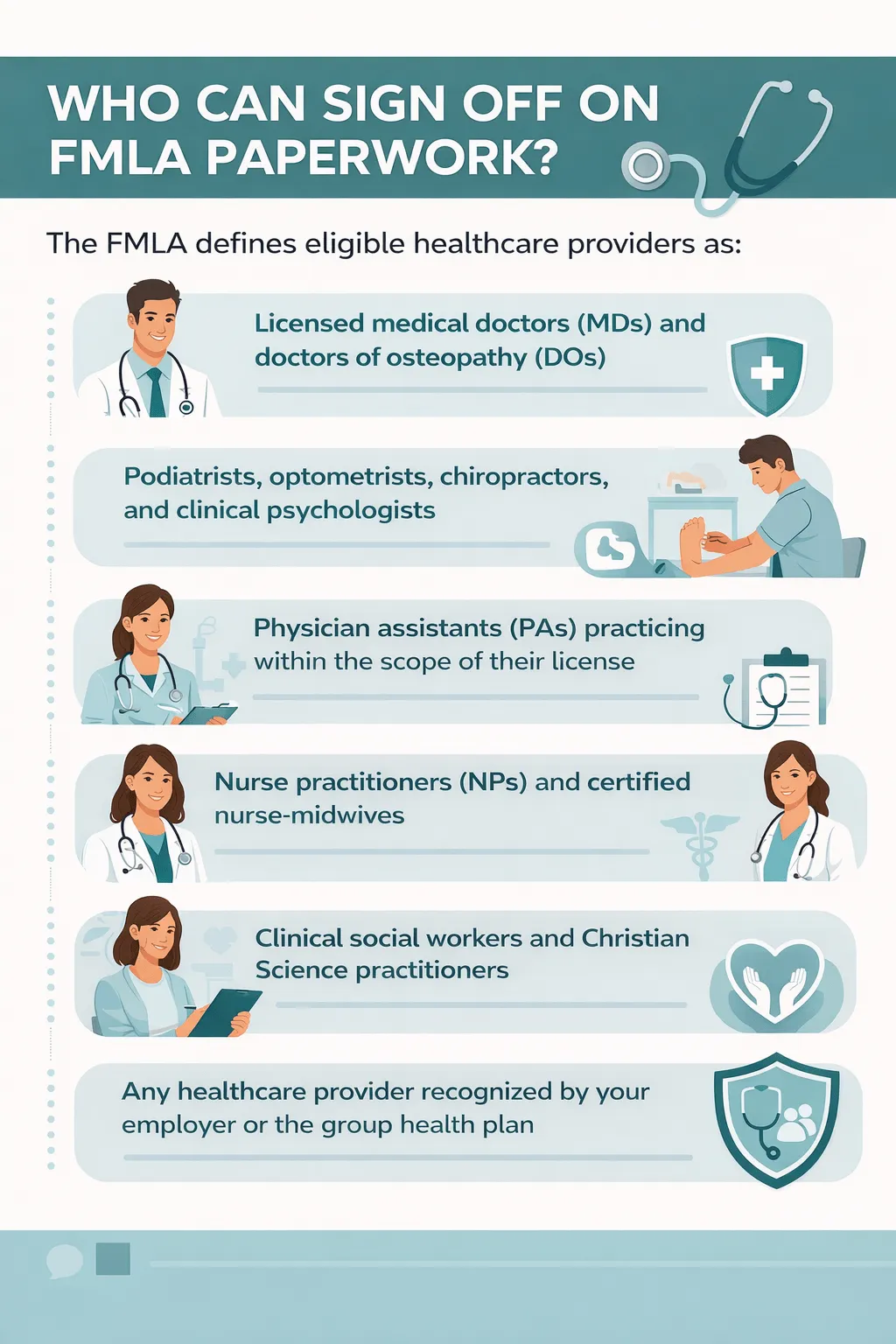
Not just any medical professional can sign off on FMLA paperwork. The FMLA defines eligible healthcare providers as:
-
Licensed medical doctors (MDs) and doctors of osteopathy (DOs)
-
Podiatrists, optometrists, chiropractors, and clinical psychologists
-
Physician assistants (PAs) practicing within the scope of their license
-
Nurse practitioners (NPs) and certified nurse-midwives
-
Clinical social workers and Christian Science practitioners
-
Any healthcare provider recognized by your employer or the group health plan
This means you do not necessarily need to see your primary care doctor. If your condition is being managed by a specialist, a mental health professional, or a nurse practitioner, they can complete the certification just as validly. Services like FMLADocs connect you with licensed physicians who review your medical information and complete FMLA paperwork compliantly, all online and accepted by employers nationwide.
Understanding the FMLA Leave Process and Certification Timeline
Knowing the exact steps and timelines involved in the FMLA leave process can prevent costly mistakes and denied leave. Here is what you need to know:
Step 1: Notify Your Employer
You must notify your employer as soon as you know you need FMLA leave. For foreseeable leave (such as a planned surgery or prenatal appointments), you should provide at least 30 days’ advance notice. For unforeseeable leave, notify your employer as soon as practicable, generally within one to two business days of learning of the need for leave.
Step 2: Employer Responds Within 5 Business Days
Your employer has 5 business days to determine your eligibility and notify you. If you are eligible, they must also provide you with your rights and responsibilities under FMLA. If they choose to request medical certification, they must notify you at this point.
Step 3: You Have 15 Calendar Days to Submit Certification
Once your employer requests medical certification, you have 15 calendar days to provide the completed form. If circumstances make it impossible to submit within 15 days despite diligent good faith efforts, the timeframe may be extended. In some cases, your employer may grant a 7-day extension, though this is not guaranteed.
Step 4: Employer Designates Leave Within 5 Business Days
After receiving your completed certification, your employer has 5 business days to notify you whether your leave has been designated as FMLA-protected or denied, which is when your FMLA denial rights come into play. If approved, your leave is job-protected, meaning your employer must return you to your same or a nearly identical position when you return to work.
What If Your Employer Does Not Request a Certification?
Employers are not required to request medical certification, and if they do not, they must proceed with processing your leave request based solely on your notification. However, it is in most employees’ best interest to have proper documentation ready, since this protects you if any dispute arises about the legitimacy or duration of your leave.
Also important: your employer cannot ask for information beyond what is specified in the FMLA regulations. They are not entitled to a specific diagnosis or your full medical history. The certification form is designed to provide the minimum clinical facts necessary to verify a qualifying condition without violating your medical privacy.
When Can Your Employer Request Recertification?
Your employer may request recertification of your ongoing serious health condition no more frequently than every 30 days, and only in connection with an absence. If your condition is expected to last more than 30 days, your employer might still request recertification every 6 months. Recertification can also be requested sooner if:
-
You request an extension of your leave.
-
The circumstances of your leave have significantly changed.
-
Your employer receives information that casts doubt on your stated reason for absence.
Understanding recertification requirements is important for employees on intermittent FMLA leave, which allows for leave taken in separate blocks of time for a single qualifying reason. For example, someone with a chronic migraine condition may take a few hours or a day off each month under an intermittent leave arrangement.
Do You Need a Doctor’s Note for FMLA Under State Leave Laws?
Many states have their own family and medical leave programs that run alongside or in addition to federal FMLA. Some states, like California, New York, Washington, and Massachusetts, offer paid family leave with their own certification processes. These state programs may have different documentation requirements, forms, and timelines.
If your state has a paid leave program, you may be able to receive partial wage replacement while also being protected by federal FMLA. In most cases, the leave time runs concurrently, meaning state paid leave and FMLA leave count toward the same 12-week period. Platforms like FMLADocs help you understand both federal and state requirements during your certification evaluation, ensuring you do not miss out on benefits you are entitled to.
Dealing with a serious health condition, caring for a loved one, or managing a complex medical situation? Get your FMLA certification through FMLADocs. Licensed providers complete your paperwork online, HIPAA-compliant and employer-accepted, with most certifications delivered within 24 hours. Approved or your money back.
Common Mistakes Employees Make With FMLA Medical Certification
Many employees lose FMLA protection not because their condition does not qualify, but because of procedural errors in the certification process. Here are the most common pitfalls to avoid:
-
Submitting an incomplete certification: Missing fields, vague descriptions, or unsigned forms can lead to denial. Your employer can request clarification but cannot require you to provide a new form if the existing one is complete.
-
Missing the 15-day deadline: If you fail to submit certification within 15 days and cannot demonstrate a good reason for the delay, your employer can deny FMLA protection for that absence.
-
Using an unqualified healthcare provider: Make sure the person completing your form is recognized under FMLA’s definition of a healthcare provider.
-
Providing too much information: You do not need to share a specific diagnosis. The certification should describe medical facts sufficient to verify a serious health condition, nothing more.
-
Not keeping a copy: Always keep a copy of your submitted certification for your own records.
How FMLADocs Makes the Certification Process Simple
One of the biggest barriers to getting FMLA leave approved is the certification process itself. Many people struggle to get a timely appointment with their doctor, or their provider is unfamiliar with FMLA documentation requirements. FMLADocs was created to solve this problem.
FMLADocs connects eligible employees with licensed physicians who specialize in FMLA evaluations. The process is entirely online: you submit your application, a licensed provider reviews your information for FMLA compliance, and you receive your completed, employer-ready certification, typically within 24 hours. All documentation is HIPAA-compliant and meets DOL requirements, so your employer cannot reject it on the basis of format or provider credentials.
Whether your need for leave stems from anxiety, depression, chronic pain, cancer treatment, pregnancy complications, or caring for a seriously ill family member, FMLADocs has licensed providers equipped to certify your condition accurately and quickly. Trusted by over 60,000 employees nationwide with a 4.9 out of 5 rating, it is the lowest-cost FMLA certification service in the United States.
Do You Need a Doctor’s Note for FMLA? Final Thoughts
To summarize: yes, you need a doctor’s note for FMLA, but it must be in the form of a completed medical certification, not just a casual slip from your physician. This certification must include specific clinical information about your condition, must be completed by a qualified healthcare provider, and must be submitted within 15 calendar days of your employer’s request.
Getting this documentation right the first time is critical. Incomplete or late certifications can result in denied leave and loss of job protection. Whether you work through your own doctor or use a streamlined online service like FMLADocs, the key is to act promptly, understand your rights, and ensure that your paperwork meets all federal FMLA standards.
You can Get FMLA certification service through FMLADocs; a board-certified physician evaluates your condition and delivers your completed certification typically within 24 hours, without a scheduling wait.
Frequently Asked Questions
1. Do you need a doctor's note for FMLA, or is verbal notice enough?
Verbal notice from you to your employer triggers the FMLA process, but it is not sufficient on its own. Your employer can and usually will request a formal medical certification from a licensed healthcare provider. A simple doctor's note that says 'patient needs time off' is not the same as a complete FMLA certification form.
2. Can my employer fire me for requesting FMLA leave?
No. It is illegal for a covered employer to interfere with, restrain, or deny the exercise of any right provided by FMLA, or to retaliate against any employee for taking FMLA leave. If you believe your employer has violated your rights, you can file a complaint with the U.S. Department of Labor's Wage and Hour Division.
3. What happens if I cannot get my doctor to complete the FMLA certification in time?
You have 15 calendar days to submit your certification. If you cannot meet this deadline despite diligent efforts, you should communicate this to your employer immediately and document your attempts to obtain the certification. Services like FMLADocs can complete your certification within 24 hours, making it much easier to meet this deadline.
4. Can my employer contact my doctor directly about my FMLA certification?
Your employer may contact your healthcare provider only to authenticate or clarify information on the certification, and only through their own healthcare provider or HR professional. They cannot ask your doctor for additional information beyond what is on the form, and they must comply with all HIPAA privacy rules.
5. Does FMLA cover mental health conditions?
Yes. Mental health conditions such as anxiety, depression, PTSD, bipolar disorder, and OCD can qualify as serious health conditions under FMLA if they involve continuing treatment by a healthcare provider. A mental health professional such as a psychiatrist, licensed clinical social worker, or clinical psychologist can complete the FMLA certification for these conditions.
6. Do you need a doctor's note for FMLA if you are taking intermittent leave?
Yes. For intermittent FMLA leave, your employer can still request a medical certification. In this case, the certification must also include information about the likely frequency of episodes and the expected duration of each episode. Your employer may request recertification no more frequently than every 30 days in connection with an absence, or every 6 months for longer-term conditions.
Meet the author
Nida Hammad
I am a professional writer with over five years of experience creating clear, engaging, and well-researched content. I specialize in healthcare topics, helping readers understand complex information in simple wording. Currently, I write for FMLA DOC, where I focus on producing accurate and trusted guides for people seeking support with FMLA and medical needs.
Get Your FMLA Certification Online in Minutes