

Intermittent FMLA for Migraines: How to Document Episodes Your Employer Will Accept
 by Nida Hammad
 Last updated:
What Intermittent FMLA for Migraines Actually Covers
If you live with chronic migraines, you know they can happen at any time. A migraine may start on a normal workday or during an important meeting. Because migraines are hard to predict, intermittent FMLA leave can help protect your job.
Intermittent FMLA leave lets you take time off in smaller amounts instead of taking all your leave at one time. Under the Family and Medical Leave Act (FMLA), eligible workers can take up to 12 weeks of unpaid, job-protected leave each year. This leave can be used in hours, half-days, or full days, depending on how serious the migraine is and how long it lasts.
According to the U.S. Department of Labor, chronic conditions like migraines can qualify as a serious health condition under FMLA if they cause occasional periods when an employee is unable to work and require treatment by a healthcare provider at least twice a year. In fact, the DOL uses migraine headaches as a direct example of a chronic serious health condition that qualifies for FMLA leave.
To qualify for FMLA, you must:
-
Work for your employer for at least 12 months
-
Have worked at least 1,250 hours during the past 12 months
-
Work at a place where the employer has at least 50 employees within 75 miles
If you meet these rules, chronic migraines that make it hard for you to work may qualify you for intermittent FMLA leave.
Why FMLA Migraine Documentation Matters So Much
Getting approved for intermittent FMLA leave often depends on how complete and clear your paperwork is. Many workers lose FMLA protection not because their migraines are fake, but because their forms are missing important details or are too unclear.
Your FMLA migraine paperwork must show three main things:
-
You have a serious long-term health condition that needs ongoing treatment
-
Your migraines sometimes make you unable to work
-
A licensed healthcare provider confirms these facts in writing
After you tell your employer that you need leave, the employer can ask for medical certification. Once they ask, you have 15 calendar days to turn in the paperwork. If the forms are missing information, your employer must tell you in writing and give you at least 7 days to fix the problem before denying your request.
Incomplete forms are one of the biggest reasons intermittent FMLA leave gets denied. Your healthcare provider should clearly explain how often your migraines happen and how long they usually last. A form that only says “the patient has migraines” without giving details about frequency or duration is usually not enough.
How to Document Migraine Episodes Between Medical Visits
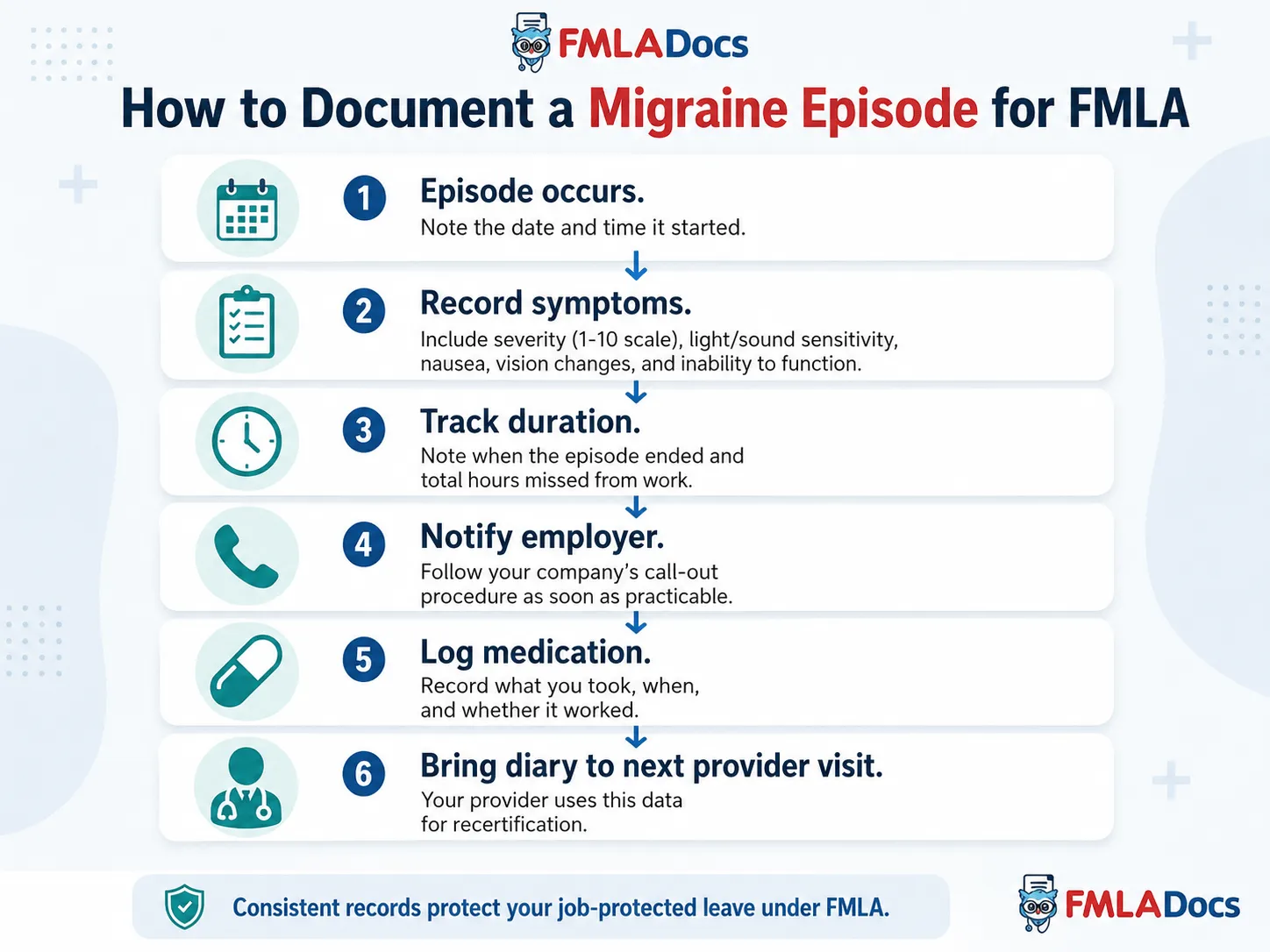
Getting your certification form approved is only the first step. After your intermittent leave starts, it is also important to keep good records of each migraine episode. These records can help you keep your approval and support future recertification.
- Keep a migraine diary.
One of the best things you can do is keep a migraine diary. The American Migraine Foundation says that a migraine diary can help you notice patterns and give your doctor clear information about your condition. This information can also make your FMLA records stronger.
Each diary entry should include:
-
The date and time the migraine started
-
How long it lasted
-
The pain level from 1 to 10
-
Your symptoms, such as light sensitivity, vomiting, aura, or trouble focusing
-
Whether you missed work or left early, and for how long
-
Any medicine you took and whether it helped
Keeping these records helps in two ways. First, it gives your healthcare provider real information when filling out recertification forms. Second, it shows that your records match what you reported to your employer.
- Follow your employer’s call-out procedures every time.
You should also follow your employer’s call-out rules every time you miss work. FMLA rules say that you still need to follow your employer’s normal absence procedures for unexpected leave. For example, if your employer says you must call before a certain time or speak to a certain person, make sure you do that. If you do not follow the rules, your absence could be marked as unexcused, even if your migraine is real.
- Notify your employer in plain language.
When telling your employer about an absence, use simple and clear words. You do not need to say, “I am using my FMLA rights.” You only need to give enough information so your employer understands that the absence may be related to FMLA. For example, saying “My migraine is very bad and I cannot work today” is usually enough after your leave has been approved.
Intermittent FMLA for Migraines: Documentation Requirements at a Glance
| Requirement | Details |
|---|---|
| Qualifying form | DOL Form WH-380-E (or employer equivalent) |
| Time to submit certification | 15 calendar days after employer request |
| Extension if needed | 7 additional days (must be requested) |
| Minimum provider visits required | At least 2 per year for chronic conditions |
| Recertification frequency | No more than once every 30 days |
| Second opinion allowed | Yes, at employer’s expense |
| Notice required for unforeseeable leave | As soon as practicable, following employer’s call-out policy |
| Leave increment minimum | As small as employer’s timekeeping allows (often 15 minutes) |
| Job protection | Yes, same or equivalent position upon return |
| Health insurance continuation | Yes, on same terms as active employment |
Recertification: What to Expect Over Time
-
For long-term conditions like migraines, FMLA recertification is a normal part of keeping your protected leave active. Employers may ask for new certification every 30 days if you used FMLA leave during that time. They can also ask for it if your situation changes a lot or if they have reason to check whether your condition is still continuing.
-
When you visit your healthcare provider for recertification, bring your migraine diary with you. The diary gives your provider clear information about how often your migraines happen and how serious they are. When providers have detailed records, they can complete the forms more clearly and accurately, which can help support your approval.
-
If your migraines start happening more often, your provider should include that change in the recertification paperwork. Employers may question absences that are more frequent than what was listed in the original certification. Honest and consistent diary records can help protect you in these situations.
-
If you want a quicker way to complete your certification or recertification forms, FMLADocs connects you with board-certified doctors who review cases online and often complete FMLA paperwork within 24 hours, without needing an in-person visit.
What Employers Can and Cannot Ask You
What Employers Can Ask For
-
A completed medical certification form, such as Form WH-380-E
-
Recertification for a chronic condition no more than once every 30 days
-
A second opinion from another healthcare provider if they have a valid reason to question the first certification. The employer must pay for this.
-
A third opinion if the first two opinions do not match. The third opinion is final.
What Employers Cannot Ask For
-
Your full medical records or test results
-
Extra medical information that is not needed to prove you have a serious health condition
-
Your exact diagnosis if your healthcare provider does not include it
-
Proof that you were unable to work during every absence after your leave has already been approved
According to the U.S. Department of Labor, employees are not required to share their diagnosis with their employer, they only need to provide enough information to confirm the leave may qualify under the FMLA. Employers do not have the right to an employee’s full medical history.
After your intermittent leave is approved, your employer should give you a Designation Notice called Form WH-382. This form confirms that your leave has been approved. Keep this form in a safe place because it proves that your absences are protected.
Conclusion
Managing intermittent FMLA leave for migraines means being consistent in two important areas: how your healthcare provider documents your condition and how you report each migraine episode at work. Your certification form should clearly explain how often your migraines happen and how long they usually last. Keeping a personal migraine diary can help your provider give accurate information. It is also important to follow your employer’s normal call-out rules every time you miss work so your absences stay protected.
You have a legal right to this protection. Migraines that regularly make it hard for you to work can qualify as a serious health condition under federal law. The paperwork process may take some effort, but it becomes much easier when you understand what is required
If you want to complete the process faster and more easily, FMLADocs connects you with licensed doctors who can review your case and complete your FMLA paperwork online. The service is accepted by employers in all 50 states and offers approval or your money back.
Frequently Asked Questions
Does a regular headache qualify for FMLA?
No. A normal headache does not count as a serious health condition under FMLA. Chronic migraines can qualify when they cause times when you cannot work, need care from a healthcare provider at least two times a year, and happen over a long period. Your doctor must confirm this in the certification form.
How often can I take intermittent FMLA leave for migraines?
You can take leave as often as your approved medical form allows. Your healthcare provider usually writes an expected pattern, like 2 to 4 migraine episodes each month, with each episode lasting 4 to 72 hours. You can use leave within that limit without applying again each time.
Can my employer fire me while I am on intermittent FMLA leave?
Your employer cannot fire you for using approved FMLA leave. That is not allowed under the law. But if you miss more work than your medical form allows, those extra absences may not be protected. Clear records of your migraines help prevent problems.
What if my employer refuses to approve my FMLA leave for migraines?
If your medical form is complete and correct, your employer must approve it. If they still refuse, you can file a complaint with the U.S. Department of Labor’s Wage and Hour Division. Keep all papers, including your form, denial letters, and absence records.
Meet the author
Nida Hammad
I am a professional writer with over five years of experience creating clear, engaging, and well-researched content. I specialize in healthcare topics, helping readers understand complex information in simple wording. Currently, I write for FMLA DOC, where I focus on producing accurate and trusted guides for people seeking support with FMLA and medical needs.
Get Your FMLA Certification Online in Minutes