Nearly 3 in 4 U.S. employees are experiencing moderate to high levels of stress at work right now. If you’re one of them and the stress has stopped being manageable, you may be entitled to more protection than you know.
FMLA covers stress and burnout, but not in the way most people expect. “Burnout” alone isn’t a qualifying medical diagnosis under federal law. What it produces is: anxiety disorders, depression, stress-related conditions requiring continuing treatment, do qualify. A physician doesn’t certify burnout. They certify mental health conditions caused by burnout . That distinction is what determines whether you have a case.
Here’s everything you need to know about qualifying, getting certified, and protecting your job.

Does Burnout Qualify for FMLA? Here’s What the Law Actually Says
This is where most online information either mislead people or leave them more uncertain than when they started. Let’s clear it up.
The World Health Organization classifies burnout in its ICD-11 as an “occupational phenomenon,” not a medical condition. That matters because FMLA requires a “serious health condition” to qualify for job-protected leave. Burnout described simply as job fatigue or exhaustion, without clinical documentation, may not be enough on its own.
But here’s what most people don’t know: what burnout leads to almost always does qualify.
Prolonged, unmanaged workplace stress is one of the most well-documented triggers for diagnosable conditions.
- Generalized anxiety disorder.
- Major depressive disorder.
- Panic disorder.
- Adjustment disorder with anxious or depressed mood.
These are recognized clinical diagnoses, and under the Department of Labor’s Fact Sheet 28O on mental health and FMLA, they qualify as serious health conditions when they require continuing treatment by a healthcare provider. That means regular therapy, psychiatric care, or medication management.
So when you work with a physician or mental health professional on FMLA certification, they aren’t certifying “burnout.” They’re certifying the condition burnout caused. It’s not about whether you feel burned out. It’s about whether what’s happening to your mind and body meets a clinical threshold, and for many people in exactly your situation, it does.
The key phrase in FMLA’s definition is “continuing treatment.” A condition requiring at least two visits to a healthcare provider within 30 days of the first incapacitating episode qualifies. Ongoing therapy, psychiatric medication management, and single incapacitating episodes that require treatment all meet this standard. A physician experienced with mental health FMLA certification knows how to evaluate and document this accurately.
5 Signs Your Burnout Qualifies for FMLA Leave
Not every difficult stretch at work rises to the level of a serious health condition. But certain signs suggest what you’re experiencing has moved well beyond normal occupational stress, into territory a licensed physician would recognize and know how to document.
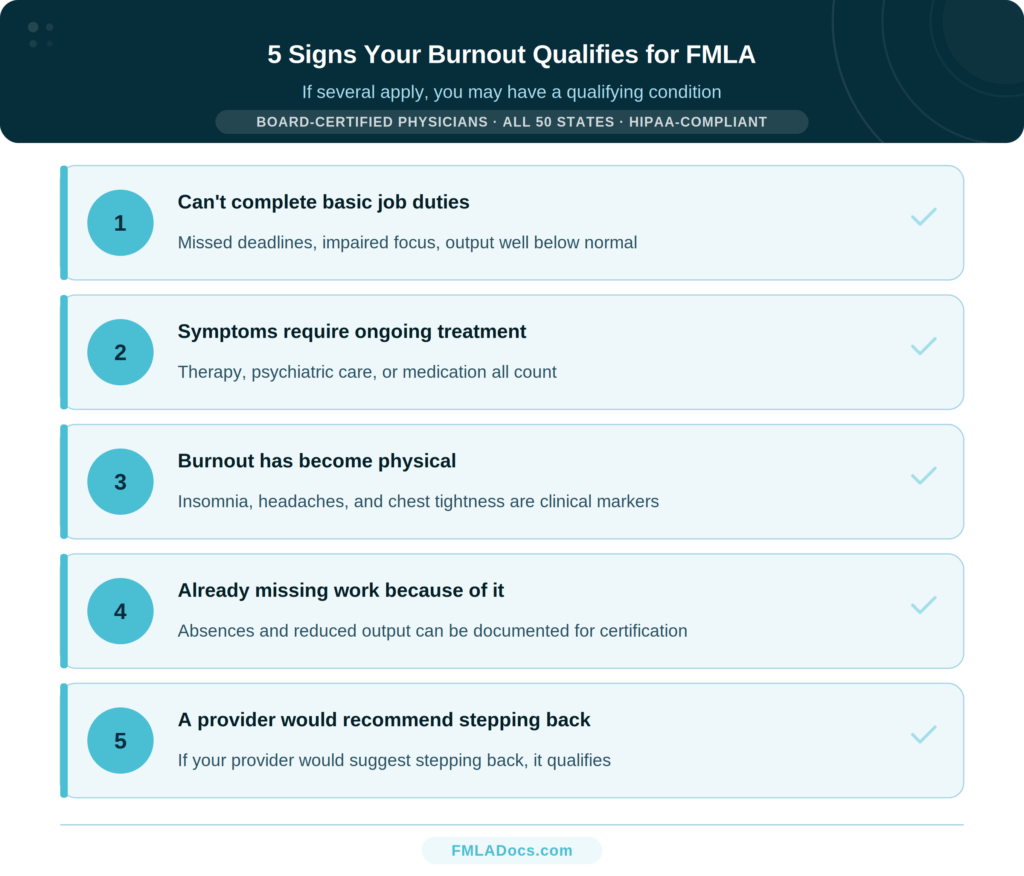
You can’t perform basic job functions.
Concentrating on routine tasks feels impossible. You’re missing deadlines you never used to miss, making errors that aren’t typical for you, and finishing the day with nothing to show for eight hours of effort. When your ability to do your job is genuinely impaired, not just slowed, that’s clinically significant.
Your symptoms require treatment.
Are you currently seeing a therapist, psychiatrist, or physician about what you’re experiencing? Or do you know you need to? Conditions requiring ongoing treatment, including regular therapy sessions, psychiatric evaluations, and medication adjustments, are precisely what FMLA’s continuing treatment standard covers. Treatment doesn’t have to have started yet. Recognizing that you need it counts.
Burnout has become physical.
Chronic stress doesn’t stay in your head. Persistent insomnia, tension headaches, GI problems, elevated heart rate, and chest tightness are documented physical expressions of stress-related and anxiety disorders. Nearly 1 in 5 U.S. adults experiences an anxiety disorder in a given year, and physical symptoms are among the most common and frequently overlooked markers.
You’ve already missed work because of it.
Calling in sick, leaving early, producing work well below your normal capacity, if stress or burnout has already started affecting your attendance or output, a physician can document that functional impact directly. That documentation is central to how FMLA certification works.
Your provider would recommend time off.
Ask yourself honestly: if you sat down with your doctor or therapist tomorrow and described exactly what you’ve been experiencing, the sleep, the focus, the physical symptoms, the dread, would they suggest stepping back for treatment or recovery? If the answer is yes, that instinct is medically grounded.
If more than two or three of these apply, there’s a real possibility your situation has crossed into qualifying territory. The signs that your mental health may qualify for FMLA are more clinically recognized than most people assume, and a board-certified physician can help you assess whether your specific situation meets the legal threshold.
| Symptom | Likely Qualifying Condition | Leave Type |
|---|---|---|
| Persistent anxiety, racing thoughts | Generalized Anxiety Disorder | Continuous or Intermittent |
| Low mood, inability to function | Major Depressive Disorder | Continuous |
| Recurrent panic attacks | Panic Disorder | Intermittent |
| Chronic insomnia and emotional exhaustion | Stress-Related Disorder | Continuous |
| Unpredictable flare-ups affecting attendance | Anxiety or MDD (episodic) | Intermittent |
Step-by-Step Process to Get FMLA Certification for Stress or Burnout
The process is more straightforward than most people expect, especially when you work with a provider experienced in mental health FMLA certification. Here’s what each step actually involves.
Step 1: Talk to a licensed provider and be specific.
You don’t need your primary care doctor. Licensed psychiatrists, psychologists, and other qualified mental health professionals can all complete FMLA certification for mental health conditions. When you speak with them, be specific and honest about how your symptoms are affecting your ability to work. Describe the insomnia. The concentration issues. The physical symptoms. The days you’ve had to push through when you couldn’t. Don’t minimize. Don’t frame months of deterioration as “just being stressed.” Your provider documents what you tell them.
FMLADocs makes this step straightforward, with board-certified physicians and licensed mental health professionals available online and certification typically delivered within 24 to 48 hours.
Step 2: Notify your employer.
For foreseeable leave, such as a planned treatment program, you’re required to give 30 days’ advance notice when possible. For situations that develop urgently, notify HR as soon as you reasonably can. You are not required to share your diagnosis. You only need to communicate that you have a medical condition requiring leave. HR handles the rest.
Step 3: Receive and complete the FMLA paperwork.
HR will provide the appropriate FMLA forms. Your physician completes a medical certification documenting your condition and how it affects your capacity to work. Per the FMLA step-by-step application process, you have 15 business days to return completed certification to HR.
Step 4: Leave is approved and your job is protected.
Once approved under federal FMLA, your position and health benefits are protected for up to 12 weeks within a 12-month period. Your employer cannot fire you, reduce your pay, or alter your benefits during this time.
One thing worth knowing: most people wait too long to start this process. Speaking with a provider earlier makes certification significantly smoother, before symptoms escalate, before attendance becomes a documented issue, and before your employer has reason to raise performance concerns.

What FMLA Protects You From When You Take Mental Health Leave
There’s understandable anxiety about what happens to your career when you take leave. It’s one of the main reasons people delay getting help they legally qualify for. Here’s exactly what federal law guarantees and what your employer cannot do.
- Your job is protected. Your employer cannot terminate you, demote you, or reassign you to a lesser position because you took approved FMLA leave. This applies to mental health leave the same as it applies to any physical health condition.
- Your health insurance continues. Your employer must maintain your group health coverage under the exact same terms as when you were actively working. You don’t lose your insurance because you stepped away for treatment.
- You’re returned to the same position. When leave ends, you’re entitled to return to your same position, or an equivalent one with the same pay, benefits, and responsibilities. Your employer cannot use your absence to restructure your role away from you.
- Your diagnosis stays private. Employers can require medical certification confirming the need for leave, but they cannot demand your specific diagnosis. They also cannot share your medical information with coworkers, your direct manager, or anyone outside HR.
- Retaliation is illegal. Any negative employment action taken because you requested or used FMLA leave is a federal violation. If your employer threatens your job, changes your workload punitively, or treats your leave as a mark against you, you have clear legal recourse.
The DOL’s guidance on mental health and FMLA is explicit: mental health conditions carry the exact same protections as physical ones. There is no legal basis for treating anxiety-related leave differently from recovery after surgery. Your full FMLA employee rights are more substantial than most people realize until they need them. More than 1 in 5 U.S. adults lives with a mental illness. Leave to treat those conditions is a federal entitlement, not a favor your employer grants you.
How to Get Paid During FMLA for Stress and Burnout: State Leave Options
FMLA is unpaid leave. That’s often where people stop investigating, and in doing so, they miss income replacement programs that can run alongside federal protection and cover a meaningful portion of salary during recovery. For burnout that has led to a diagnosable mental health condition, several state programs explicitly qualify.
California
California has among the broadest employee protections in the country. The California Family Rights Act (CFRA) mirrors FMLA but applies to employers with as few as five employees, far more inclusive than the federal 50-employee threshold. California State Disability Insurance (SDI) can replace 60 to 70 percent of wages when a mental health condition has been medically certified. CFRA and SDI can run concurrently with FMLA for eligible employees, providing both job protection and income replacement at the same time.
New York
New York employees can stack FMLA with the state’s Disability Benefits Law (DBL), which covers your own serious health condition including mental health diagnoses during a leave period. NY Paid Family Leave handles bonding and caregiving situations and can complement DBL for broader coverage scenarios, giving New Yorkers layered protection during mental health leave.
New Jersey
New Jersey offers Temporary Disability Insurance (TDI), which covers serious health conditions including mental illness at roughly 85 percent wage replacement, one of the most generous rates in the country. NJ TDI runs concurrently with federal FMLA, meaning you can have both job protection and income at the same time.
Washington
Washington employees have access to the state’s Paid Family and Medical Leave (PFML) program, which explicitly covers serious health conditions including mental health disorders. For lower-income earners, wage replacement can reach up to 90 percent, the highest rate of any state program currently operating, and it runs alongside FMLA for eligible workers.
| State | Program | Paid? | Wage Replacement | Mental Health Covered? |
|---|---|---|---|---|
| California | CFRA + CA SDI | Yes | 60-70% | Yes |
| New York | FMLA + NY DBL | Yes (DBL) | ~50% | Yes |
| New Jersey | FMLA + NJ TDI | Yes | ~85% | Yes |
| Washington | WA PFML | Yes | Up to 90% | Yes |
| All other states | Federal FMLA only | No | No | Varies by employer |
FMLADocs can certify you for both federal FMLA and state family leave in a single online consultation. For a full breakdown of every income option available during leave, the guide on how to get paid during FMLA covers state programs, short-term disability, and paid leave substitution in detail.
Your Condition Is Real. Your Leave Is Protected.
If stress and burnout have reached the point where your mental health is affecting your ability to work, FMLA for stress and burnout may be exactly the protection you’re entitled to. In California, New York, New Jersey, Washington, and other states, paid programs can run right alongside federal leave so you’re not facing recovery without income.
The process starts with an honest conversation with a licensed provider. FMLADocs makes that step straightforward: board-certified physicians and licensed mental health professionals, available entirely online, with certification typically completed within 24 to 48 hours and documentation accepted by employers across all 50 states.
Your mental health is a serious health condition. Federal law says so. Get your FMLA certification today – HIPAA-compliant, and handled by providers who understand exactly what you’re going through.
Get Your Mental Health FMLA Certification
FAQs
Does burnout qualify for FMLA leave?
Burnout alone is not a qualifying medical condition under federal FMLA. When burnout leads to a diagnosable condition such as anxiety disorder, major depression, or a stress-related illness requiring ongoing treatment, you may qualify. A board-certified physician evaluates your symptoms and certifies the underlying condition burnout caused, not the burnout label itself.
Can I take FMLA leave for stress?
Yes, stress can qualify for FMLA when it rises to the level of a serious health condition, meaning it requires continuing treatment by a healthcare provider or has resulted in incapacitation. Calling in overwhelmed without medical documentation doesn’t qualify. Working with a licensed physician to certify your condition does.
How do I prove burnout for FMLA?
You don’t certify burnout. You certify the condition burnout caused. A licensed physician or mental health provider documents your symptoms, how they impair your ability to work, and that your condition requires ongoing treatment or recovery time. Your employer receives the certification without your specific diagnosis disclosed.
Can my employer deny FMLA for mental health?
An employer can deny FMLA if eligibility requirements aren’t met, including 12 months employed, 1,250 hours worked, and employer having 50 or more employees within 75 miles, or if paperwork is incomplete or uncertified. They cannot lawfully deny FMLA because the condition is mental rather than physical. That would constitute unlawful discrimination under federal law.
What mental health conditions qualify for FMLA?
Qualifying conditions include anxiety disorders, major depressive disorder, PTSD, bipolar disorder, OCD, and stress-related disorders requiring inpatient care or continuing treatment. The condition must meaningfully impair your ability to perform essential job functions. General work stress that hasn’t produced a diagnosable condition typically doesn’t meet this threshold.