What Qualifies for FMLA Leave? Conditions, Eligibility, and How to Get Certified
 by Alisha Shabbir
 Last updated:
You’re dealing with a health condition that’s making work feel impossible, and one question keeps circling: does this actually qualify for FMLA leave? Maybe your anxiety has gotten worse over the past few months. Maybe chronic pain flares up without warning and you’ve burned through all your sick days. Or maybe you need time to care for a parent who just got a serious diagnosis. Whatever the situation, the uncertainty alone is exhausting.
Here’s what you should know: what qualifies for FMLA leave is broader than most people realize. The Family and Medical Leave Act covers everything from mental health conditions and chronic illness to pregnancy, surgery recovery, and family caregiving. This guide breaks down the specific qualifying conditions, the eligibility requirements you need to meet, and how to get your FMLA certification without the usual runaround.
The Five Qualifying Reasons for FMLA Leave
The Family and Medical Leave Act protects eligible employees with up to 12 weeks of unpaid, job-protected leave per year. Your employer must maintain your health insurance during this time and restore you to the same or an equivalent position when you return. But not every absence qualifies. Under federal law (29 U.S.C. § 2601), FMLA leave is available for five specific reasons.
1. Your Own Serious Health Condition
This is by far the most common reason people take FMLA leave. If you have a physical or mental health condition that prevents you from performing your job duties, you’re likely covered. That includes conditions you might not expect: anxiety that makes it impossible to concentrate, depression that keeps you in bed, chronic migraines that strike without warning, or recovery from a surgery that requires weeks of rehab.
The key threshold is that your condition must involve either inpatient care (an overnight hospital stay) or continuing treatment by a healthcare provider. We’ll break down exactly what “serious health condition” means in the next section, but if you’re currently seeing a doctor, therapist, or psychiatrist for something that’s affecting your ability to work, there’s a strong chance it qualifies.
2. Caring for a Family Member’s Serious Health Condition
FMLA doesn’t just protect your own health. If your spouse, child, or parent has a serious health condition and needs your care, you’re entitled to the same 12 weeks of protected leave. This covers situations like helping a parent recover from a hip replacement, caring for a child going through cancer treatment, or supporting a spouse after a psychiatric hospitalization.
One important limitation: “family member” under federal FMLA only includes your spouse, son or daughter, and parent. It does not cover siblings, in-laws, or grandparents. However, some state leave programs expand this definition, so it’s worth checking your state’s specific rules.

3. Birth and Bonding
Expecting or recently had a baby? FMLA covers the full spectrum: prenatal doctor visits, pregnancy complications like severe morning sickness or gestational diabetes, labor and delivery, C-section recovery, and postpartum bonding with your newborn. Unlike most other qualifying reasons, pregnancy-related incapacity doesn’t need to meet the three-day threshold. Any period of incapacity due to pregnancy qualifies automatically.
Both mothers and fathers are eligible for bonding leave, which must be taken within 12 months of the child’s birth. You can take it all at once or, if your employer agrees, as intermittent leave.

4. Adoption or Foster Care Placement
Adoptive and foster parents get the same 12 weeks of protected leave as biological parents. This covers time needed before and after placement: attending court hearings, meeting with attorneys, completing required counseling sessions, traveling for international adoption, and bonding with your newly placed child.
Like birth and bonding leave, adoption and foster care leave must be used within 12 months of the placement date. The leave applies regardless of the child’s age at placement.
5. Military Family Leave
FMLA provides two types of military-related leave. The first is qualifying exigency leave, which gives you up to 12 weeks for urgent situations that arise when a family member (spouse, child, or parent) is deployed or notified of an impending deployment to a foreign country. This covers things like arranging childcare, attending military ceremonies, handling financial and legal matters, and short-notice deployment activities.
The second type is military caregiver leave, which extends FMLA protections to 26 weeks in a single 12-month period. This applies when you’re caring for a servicemember or recent veteran with a serious injury or illness sustained in the line of duty.
| Reason | Who’s Covered | Leave Duration |
|---|---|---|
| Your own health condition | You | Up to 12 weeks |
| Family member’s health condition | Spouse, child, or parent | Up to 12 weeks |
| Birth and bonding | Mother or father | Up to 12 weeks |
| Adoption or foster care | Adoptive/foster parent | Up to 12 weeks |
| Military family leave | Military family members | 12 weeks (exigency) or 26 weeks (caregiver) |
The most common reason people take FMLA leave? Their own serious health condition. According to the National Partnership for Women & Families, more than 15 million workers were supported by FMLA in 2024 alone. And a significant portion of those leaves were for mental health conditions, which brings us to the question that trips up the most people.

What Counts as a “Serious Health Condition” Under FMLA?
This is where things get confusing for most employees, and understandably so. The phrase “serious health condition” sounds like it only applies to extreme situations. It doesn’t.
Under FMLA regulations (29 CFR § 825.113), a serious health condition is any illness, injury, impairment, or physical or mental condition that involves either inpatient care or continuing treatment by a healthcare provider. The Department of Labor breaks this down into six specific categories:
-
Inpatient care. Any condition requiring an overnight stay in a hospital, hospice, or residential care facility, plus any related follow-up treatment.
-
Three or more days of incapacity plus continuing treatment. If your condition keeps you from working for more than three consecutive calendar days AND requires ongoing treatment (two or more visits to a healthcare provider within 30 days, or one visit followed by a continuing regimen of care like medication), it qualifies.
-
Pregnancy and prenatal care. Any period of incapacity related to pregnancy qualifies automatically. This includes morning sickness, bed rest, prenatal appointments, and delivery. No three-day incapacity requirement applies here.
-
Chronic conditions requiring periodic treatment. Conditions that recur over an extended period and require treatment by a healthcare provider at least twice per year. Think asthma, epilepsy, diabetes, or recurring migraines.
-
Permanent or long-term incapacity. Conditions where treatment may not be effective but the person is under continuing supervision of a healthcare provider. This includes Alzheimer’s disease, terminal cancer, and severe stroke.
-
Multiple treatments. Absences for restorative surgery after an injury, or for conditions that would result in more than three days of incapacity if left untreated (chemotherapy, dialysis, physical therapy for severe arthritis).
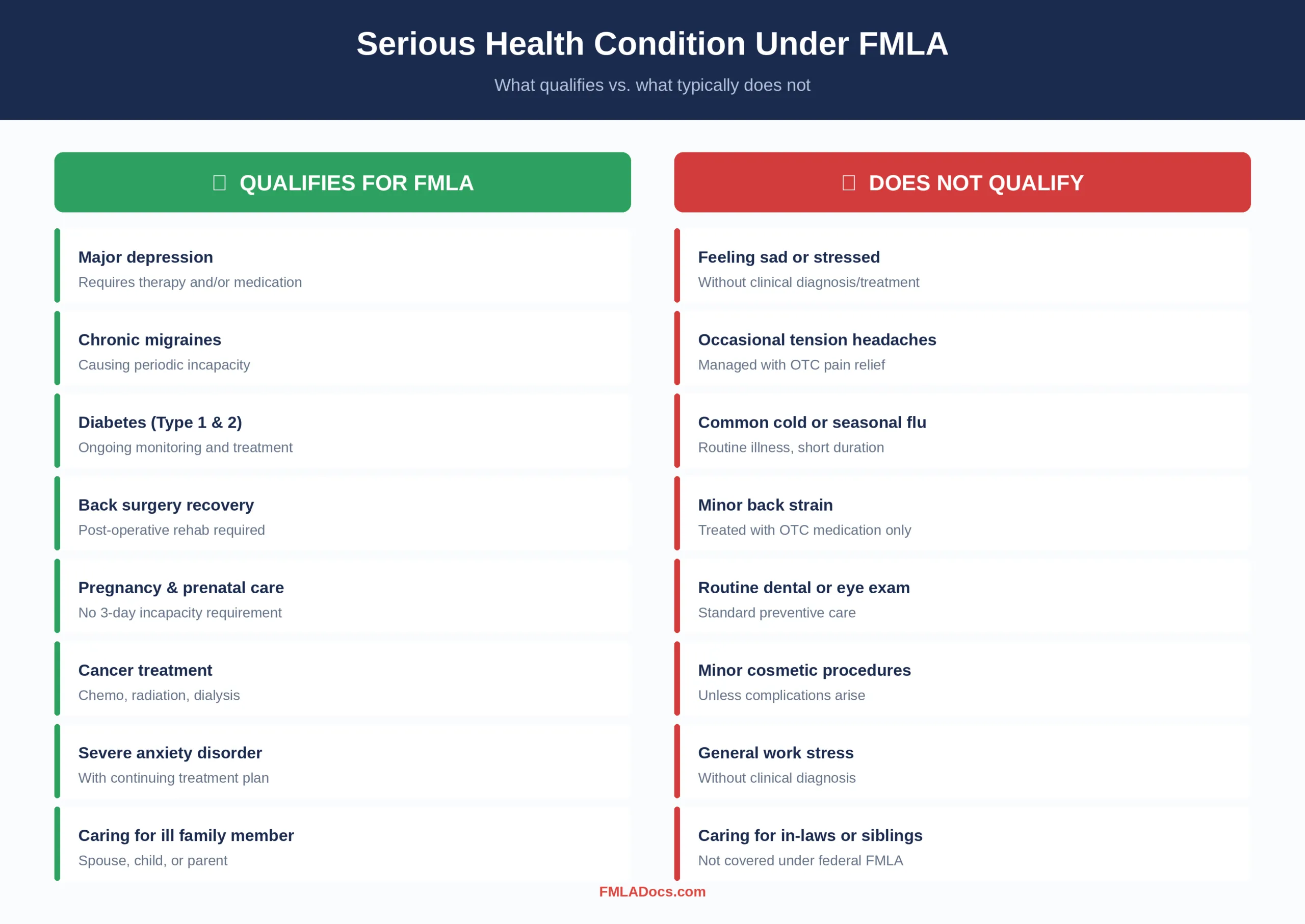
What does NOT qualify? The DOL is clear that routine illnesses like the common cold, standard flu, earaches, upset stomachs, minor headaches (not migraines), and routine dental problems do not meet the threshold, which is a common point of confusion when comparing FMLA to regular sick leave. Cosmetic procedures generally don’t qualify either, unless complications arise or hospitalization is required.
Qualifying Medical Conditions for FMLA Leave
So what does this look like in practice? Let’s walk through the specific conditions that qualify, organized by category. This is not an exhaustive list, but it covers the most common reasons people seek FMLA certification.
Mental Health Conditions
If you’ve been wondering whether your mental health condition is “serious enough” to qualify for FMLA leave, the answer is almost certainly yes, provided you’re receiving treatment from a licensed healthcare provider.
The Department of Labor’s Fact Sheet #28O specifically addresses mental health and FMLA. Qualifying mental health conditions include:
-
Anxiety disorders : panic attacks or generalized anxiety severe enough to require ongoing therapy or medication management qualify, even without hospitalization.
-
Depression : major depressive episodes that affect concentration, sleep, or daily functioning, when treated by a licensed provider.
-
PTSD : trauma-related symptoms triggered by combat, assault, or accidents, especially when flare-ups require intermittent time off.
-
Bipolar disorder : manic or depressive episodes under psychiatric care, including medication adjustment periods.
-
OCD : compulsive behaviors or intrusive thoughts disruptive enough to require structured treatment.
-
Stress and burnout : only qualifies once a provider diagnoses a related condition (e.g., anxiety, depression) caused by chronic workplace stress.
-
Substance use disorders requiring inpatient or outpatient treatment
Mental health conditions can qualify for continuous FMLA leave (a block of time off for intensive treatment or recovery) or intermittent FMLA (periodic absences for therapy appointments, medication management, or flare-ups). And here’s something important: your employer cannot legally require you to disclose your specific diagnosis. They only need certification that you have a qualifying serious health condition.

Chronic Physical Conditions
Chronic conditions are one of the most common reasons for intermittent FMLA leave, and they qualify when they cause periodic episodes of incapacity and require treatment at least twice per year. Conditions in this category include:
-
Diabetes : Type 1 or Type 2, when blood sugar instability causes periodic incapacity.
-
Chronic pain : including fibromyalgia and chronic back pain with recurring flare-ups.
-
Migraines : chronic, provider-diagnosed migraines (not occasional headaches) treated at least twice a year.
-
Asthma / respiratory conditions : including COPD, when episodes require emergency or provider-directed treatment.
-
Heart conditions : arrhythmia, coronary artery disease, or congestive heart failure under ongoing cardiac care.
-
Cancer treatment : chemotherapy, radiation, and recovery periods automatically meet the “continuing treatment” standard.
Living with a condition that flares unpredictably is stressful enough without worrying about losing your job over missed days. Intermittent FMLA protects you during those flare-ups, allowing you to take time as needed without it counting against you.
Pregnancy, Surgery, and Acute Conditions
Pregnancy qualifies for FMLA leave in virtually all circumstances, including prenatal appointments, pregnancy-related complications, delivery, and postpartum recovery. You do not need to be incapacitated for three or more days for pregnancy to qualify.
-
Pregnancy : prenatal appointments, complications like gestational diabetes, delivery, and postpartum recovery all qualify without the usual 3-day incapacity rule.
-
Surgery & recovery : planned procedures like knee replacement or hysterectomy, and recovery periods exceeding 3 days.
Planned and emergency surgeries also qualify when they involve inpatient care or require more than three days of recovery. Common qualifying surgeries include knee replacement, back surgery, cardiac procedures, gallbladder removal, hysterectomy, and C-section delivery.
Other acute conditions that qualify include cancer (and all related treatments), kidney disease requiring dialysis, serious injuries from accidents, and any condition requiring hospitalization.
Caregiving
-
Caring for a parent : supporting recovery after a hip replacement or managing a new chronic diagnosis.
-
Caring for a child : including a child undergoing cancer treatment or a serious injury.
-
Caring for a spouse : such as post-surgical care or supporting a spouse through psychiatric hospitalization.
Recognize your condition on this list? Check If You Qualify
FMLA Eligibility Requirements: Do You Qualify?
Having a qualifying condition is only one piece of the puzzle. You also need to meet three employee eligibility requirements:
Requirement 1: 12 months of employment.
You must have worked for your current employer for at least 12 months. These don’t have to be consecutive, but generally must fall within the last seven years.
Requirement 2: 1,250 hours worked.
You need at least 1,250 hours of service during the 12 months immediately before your leave starts. That works out to roughly 24 hours per week. Part-time employees can qualify if they meet this threshold.
Requirement 3: Employer size and location.
Your employer must have at least 50 employees within a 75-mile radius of your worksite. All public agencies and public/private schools are covered regardless of employee count.
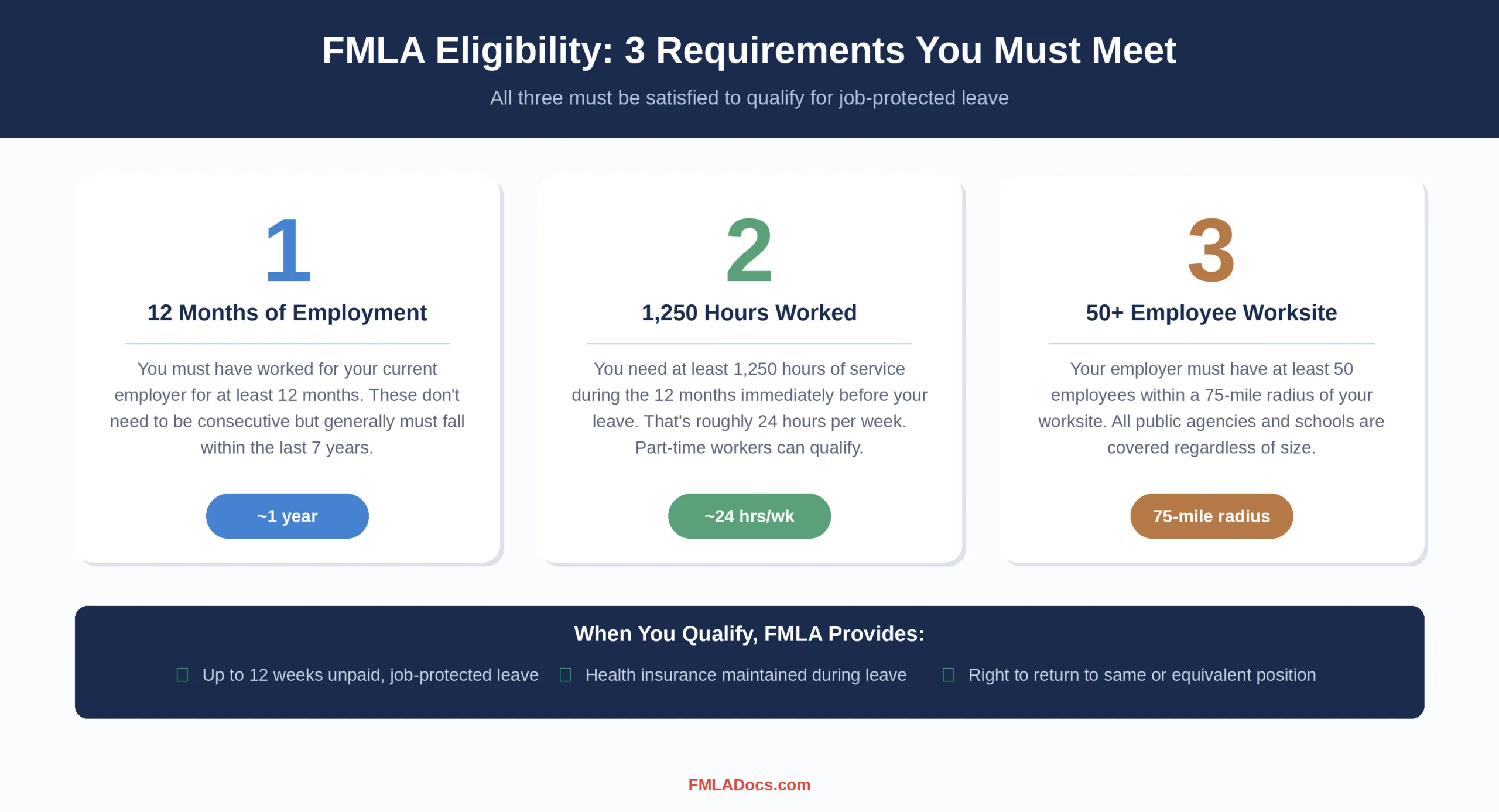
If you meet all three requirements AND have a qualifying reason, you’re eligible for up to 12 weeks of job-protected leave. Some states also have their own family and medical leave programs with broader eligibility. California, New York, New Jersey, Washington, and several others offer paid family leave programs that can run alongside or supplement federal FMLA. If your state has its own program, you may also benefit from state family leave certification.
How to Get Your FMLA Certification
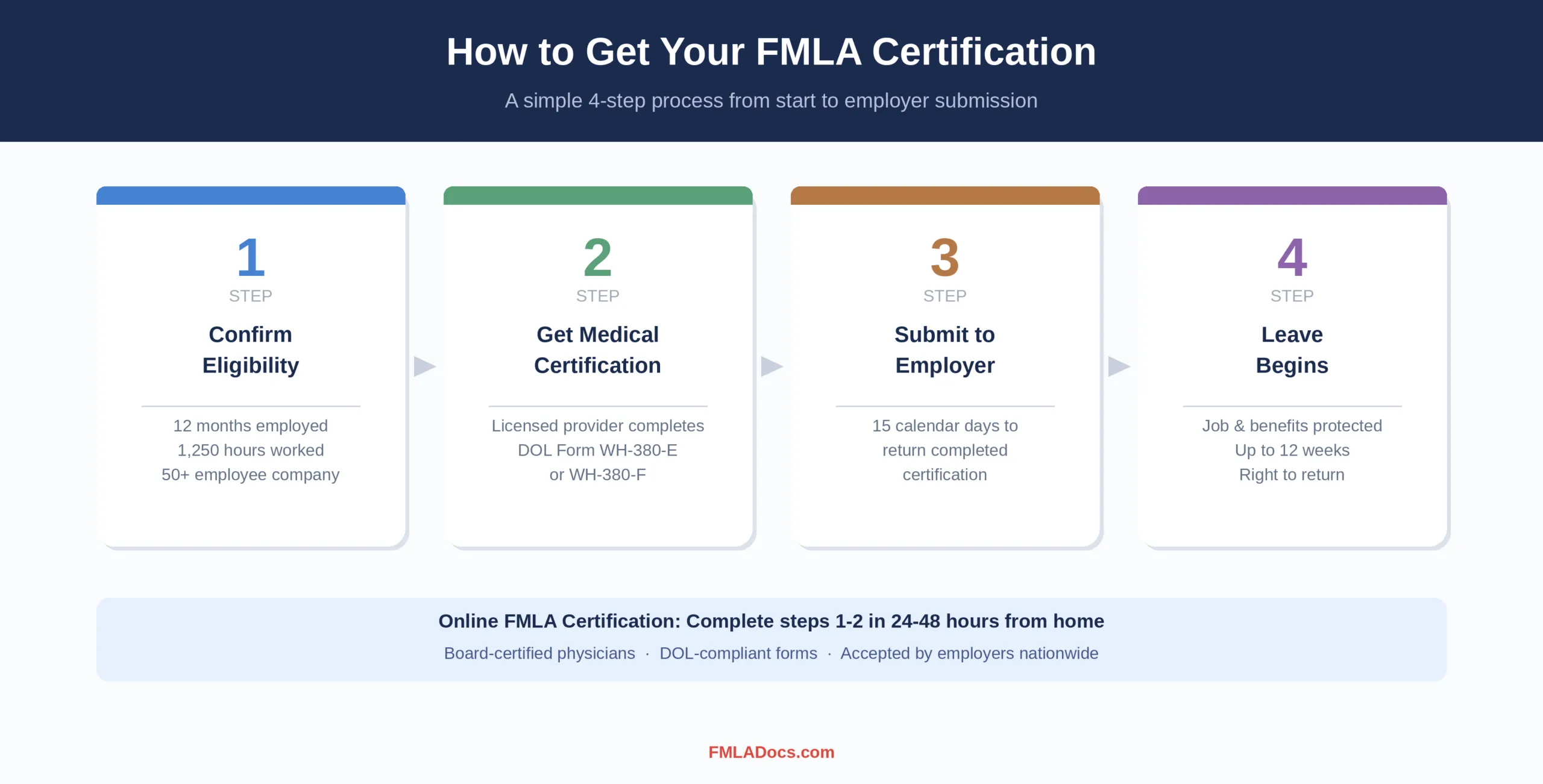
Once you know you qualify, the next step is getting your medical certification. This is the document your employer needs to approve your FMLA leave, and it must come from a licensed healthcare provider. Here’s how the process works:
Step 1: Confirm your eligibility.
Verify you meet the three requirements above. If you’re unsure, your employer is required to tell you whether you’re eligible within five business days of your leave request.
Step 2: Obtain medical certification.
A healthcare provider needs to complete DOL Form WH-380-E (for your own condition) or WH-380-F (for a family member’s condition). This form documents the serious health condition, expected duration, and whether you need continuous or intermittent leave.
Step 3: Submit certification to your employer.
You generally have 15 calendar days to return the completed certification. Your employer reviews it and designates your leave as FMLA-protected (FMLA approval timeline guide).
Step 4: Your leave begins.
Your job and health benefits are protected for up to 12 weeks. Your employer cannot retaliate against you for taking FMLA leave.
Skip the wait. Get certified in 24–48 hours. Start My Certification
If you’re weighing paid vs. unpaid options, it’s worth understanding FMLA vs. short-term disability before you certify. The traditional route means scheduling an appointment with your doctor, waiting days or weeks for availability, paying a visit fee (often $150 to $300 or more), and then waiting again for how to get FMLA paperwork. For many people, especially those dealing with mental health conditions or chronic illness, that process feels like its own obstacle.
| Factor | Online FMLA Certification | Traditional Doctor Visit |
|---|---|---|
| Time to complete | 24-48 hours | 1-3 weeks |
| Cost | Competitive, transparent pricing | $100-$300+ (plus follow-up fees) |
| Convenience | From home, on your schedule | Limited to office hours |
| Provider type | Board-certified physicians | Varies by provider |
| Employer acceptance | Accepted in all 50 states | Accepted in all 50 states |
| Follow-up support | Included if employer requests additional info | Typically requires another appointment |
Online FMLA certification offers a faster, more accessible alternative. Board-certified physicians review your condition through a secure video consultation and complete your certification forms, typically within 24 to 48 hours. The certification is accepted by employers nationwide, and if your employer requests additional documentation or has questions, follow-up support is included.
Summing Up
Understanding what qualifies for FMLA leave is the first step toward protecting both your health and your job. Whether you’re managing a mental health condition, living with a chronic illness, preparing for surgery, navigating pregnancy, or caring for a family member, federal law provides up to 12 weeks of job-protected leave. Your condition is likely more qualifying than you think, and you don’t have to go through the certification process alone. Board-certified physicians at FMLADocs can complete your FMLA certification in as little as 24 to 48 hours, accepted by employers in all 50 states.
Frequently Asked Questions
What is considered a serious health condition for FMLA?
A serious health condition under FMLA is any illness, injury, impairment, or physical or mental condition that requires inpatient care (an overnight hospital stay) or continuing treatment by a healthcare provider. This includes conditions causing three or more days of incapacity with ongoing treatment, chronic conditions needing periodic visits, pregnancy, and permanent conditions under medical supervision. Common examples include depression, diabetes, cancer, migraines, and recovery from surgery.
Can I get FMLA for anxiety and depression?
Yes. Anxiety and depression can qualify for FMLA leave when they meet the definition of a serious health condition. If your anxiety or depression requires continuing treatment from a healthcare provider (such as therapy sessions, medication management, or both) and affects your ability to work, you are likely eligible. The Department of Labor specifically recognizes mental health conditions as qualifying reasons for FMLA leave.
How many hours of service do you need to qualify for FMLA?
You need at least 1,250 hours of service with your employer during the 12 months immediately before your leave begins. That averages to about 24 hours per week. You must also have worked for the employer for at least 12 months total, and your employer must have 50 or more employees within 75 miles of your worksite.
Can you be denied FMLA leave?
Yes, FMLA leave can be denied if you don't meet the eligibility requirements (12 months of employment, 1,250 hours, employer size) or if your condition does not qualify as a serious health condition. Your employer can also deny leave if you fail to provide adequate medical certification within the required timeframe. However, if you are eligible and have a qualifying condition with proper certification, your employer cannot legally deny your leave.
Does FMLA cover family members?
FMLA allows you to take leave to care for a spouse, child, or parent with a serious health condition. The definition of "child" includes biological, adopted, foster, and stepchildren, as well as children for whom you have a parental relationship. However, FMLA does not cover leave to care for in-laws, siblings, grandparents, or other extended family members unless they stood in loco parentis (a parental role) when you were a child.
Can a virtual doctor fill out FMLA paperwork?
Yes, when the clinician is a licensed healthcare provider and has evaluated you. FMLADocs uses a telehealth evaluation. The provider completes the medical certification only if a serious health condition is documented. Employers accept a complete certification from a licensed provider; they do not require an in-office visit. Approval of leave is the employer's decision.
Can FMLA be denied with a doctor's note?
Yes. A signed certification does not force the employer to approve leave. The employer can ask for a complete form, a second opinion, or deny leave if you are not an eligible employee. FMLADocs provides the medical certification. HR still applies the 12-month / 1,250-hour rules and job-protection rules.
How is FMLA certified?
Your employer gives you the WH-380-E or WH-380-F form. A licensed provider completes the medical facts, dates, and duty limitations. FMLADocs collects your history online and the provider completes the form when a serious health condition is present. Return the form to HR within the deadline they give you.
How long does FMLA certification last?
The certification covers the period the provider documents — a continuous block or intermittent episodes. Employers may request recertification later, often every 30 days for ongoing conditions or when leave use changes. If your condition changes, start a new evaluation so the form matches current limitations.
Where can I get my FMLA paperwork filled out online?
FMLADocs is an online evaluation for FMLA medical certification. You complete intake, a licensed provider reviews whether a serious health condition is documented, and — if so — completes the form. This is not legal advice and not a guarantee that HR will approve leave. Use the certification with your employer's FMLA process.
Why are doctors so hesitant to fill out FMLA paperwork?
Many clinics treat FMLA forms as unpaid paperwork and will not complete them without a visit. Telehealth providers who handle certification as part of the evaluation can complete the form when the medical criteria are met. FMLADocs does that review. The provider will not sign if the record does not support a serious health condition.
Are online FMLA doctors legit?
They can be, when the provider is licensed. The process starts with an online medical intake. A licensed healthcare provider evaluates your condition and, if clinically appropriate, completes the DOL certification form. Employees with a serious health condition, or who care for a qualifying family member, may qualify. Approval is not guaranteed. Start your certification on this page.
Can I be fired if my FMLA is denied?
Possibly. FMLA job protection applies only to eligible employees with a qualifying reason, so a valid denial may leave attendance rules in force. Employers cannot unlawfully interfere with FMLA rights, however. A licensed provider evaluates whether your condition qualifies, and approval is not guaranteed. Start your certification on this page to document your need.
Can I be fired while on FMLA leave?
Not for taking FMLA leave. Employers cannot retaliate against employees for using protected leave, but eligible employees can still be let go for reasons unrelated to leave, such as a layoff that would have happened anyway. To begin, a licensed provider evaluates your condition, and approval is not guaranteed. Start your certification on this page.
Can I call in sick if I'm not sick?
It is not advisable. Calling in sick without a real reason may violate company policy and put your job at risk, and FMLA does not cover it. FMLA leave is for eligible employees with a serious health condition, which a licensed provider evaluates. Approval is not guaranteed. Start your certification on this page if you need protected time off.
Can I get a doctor's note without actually going to the doctor?
You may not need an in-person visit. After an online medical intake, a licensed provider evaluates your condition and completes documentation only if it is clinically appropriate. Employees with a serious health condition, or who care for a qualifying family member, may qualify. Certification is not guaranteed. Start your certification on this page.
Can I take FMLA leave due to work stress?
Possibly. Stress itself is not automatically covered, but a stress-related condition such as anxiety or depression may qualify if it meets the DOL's serious health condition standard. Any licensed healthcare provider can evaluate and certify it. Employees must also meet FMLA eligibility rules. Approval is not guaranteed. Start your certification on this page.
What medical conditions qualify for FMLA leave?
A serious health condition may qualify, meaning an illness, injury, or condition involving inpatient care or continuing treatment by a health care provider. Examples may include surgery recovery, chronic illness, pregnancy, and mental health conditions. A licensed provider evaluates whether your condition meets the DOL standard. Approval is not guaranteed. Start your certification on this page.
Who is eligible for FMLA leave?
Eligible employees have worked for a covered employer for at least 12 months, logged at least 1,250 hours in the 12 months before leave begins, and work where the employer has 50 or more employees within 75 miles. A licensed provider evaluates the medical need. Approval is not guaranteed. Start your certification on this page.
Meet the author
Alisha Shabbir
Alisha is a health content specialist with 7 years of experience writing about employee benefits, medical leave, and healthcare access. With a background in healthcare communications, she breaks down complex regulations and medical topics into practical, actionable guidelines. From workplace wellness to preventive health, she helps readers navigate the healthcare system with confidence. When she's not working, she enjoys long walks, baking, and spending time with her pets.
Get Your FMLA Certification Online in Minutes