
Form WH-381: What Your Employer's FMLA Eligibility Notice Must Include
 by Nida Hammad
 Last updated:
Your employer has five business days to answer one question: are you eligible for FMLA leave, yes or no. The answer arrives on FMLA Form WH-381, the Notice of Eligibility and Rights & Responsibilities. This is the FMLA eligibility notice that starts the entire paperwork process, and it is worth reading line by line before you sign anything or send anything back.
FMLA Form WH-381 is not a form you fill out. Your employer completes it and hands it to you. It has three parts: a statement of your eligibility, a request for any extra documents needed, and a full list of your rights and responsibilities under federal law.
Ready for the next step? Begin your FMLA documentation process online through FMLA Docs and receive guidance from a licensed provider.
What FMLA Form WH-381 Actually Looks Like
FMLA Form WH-381 runs four pages, and almost none of it is filler. At the top, your employer lists the date they learned about your leave request and the reason you gave, matched against one of five categories: your own serious health condition, a family member’s serious health condition, bonding with a new child, a qualifying military exigency, or military caregiver leave.
Below that is Section I, the eligibility answer. Then Section II, which lists anything else your employer still needs from you. Then Section III, several pages of rights and responsibilities language written in plain terms, broken into labeled parts.
Every box your employer checks and every date your employer fills in becomes part of your official leave record. Employers are required to keep a copy of this notice on file for three years, so treat your own copy the same way. Save it, whether it lands in your inbox or your mailbox, and keep it with any other paperwork tied to your leave.
FMLA Form WH-381: Understanding the 5-Day Employer Deadline
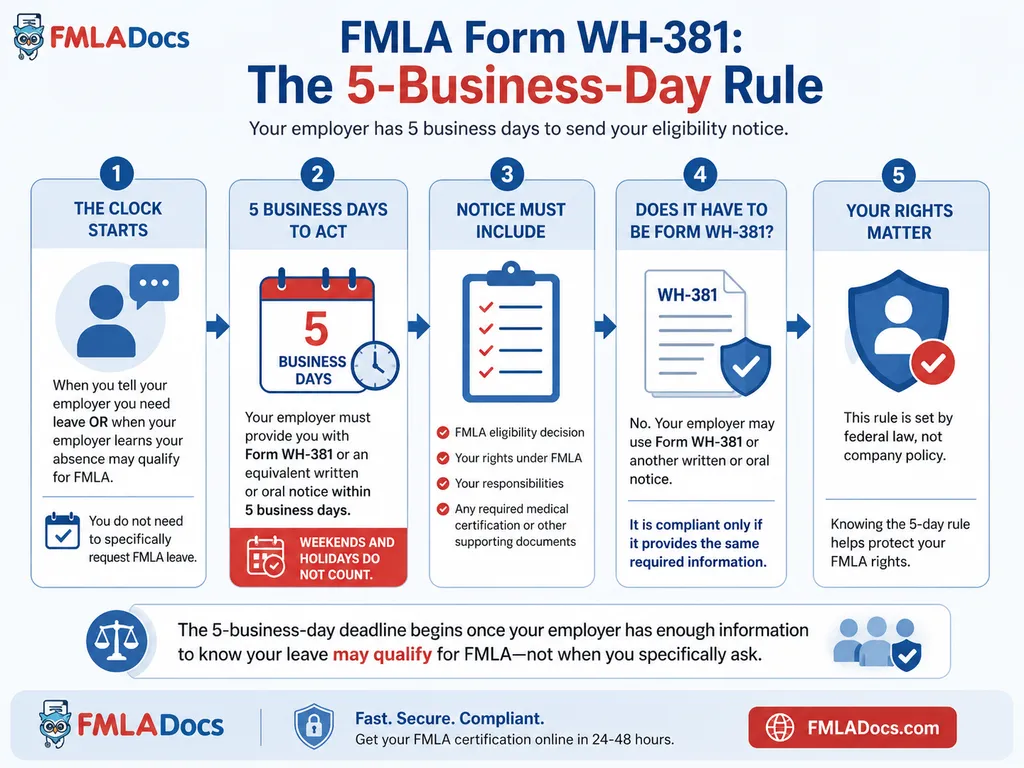
The clock starts the moment you tell your employer you need leave, or the moment your employer learns your absence might qualify. From that point, your employer has five business days to send you FMLA Form WH-381 or an equivalent written or oral notice. Weekends and holidays do not count toward those five days.
This deadline comes from federal regulation, not company policy. Under 29 C.F.R. § 825.300, the eligibility notice must be provided within five business days, absent extenuating circumstances.
According to the U.S. Department of Labor (DOL), the five-business-day deadline starts once your employer has enough information to determine that your leave may be FMLA-qualifying. You do not need to specifically request FMLA leave; any notice of a potentially qualifying reason can trigger the requirement to issue Form WH-381.
In practice, most employers use Form WH-381 because it contains every legally required eligibility and rights notification in a single document. If your employer sends a notice that looks different from the standard WH-381, it is not automatically invalid. The key question is whether it provides the same required information about your eligibility, rights, responsibilities, and any additional documentation needed.
FMLA Form WH-381 Section I: Eligible vs. Not Eligible
Section I is the part most employees read first, because it answers the only question that matters right away. To be eligible, you generally need to meet three conditions. You must have worked for your employer for at least 12 months. You must have logged at least 1,250 hours of service in the 12 months before your leave starts. And you must work at a location with 50 or more employees within 75 miles.
Under 29 C.F.R. § 825.110, FMLA eligibility depends on meeting specific employment requirements, including how the 12 months of employment and 1,250 hours worked are calculated. The regulation also provides special protections for employees returning from certain types of military service by crediting qualifying service toward these eligibility requirements.
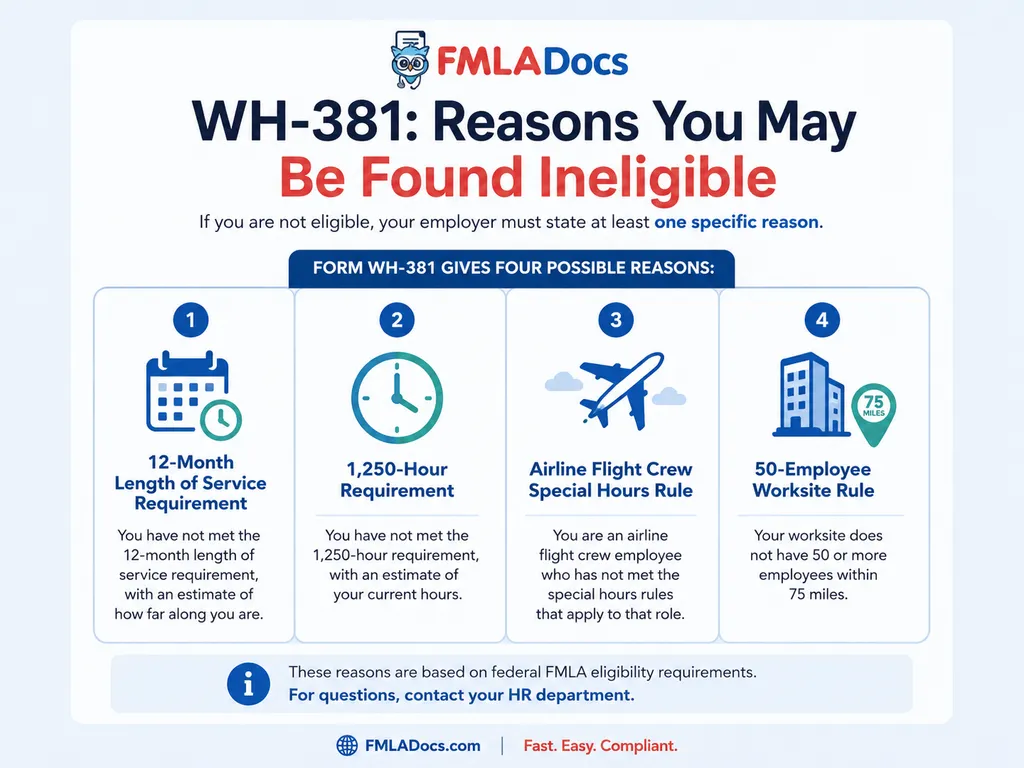
If you are not eligible, your employer must state at least one specific reason. The form gives four possible boxes:
-
You have not met the 12-month length of service requirement, with an estimate of how far along you are
-
You have not met the 1,250-hour requirement, with an estimate of your current hours
-
You are an airline flight crew employee who has not met the special hours rules that apply to that role
-
Your worksite does not have 50 or more employees within 75 miles
If Form WH-381 states that you are not eligible for FMLA leave, your employer must identify the specific eligibility requirement you did not meet and, when applicable, explain how close you are to meeting it. If the notice does not include this information, ask for clarification in writing. Because FMLA eligibility is determined based on your leave start date, not the date you request leave, even a small difference in your length of employment or hours worked can affect the decision. If you need help understanding the 12-month employment requirement, 1,250-hour rule or other eligibility standards, that guide walks through the details.
FMLA Form WH-381 Section III: Your Rights and Responsibilities
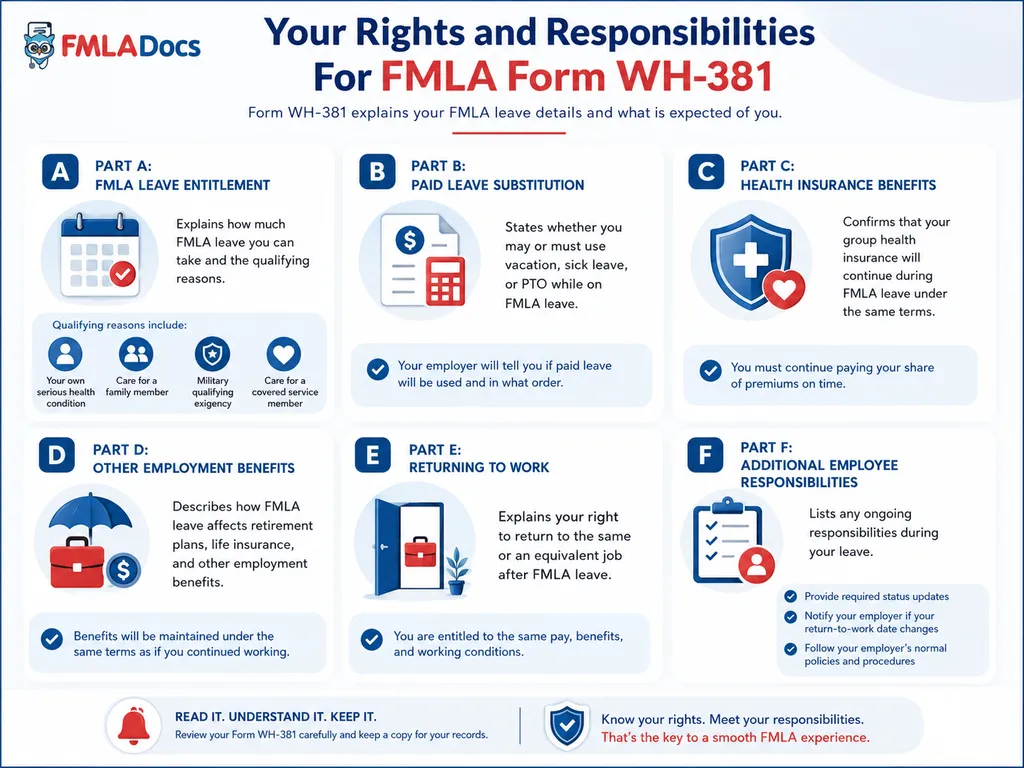
If you are eligible for FMLA leave, Section III of Form WH-381 outlines your rights, responsibilities, and the steps you must take to maintain FMLA protection. This section serves as the official communication between you and your employer, explaining what benefits and job protections you may receive, what documentation may be required, and how leave will be tracked.
-
Part A: FMLA Leave Entitlement Explains how much FMLA leave you can take and the qualifying reasons. It also identifies your employer’s 12-month leave calculation method, which determines your available leave balance.
-
Part B: Paid Leave Substitution States whether you may or must use vacation, sick leave, or PTO while on FMLA leave. This section explains when paid leave will run at the same time as unpaid FMLA leave.
-
Part C: Health Insurance Benefits Confirms that your group health insurance will continue during FMLA leave under the same terms. It also explains your premium payment responsibilities and any applicable payment deadlines.
-
Part D: Other Employment Benefits Describes how FMLA leave affects retirement plans, life insurance, and other employment benefits. It also explains how these benefits are restored when you return to work.
-
Part E: Returning to Work Explains your right to return to the same or an equivalent job after FMLA leave. It also outlines any fitness-for-duty certification requirements before you resume work.
-
Part F: Additional Employee Responsibilities Lists any ongoing responsibilities during your leave, such as providing status updates or notifying your employer if your return-to-work date changes. Following these requirements helps keep your FMLA protections in place.
Two details in Section III of Form WH-381 deserve close attention. If you are classified as a key employee, generally one of the highest-paid 10% at your worksite, you still have the right to take FMLA leave. However, your employer may be able to deny job restoration if returning you to work would cause substantial economic harm. The form should clearly state whether this exception applies to you. You should also review your employer’s 12-month leave calculation method listed in Part A, because it determines how much FMLA leave you have available. For example, a rolling 12-month method calculates leave differently than a calendar-year method, which can affect your remaining leave balance throughout the year.
How FMLA Form WH-381 Handles the Medical Certification Request
Section II of Form WH-381 tells you whether your employer needs additional documentation before your leave can be designated as FMLA-protected leave. In most cases, this means submitting a medical certification, but your employer may also request other supporting documents depending on the reason for your leave.
| Section II Requirement | What It Means |
|---|---|
| Medical certification required | Your employer must specify whether certification is needed for your own serious health condition, a family member’s condition, a qualifying military exigency, or military caregiver leave. |
| Certification form | The notice should indicate whether the required certification form is attached or explain how you can obtain it. |
| 15-day deadline | You must generally return the requested medical certification within 15 calendar days of your employer’s request, unless it is not practicable despite your diligent efforts. |
| Other supporting documents | If you are requesting leave to care for a family member, your employer may ask for proof of the family relationship, such as a birth certificate or adoption records. |
| Incomplete or insufficient certification | If your certification is missing information or contains unclear answers, your employer must explain the deficiency in writing and give you at least seven calendar days to correct it before denying FMLA leave. |
To avoid delays in your FMLA leave request, review Section II of Form WH-381 carefully and submit all requested documentation by the stated deadline. Make sure your medical certification is complete, and if your employer identifies a problem with your certification, they must explain what needs to be corrected and generally provide at least seven calendar days to submit the missing information.
Keep copies of every form and supporting document you provide, as they may be needed if questions arise later in the FMLA process.
Consequences of FMLA Form WH-381 Being Late or Skipped
Missing deadlines cuts both ways under the FMLA, and FMLA Form WH-381 sits at the center of both directions.
-
Employers must provide Form WH-381 within five business days of learning that your leave may qualify for FMLA, unless a valid extenuating circumstance prevents timely notice.
-
If your employer misses this deadline and the delay causes you harm, such as lost pay or loss of FMLA protections, the employer may be responsible for lost wages, benefits, or other legal remedies.
-
Employees must generally return a requested medical certification within 15 calendar days of the employer’s request, unless the delay is beyond their control despite diligent efforts.
-
Missing the certification deadline may allow your employer to deny FMLA protection until the required documentation is received.
-
Failing to submit the requested certification altogether can result in your leave not being designated as FMLA leave.
-
Review Form WH-381 as soon as you receive it, respond to every request before the deadline, and keep copies of all documents to help protect your FMLA rights.
What to Do If Your FMLA Form WH-381 Is Late or Incomplete
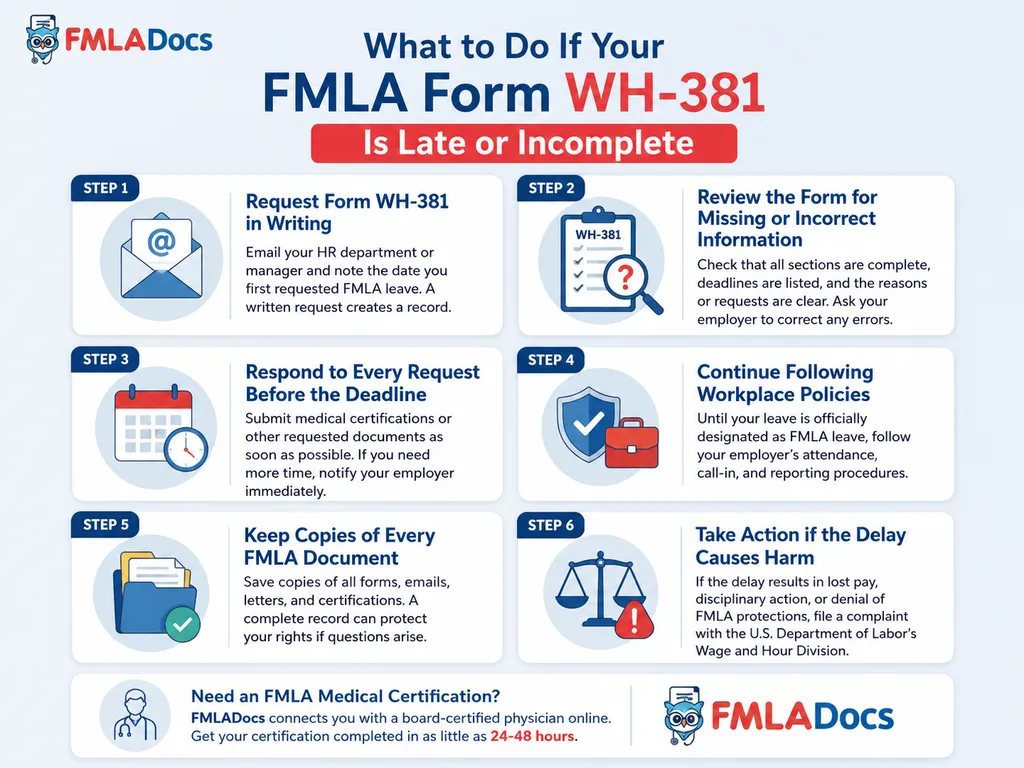
Step 1: Request Form WH-381 in Writing
If you do not receive Form WH-381 within five business days after notifying your employer of a potentially FMLA-qualifying reason, send a polite email to your HR department or manager requesting your eligibility notice. Include the date you first requested leave and ask when you can expect the form. Keeping this request in writing creates a record if the delay later affects your FMLA rights.
Step 2: Review the Form for Missing or Incorrect Information
Read every section of Form WH-381 before responding. Make sure the eligibility decision is clearly explained, all deadlines are listed, and any requested documentation is identified. If the form is incomplete or contains incorrect information, ask your employer to correct it in writing before submitting additional paperwork.
Step 3: Respond to Every Request Before the Deadline
If your employer requests a medical certification, proof of a family relationship, or other supporting documents, submit them as soon as possible. Waiting until the last day increases the risk of delays, especially if corrections are needed. If you cannot meet the deadline despite your diligent efforts, notify your employer immediately and explain the reason.
Step 4: Continue Following Workplace Policies
Until your leave is officially designated as FMLA-protected leave, continue following your employer’s attendance, call-in, and reporting procedures. Missing work without following these policies could result in disciplinary action, even if your leave is later designated as FMLA-protected.
Step 5: Keep Copies of Every FMLA Document
Create a file containing Form WH-381, medical certifications, emails, letters, fax confirmations, and any other documents related to your leave request. These records can be valuable if there is a disagreement about deadlines, eligibility, or whether paperwork was submitted on time.
Step 6: Take Action if the Delay Causes Harm
If your employer continues to delay your eligibility notice or the delay results in lost pay, disciplinary action, or denial of FMLA protections, you may file a complaint with the U.S. Department of Labor’s Wage and Hour Division. Detailed records of your communications and paperwork can help support your claim.
Need a medical certification? You can start your FMLA medical certification online with a board-certified physician through FMLADocs, with forms typically completed within 24 to 48 hours, if appropriate.
Frequently Asked Questions
Is FMLA Form WH-381 required?
Using the specific WH-381 template is optional. What is required is the information it contains: your eligibility status, at least one reason if you are not eligible, and your rights and responsibilities.
Can leave start before FMLA Form WH-381 arrives?
Yes. Your leave can begin the moment you request it or the moment your employer learns it may qualify, even before the notice is delivered. The FMLA eligibility notice confirms your status; it does not create your right to leave in the first place.
What if my employer says I am not eligible on FMLA Form WH-381?
Check the stated reason first. If it is based on hours or tenure, ask for the estimate your employer used, since miscounted hours are a common error. If you believe the reason is wrong, raise it in writing and ask for a recalculation before assuming the door is closed.
Does FMLA Form WH-381 need to be signed by me?
No. This is a notice from your employer to you, not an agreement you sign. You do not need to return a signed copy for it to take effect.
How long does my employer have to send FMLA Form WH-381?
Five business days from the date you request leave, or from the date your employer learns your absence might qualify, whichever comes first. Weekends and company holidays do not count against that window.
What happens if my employer never sends FMLA Form WH-381 at all?
Your rights under the FMLA still apply even without the paperwork. A missing notice is a compliance failure on your employer's part, and it can support a claim if the missing notice caused you to lose pay, benefits, or job protection.
Can FMLA Form WH-381 be sent by email?
Yes. The notice can be delivered electronically as long as it reaches you within the five-business-day window and includes all the required information.
What is the difference between FMLA Form WH-381 and FMLA Form WH-382?
FMLA Form WH-381 tells you if you are eligible and outlines your rights before your leave is confirmed. FMLA Form WH-382 comes later and formally designates whether your absence counts as FMLA leave, once any requested certification has been reviewed.
Meet the author
Nida Hammad
I am a professional writer with over five years of experience creating clear, engaging, and well-researched content. I specialize in healthcare topics, helping readers understand complex information in simple wording. Currently, I write for FMLA DOC, where I focus on producing accurate and trusted guides for people seeking support with FMLA and medical needs.
Get Your FMLA Certification Online in Minutes