

FMLA Renewal: How to Renew Your Leave and Medical Certification
 by Anam Moin
 Last updated:
You may depend on FMLA leave to manage treatment, recover from a health condition, or care for a family member, but what happens when your approval period approaches its end?
An FMLA renewal does not always involve one simple renewal form. Depending on your circumstances, you may need to provide a recertification, submit a new medical certification, request an extension, or wait for your employer’s 12-month leave period to reset.
Getting this distinction right matters. Missing an employer’s paperwork deadline could interrupt FMLA protection for future absences, even when your underlying medical need continues.
This guide explains how FMLA renewal works, when an employer may request updated medical information, what deadlines you need to follow, and how to prepare for another FMLA leave year. It addresses federal FMLA requirements, but state leave laws, collective bargaining agreements, and employer policies may provide additional rights.
Important: FMLA eligibility and approval depend on federal requirements, your circumstances, the information supplied to your employer, and any applicable state law. No service or healthcare provider can guarantee that an employer will approve or renew FMLA leave.
What Does FMLA Renewal Mean?
FMLA renewal commonly refers to continuing or restarting leave under the Family and Medical Leave Act. However, federal regulations do not use “renewal” as a single process that applies to every employee.
The phrase usually describes one of four situations:
-
Recertifying an ongoing condition: Your employer asks for updated medical information supporting your continued need for leave.
-
Starting a new FMLA leave year: Your employer’s designated 12-month period resets, and you request leave during the new period.
-
Submitting a new medical certification: Your employer requires a fresh certification for a condition that continues into a new FMLA leave year.
-
Extending an existing leave period: Your condition or treatment lasts longer than the period described in your original certification.
You should ask your human resources department which process applies to you. The correct next step depends on your employer’s leave-year calculation, the duration stated in your certification, and whether your medical circumstances have changed.
Does FMLA Automatically Renew?
No. FMLA leave does not automatically renew in the same way as a membership or insurance policy.
A new 12-month FMLA period may give you access to a new leave entitlement, but you must still satisfy the applicable eligibility requirements when the new leave begins. You must also provide any properly requested certification or other supporting information.
Your employer may require you to follow its usual call-in and leave-request procedures. A previous approval does not necessarily protect every future absence connected to the same condition.
How Does FMLA Renewal Work?
FMLA renewal starts with identifying what has reached its end. Your medical certification, approved leave schedule, and available FMLA hours can each have different timelines.
For example, your certification may describe six months of intermittent treatment while your employer calculates FMLA entitlement using a rolling 12-month period. Your need for leave may continue even though you have not yet regained all the FMLA hours you previously used.
A practical renewal review should answer these questions:
-
When does your employer’s FMLA year begin and end? This determines when leave becomes available under the employer’s calculation method.
-
How much FMLA leave have you already used? Your available balance depends on the leave-year method and your prior absences.
-
How long does your current medical certification support leave? Check the estimated duration, treatment schedule, and expected frequency of flare-ups.
-
Has your employer requested recertification or a new certification? Follow the written request and note the response deadline.
-
Do you still meet the employee eligibility rules? A new leave year does not override eligibility requirements.
-
Has your condition or caregiving need changed? Your healthcare provider should describe current medical facts rather than repeat outdated estimates.
The U.S. Department of Labor’s FMLA overview explains the federal law’s basic employee protections and employer responsibilities.
When Does Your 12-Month FMLA Period Reset?
A covered employer must select an approved method for calculating the 12-month FMLA period. The method affects when you regain access to leave, so you should not assume your 12 weeks return every January.
The Four FMLA Leave-Year Methods
Employers generally may use one of the following methods:
-
Calendar year: The FMLA year runs from January 1 through December 31.
-
Fixed 12-month period: The employer uses a consistent year, such as its fiscal year, an employee anniversary year, or another fixed period.
-
Forward-looking period: The 12-month period begins on the first day you take FMLA leave and continues for the following 12 months.
-
Rolling backward period: Each time you request FMLA leave, the employer looks back 12 months and subtracts the amount of FMLA leave you used during that window.
The rolling method can feel confusing because leave becomes available gradually as older absences move outside the look-back period. You may not regain a complete 12-week balance on one specific date.
How Can You Find Your Employer’s Method?
Review your employee handbook, FMLA policy, eligibility notice, or designation notice. If the method remains unclear, ask HR to identify it in writing and provide your current leave balance.
You might ask:
“Which 12-month method does the company use to calculate FMLA leave, what is my current available balance, and when will previously used hours become available again?”
Getting a written response can help you plan treatment and avoid relying on an incorrect reset date.
Do You Receive Another 12 Weeks Every Year?
Eligible employees generally may use up to 12 workweeks of FMLA leave during the applicable 12-month period for qualifying reasons. Military caregiver leave may provide up to 26 workweeks during a single 12-month period under separate rules.
However, the start of another leave year does not erase the other requirements. You must work for a covered employer, satisfy the employment and hours-of-service tests, work at a qualifying location, and need leave for an FMLA-covered reason.
Eligibility Must Still Exist When New Leave Begins
For most private-sector employees, eligibility generally requires that you:
-
Have worked for the employer for at least 12 months;
-
Have completed at least 1,250 hours of service during the 12 months immediately before leave begins; and
-
Work at a location where the employer has at least 50 employees within 75 miles.
Different coverage rules apply to public agencies and eligible school employees. Certain airline flight crew employees also follow specialized hours-of-service standards.
Your 12 months of employment do not always need to run consecutively. Nevertheless, long breaks in service can affect which earlier employment periods count.
FMLA Renewal Versus Medical Recertification
FMLA renewal and recertification often occur near each other, but they do not mean the same thing.
Renewal commonly describes your broader effort to continue FMLA leave or begin using leave in another FMLA year. Recertification involves updated medical information about a previously certified serious health condition.
A recertification may confirm:
-
Whether the serious health condition continues;
-
Whether you still need continuous or intermittent leave;
-
How often episodes or appointments may occur;
-
How long an episode may incapacitate you;
-
Whether you need to care for a covered family member; and
-
Whether the expected duration has changed.
Your employer, not your healthcare provider, decides whether an absence qualifies for FMLA protection. Your provider supplies medical information within the form’s scope rather than making the employer’s legal determination.
How Often Can an Employer Request FMLA Recertification?
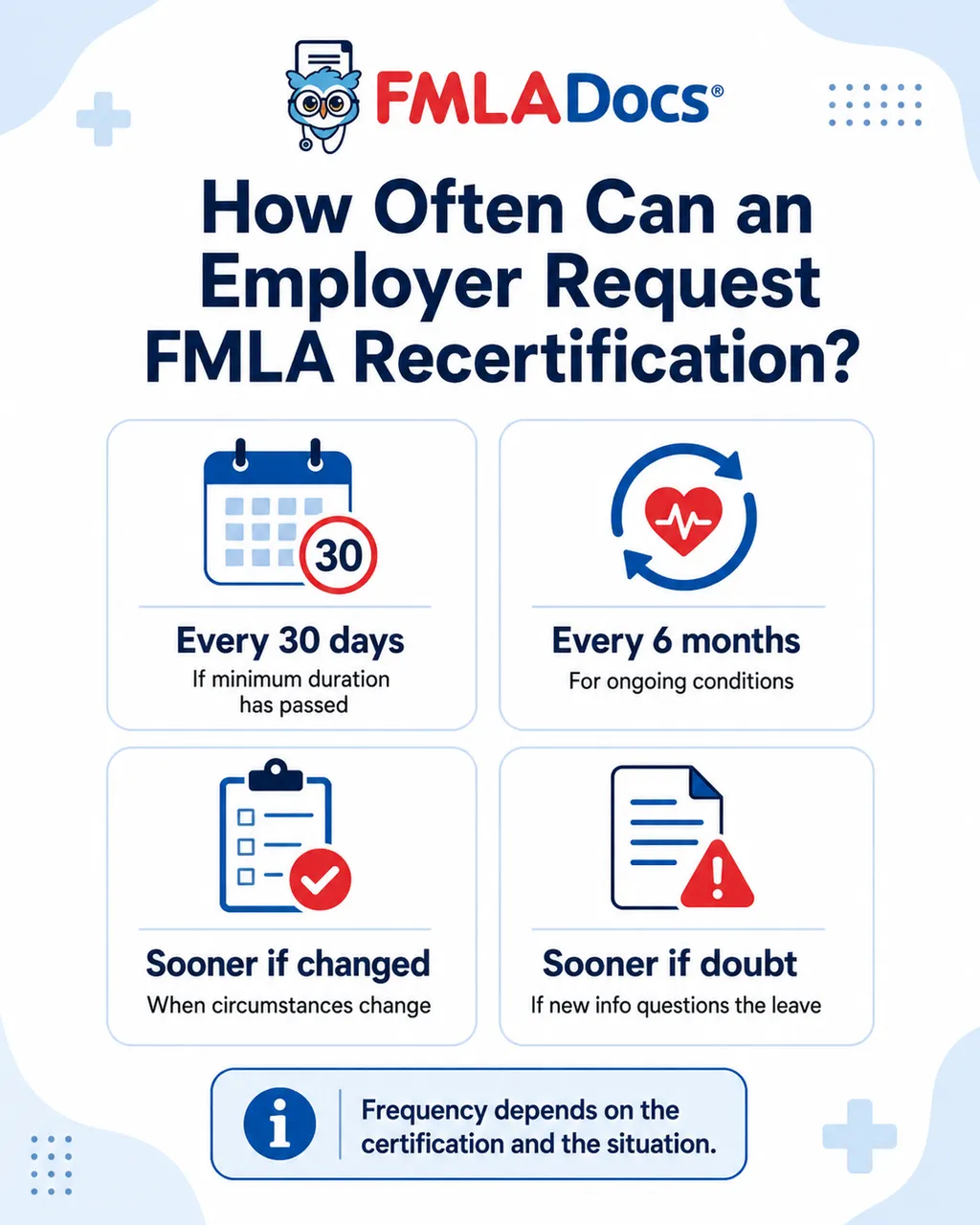
An employer generally may request recertification no more often than every 30 days and only in connection with an absence. The 30-day rule does not mean an employer automatically receives updated paperwork every month.
The timing depends on the minimum duration stated in the prior certification. It also depends on whether an exception allows the employer to request information sooner.
The General 30-Day Recertification Rule
If your certification supports an ongoing condition without identifying a minimum duration longer than 30 days, your employer generally may request recertification every 30 days in connection with an absence.
For example, suppose your certification supports intermittent leave for unpredictable episodes over the next several months. If you have an absence after 30 days have passed, your employer may have grounds to request recertification.
The employer generally cannot demand recertification every 30 days when no related absence occurs.
What If the Certification Covers More Than 30 Days?
When a certification identifies a minimum duration longer than 30 days, the employer generally must wait until that stated period ends.
Suppose your provider certifies that you cannot work continuously for 40 days. Your employer generally must wait until the 40-day period ends before requesting recertification unless a regulatory exception applies.
For long-term or indefinite conditions, an employer generally may request recertification every six months in connection with an absence. This six-month rule can apply even when the provider expects the condition to continue longer.
When May an Employer Request Recertification Early?
An employer may request recertification in fewer than 30 days when:
-
You request an extension: You need leave beyond the period supported by your existing certification.
-
Your circumstances change significantly: The duration or frequency of absences differs substantially from the prior estimate.
-
The employer receives information that creates doubt: Credible information casts doubt on your stated reason for an absence or the certification’s continuing validity.
A significant change can involve longer episodes, much more frequent absences, or a shift from intermittent leave to continuous incapacity. Minor differences do not necessarily establish a significant change, and the facts matter.
Can Your Employer Require a New Certification Each FMLA Year?
Yes. When a serious health condition lasts beyond one FMLA leave year, an employer may request a new medical certification when you request leave for that condition in a new leave year.
A new annual certification differs from a recertification. The procedures available for an initial certification—including second and third medical opinions at the employer’s expense—may apply to the new certification.
By contrast, an employer may not require a second or third opinion for an ordinary recertification. Understanding whether HR wants a “new certification” or a “recertification” helps you identify the rules that govern the request.
Does a New Leave Year Guarantee Approval?
No. A new FMLA year does not guarantee approval, and a healthcare provider’s completed form does not make the final designation decision.
Your employer may review:
-
Whether the organization remains a covered employer;
-
Whether you satisfy employee eligibility requirements;
-
Whether you have available FMLA leave;
-
Whether the reason for leave qualifies;
-
Whether the certification is complete and sufficient; and
-
Whether you followed applicable notice requirements.
You should respond promptly if your employer identifies missing or unclear information. Silence can create avoidable delays.
How Long Do You Have to Submit FMLA Renewal Paperwork?
When an employer properly requests medical certification or recertification, it generally must allow you at least 15 calendar days to provide it. The deadline runs from the employer’s request, not from the date of your next medical appointment.
If you cannot meet the deadline despite diligent, good-faith efforts, tell HR before the due date. Explain the obstacle, describe what you have done to obtain the paperwork, and request a reasonable extension.
Examples of circumstances that may affect timing include:
-
Your provider cannot offer an appointment before the deadline;
-
The office has not processed the employer’s form;
-
Your provider needs updated testing before estimating restrictions;
-
You received the request late because of circumstances outside your control; or
-
A medical emergency prevented you from coordinating the paperwork.
A busy schedule alone may not excuse a late response. Keep records of appointment requests, portal messages, calls, faxes, and emails showing your efforts.
What Happens If You Miss the Recertification Deadline?
If you fail to provide a timely and sufficient recertification without a valid reason, your employer may deny continued FMLA protection until you submit the requested information.
When you eventually provide a sufficient recertification, the treatment of earlier absences may depend on the timing, circumstances, and applicable rules. If you never supply the recertification, the employer may treat the related absences as non-FMLA leave.
That outcome can expose the absences to the employer’s normal attendance rules. For that reason, you should not ignore the request simply because your employer approved the condition previously.
What Should You Do When Time Is Running Out?
Take these steps before the deadline:
-
Contact your healthcare provider and clearly state the due date.
-
Confirm that the office received every page of the requested form.
-
Ask whether the provider needs an appointment or updated records.
-
Notify HR promptly if completion within 15 days appears impracticable.
-
Document your good-faith attempts to obtain the certification.
-
Submit the form through a method that provides delivery confirmation.
-
Keep a complete copy of what you submit.
Do not alter medical answers after your provider completes the form. If you notice an error, ask the provider to correct and initial it.
Who Pays for FMLA Recertification?
The employee generally bears the cost of obtaining a recertification unless the employer chooses to pay. This may include appointment fees, form-completion charges, and other provider costs not covered by insurance.
An employer that requires a second or third opinion for a new or initial certification generally must pay for those opinions. It cannot require second or third opinions for a recertification.
Federal employees should review the rules that apply to their agency. The U.S. Office of Personnel Management’s FMLA fact sheet explains medical recertification principles for covered federal employees, including agency-paid periodic recertification requirements.
Which Forms May Apply to an FMLA Renewal?
The correct form depends on why you need leave. The Department of Labor publishes optional forms, but employers may use their own documents if those documents meet federal requirements and do not seek information beyond what the law permits.
Common forms include:
-
WH-380-E: Certification for your own serious health condition.
-
WH-380-F: Certification when you need leave to care for a covered family member.
-
WH-384: Certification for a qualifying military exigency.
-
WH-385: Certification for military caregiver leave involving a current servicemember.
-
WH-385-V: Certification for military caregiver leave involving a veteran.
-
WH-381: Notice explaining eligibility and rights and responsibilities.
-
WH-382: Notice stating whether the employer designated the leave as FMLA leave.
You can review the current Department of Labor FMLA forms. Confirm which form your employer wants before asking your provider to complete it.
Can Your Employer Use Its Own Form?
Yes. An employer may use its own certification form, but it generally cannot request more information than federal FMLA rules allow.
Read the entire form before sending it to your provider. Complete the employee sections accurately, sign any appropriate authorization, and make sure your provider understands your job’s essential functions when those functions affect the certification.
How Should Your Healthcare Provider Update the Certification?
Your provider should base the updated certification on current medical facts and reasonable medical estimates. The document does not need to disclose your complete medical history.
A useful certification may address:
-
The approximate date the condition began;
-
The probable duration of the condition;
-
Relevant medical facts establishing a serious health condition;
-
Whether you cannot perform one or more essential job functions;
-
Whether you need continuous, intermittent, or reduced-schedule leave;
-
The expected frequency and duration of episodes;
-
A treatment or appointment schedule; and
-
Why your presence helps when you care for a family member.
Your provider should not inflate the estimated frequency “just in case.” Overly broad estimates can create confusion, while estimates that understate your actual needs may result in repeated questions when your absences exceed the certification.
What If Your Symptoms Are Unpredictable?
A provider may use reasonable estimates when a chronic condition produces unpredictable flare-ups. The provider can explain the expected number of episodes over a period and the likely duration of each episode.
If the pattern later changes substantially, you may need updated documentation. Tell your provider how the condition actually affects attendance and job functions instead of asking for a predetermined amount of leave.
What Information Should You Bring to the Appointment?
Bring information that helps your provider make a medically supported estimate:
-
Your job description or list of essential duties;
-
Your employer’s certification form and deadline;
-
Dates and durations of recent episodes;
-
Your treatment and follow-up schedule;
-
Medication effects that affect your work;
-
Relevant hospitalization or testing records; and
-
Details about the care you provide to a family member.
Your employer generally does not need your complete medical chart. The certification should supply sufficient information for the FMLA request without disclosing unrelated medical details.
Can HR Contact Your Healthcare Provider?
Your direct supervisor may not contact your healthcare provider to authenticate or clarify a certification. An authorized HR professional, leave administrator, management official, or healthcare provider representing the employer may make permitted contact.
Authentication asks whether the provider completed or authorized the document. Clarification addresses handwriting or the meaning of an answer without asking for information beyond the certification requirements.
The employer may need your permission before obtaining clarification that falls under medical privacy rules. You must provide a complete and sufficient certification and cooperate with an appropriate clarification process.
Can Your Employer Request Your Medical Records?
You generally do not have to give your employer your full medical records as part of FMLA certification. The employer may request a complete and sufficient certification containing the information federal rules permit.
You may voluntarily authorize your provider to release additional information, but you should understand the scope of any authorization before signing it. Ask HR which specific answer needs clarification instead of automatically sending an entire chart.
Does Intermittent FMLA Need Annual Renewal?
Intermittent FMLA often requires updated paperwork because chronic or long-term conditions can continue across leave years. Your employer may request recertification at allowed intervals and a new certification when you seek leave in a new FMLA year.
Intermittent leave uses your entitlement in smaller increments rather than one continuous block. Your employer generally may count only the time you actually take for an FMLA-covered reason against your available entitlement.
Track the Frequency and Duration of Your Absences
Keep a personal log that records:
-
The date of each FMLA-related absence;
-
The number of hours or days used;
-
Whether the absence involved treatment or incapacity;
-
When you notified your employer;
-
Which call-in procedure you followed; and
-
Your employer’s reported remaining balance.
This log can help you spot payroll or leave-balance errors. It also gives your provider factual information if the pattern of episodes changes.
Can You Extend FMLA Before It Expires?
You can request additional FMLA leave before your currently certified period ends, but your employer may request recertification because you are seeking an extension.
An extension does not increase the federal 12-week entitlement. It supports continued use of any FMLA leave you still have available during the applicable 12-month period.
If you have exhausted your FMLA entitlement, ask whether another law or employer policy may apply. Potential options can include state family and medical leave, paid sick leave, employer-provided personal leave, short-term disability benefits, or a reasonable accommodation under disability law.
Start the Conversation Before Your Last Approved Day
Contact HR as soon as you reasonably know that you will need more leave. For foreseeable leave, federal rules generally require 30 days’ advance notice when practical.
You do not need to use a particular legal phrase, but you must give enough information to indicate that the leave may involve an FMLA-qualifying reason. Simply calling in “sick” without more information may not give the employer adequate notice.
Does Recertification Apply to Military Family Leave?
Certification procedures differ for military family leave. The general 15-day submission period can apply when an employer requests certification, but ordinary medical recertification rules do not govern every military leave category.
An employer generally cannot require recertification for qualifying exigency leave. It also cannot require second or third opinions on a qualifying exigency certification.
When a qualifying exigency involves a meeting with a third party, an employer may verify the meeting’s schedule and purpose. It may also confirm covered active-duty status through the appropriate Department of Defense unit.
How Can You Prepare for FMLA Renewal?
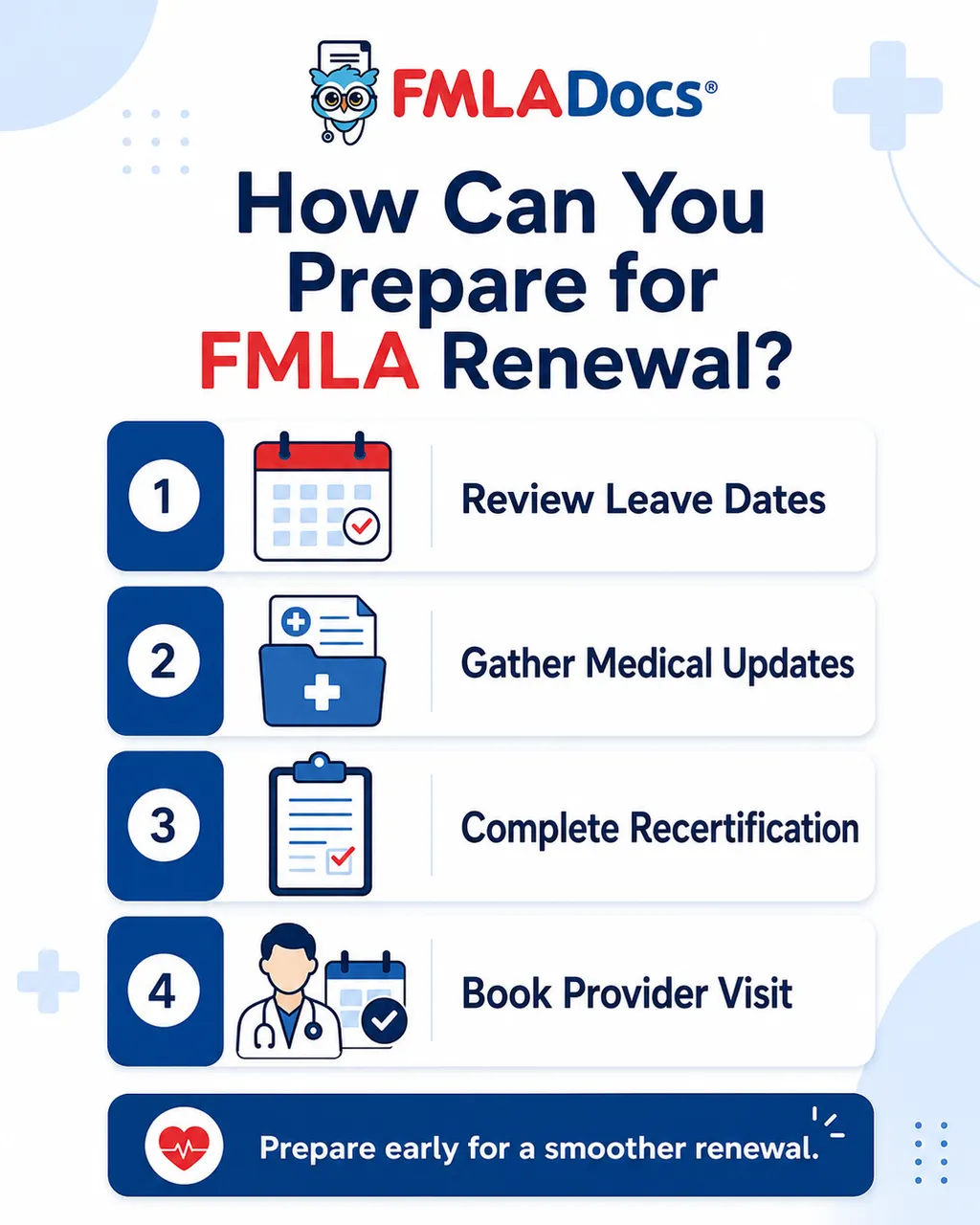
Start preparing several weeks before your current certification or approved period ends. Early preparation gives you time to coordinate with HR and your healthcare provider without creating a gap.
Use this checklist:
-
Review your approval documents: Identify the approved period, leave schedule, and any expiration date.
-
Confirm the leave-year method: Do not assume that your balance resets on January 1.
-
Request your current balance: Ask HR how much leave remains and how it calculated that number.
-
Ask which document you need: Clarify whether HR wants a recertification, new annual certification, or extension request.
-
Schedule medical care early: Some providers need an appointment before completing updated paperwork.
-
Describe current limitations accurately: Explain changes in your symptoms, treatment, and work capacity.
-
Follow your employer’s procedures: Continue complying with normal call-in rules unless unusual circumstances prevent you.
-
Keep copies and delivery records: Save the request, completed certification, fax confirmation, and relevant correspondence.
-
Review the employer’s response: Check whether the employer approved the requested frequency, duration, and schedule.
Good preparation cannot guarantee approval, but it can reduce preventable delays and incomplete paperwork.
Common FMLA Renewal Mistakes to Avoid
Many renewal problems result from misunderstandings rather than the medical condition itself. You can lower the risk by avoiding several common mistakes.
Waiting for HR to Remind You
Your employer may send a request or reminder, but you should also monitor the dates on your documents. Contact HR when you know the medical need will continue.
Assuming Your 12 Weeks Reset in January
Only employers using the calendar-year method follow a January 1 reset. A rolling or forward-looking method may produce a very different available balance.
Sending the Form After the Deadline Without Explanation
If you cannot meet the deadline despite good-faith efforts, tell HR before it expires. Documentation of your efforts can become important.
Asking Your Provider for a Guaranteed Amount of Leave
Your provider should make a medically reasonable estimate based on your condition. Your employer makes the legal designation and tracks your available entitlement.
Ignoring Normal Call-In Rules
Certification does not always replace your employer’s regular absence-reporting procedures. Unless unusual circumstances interfere, follow the required call-in process for every absence.
Treating Recertification as a New Leave Balance
Recertification supports the medical need for leave. It does not restore hours that you have already used or expand the statutory entitlement.
Keep Your FMLA Renewal on Track With FMLADocs
FMLA renewal may involve an updated recertification, a new annual certification, or a request for continued leave, not an automatic extension of your previous approval. Knowing your employer’s leave-year method, responding within the required timeframe, and giving your provider accurate information can help you avoid preventable paperwork gaps.
At FMLADocs, we connect people across the United States with licensed healthcare professionals for independent medical evaluations and appropriate FMLA certification support. A clinician reviews your individual circumstances and determines whether medical certification is clinically appropriate; FMLADocs does not guarantee employer approval, job protection, or legal eligibility.
If you need help preparing updated medical documentation to discuss FMLA renewal support throughout the United States.
Frequently Asked Questions
How often may my employer ask for certification for an ongoing serious health condition?
Your employer generally may request recertification every 30 days in connection with an absence. If the current certification states a minimum duration longer than 30 days, the employer generally must wait until that period expires, subject to limited exceptions. For long-term conditions, an employer generally may request recertification every six months in connection with an absence and may request a new certification during a new FMLA leave year.
Can my employer request FMLA recertification after only two weeks?
It may do so only under specific circumstances, such as when you seek an extension, your circumstances change significantly, or credible information casts doubt on the stated reason for leave or the certification's continuing validity.
Do I need a new doctor's appointment for FMLA renewal?
Federal rules do not require a new appointment in every case. Your healthcare provider decides whether an appointment, examination, or updated testing is medically necessary before completing the requested form.
Can my employer deny leave if my recertification arrives late?
Your employer may delay or deny continued FMLA protection if you fail to provide a timely and sufficient recertification without a valid reason. The employer must generally allow at least 15 calendar days after requesting the documentation.
What if I still need leave after using all 12 weeks?
FMLA generally does not require an employer to provide more than your available statutory entitlement. However, another federal law, state leave program, employer policy, collective bargaining agreement, or disability accommodation may provide another option.
Meet the author
Anam Moin
I'm Anam Moin, and my work at FMLADocs focuses on workplace leave and FMLA education. I cover certification, documentation, employee rights, and leave-related questions to provide readers with useful information when they need it most.
Get Your FMLA Certification Online in Minutes