New York FMLA: Protect Your Job & Take Leave
 by Areeba Imran
 Last updated:
New York FMLA can protect your job while you take qualifying time off for medical or family needs. If you meet the federal requirements, you may be entitled to up to 12 weeks of unpaid, job-protected leave during a 12-month period. Needing time away from work can be stressful enough without wondering whether your job will still be there. FMLA can give eligible workers important job and health benefit protections while they deal with a serious health condition, care for a qualifying family member, welcome a new child, or handle certain military family needs. This guide explains who can qualify, which reasons can support leave, how long leave can last, how notice works, and when medical certification may be required. It also explains how federal FMLA differs from New York Paid Family Leave, because the programs have different rules and purposes.
What Is FMLA in New York?
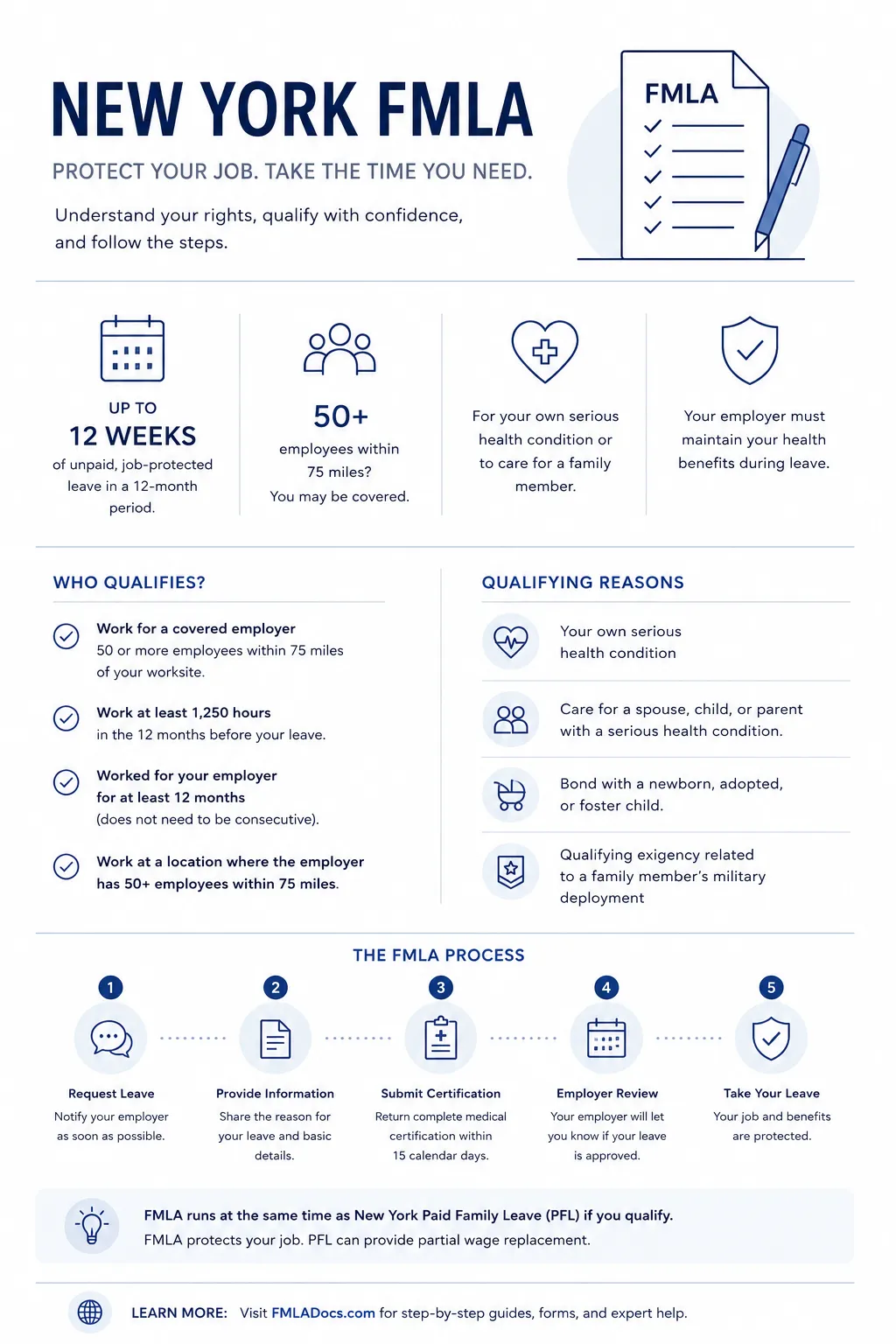 The Family and Medical Leave Act, or FMLA, is a federal law that gives eligible employees of covered employers job-protected leave for qualifying family and medical reasons. FMLA also generally requires continuation of group health benefits under the same conditions that would apply if the employee had continued working. The U.S. Department of Labor’s FMLA overview is the primary federal source for these rules.
FMLA is not a New York-only benefit. It is a federal protection that applies to eligible workers in New York when the employee and employer meet federal requirements. New York also has separate leave programs, so it is important not to treat federal FMLA and state paid leave as the same benefit.
If you are checking whether you may qualify, review the FMLA eligibility requirements before assuming that your leave is protected.
The Family and Medical Leave Act, or FMLA, is a federal law that gives eligible employees of covered employers job-protected leave for qualifying family and medical reasons. FMLA also generally requires continuation of group health benefits under the same conditions that would apply if the employee had continued working. The U.S. Department of Labor’s FMLA overview is the primary federal source for these rules.
FMLA is not a New York-only benefit. It is a federal protection that applies to eligible workers in New York when the employee and employer meet federal requirements. New York also has separate leave programs, so it is important not to treat federal FMLA and state paid leave as the same benefit.
If you are checking whether you may qualify, review the FMLA eligibility requirements before assuming that your leave is protected.
Is New York FMLA Paid or Unpaid?
Federal FMLA is generally unpaid. The law protects qualifying leave but does not generally require an employer to pay wages during FMLA leave. FMLA may, however, run at the same time as employer-provided paid leave when applicable. The Department of Labor explains how paid leave can interact with FMLA. New York workers may separately qualify for New York Paid Family Leave. In 2026, eligible employees can receive 67% of their average weekly wage, subject to a maximum weekly benefit of $1,228.53, for up to 12 weeks. New York Paid Family Leave covers qualifying family-related situations such as bonding with a new child, caring for a family member with a serious health condition, or certain military family needs. It does not provide Paid Family Leave for an employee’s own serious health condition.
Does FMLA Protect Your Job?
Yes. When an eligible employee takes qualifying FMLA leave, the employer generally must restore the employee to the same or a virtually identical position when the employee returns. FMLA also protects employees from interference with their rights and retaliation for exercising those rights. Job protection and wage replacement are different. FMLA can protect your employment while you are away, but federal FMLA itself is generally unpaid.
Does FMLA Protect Your Health Insurance?
Generally, yes. During FMLA leave, your employer must maintain your group health insurance under the same conditions that would apply if you continued working. You remain responsible for your normal share of the premium. The Department of Labor explains health benefit continuation during FMLA. If your employer requires medical certification for your own serious health condition or a qualifying family member’s serious health condition, the certification needs enough information to support the FMLA request. Start your certification when you are ready to begin.
Who Is Eligible for FMLA in New York?
FMLA eligibility depends on both the employee and the employer. Meeting one requirement does not establish eligibility by itself. The federal rules generally require the employee to work for a covered employer, have worked for that employer for at least 12 months, have at least 1,250 hours of service during the previous 12 months, and work at a location where the employer has at least 50 employees within 75 miles.
What Are the New York FMLA Eligibility Requirements?
- You work for a covered employer.
- You have worked for that employer for at least 12 months.
- You have worked at least 1,250 hours during the 12 months before your FMLA leave begins.
- You work at a location where the employer has at least 50 employees within 75 miles. For most private employers, FMLA coverage applies to employers with 50 or more employees in 20 or more workweeks in the current or preceding calendar year. Public agencies and certain schools have separate coverage rules.
How Long Do You Have to Work for Your Employer?
You generally must have worked for your employer for at least 12 months before the FMLA leave begins. The 12 months do not always have to be consecutive. The Department of Labor explains that, in general, employment within seven years can count, subject to exceptions such as certain military service or written agreements. Review the Department of Labor’s FMLA FAQ.
How Many Hours Do You Need to Work?
You generally need at least 1,250 hours of service during the 12 months before your FMLA leave starts. The 1,250 hours must be hours actually worked. Paid leave and unpaid leave generally do not count toward the 1,250-hour threshold.
Does Your Employer Need 50 Employees?
For most private employers, the FMLA coverage threshold is 50 or more employees in 20 or more workweeks in the current or preceding calendar year. For an individual employee, the worksite test generally requires 50 or more employees within 75 miles of the employee’s worksite. Public agencies and certain schools are covered under separate federal rules.
Do Part-Time Workers Qualify for FMLA?
Part-time employees can qualify for FMLA. Federal law does not require an employee to work a full-time schedule. The employee still must satisfy the applicable eligibility requirements, including the hours-of-service and worksite requirements.
What Reasons Qualify for New York FMLA?
Federal FMLA covers specific family and medical situations. Qualifying reasons include an employee’s own serious health condition, caring for a spouse, child, or parent with a serious health condition, the birth or placement of a child, and certain military family situations. The Department of Labor’s qualifying-reasons guide provides the federal list.
Can You Take FMLA for Your Own Serious Health Condition?
Yes, if the condition meets the federal definition of a serious health condition and you meet the other FMLA requirements. A serious health condition can involve inpatient care or continuing treatment by a health care provider. The specific medical facts determine whether a condition qualifies.
Can You Take FMLA to Care for a Family Member?
Yes. FMLA can cover leave to care for a spouse, child, or parent with a serious health condition. The federal definition of a qualifying family member is specific, so not every relative or person who lives with you qualifies.
Can FMLA Cover Pregnancy and Childbirth?
Yes. FMLA can cover prenatal care, pregnancy-related incapacity, childbirth, recovery, and bonding with a newborn when the employee meets the federal eligibility requirements. Pregnancy-related leave uses the employee’s available FMLA entitlement when the leave qualifies.
Can FMLA Cover Military Family Leave?
Yes. FMLA has two special military family leave provisions. Eligible employees may take up to 12 workweeks for certain qualifying exigencies related to a covered family member’s military service. Eligible employees may also receive up to 26 workweeks in a single 12-month period to care for a covered servicemember with a serious injury or illness.
How Long Can You Take FMLA Leave in New York?
For most qualifying FMLA reasons, eligible employees can take up to 12 workweeks during the applicable 12-month period. Military caregiver leave can provide up to 26 workweeks during a single 12-month period when the employee meets the federal requirements.
Can You Take FMLA Intermittently?
Yes, when the federal rules allow it. Intermittent leave means taking FMLA in separate blocks instead of using the full entitlement at once. This can be useful for recurring treatment, appointments, flare-ups, or other periods when a serious health condition prevents an employee from working. The medical certification may need to describe the expected frequency and duration of intermittent absences.
Can You Use a Reduced Work Schedule?
Yes, in qualifying circumstances. A reduced schedule means temporarily working fewer hours than your normal schedule. For an employee’s own serious health condition or to care for a qualifying family member, the need for a reduced schedule generally must be medically necessary. For bonding leave, intermittent or reduced-schedule FMLA generally requires the employer and employee to agree.
When Does Your FMLA Entitlement Reset?
Your FMLA entitlement does not necessarily reset on January 1. Federal rules allow employers to use several methods for measuring the 12-month period, including the calendar year, another fixed 12-month period, a forward-looking 12-month period, or a rolling 12-month period measured backward from the date leave is used. The Department of Labor’s 12-month period guidance explains these methods.
What FMLA Job Protection Do New York Workers Have?
FMLA generally requires an employer to restore an eligible employee to the same or an equivalent position after qualifying leave. An equivalent position generally has substantially the same pay, benefits, work schedule, duties, responsibilities, and other important employment conditions. The Department of Labor’s employee protection guidance explains these protections.
Can Your Employer Retaliate Against You?
FMLA prohibits employers from interfering with, restraining, or denying an employee’s FMLA rights. It also prohibits retaliation for exercising FMLA rights. For example, protected FMLA absences generally cannot be counted against an employee under a policy in a way that penalizes the employee for using FMLA.
What Happens to Your Health Benefits During FMLA?
Your employer generally must continue your group health insurance during FMLA leave under the same conditions that would apply if you continued working. You remain responsible for your normal share of the premium.
New York FMLA vs. New York Paid Family Leave
Federal FMLA and New York Paid Family Leave can both matter to a New York worker, but they are different programs. FMLA is a federal job-protection law. New York Paid Family Leave is a state insurance benefit that provides paid, job-protected leave for qualifying family-related situations. In 2026, New York Paid Family Leave provides up to 12 weeks of leave and pays 67% of the employee’s average weekly wage, capped at $1,228.53 per week. The 2026 maximum total benefit is $14,742.36.
Can You Get FMLA and New York Paid Family Leave at the Same Time?
The same absence can qualify under both FMLA and New York Paid Family Leave. When the requirements are met, the leaves can run concurrently rather than creating two separate periods of leave. The programs still have different eligibility requirements, so qualifying for one does not automatically establish eligibility for the other.
How Do You Apply for FMLA in New York?
Federal FMLA is generally requested through your employer. There is no separate New York state application for federal FMLA. If your leave is for your own serious health condition or to care for a qualifying family member, your employer may require medical certification.
When Should You Tell Your Employer?
If you know you will need FMLA leave at least 30 days in advance, you generally must give your employer at least 30 days’ advance notice. If 30 days is not possible, you must notify your employer as soon as you can. For unexpected leave, notice should generally follow your employer’s usual call-in procedures unless unusual circumstances prevent you from doing so. The Department of Labor’s FMLA notice guidance provides the federal rules. You do not have to use the words ‘FMLA’ when requesting leave. You do need to give enough information for your employer to understand that the absence may be for an FMLA-qualifying reason.
What FMLA Forms Do You Need?
The form depends on the reason for leave. The U.S. Department of Labor provides model FMLA forms, including medical certification forms for an employee’s own serious health condition and for a family member’s serious health condition. View the official FMLA forms.
When Does Your Employer Request Medical Certification?
An employer may require medical certification when you request FMLA leave because of your own serious health condition or to care for a spouse, child, or parent with a serious health condition. The employer must tell you that certification is required. In most circumstances, the employer should request certification when you give notice of the need for leave or within five business days after receiving your notice.
How Long Do You Have to Return FMLA Certification?
You generally must provide requested medical certification within 15 calendar days after your employer asks for it. Your employer can allow more time. If you make diligent, good-faith efforts but cannot meet the deadline because of circumstances beyond your control, additional time may be available. See the Department of Labor certification rules.
What Medical Conditions Can Qualify for FMLA?
FMLA does not cover every illness, injury, or medical appointment. The condition generally must meet the federal definition of a serious health condition, and the employee must also meet the other eligibility requirements.
What Counts as a Serious Health Condition?
A serious health condition can include an illness, injury, impairment, or physical or mental condition involving inpatient care or continuing treatment by a health care provider. The facts matter, including the type of treatment, duration, and need for time away from work. The Department of Labor’s serious health condition guidance explains the federal definition.
Can Mental Health Conditions Qualify for FMLA?
Yes. A mental health condition can qualify when it meets the federal definition of a serious health condition and the employee meets the other FMLA requirements. The diagnosis alone does not establish eligibility. The medical facts must support the need for qualifying leave.
Can Chronic Conditions Qualify for FMLA?
Some chronic conditions can qualify. A chronic condition may qualify when it requires periodic treatment, continues over an extended period, and causes periods when the employee cannot work. Whether a particular condition qualifies depends on the medical facts and federal definition.
Can Surgery and Recovery Qualify for FMLA?
Yes. Surgery and recovery can qualify when the underlying condition or treatment meets the federal definition of a serious health condition and the employee is otherwise eligible. Medical certification may be required to document the condition, treatment, expected recovery period, and need for leave.
What FMLA Paperwork Do You Need in New York?
FMLA paperwork is governed by federal law. New York employees generally follow the same federal certification process as eligible employees in other states. Your employer may use Department of Labor model forms or other documentation that meets federal requirements.
What Happens if Your Certification Is Incomplete?
If a certification is incomplete or insufficient, the employer generally must identify what information is missing and give the employee an opportunity to correct the deficiency. A complete certification should provide enough information to determine whether the leave qualifies under FMLA without unnecessary medical details.
Conclusion
New York FMLA can give eligible employees important job protection when they need time away from work for a qualifying medical or family reason. The federal rules cover eligibility, qualifying reasons, notice, medical certification, leave duration, health benefits, and return to work. New York workers may also have rights under state programs such as New York Paid Family Leave. Because these programs have different eligibility rules and purposes, do not assume that qualifying for one automatically means you qualify for the other. The current 2026 New York Paid Family Leave maximum is $1,228.53 per week, but that benefit is separate from federal FMLA. If your employer requires medical certification for your FMLA leave, accurate documentation is an important part of the process. Start my certification and prepare your information for your health care provider.
Frequently Asked Questions
How do I qualify for FMLA in New York?
You generally need to work for a covered employer, have at least 12 months of employment, have worked 1,250 hours during the previous 12 months, and work at a location where the employer has at least 50 employees within 75 miles. Special coverage rules apply to certain public agencies and schools.
Is FMLA paid in New York?
Federal FMLA is generally unpaid. New York workers may separately qualify for paid benefits, such as New York Paid Family Leave, when they meet that program's requirements.
How many weeks of FMLA can you take in New York?
Eligible employees can generally take up to 12 workweeks of FMLA during the applicable 12-month period. Eligible employees who qualify for military caregiver leave can receive up to 26 workweeks during a single 12-month period.
Does FMLA protect your job in New York?
Yes. FMLA generally requires an employer to restore an eligible employee to the same or an equivalent position after qualifying leave. FMLA also protects employees from interference and retaliation.
Can FMLA and New York Paid Family Leave be used together?
They can apply to the same period of leave when the absence qualifies under both programs and the applicable requirements are met. The programs remain separate and have different eligibility rules.
Can you take FMLA for your own medical condition?
Yes. An eligible employee can take FMLA for their own serious health condition when the condition meets the federal requirements.
Can mental health conditions qualify for FMLA?
Yes. A mental health condition can qualify when it meets the federal definition of a serious health condition and the employee meets the other FMLA requirements.
What FMLA forms do I need in New York?
The forms depend on the reason for leave. The U.S. Department of Labor provides official FMLA forms and medical certification forms. Your employer may also use other documentation that meets federal requirements.
Meet the author
Areeba Imran
I am a healthcare professional and seasoned medical writer with 13+ years of experience across health, wellness, and clinical content. My work focuses on delivering trustworthy, evidence-based information that empowers readers to make informed decisions. With a keen interest in innovation and evolving areas of patient care, I bring a modern perspective to today's healthcare setup.
Get Your FMLA Certification Online in Minutes