

FMLA for Autoimmune Flare-Ups: Lupus, MS, IBD, and Recurring Episodes
 by Anam Moin
 Last updated:
An autoimmune flare can disrupt your workday without warning, leaving you to choose between protecting your health and protecting your job.
You may feel capable of working one week, then face severe pain, fatigue, weakness, digestive symptoms, or neurological problems the next.
FMLA for autoimmune disease may provide unpaid, job-protected leave when your condition meets the federal definition of a serious health condition and you satisfy the employee eligibility rules.
Because autoimmune symptoms often come and go, intermittent leave may offer more practical protection than one continuous absence.
This guide explains how the Family and Medical Leave Act may apply to lupus, multiple sclerosis, inflammatory bowel disease, and other recurring autoimmune conditions.
It also shows you what medical certification should communicate without guaranteeing that your employer will approve your request.
Can You Use FMLA for Autoimmune Disease?
Yes, you may be able to use FMLA for autoimmune disease if you work for a covered employer, meet the employee eligibility requirements, and have a qualifying serious health condition.
Your symptoms or treatment must create a medically supported need for leave.
Federal FMLA generally provides an eligible employee with up to 12 workweeks of leave during the employer’s designated 12-month period. The law also requires the employer to maintain group health coverage under the same terms that applied before qualifying leave began.
Autoimmune Disease Does Not Qualify by Diagnosis Alone
FMLA does not maintain a simple list of automatically approved diseases.
Instead, it examines how the condition affects you and whether it involves inpatient care or continuing treatment by a health care provider.
A chronic condition may meet the standard when it:
-
Requires periodic visits for treatment by a health care provider.
-
Continues over an extended period.
-
May cause episodic periods of incapacity rather than constant disability.
-
Makes you unable to perform one or more essential functions of your position.
You do not necessarily need to remain incapacitated every day. A condition can remain chronic even when you experience stable periods between flares.
Who Is Eligible for Federal FMLA Leave?
Having a qualifying medical condition addresses only one part of an FMLA request. You must also satisfy the federal employment requirements.
You generally need to:
-
Work for a covered employer.
-
Have worked for that employer for at least 12 months.
-
Have completed at least 1,250 hours of service during the 12 months before leave starts.
-
Work at a location where the employer has at least 50 employees within 75 miles.
Public agencies and eligible public or private schools follow specific coverage rules. State family and medical leave laws may provide broader protection, so you should also check with your state labor department.
Why Intermittent FMLA Fits Recurring Autoimmune Flares
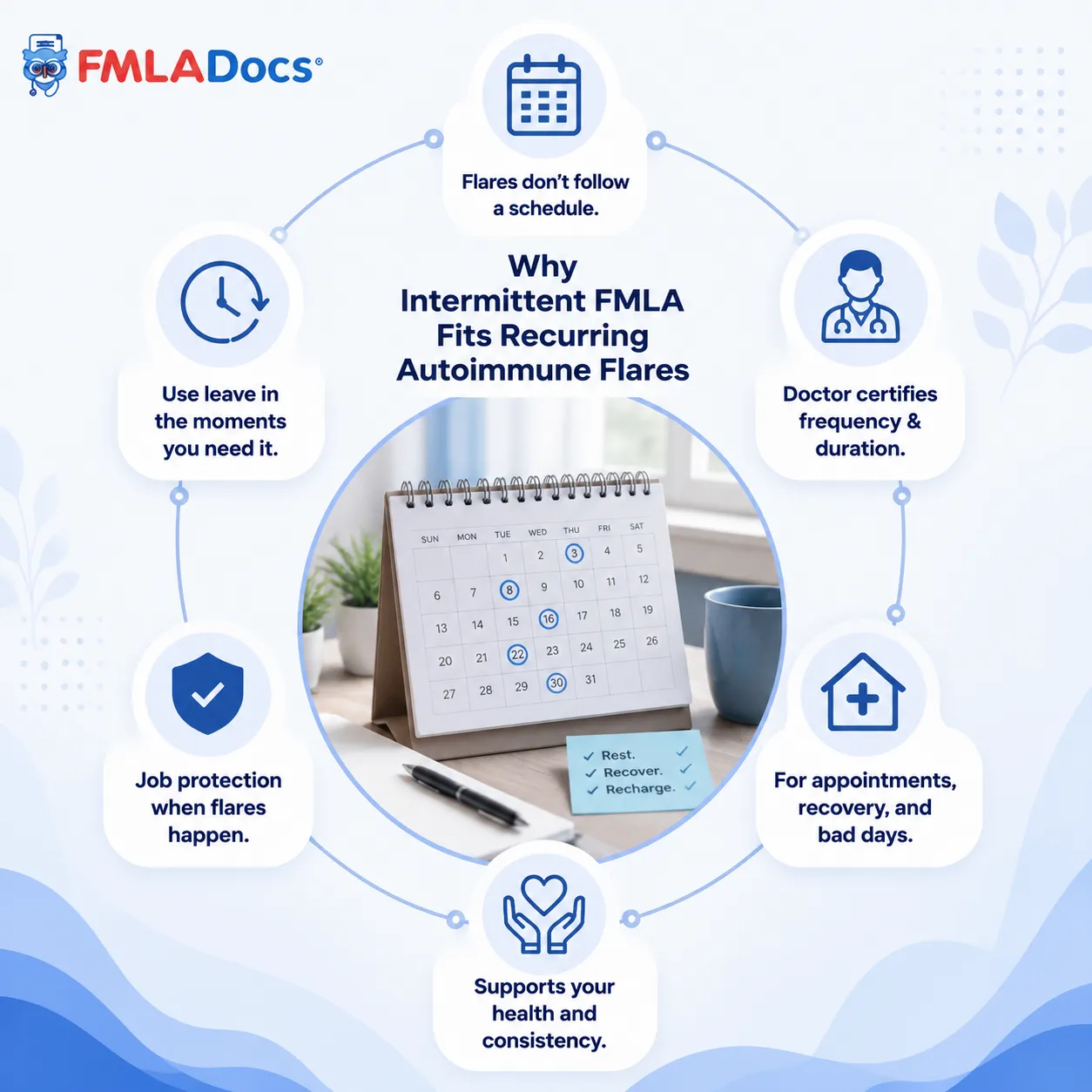
Intermittent FMLA lets you take qualifying leave in separate blocks instead of using all your leave at once. This structure often matches autoimmune diseases because symptoms can intensify, improve, and return.
Your medically necessary leave might cover:
-
A full day when severe symptoms prevent you from working.
-
Several hours for an infusion, examination, or specialist visit.
-
Recovery time after treatment.
-
A late arrival caused by disabling morning symptoms.
-
Several consecutive days during a significant flare.
-
A reduced work schedule during treatment or recovery.
Federal regulations recognize that intermittent leave may cover planned treatment and unanticipated periods of incapacity. Your employer’s agreement generally is not required when intermittent leave is medically necessary for your own qualifying serious health condition.
Intermittent Leave Versus a Reduced Schedule
These arrangements address different work limitations.
| Leave arrangement | How it works | Autoimmune example |
|---|---|---|
| Intermittent leave | You take separate blocks of leave as medical needs arise | Missing one or two days during an unpredictable lupus flare |
| Reduced leave schedule | You temporarily work fewer hours each day or week | Working six-hour days while recovering from an MS relapse |
| Continuous leave | You remain away from work for one uninterrupted period | Taking three weeks off after hospitalization for severe IBD complications |
Your provider should recommend the arrangement that reflects your medical needs. Personal convenience alone does not establish medical necessity.
How Lupus Flare-Ups May Support FMLA Leave
Lupus can affect the joints, skin, kidneys, blood, nervous system, and other organs. A flare may involve profound fatigue, joint pain, fever, cognitive difficulty, light sensitivity, or organ-related complications.
FMLA may cover time when lupus symptoms prevent you from performing essential job duties. It may also cover appointments, laboratory monitoring, infusions, medication management, and medically necessary recovery.
What a Lupus Certification Should Explain
Your certification does not need to disclose every private detail. However, it should provide enough medical facts to explain why leave is necessary.
Useful information may include:
-
The condition’s chronic nature and probable duration.
-
The functional effects of a typical flare.
-
The estimated number of episodes expected each month.
-
The likely duration of each episode.
-
The anticipated frequency of appointments or treatment.
-
Whether recovery time may follow treatment.
These figures should represent reasonable clinical estimates rather than promises about exactly when symptoms will occur.
How Multiple Sclerosis Episodes May Affect Work
Multiple sclerosis can produce fatigue, muscle weakness, numbness, visual changes, balance problems, pain, and cognitive symptoms. Some people experience relapses followed by partial or substantial recovery, while others face symptoms that fluctuate throughout the day.
Your need for leave depends on how the condition affects your job. For example, vision changes may interfere with driving, weakness may affect lifting, and cognitive fatigue may limit sustained concentration.
Examples of MS-Related FMLA Use
Medically supported leave may cover:
-
Neurology appointments and diagnostic testing.
-
Infusion therapy or medication administration.
-
Acute relapses that prevent safe work.
-
Recovery after treatment.
-
Reduced hours during a period of severe fatigue.
-
Physical or occupational therapy appointments.
The certification should connect the medical need to your inability to perform essential job functions without asking your provider to make employment or legal decisions.
How IBD Flares May Qualify
Inflammatory bowel disease includes Crohn’s disease and ulcerative colitis. Symptoms may include abdominal pain, urgent or frequent bowel movements, diarrhea, bleeding, dehydration, fatigue, fever, and weight loss.
Severe gastrointestinal symptoms can make commuting, attending meetings, operating equipment, or remaining at a workstation difficult or unsafe. FMLA may also cover colonoscopies, infusions, medical appointments, hospitalization, surgery, and recovery when the legal requirements apply.
What Are Autoimmune Symptoms in the Stomach?
Several autoimmune and immune-mediated conditions can affect the digestive system. Symptoms may include abdominal cramping, nausea, diarrhea, bleeding, bloating, reduced appetite, and urgent bowel movements.
These symptoms do not identify one specific disease. You should seek medical evaluation because infections, medication effects, and other conditions can cause similar problems.
Other Autoimmune Conditions That May Need Leave
The same legal framework may apply to other chronic immune-related conditions. What matters is the documented medical need, not merely the name of the diagnosis.
Examples may include:
-
Rheumatoid arthritis when pain, swelling, or limited mobility prevents essential work activities.
-
Psoriatic arthritis when joint or skin symptoms cause incapacity or require recurring treatment.
-
Scleroderma when pain, fatigue, circulation problems, or organ complications affect work.
-
Sjögren’s disease when fatigue, pain, dryness, or systemic complications become disabling.
-
Autoimmune thyroid disease when significant symptoms or treatment complications create qualifying incapacity.
Each request requires an individual assessment. Two employees with the same diagnosis may have very different functional limitations and leave needs.
What Should Medical Certification Include?
An employer may request medical certification from a health care provider. Under federal regulations, the form may seek medical facts supporting the need for leave without requiring a complete medical record.
A thorough certification commonly addresses:
| Certification topic | Information that may help |
|---|---|
| Condition timeline | Approximate start date and probable duration |
| Medical facts | Appropriate facts showing why the condition may qualify |
| Work limitations | Essential job functions you cannot perform during an episode |
| Treatment | Expected appointments, therapies, or recovery periods |
| Flare pattern | Estimated frequency and duration of incapacitating episodes |
| Schedule need | Whether continuous, intermittent, or reduced-schedule leave is medically necessary |
Your provider should use medically supportable estimates. Vague phrases such as “leave as needed” may not give your employer enough information to evaluate the request.
How Can You Prepare for Certification?
Good preparation helps your provider understand how flares affect your work. It also reduces the risk of missing information or inconsistent estimates.
Before your appointment, consider taking these steps:
-
Obtain the correct certification form from your employer.
-
Write down your essential job duties and physical or cognitive demands.
-
Review recent flare dates, duration, symptoms, and treatment.
-
List scheduled appointments and expected recovery time.
-
Bring relevant records or provider contact information.
-
Explain whether you need full-day absences, partial days, or reduced hours.
-
Check your employer’s submission deadline and return instructions.
Do not exaggerate the frequency of future episodes. A credible estimate based on your medical history gives your provider a stronger foundation for completing the form.
What Happens After You Submit Your Paperwork?
Your employer reviews your eligibility and decides whether the leave qualifies for FMLA protection. Your employer should provide notices explaining your eligibility, rights, responsibilities, and whether it designated the leave as FMLA.
If the certification is incomplete or insufficient, the employer generally must identify the deficiency and allow an opportunity to correct it under applicable rules. Respond promptly and keep copies of forms, notices, emails, and attendance records.
Do Call-In Procedures Still Apply?
Yes. FMLA protection does not usually eliminate your employer’s normal absence-reporting procedures.
When a flare occurs, report the absence according to workplace policy and provide enough information to connect it with your approved or pending FMLA reason. You do not necessarily need to repeat your diagnosis during every call.
Can an Employer Request Recertification?
An employer may request recertification in circumstances permitted by federal regulations. The usual timing depends on the certification’s stated duration and whether your circumstances have changed significantly.
An employer may sometimes request an earlier update if you seek an extension, your frequency or duration changes materially, or credible information creates doubt about the continuing validity of the certification.
Protect Your Flare Days With Clearer FMLA Documentation
FMLA for autoimmune disease may protect eligible employees who need medically necessary leave for lupus, MS, IBD, or other recurring flare-ups. Strong documentation explains your functional limitations, treatment needs, and realistic episode pattern without claiming certainty.
At FMLADocs, we connect employees across the United States with licensed medical professionals who evaluate their circumstances and, when clinically appropriate, complete FMLA certification paperwork.
We cannot guarantee approval because your employer determines eligibility and designation under the law.
Start your certification. You can also see how the FMLADocs process works before deciding on your next step.
Frequently Asked Questions
What is an autoimmune flare-up?
An autoimmune flare-up is a period when disease activity or symptoms become more intense. A flare may cause pain, inflammation, fatigue, digestive problems, weakness, cognitive changes, or other condition-specific symptoms.
Can you get intermittent FMLA for autoimmune disease?
Yes, an eligible employee may use intermittent FMLA when a qualifying autoimmune condition creates a medically necessary need for separate absences. Certification should estimate the expected frequency and duration of episodes.
Can you take FMLA for lupus?
Lupus may support FMLA leave when it meets the serious-health-condition standard and causes incapacity, requires continuing treatment, or creates another qualifying medical need. Approval depends on individual eligibility and documentation.
Can you take FMLA for multiple sclerosis?
MS may qualify when relapses, symptoms, treatment, or recovery make you unable to perform essential job functions. Intermittent or reduced-schedule leave may apply when medically necessary.
Does inflammatory bowel disease qualify for FMLA?
Crohn’s disease or ulcerative colitis may qualify when the condition meets federal requirements. Leave may cover incapacitating flares, appointments, procedures, hospitalization, treatment, or recovery.
Do you have to disclose your exact autoimmune diagnosis?
An employer may request sufficient medical information to support certification, but a diagnosis is not always required under federal FMLA rules. Your provider must still explain appropriate medical facts and the need for leave.
Is autoimmune FMLA leave paid?
Federal FMLA leave is generally unpaid. However, employer-provided paid leave, disability benefits, or state paid-leave programs may run concurrently when their rules apply.
Can your employer deny intermittent FMLA?
An employer may deny a request if you are ineligible, the employer is not covered, the condition does not qualify, or required certification remains insufficient after the applicable correction process. An autoimmune diagnosis alone does not guarantee approval.

Meet the author
Anam Moin
I'm Anam Moin, and my work at FMLADocs focuses on workplace leave and FMLA education. I cover certification, documentation, employee rights, and leave-related questions to provide readers with useful information when they need it most.
Get Your FMLA Certification Online in Minutes