
FMLA for Chronic Illness Flare-Ups: How Intermittent Leave Works
 by Anam Moin
 Last updated:
Your chronic illness may not stop you from working every day, but what happens when an unexpected flare-up makes working impossible?
FMLA for chronic illness may protect eligible employees who need time away for unpredictable episodes, treatment appointments, or temporarily reduced work schedules. Instead of taking all your leave at once, you may use intermittent FMLA in smaller blocks when medically necessary.
However, your diagnosis alone does not automatically qualify you. Your eligibility, medical certification, need for leave, and employer coverage all matter.
This guide explains how to prepare a clear request, document flare-ups, and avoid common communication mistakes.
How Does FMLA for Chronic Illness Work?
FMLA for chronic illness can provide eligible employees with up to 12 workweeks of unpaid, job-protected leave during the employer’s applicable 12-month leave year.
Your employer must generally maintain group health coverage under the same terms while you take protected leave.
You may qualify for leave when your own serious health condition makes you unable to perform one or more essential functions of your job. You may also qualify when you need to care for a spouse, child, or parent with a serious health condition.
What Counts as a Chronic Serious Health Condition?
Under federal FMLA rules, a chronic condition generally:
-
Requires periodic visits for treatment by a healthcare provider, or a nurse working under the provider’s supervision.
-
Continues over an extended period.
-
May cause episodic rather than continuous incapacity.
The Department of Labor defines periodic visits for this purpose as visits at least twice a year. Your condition does not need to incapacitate you continuously, but an absence must relate to the qualifying condition, treatment, or recovery.
Do You Meet the Employee Eligibility Rules?
A qualifying medical condition represents only one part of the process. In most situations, you must also:
-
Have worked for your employer for at least 12 months.
-
Have completed at least 1,250 hours of actual work during the previous 12 months.
-
Work at a location where the employer has at least 50 employees within 75 miles.
-
Work for an employer covered by the FMLA.
Paid vacation, sick leave, unpaid leave, and previous FMLA leave generally do not count toward the 1,250 hours because the calculation includes hours actually worked.
Which Chronic Conditions May Support an FMLA Request?
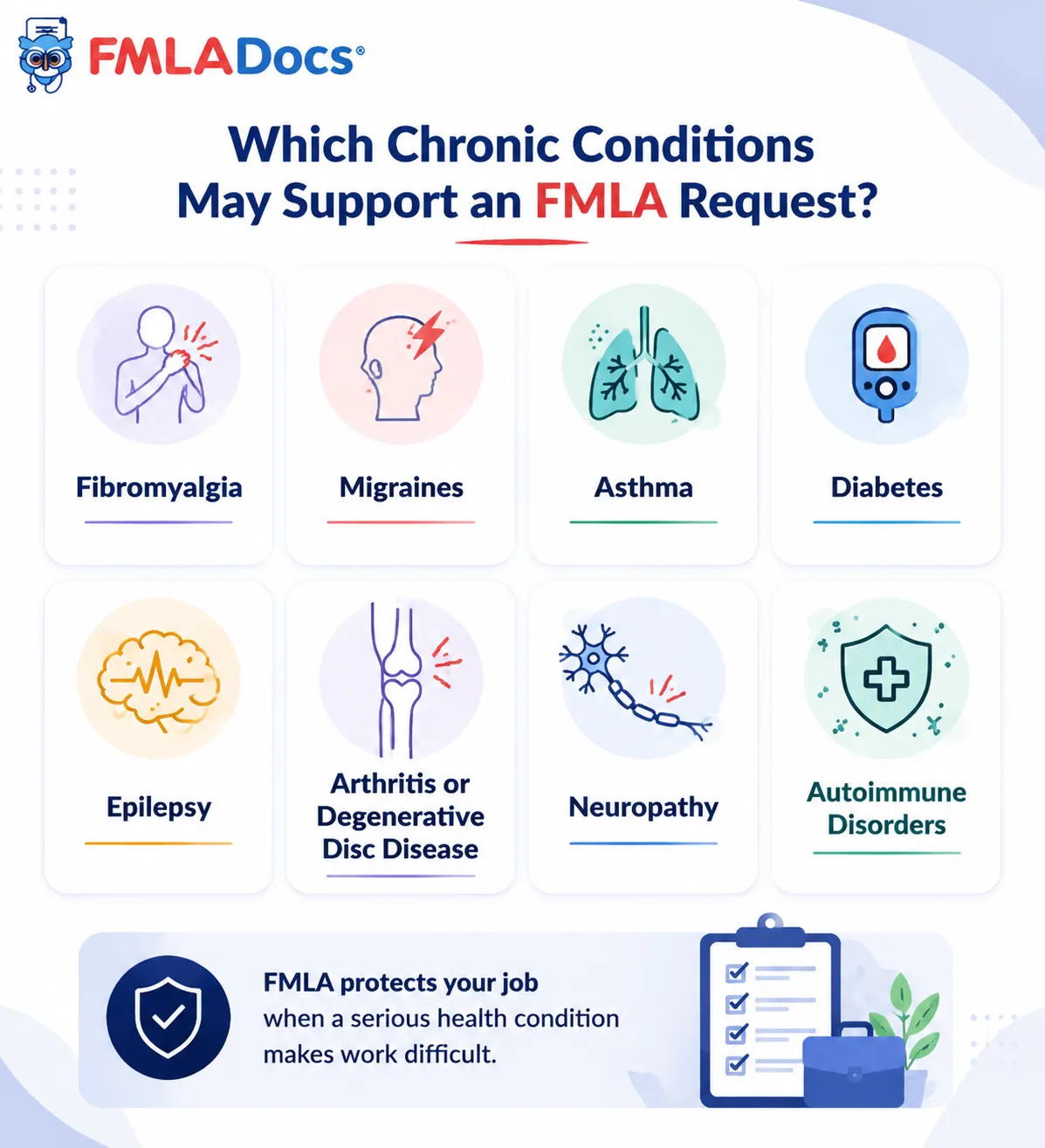
FMLA does not approve or reject employees based only on a list of diagnoses. The central question is whether your condition meets the legal requirements and creates a medically necessary need for leave.
Conditions that may meet the standard include:
-
Fibromyalgia: Pain, fatigue, sleep disruption, and cognitive symptoms may cause unpredictable periods of incapacity.
-
Migraines: Severe episodes may interfere with vision, concentration, driving, or screen use.
-
Asthma: Attacks, respiratory treatments, or medication adjustments may require short-notice absences.
-
Diabetes: Complications, treatment, or unstable symptoms may temporarily prevent safe work.
-
Epilepsy: Seizures and recovery periods may create episodic incapacity.
-
Arthritis or degenerative disc disease: Pain and limited movement may interfere with sitting, standing, lifting, or walking.
-
Neuropathy: Burning pain, numbness, poor balance, and reduced grip strength may affect essential job duties.
-
Autoimmune disorders: Conditions such as lupus may alternate between stable periods and disabling flares.
What Is Intermittent FMLA Leave?
Intermittent FMLA lets you take leave in separate blocks for one qualifying reason. For example, you might miss four hours for an infusion, one day during a migraine, or two days while recovering from a severe pain flare.
A reduced leave schedule changes your normal daily or weekly schedule. You might work six-hour days instead of eight-hour days or four days per week during a treatment period.
| Leave arrangement | How it works | Possible chronic illness use |
|---|---|---|
| Continuous leave | One uninterrupted period away | Recovery after hospitalization or intensive treatment |
| Intermittent leave | Separate blocks of time | Unpredictable flares, appointments, or episodic incapacity |
| Reduced schedule | Fewer hours per day or week | Fatigue management, rehabilitation, or gradual return |
Can You Use FMLA for Unpredictable Flare-Ups?
Yes, an eligible employee may use intermittent FMLA for unpredictable flare-ups when a healthcare provider certifies that intermittent leave is medically necessary.
You usually cannot give 30 days’ notice for an episode that arrives without warning.
You should still notify your employer as soon as practicable and identify the absence as connected to your approved condition or FMLA leave.
Do not assume that HR will automatically connect every call-out to your certification.
What Should Your Medical Certification Explain?
Medical certification should connect your health condition to your work limitations and expected need for leave. Vague phrases such as “leave as needed” may not give your employer enough information.
A complete certification may address:
-
When the condition began and how long it may continue.
-
Relevant medical facts supporting the need for leave.
-
Whether you cannot perform one or more essential job functions.
-
Why intermittent leave or a reduced schedule is medically necessary.
-
The estimated frequency of flare-ups.
-
The estimated duration of each episode.
-
The expected schedule of planned treatment.
These figures are good-faith medical estimates, not guarantees. Chronic illnesses fluctuate, so your provider can describe a medically reasonable range when exact predictions are impossible.
How Can You Help Your Provider Give Useful Estimates?
Give your provider concrete information rather than asking them to “fill out an FMLA form.” Explain your essential duties and how symptoms affect your ability to perform them.
For example, track:
-
How many flare-ups occurred during the last three months.
-
How long a typical and severe episode lasted.
-
Which duties became unsafe or impossible.
-
How often you attended appointments or treatments.
-
Whether medication caused drowsiness, dizziness, nausea, or cognitive impairment.
For additional preparation tips, read how to talk to your doctor about FMLA.
Can You Request a Reduced Schedule or Part-Time Return?
A reduced schedule may help when you can perform your duties but cannot safely sustain your usual hours. Your provider must explain why the change is medically necessary and estimate how long you may need it.
FMLA does not create unlimited part-time employment. Your reduced hours generally count against your available FMLA entitlement according to the amount of leave used.
Can Your Employer Temporarily Transfer You?
For foreseeable, recurring treatment, your employer may temporarily transfer you to an available alternative position that better accommodates your leave schedule. The position must provide equivalent pay and benefits, although its duties may differ.
This temporary arrangement should accommodate the recurring leave rather than punish you for requesting it.
How Do You Start the Conversation With HR?
You do not need to diagnose yourself for HR or use legal language. You need to provide enough information for your employer to understand that your leave may qualify.
You can use this script:
“I have an ongoing health condition that sometimes prevents me from performing my job and requires continuing treatment. I may need intermittent leave for flare-ups and appointments. Please send me the applicable FMLA notices, certification form, deadline, and call-in instructions.”
When your condition previously received FMLA protection, connect the new absence to that approved reason. Ask HR how it tracks intermittent hours and how you can review your remaining balance.
What Happens When Your Needs Change?
Contact HR and your healthcare provider when the frequency, duration, or type of leave you need changes significantly. For example, a certification estimating one episode per month may need updating if your condition begins causing weekly incapacity.
An employer may request recertification in permitted circumstances. The timing depends on the certification period and whether circumstances change, you request an extension, or credible information creates doubt about the stated need for leave.
FMLADocs Helps You Prepare for Chronic Illness Leave
FMLA for chronic illness can help eligible employees manage medically necessary flare-ups, treatment, and reduced schedules without using all their leave in one continuous block.
At FMLADocs, we connect people across the United States with licensed healthcare professionals who review their information and, when medically appropriate, complete employer-ready FMLA certification through a secure online process. Certification does not guarantee that an employer will approve or designate leave.
You can start your certification or get the free FMLA guide before speaking with HR.
Frequently Asked Questions
Does every chronic illness qualify for FMLA?
No. Your condition must meet the definition of a serious health condition, your leave must be medically necessary, and you must satisfy the employee eligibility rules. Your employer must also fall under FMLA coverage.
Can I use intermittent FMLA every time my condition flares?
You may use it for absences that fall within your certification and available entitlement. Follow your employer’s call-in rules and identify the absence as related to your approved qualifying reason.
Does FMLA pay me during chronic illness leave?
Federal FMLA leave is unpaid. However, you or your employer may apply accrued sick leave, vacation, or other paid leave according to applicable policies, and another wage-replacement benefit may run concurrently.
Do PTO and sick leave count toward the 1,250-hour requirement?
No. The 1,250-hour test generally counts hours actually worked. Vacation, sick leave, unpaid leave, and FMLA leave do not count toward that total.
Can my employer require a medical certification?
Yes. Your employer may request certification from an authorized healthcare provider. Employees generally receive at least 15 calendar days to return it when certification is requested, unless diligent good-faith efforts cannot meet the deadline.
Must I disclose my exact diagnosis to HR?
Not necessarily. Certification must contain enough medical facts to establish a potentially qualifying serious health condition and the need for leave, but a diagnosis is not always mandatory under federal FMLA rules.
Can my employer change my job during intermittent leave?
For foreseeable recurring treatment, your employer may temporarily transfer you to an alternative position that better accommodates the absences. The alternative position must provide equivalent pay and benefits.
What if my employer says my certification is incomplete?
Your employer should identify in writing what information is incomplete or insufficient and generally allow at least seven calendar days to correct it. Contact your provider promptly and document your efforts.

Meet the author
Anam Moin
I'm Anam Moin, and my work at FMLADocs focuses on workplace leave and FMLA education. I cover certification, documentation, employee rights, and leave-related questions to provide readers with useful information when they need it most.
Get Your FMLA Certification Online in Minutes