

Workplace Accommodations After FMLA: what to ask HR
 by Anam Moin
 Last updated:
Your FMLA leave is ending, but are you ready?
You may be watching your leave expire while pain, fatigue, medication effects, anxiety, or mobility limits still affect your work. That creates a hard question: must you return with no restrictions, or can you ask HR for support?
Return to work accommodations after FMLA may include a temporary schedule change, breaks, equipment, telework, task changes, more unpaid leave, or reassignment.
This guide explains what to request, what documentation to gather, and how to prepare before the deadline.
Return to Work Accommodations After FMLA: The Direct Answer
Ask HR to begin the ADA interactive process when a medical condition still limits your work after FMLA. Request your essential-functions list, the accommodation procedure, documentation requirements, possible temporary changes, and a decision timeline.
FMLA and the ADA serve different purposes. FMLA can provide eligible employees with job-protected leave, while the ADA may require covered employers to consider changes that help a qualified employee perform essential duties.
| Issue | FMLA | ADA |
|---|---|---|
| Main purpose | Job-protected leave for qualifying reasons | Equal opportunity and reasonable accommodation |
| Time | Usually up to 12 workweeks in 12 months | No fixed accommodation-leave limit; facts and hardship matter |
| Return standard | Same or equivalent job in most cases | Essential functions with or without accommodation |
| Employer limit | Eligibility and statutory rules | Undue hardship and other ADA standards |
What Matters When Limitations Continue?
The central question is not whether you feel “100% healed.” It is whether you can perform the job’s essential functions with or without reasonable accommodation.
Essential functions are fundamental duties, not every minor task listed in a job description. Ask HR for a current list and explain which duties your restriction affects.
A No-Restrictions Rule May Conflict With the ADA
An employer generally should not block your return only because your provider lists restrictions. HR should consider whether an effective accommodation could address them without undue hardship or a direct safety threat.
Questions to Ask About Essential Duties
Keep the discussion focused with questions such as:
- Which duties does the company consider essential?
- How often must I perform each physical, cognitive, or scheduling requirement?
- Can nonessential duties shift temporarily?
- Who will manage the request and communicate the decision?
Which Accommodations Can You Request?
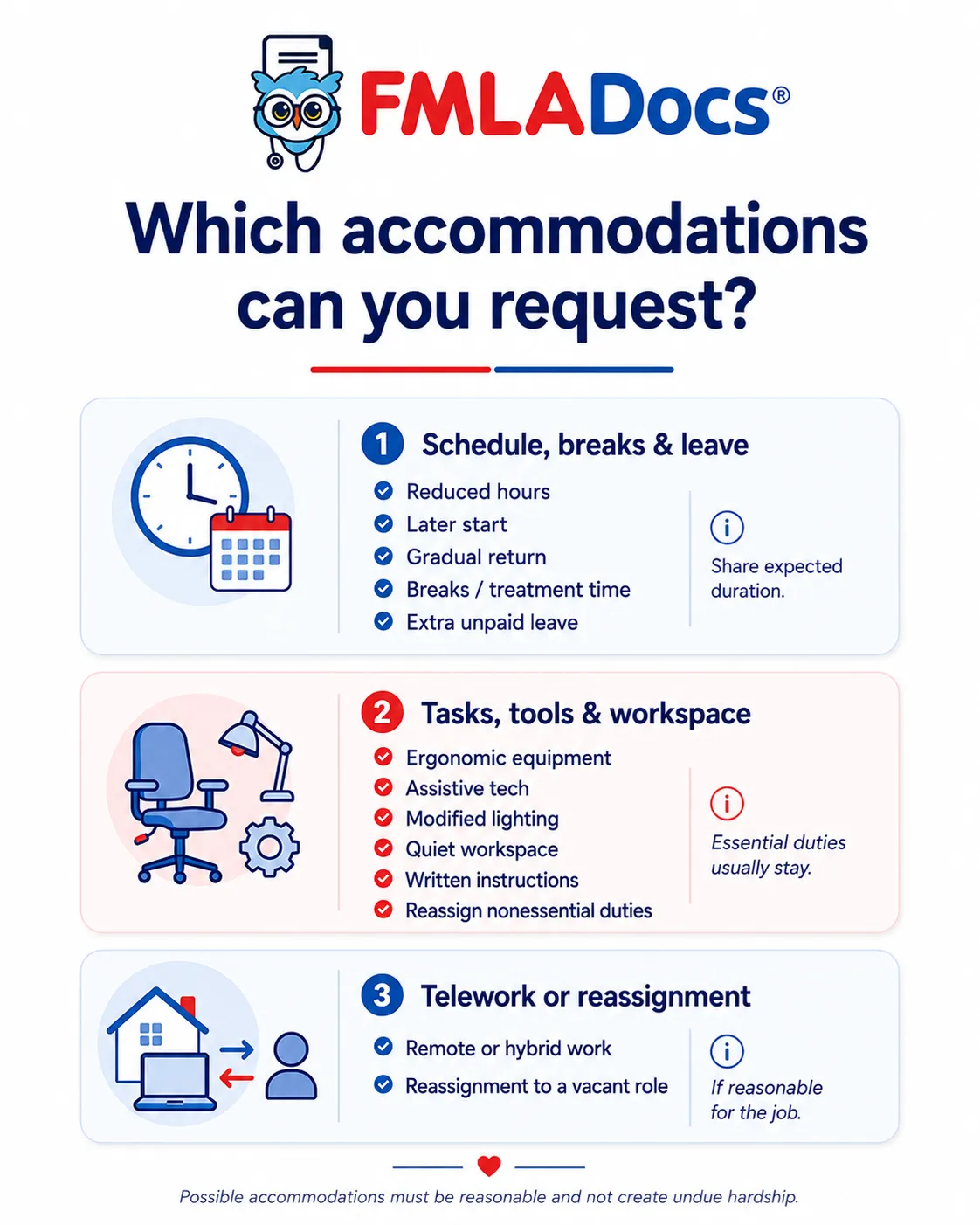
A strong request connects a specific medical limitation to a practical workplace change. You can suggest one preferred option and one or two alternatives.
Schedule, Breaks, and Additional Leave
You might request reduced hours, a later start, a gradual return, periodic breaks, intermittent time for treatment, or a defined extension of unpaid leave. Give an expected duration or return date when your provider can estimate one.
The EEOC recognizes leave, modified schedules, and additional unpaid leave as possible accommodations when they remain reasonable and do not create undue hardship.
Tasks, Tools, and Workspace Changes
Possible adjustments include ergonomic equipment, assistive technology, modified lighting, a quieter workspace, written instructions, or temporary redistribution of nonessential duties. The ADA generally does not require an employer to remove an essential function.
Telework or Reassignment
Telework may qualify when you can perform essential duties remotely. Reassignment may become relevant when no reasonable change lets you perform your current role and a suitable vacant position exists.
What Documentation Should You Prepare?
Good documentation translates your condition into work-related limitations. It should explain:
- What you cannot safely or reliably do
- How long the limitation may last
- What adjustments may help
Ask HR what information it needs before your provider visit.
For added context, review what your employer can and cannot ask on FMLA paperwork.
What Should a Provider Note Cover?
A focused note may address:
- The functional limitations caused by the condition.
- The job activities affected, such as standing, lifting, concentrating, or following a fixed schedule.
- The expected duration of each restriction.
- Medical parameters for a safe accommodation.
- Whether you can return now, need a gradual return, or require a defined leave extension.
The EEOC permits employers to request reasonable information about the limitation, the expected duration, and accommodations that may help when the disability or need is not already obvious.
Avoid an Unfocused Medical History
When the disability or need is not obvious, an employer may request reasonable supporting information. The request should relate to the condition and accommodation, not unrelated medical details.
Keep copies of forms, notes, emails, and deadlines. Your records show what you requested, what HR required, and how each side responded.
How Should You Prepare for the HR Meeting?
Preparation turns a broad request for “help” into a workable proposal. Bring a short summary linking your limitation, essential duties, requested change, expected duration, and alternatives.
For condition-specific examples, you can review this employee resource about FMLA and anxiety.
Return-to-Work Meeting Checklist
Complete these steps before the meeting:
- Confirm your FMLA expiration date.
- Request the current job description and essential-functions list.
- Ask whether HR requires a fitness-for-duty certification.
- Obtain a provider note describing restrictions and duration.
- Choose a preferred accommodation and an effective alternative.
- Ask about pay, benefits, schedule, reporting, and review dates.
- Send the request in writing and save a copy.
- Email a factual summary after the meeting.
Plain-English Accommodation Request Script
You can say:
“My medical condition continues to limit certain work activities after my FMLA leave ends. I can perform the essential functions of my job with a temporary accommodation, and I would like to begin the interactive process. My provider recommends [adjustment] through [date]. Please tell me what documentation you need.”
Can HR Require Fitness-for-Duty Certification?
An employer may require fitness-for-duty certification under a uniformly applied policy for similarly situated employees returning from FMLA leave for their own serious health condition. It generally must notify you of the requirement in the designation notice.
If the employer timely gave your provider the essential-functions list, it may require the certification to address those duties. A missing certification can delay restoration, so request the form and deadline early.
Important: A release with restrictions can also communicate the need for an ADA accommodation. Fitness for duty does not always mean returning without any workplace adjustment.
What Can an Employer Decline?
The ADA does not require an employer to remove essential duties, create a job, provide your preferred option when another effective one works, or accept an accommodation that causes undue hardship.
Cost, staffing, operational impact, duration, and predictability may affect that analysis.
A denial does not have to end the discussion. Ask which alternatives HR considered and whether a trial period, narrower change, or different schedule could work.
What if Your Original Job Cannot Be Held?
FMLA generally requires the same or an equivalent role when you return within protected leave and meet return requirements. An equivalent role should closely match pay, benefits, schedule, location, duties, responsibility, and status.
After FMLA ends, the ADA may still require consideration of accommodation or reassignment. Extra leave and reassignment are not automatic; the result depends on the facts, vacancies, documentation, and undue hardship.
Build a Documented Return Plan With FMLADocs
Return to work accommodations after FMLA can bridge the gap between expired leave and a medically realistic return, but no accommodation or certification receives guaranteed approval.
Act early, communicate in writing, and focus on functional limits and essential duties.
FMLADocs connects employees across the United States with licensed medical professionals through an online process for medical leave certification and employer-ready documentation.
Explore the FMLA services hub and start your certification.
Frequently Asked Questions
Must I be fully recovered before returning?
Not necessarily. When the ADA applies, the question is whether you can perform essential functions with or without reasonable accommodation.
Can I request more leave after 12 weeks?
Yes. Additional unpaid leave may qualify as an ADA accommodation, subject to disability coverage, expected duration, and undue hardship.
Can my employer require a fitness-for-duty note?
Yes, under a uniformly applied policy and with proper notice. The request generally must relate to the condition that caused your leave.
What if I do not provide the requested certification?
Your employer may delay restoration after a proper request. Communicate promptly if your provider needs clarification or more time.
Can my employer move me to another job?
FMLA generally requires the same or an equivalent role. ADA reassignment may apply when you cannot perform your current role even with accommodation and a suitable vacancy exists.
Must HR approve my exact request?
No. The employer may offer another effective accommodation that addresses your limitations.
How much medical information can HR request?
HR may request reasonable information about functional limitations, duration, and accommodation needs. It generally should not seek unrelated medical history.
Should I request accommodation in writing?
A verbal request may start the process, but writing creates a clearer record. State the limitation, requested change, expected duration, and your request for an interactive discussion.

Meet the author
Anam Moin
I'm Anam Moin, and my work at FMLADocs focuses on workplace leave and FMLA education. I cover certification, documentation, employee rights, and leave-related questions to provide readers with useful information when they need it most.
Get Your FMLA Certification Online in Minutes