

How to Fill Out FMLA Form WH-380 Correctly: A Simple Guide
 by Areeba Imran
Last updated:
Learning how to fill out FMLA form WH-380 correctly can mean the difference between approved leave and weeks of delays. One blank field or vague medical description triggers an automatic send-back from HR. Most rejections happen because employees don’t know which sections they complete versus what their doctor must fill out. The 15-day certification deadline makes these mistakes costly.
This complete FMLA paperwork guide breaks down every line of FMLA form WH-380-E for your own condition, and WH-380-F for family care. You’ll see what belongs in Section I. You’ll also learn which medical details your healthcare provider’s FMLA certification must include. We’ll cover the serious health condition fields that confuse most people. We’ll also cover the intermittent leave language employers expect, plus the top mistakes that trigger HR rejections.
You’ll also learn where to download current DOL forms and how to submit them online. You’ll see when waiting weeks for your primary care provider puts your deadline at risk. By the end, you’ll know how to fill out FMLA form WH-380 without guesswork or errors.
How to Fill Out FMLA Form WH-380: WH-380-E vs. WH-380-F
Choosing the right FMLA form starts with understanding who needs the leave. The Department of Labor provides two main certification forms. Each serves a distinct purpose. Using the wrong one delays your application.
Form WH-380-E: Certification for Your Own Serious Health Condition
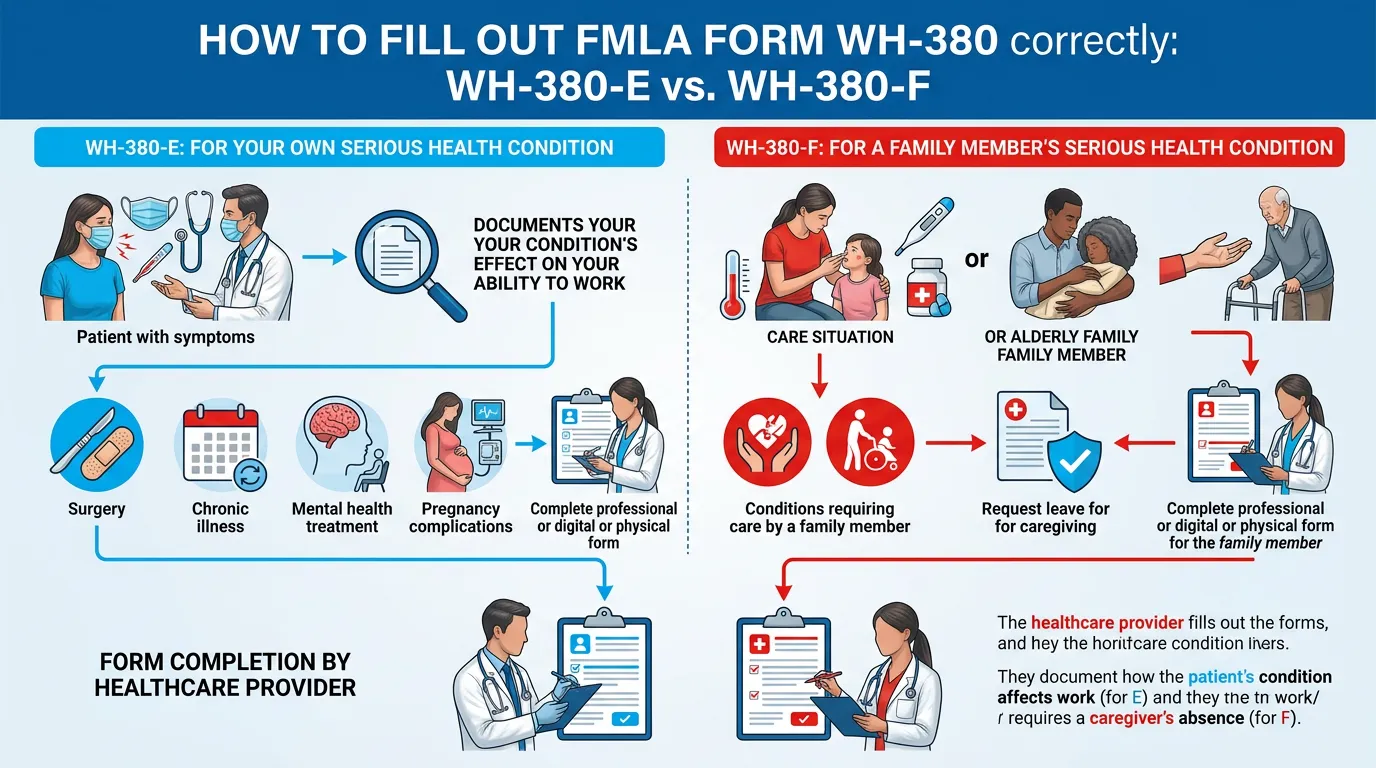
Use WH-380-E when you need leave for your own medical condition. This covers surgery, chronic illness, mental health treatment, or pregnancy complications. Your healthcare provider completes this form. It documents how your condition affects your ability to work.
The form asks about your diagnosis, treatment plan, and expected recovery time. It also requires details about work limitations. For example, if you can’t lift, stand, or concentrate. This information helps your employer understand your needs.
Form WH-380-F: Certification for Family Member’s Serious Health Condition
Use WH-380-F when caring for a spouse, child, or parent with a serious health condition. Your family member’s healthcare provider completes this form. It documents their medical situation and why they need your care.

The form explains the nature of their condition and care requirements. It also shows how often you’ll need to provide care. This might include daily assistance, medical appointments, or recovery support.
Where to Get the Official Forms
Both forms are available for free from the Department of Labor website. Your employer’s HR department should also provide them. Download forms directly from DOL to get the current version.
Using outdated versions can result in rejection. Even if all the information is correct, old forms don’t meet current standards. Your employer may provide their own equivalent form instead. That’s fine, as long as it asks for the same information the DOL requires. Our WH-380-E certification guide and support help you complete forms right the first time.
Section I: Employee Portion (Line-by-Line)
Before you hand the form to your healthcare provider, you must complete Section I. This part collects your personal information and job details. Your provider needs this context to assess how your condition affects your work.
Employee Name and Contact Information
Start by filling in your full legal name. Include your address, phone number, and email. Your employer uses this information to contact you about your leave status. Double-check spelling and accuracy before moving forward.
Job Title and Essential Functions
Write your official job title as it appears in company records. Then describe your core job duties in clear detail. Don’t just write “office work” or “customer service.” Instead, explain what you do each day.
For example, if you work retail, note that you stand for eight-hour shifts and lift boxes up to 30 pounds. If you work at a desk, mention that you type for six hours daily and attend back-to-back meetings. Your provider needs these physical and mental details to complete the WH-380-F medical certification form.
Dates and Type of Leave Requested
Specify whether you need continuous leave, intermittent leave, or a reduced work schedule. Continuous leave means you’ll be out for an uninterrupted block of time. Intermittent leave covers unpredictable episodes or recurring appointments. A reduced schedule means working fewer hours per day or week.
Include approximate start and end dates, even if you don’t know exact dates yet. Write “estimated” if the timeline isn’t certain. For intermittent leave, note how often you expect to miss work. This helps your provider document the medical necessity correctly.
Section II: Healthcare Provider Portion (What You Cannot Fill Out Yourself)
This section requires your healthcare provider’s direct input. You can’t complete it alone. The form asks for medical details only a licensed professional can verify. Learn more about do you need a doctor’s note for FMLA to understand what documentation your employer requires.
Provider Credentials and Contact Information
Part B asks for your provider’s credentials, specialty, and contact information. It also asks whether they’ve treated you before. This establishes they have enough knowledge of your condition to certify leave.
Your employer must confirm the provider’s qualifications. They check credentials to verify the certification comes from a legitimate medical source. Without complete provider information, your form gets rejected.
Medical Facts About the Condition
Part C is where most mistakes happen. This section requires your diagnosis code, onset date, probable duration, and treatment plan. For intermittent leave, the provider must estimate how often episodes occur.
The provider must include specific numbers. Vague answers like “ongoing” or “as needed” will get the form rejected. Your employer sends it back for clarification, which burns through your 15-day deadline.
FMLADocs physicians complete these sections daily and know what employers need to see. They provide specific dates, frequencies, and durations that meet DOL standards the first time.
Functional Limitations and Work Restrictions
The provider must explain how your serious health condition stops you from doing your job. Listing symptoms alone isn’t enough. The certification has to tie your condition to specific work limits.

For panic disorder, the certification should describe episodes: racing heart, trouble breathing, trouble concentrating. For migraines, it should note severe pain, light sensitivity, and an inability to look at screens. This level of detail gets your form approved.
Ready to get your WH-380 completed correctly?
Have a physician complete your WH-380 with FMLADocs. Our board-certified doctors specialize in FMLA certification. They deliver complete forms within 24-48 hours. Don’t risk rejection or delays. Get certification that meets DOL standards the first time.
Serious Health Condition Fields Explained in Plain English
When you fill out FMLA form WH-380, the serious health condition section often trips people up. You need to understand what qualifies before your provider completes the paperwork. This section determines whether your leave gets approved or denied.
What Counts as a Serious Health Condition
A serious health condition covers any illness, injury, or physical or mental condition. It must involve inpatient care or continuing treatment by a healthcare provider. Many people assume their condition isn’t severe enough to qualify. That assumption is often wrong.
Federal law recognizes depression, anxiety, PTSD, and panic disorder as serious health conditions. Pregnancy complications qualify too. So does ongoing treatment like chemotherapy or dialysis, and any condition needing multiple treatments. Your diagnosis doesn’t need to be life-threatening to meet the standard.
According to the official DOL forms page, WH-380 forms ask specific questions about how your condition affects your work. Your provider must explain those effects on your job functions. Vague descriptions get rejected.
Inpatient Care vs. Continuing Treatment
Inpatient care means an overnight stay in a hospital, hospice, or residential medical facility. That alone qualifies as a serious health condition. No other criteria apply.
Continuing treatment is more common but has specific requirements. Your condition must cause more than three consecutive days of incapacity plus two or more provider visits. The first visit must occur within seven days of incapacity starting. The second visit must occur within 30 days of incapacity beginning.
Treatment also includes any pregnancy or prenatal care. You don’t need three days of incapacity for pregnancy-related conditions. Regular prenatal visits establish continuing treatment on their own.
Chronic Conditions and Episodic Incapacity
Chronic conditions work differently on FMLA certification requirements. These conditions require periodic visits at least twice yearly. They may cause episodic incapacity even without three consecutive days off.
Conditions that qualify include:
-
Migraines causing periodic inability to work.
-
Diabetes requiring ongoing monitoring and treatment
-
Asthma with severe episodes
-
Rheumatoid arthritis with flare-ups
-
Crohn’s disease with unpredictable episodes
Your provider must document episode frequency and duration. Writing “as needed” doesn’t establish a pattern. A specific estimate, like “two to four times a month, lasting four to eight hours,” gives employers what they need to approve intermittent leave.
Intermittent Leave Block: Frequency/Duration Language
When you fill out FMLA form WH-380 for intermittent leave, vague language kills your application. Writing “as needed” for frequency doesn’t establish a schedule. Employers reject certifications that lack specific estimates. Your provider must include concrete numbers that reflect medical reality.
How to Describe Episode Frequency
Frequency must include specific ranges. Write “2-3 times per month” or “4-6 episodes monthly” instead of “occasional” or “varies.” Federal rules on medical certification content call for clear estimates like these. For migraines, that might mean “3-5 episodes per month.” For Crohn’s flare-ups, “2-4 times monthly.” These ranges show medical judgment without false precision.
Estimating Duration Per Episode
Duration tells employers how long each absence lasts. Specify “4-8 hours” or “1-2 days” per episode. For panic attacks, write “30-90 minutes per episode.” For severe migraines, write “8-24 hours with complete inability to work.” Ranges work better than exact numbers because symptoms vary. But “varies” alone gets rejected. Your provider must give employers enough detail to plan coverage.
Predictable vs. Unpredictable Episodes
Providers must indicate whether episodes follow a pattern. Predictable episodes include scheduled chemotherapy every Tuesday or weekly physical therapy sessions. Unpredictable episodes include sudden migraine attacks or Crohn’s flare-ups with no warning. For unpredictable conditions, explain triggers if known. Stress-induced panic disorder might note “triggered by high-pressure situations.” Migraine certification might list “weather changes, bright lights, or stress.” This context helps employers understand why you can’t schedule absences in advance.
Common WH-380 Mistakes That Trigger HR Send-Backs
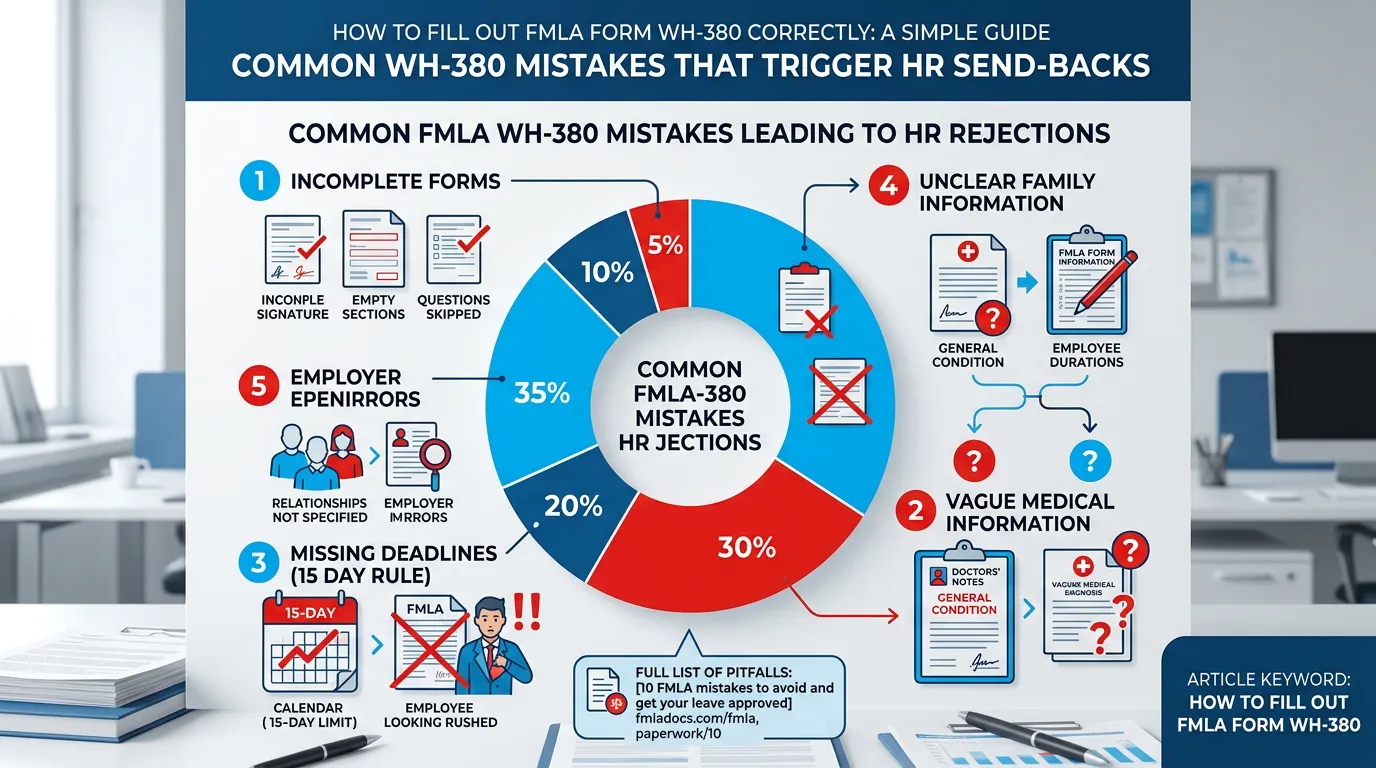
HR departments reject thousands of FMLA certifications every month. Most rejections happen because providers leave sections blank or write vague answers. These mistakes force employees to restart the process and burn through their 15-day deadline. For a full list of pitfalls, see 10 FMLA mistakes to avoid and get your leave approved.
Missing Dates and Duration Information
Writing “unknown” for expected duration gets forms rejected immediately. Employers need a reasonable medical estimate based on typical recovery timelines. Your provider should write “4-6 weeks” or “ongoing with monthly treatment” instead of leaving it blank.
Leaving the frequency section empty for intermittent leave makes approval impossible. According to the SHRM guide to FMLA forms, employers can’t approve a schedule without knowing how often you’ll be absent. Your certification must state “2-3 times per month” or “weekly appointments every Tuesday.”
Insufficient Functional Impact Description
General statements like “patient cannot work” don’t explain why. Your provider must describe specific work limitations. Can you stand for extended periods? Do you have difficulty concentrating? Do you need frequent bathroom access?
These details show how your condition affects job functions. Writing “severe migraines” without explaining light sensitivity, nausea, or inability to look at screens leaves room for denial. Functional impact is what proves you qualify.
Incomplete Provider Signatures and Credentials
Providers who sign without including their medical license number create verification problems. HR needs to confirm the person completing your form is actually licensed. Missing specialty information or contact details also trigger rejections.
Your certification must show the provider’s full credentials. That means license number, specialty area, phone number, and practice address. Without this information, employers can’t verify authenticity and will send the form back for corrections.
Where to Get Current DOL Forms + Electronic Submission Tips
Getting the right FMLA forms matters. Using outdated versions can delay your application or cause rejection. Here’s where to find current forms and how to submit them properly.
Official Department of Labor Download Links
Download WH-380-E and WH-380-F forms directly from the DOL website. These are the official versions employers accept. The DOL updates forms periodically to reflect regulation changes. Always check the form date before submitting.
According to 12-week FMLA entitlement rules, WH-380-E covers your own serious health condition. WH-380-F applies when you’re caring for a family member. Don’t mix them up.
Employer-Provided Forms and Equivalents
Some employers provide their own forms through HR portals or benefits systems. These must meet DOL requirements to be valid. Check with HR before using employer-specific forms.
Your employer’s form should ask the same questions as the DOL version. It should cover diagnosis, treatment frequency, and functional limitations. If it doesn’t, request the standard DOL form instead.
Electronic vs. Paper Submission
Electronic submission through employer portals offers clear advantages. You get automatic confirmation and timestamp records. This proves you submitted on time if disputes arise later.
Paper forms need extra protection. Submit with delivery confirmation or hand-deliver with a receipt. Keep proof of submission date. Without it, you can’t prove you met the 15-day deadline.
Before submitting either way, save digital copies of completed forms. Store them in a personal email or cloud drive. If the original gets lost, you’ll have backup documentation.
When to Use FMLADocs Instead of Waiting on Your PCP
Scheduling Delays and the 15-Day Deadline
Most primary care providers book two to four weeks out. That eats up your entire 15-day certification window.
You can’t afford to wait when your job protection depends on timely paperwork. Missing the deadline puts your FMLA leave at risk.
When Your Provider Isn’t Familiar With FMLA Forms
Many doctors don’t handle FMLA forms often. They leave sections blank or write vague answers.
Employers reject incomplete forms. You’re back to square one, scrambling to fix errors with days left.
How FMLADocs Completes Certification Quickly
FMLADocs connects you with board-certified doctors who specialize in FMLA cases. They know precisely what employers need to approve your leave.
Our doctors complete forms correctly the first time. They include specific frequency, duration, and functional impact details that meet federal requirements.
Turnaround takes 24-48 hours. You get proper certification without scheduling delays or incomplete paperwork.
Start your FMLA certification online right now. Skip the wait and get forms done right when your deadline approaches.
Conclusion
Form WH-380 doesn’t have to derail your leave plans. You now know which form to use, what goes in each section, and how to avoid the mistakes that trigger rejections. The employee portion requires your personal details and employer information. The healthcare provider section needs specific medical documentation you can’t complete yourself. Vague duration estimates and missing frequency details cause most send-backs.
When you understand FMLA certification requirements, the process becomes manageable. Your healthcare provider must describe functional limitations clearly. They need to specify how often episodes occur and how long each one lasts. Generic statements won’t pass HR review.
Most primary care offices book weeks out. That timeline doesn’t work when you face a 15-day certification deadline. If your regular provider can’t complete your paperwork in time, you need a faster option. FMLADocs connects you with licensed physicians who specialize in completing FMLA medical forms correctly the first time. Our doctors understand precisely how to fill out FMLA form WH-380 to meet DOL standards, and they typically finish certifications within 24-48 hours so you can meet your deadline without scheduling stress.
Ready to move forward? Check your eligibility for FMLA leave today and take the first step toward protecting your job while you care for your health.
Frequently Asked Questions
What is DOL Form WH-380-E?
DOL Form WH-380-E is the official FMLA certification form for your own serious health condition. You use this form when you need leave for surgery, chronic illness, mental health treatment, or pregnancy complications. Your healthcare provider completes this form to document how your condition affects your ability to work.
What is WH-380-F?
WH-380-F is the FMLA certification form for when you're caring for a family member with a serious health condition. You use this form to request leave to care for a spouse, child, or parent who needs medical attention. Your family member's healthcare provider completes this form to document their condition and care requirements.
Can I fill out the doctor's section?
No, you cannot fill out Section II of the WH-380 form yourself. Section II must be completed by an authorized healthcare provider who has treated you or your family member. Only a licensed medical professional can verify the medical facts, diagnosis, and functional limitations required by your employer.
Where do I download WH-380 forms?
Download WH-380-E and WH-380-F forms directly from the Department of Labor WHD FMLA forms page at DOL.gov. Always verify you have the current version, as the DOL updates forms periodically to reflect regulation changes. Using outdated versions can result in rejection even if all information is correct.
How long is WH-380 certification valid?
WH-380 certification typically remains valid until the end of the leave period specified on the form, usually up to one year for intermittent leave. Your employer may request recertification if your leave extends beyond the original certification period. The specific validity timeline depends on your condition and the leave arrangement you and your employer establish.
What if my doctor leaves fields blank?
Incomplete WH-380 forms may be rejected by your employer's HR department. When a form has blank sections, your employer must specify the deficiencies in writing and return it for corrections. This delays your leave approval and burns through your 15-day certification deadline, so verify your provider completes every required field.
Can telehealth physicians complete WH-380?
Yes, telehealth physicians can complete WH-380 certification forms when a proper evaluation has been performed. The healthcare provider must have sufficient knowledge of your condition to accurately document your medical facts and functional limitations. The DOL does not prohibit telehealth providers from certifying FMLA leave as long as they meet all qualification requirements.
Does WH-380 require a diagnosis on the form?
Healthcare providers describe your condition and functional limitations on WH-380, but diagnosis disclosure rules vary by state and situation. You should educate yourself about what information your employer needs without oversharing sensitive health details to HR. Your provider can focus on functional impact rather than specific diagnosis codes when appropriate.

Meet the author
Areeba Imran
I am a healthcare professional and seasoned medical writer with 13+ years of experience across health, wellness, and clinical content. My work focuses on delivering trustworthy, evidence-based information that empowers readers to make informed decisions. With a keen interest in innovation and evolving areas of patient care, I bring a modern perspective to today's healthcare setup.
Get Your FMLA Certification Online in Minutes