

What Is a Serious Health Condition Under FMLA?
 by Nida Hammad
 Last updated:
If you are dealing with a serious illness, managing a chronic condition, or caring for a sick family member, understanding what is a serious health condition under FMLA can make all the difference in protecting your job. The Family and Medical Leave Act (FMLA) grants eligible employees up to 12 workweeks of unpaid, job-protected leave each year. But not every medical issue qualifies. The FMLA serious health condition definition is specific and legally defined, and knowing exactly where your situation falls can help you take the right steps without risking your employment.
This article covers everything you need to know about the FMLA serious health condition definition, the categories of qualifying conditions, what is not covered, and how to get your certification in order.
The FMLA Serious Health Condition Definition
According to the U.S. Department of Labor’s Wage and Hour Division Fact Sheet #28F, a serious health condition under the FMLA is an illness, injury, impairment, or physical or mental condition that involves either inpatient care at a hospital, hospice, or residential medical care facility, or continuing treatment by a healthcare provider. The definition also encompasses any period of incapacity that makes the employee unable to work, attend school, or perform regular daily activities.
The term is intentionally not meant to cover short-term conditions where treatment and recovery are brief. According to the U.S. Office of Personnel Management (OPM), common examples of serious health conditions include cancer, heart attacks, strokes, severe injuries, Alzheimer’s disease, and any incapacity resulting from pregnancy or childbirth. By contrast, the common cold, earaches, upset stomach, routine headaches (other than migraines), and standard dental problems generally do not qualify unless complications arise.
To learn more about what conditions qualify, visit FMLADocs’ guide on what qualifies for FMLA leave.
The Six Categories of FMLA Serious Health Conditions
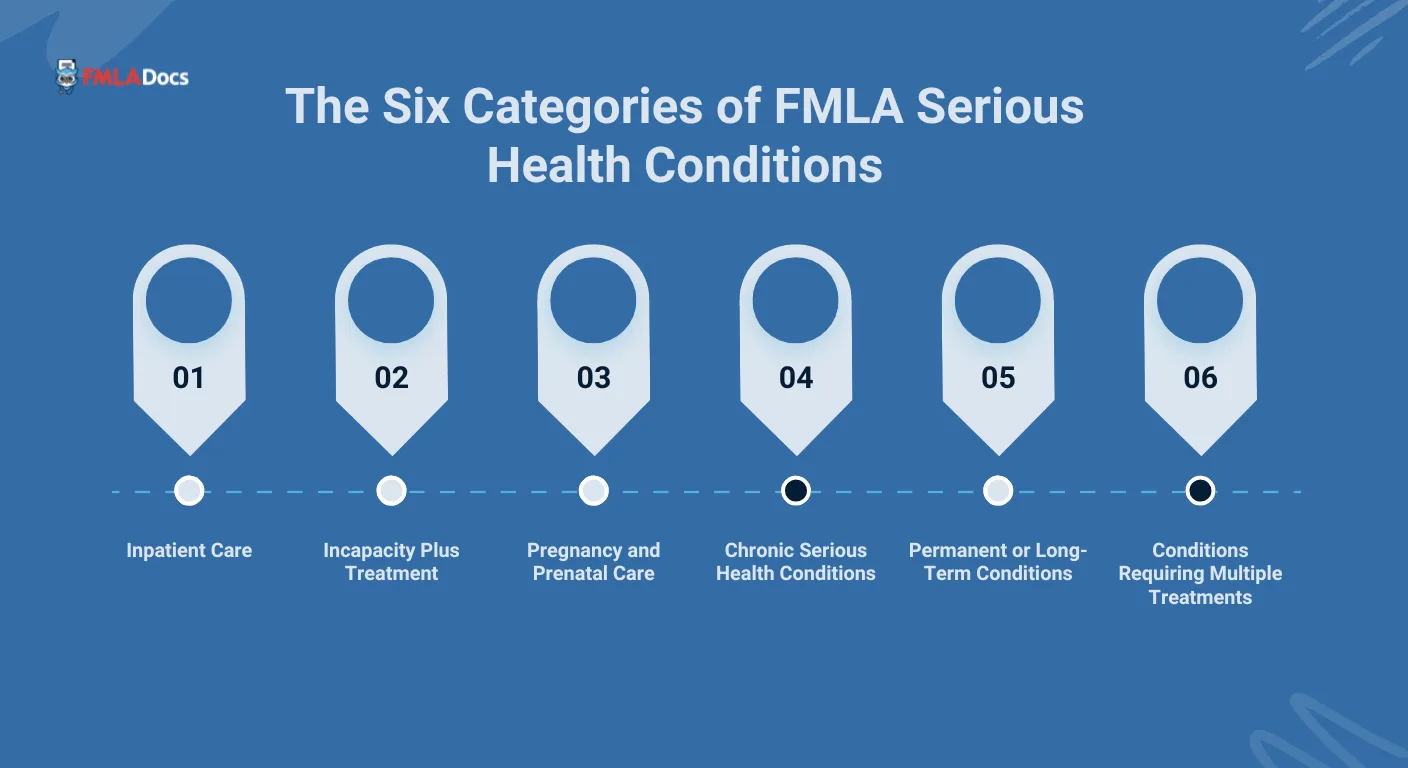
Federal regulations establish six distinct categories that define what constitutes a serious health condition under FMLA. The DOL Employer’s Guide to the FMLA outlines these categories in detail. Your condition must fall into at least one of them in order to qualify for protected leave.
1. Inpatient Care
This category applies when an employee or their family member requires an overnight stay in a hospital, hospice, or residential medical care facility. Any subsequent incapacity or treatment connected to that inpatient stay also qualifies. For example, a hospitalization for a surgical procedure followed by weeks of home recovery would fall under this category.
2. Incapacity Plus Treatment
A condition qualifies if it causes incapacity lasting more than three consecutive calendar days, combined with ongoing medical treatment. Ongoing treatment means either two or more visits to a healthcare provider within 30 days, or a single visit followed by a regimen of continuing treatment such as prescription medication. Both elements, incapacity and treatment, must be present.
3. Pregnancy and Prenatal Care
Pregnancy is explicitly recognized as a serious health condition under FMLA. This includes prenatal appointments, incapacity due to morning sickness, medically required bed rest, and recovery from childbirth. As noted in DOL Fact Sheet #28F, both the birth parent and the other parent may use FMLA leave related to the birth or care of a newborn during the 12-month period following delivery.
4. Chronic Serious Health Conditions
Chronic conditions are among the most common reasons employees use FMLA. According to the FMLA Frequently Asked Questions published by the DOL, a condition qualifies as chronic when it requires periodic visits to a healthcare provider at least twice a year, continues over an extended period of time, and may cause episodic rather than continuous periods of incapacity. Conditions like asthma, diabetes, epilepsy, migraines, PTSD, and rheumatoid arthritis often meet this definition, even if the employee is able to work most of the time.
5. Permanent or Long-Term Conditions
When a condition is permanent or expected to result in long-term incapacity, leave may still be available even without active medical treatment. The OPM FMLA fact sheet specifically notes that Alzheimer’s disease, severe strokes, and the terminal stages of serious illnesses fall into this category. The employee must still be under the supervision of a healthcare provider, even if the condition cannot be cured.
6. Conditions Requiring Multiple Treatments
Some conditions require multiple treatments to prevent long-term incapacity if left untreated. Cancer chemotherapy, kidney dialysis, physical therapy following a severe injury, and restorative surgery are all examples. The employee need not be incapacitated between treatments for this category to apply.
Not sure if your condition qualifies? Check your eligibility and get your FMLA certification online through FMLADocs — a licensed physician reviews your case and completes your paperwork, often within 24 hours, without an in-person visit.
FMLA Serious Health Condition List: Common Qualifying Conditions
While the law does not provide an exhaustive FMLA serious health condition list, the categories above cover a wide range of physical and mental health conditions. The FMLA Triggers reference published by Montgomery County, MD offers a practical breakdown of triggering events. The following are among the most commonly approved conditions:
Physical Health Conditions
-
Cancer and cancer treatment (chemotherapy, radiation, surgery recovery)
-
Heart disease, heart attacks, and post-cardiac event recovery
-
Diabetes requiring ongoing monitoring and treatment
-
Severe back injuries and spinal conditions
-
Asthma and chronic respiratory conditions
-
Migraines (classified as a serious health condition when chronic or severe)
-
Pregnancy complications, gestational diabetes, and preeclampsia
-
Major surgery recovery
Mental Health Conditions
Mental health conditions are fully recognized under the FMLA serious health condition definition. According to the DOL’s FMLA Frequently Asked Questions, a chronic mental health condition such as anxiety, depression, PTSD, or bipolar disorder that causes occasional periods of incapacity and requires treatment by a healthcare provider at least twice a year qualifies as a serious health condition. Specific examples include:
-
Major depressive disorder
-
Generalized anxiety disorder and panic disorder
-
Bipolar disorder
-
Post-traumatic stress disorder (PTSD)
-
Obsessive-compulsive disorder (OCD)
-
Eating disorders requiring ongoing treatment
-
Substance abuse disorders requiring inpatient or outpatient treatment
Caregiving Situations
Eligible employees can also take FMLA leave to care for a spouse, child, or parent who has a serious health condition. As detailed in DOL Fact Sheet #28F, caring for a family member under the FMLA includes assistance with basic medical, hygienic, nutritional, and safety needs, as well as transportation to appointments and psychological comfort and support.
What Does NOT Qualify as a Serious Health Condition Under FMLA?
Understanding the limits of the FMLA serious health condition definition is just as important as knowing what qualifies. The OPM FMLA fact sheet makes clear that the following typically do not meet the standard, unless complications arise:
-
The common cold and seasonal flu (unless complications lead to hospitalization)
-
Routine dental or orthodontia procedures
-
Ordinary upset stomach or earaches
-
Minor injuries or sprains that do not result in incapacity beyond three days
-
Elective cosmetic procedures not medically necessary
The key principle is that the condition must genuinely impair the employee’s ability to work, attend school, or carry out major daily activities, either continuously or periodically over time.
FMLA Eligibility: Who Qualifies to Take Leave?
Even if your condition clearly meets the FMLA serious health condition definition, you must also meet the employee eligibility requirements. According to DOL Fact Sheet #28F, to be eligible for FMLA leave you must:
-
Work for a covered employer (private employers with 50 or more employees, public agencies, or local educational agencies)
-
Have worked for your employer for at least 12 months
-
Have logged at least 1,250 hours of service during the 12 months prior to the start of leave
-
Work at a location where the employer has at least 50 employees within 75 miles
Federal employees are covered under separate rules administered by the Office of Personnel Management (OPM), but the core protections are broadly similar.
Intermittent Leave for Serious Health Conditions
One of the most valuable but underused aspects of FMLA is intermittent leave. When medically necessary, employees with a qualifying serious health condition do not have to take all 12 weeks at once. They can take leave in separate blocks of time or reduce their usual work schedule, for instance, leaving early on days when symptoms flare or taking off one day per week for treatment appointments.
This is especially important for employees managing chronic conditions such as migraines, Crohn’s disease, PTSD, or diabetes. Learn more about how intermittent FMLA leave works and whether it applies to your situation. The DOL’s guidance on how to talk to your employer about leave also provides practical advice on communicating your intermittent leave needs without disclosing unnecessary medical details.
How to Document a Serious Health Condition for FMLA
Once you have determined that your condition likely qualifies, the next step is documentation. According to the DOL FMLA Frequently Asked Questions, your employer is entitled to request a medical certification from your healthcare provider. The official FMLA certification forms (WH-380-E for the employee’s own condition, WH-380-F for a family member’s condition) are available from the DOL. The certification must include:
-
The date the serious health condition began
-
The probable duration of the condition
-
The medical facts about the condition sufficient to establish that it qualifies
-
Whether the employee is unable to perform essential job functions
-
If applicable, whether intermittent or reduced-schedule leave is medically necessary
The employer must give you at least 15 calendar days to obtain and return the certification. If your certification is found to be incomplete, your employer must advise you in writing and allow you at least 7 additional days to correct the deficiency, as outlined in the DOL Employer’s Guide to the FMLA.
Your employer may request a second or third opinion, at their own expense, if they have reason to doubt the validity of the original certification. Recertification may be requested no more frequently than every 30 days, or more often if circumstances change significantly.
Your Rights Once a Serious Health Condition Is Documented
Once your leave is approved, federal law gives you significant protections. According to DOL Fact Sheet #77B on FMLA Protections, your employer is prohibited from:
-
Interfering with, restraining, or denying any FMLA right
-
Discriminating or retaliating against you for exercising your FMLA rights
-
Using your FMLA leave as a negative factor in employment decisions such as hiring, promotions, or disciplinary actions
-
Counting FMLA leave against you under attendance policies
When you return from FMLA leave, you are entitled to be restored to the same position you held before, or an equivalent position with the same pay, benefits, and other terms and conditions of employment.
Your health insurance coverage must also continue during your leave under the same conditions as if you had not taken leave. You are simply responsible for continuing to pay your share of the premium.
Ready to take action? FMLADocs connects you with licensed physicians who can complete your FMLA medical certification online — accepted by employers nationwide, HIPAA-compliant, and typically delivered within 24 hours. Thousands of employees have used FMLADocs to navigate their FMLA certification with confidence and ease.
State-Level Protections Beyond the FMLA
While the FMLA provides a federal baseline, many states offer additional or more generous family and medical leave protections. The DOL’s Military Family Leave Guide also highlights how military-connected families may access additional state-level benefits. For example, California offers up to 8 weeks of Paid Family Leave, New York provides up to 12 weeks of paid leave for family care or bonding, and states like Colorado, Oregon, and Washington have enacted their own paid leave programs. In most cases, if you qualify for both state and federal leave, your time off runs concurrently. The FMLA still plays a critical role in ensuring your job is protected even when your state provides wage replacement.
If you work for a small employer or have not yet met all federal FMLA eligibility requirements, your state program may still provide partial protections. It is always worth checking both federal and state leave entitlements.
Frequently Asked Questions
1. Does anxiety qualify as a serious health condition under FMLA?
Yes. Anxiety disorders, including generalized anxiety disorder and panic disorder, can qualify as a serious health condition under FMLA if the condition causes periods of incapacity and requires treatment by a healthcare provider at least twice a year. The DOL FMLA FAQ specifically addresses mental health conditions as qualifying serious health conditions. A licensed provider must document that the condition is ongoing and impacts your ability to perform essential job functions.
2. Can I use FMLA for a family member's serious health condition?
Yes. Eligible employees may take FMLA leave to care for a spouse, child, or parent with a serious health condition. According to DOL Fact Sheet #28F, this includes providing physical assistance, transportation to medical appointments, and psychological support. However, leave to care for siblings, in-laws, or extended family members is not covered under federal FMLA unless a specific legal relationship applies.
3. How long does a condition have to last to be considered serious under FMLA?
For the incapacity-plus-treatment category, the incapacity must last more than three consecutive calendar days and be accompanied by ongoing treatment. For chronic conditions, the condition must recur over an extended period with at least two healthcare provider visits per year. Inpatient care triggers coverage regardless of duration, as even a single overnight hospital stay can qualify.
4. What forms does my employer need for FMLA documentation?
The standard forms are the DOL's WH-380-E and WH-380-F for the employee's own serious health condition and for a family member's serious health condition, respectively. These forms must be completed by a licensed healthcare provider and returned to your employer within 15 calendar days of the request. FMLADocs can connect you with a licensed provider to complete these forms accurately and compliantly.
5. Can my employer deny FMLA leave for a serious health condition?
Your employer can only deny FMLA leave if you do not meet the eligibility requirements, if you have already used your full 12-week entitlement, or if the medical certification provided is incomplete or insufficient. If your certification is complete and you meet the eligibility criteria, denial constitutes interference with your FMLA rights. Under Fact Sheet #77B, such interference may be grounds for a complaint with the Wage and Hour Division.
6. Is pregnancy a serious health condition under FMLA?
Yes. Pregnancy is explicitly covered as a serious health condition under FMLA. As confirmed by the DOL FMLA Frequently Asked Questions, this includes prenatal care visits, incapacity due to morning sickness, pregnancy-related complications such as preeclampsia or gestational diabetes, medically required bed rest, and recovery from childbirth. Both parents also have the right to take FMLA leave to bond with a newborn during the 12 months following birth.
Meet the author
Nida Hammad
I am a professional writer with over five years of experience creating clear, engaging, and well-researched content. I specialize in healthcare topics, helping readers understand complex information in simple wording. Currently, I write for FMLA DOC, where I focus on producing accurate and trusted guides for people seeking support with FMLA and medical needs.
Get Your FMLA Certification Online in Minutes