

FMLA Certification Deadline: Employee vs Employer
 by Nida Hammad
 Last updated:
Missing the fmla certification deadline can cost you job protection. The 15-day window starts when your employer formally requests certification, not when you schedule your doctor visit. Most employees don’t realize this. They assume the clock starts when forms arrive in the mail or when they finally get an appointment. That confusion leads to missed deadlines and denied leave requests.
The U.S. Department of Labor reports that incomplete or late medical certification causes most FMLA application delays. Doctor scheduling delays average 2-4 weeks in many areas. That means your 15 day fmla certification deadline can close before you even sit down with your healthcare provider. Employers face strict timelines too. Many HR departments struggle to meet their own deadlines consistently.
This guide breaks down every certification deadline from both sides. You’ll learn exactly when each clock starts ticking, what happens when deadlines are missed, and how to protect your job while getting certification completed. We cover the 15-day employee window, the 5-day employer request deadline, intermittent leave requirements, and whether your leave can start before certification returns. You’ll also discover what protections you gain when employers miss their deadlines.
Don’t let a missed appointment cost you your job protection**,** get your FMLA certification started today.
The 15-Day Employee FMLA Certification Deadline: When the Clock Actually Starts
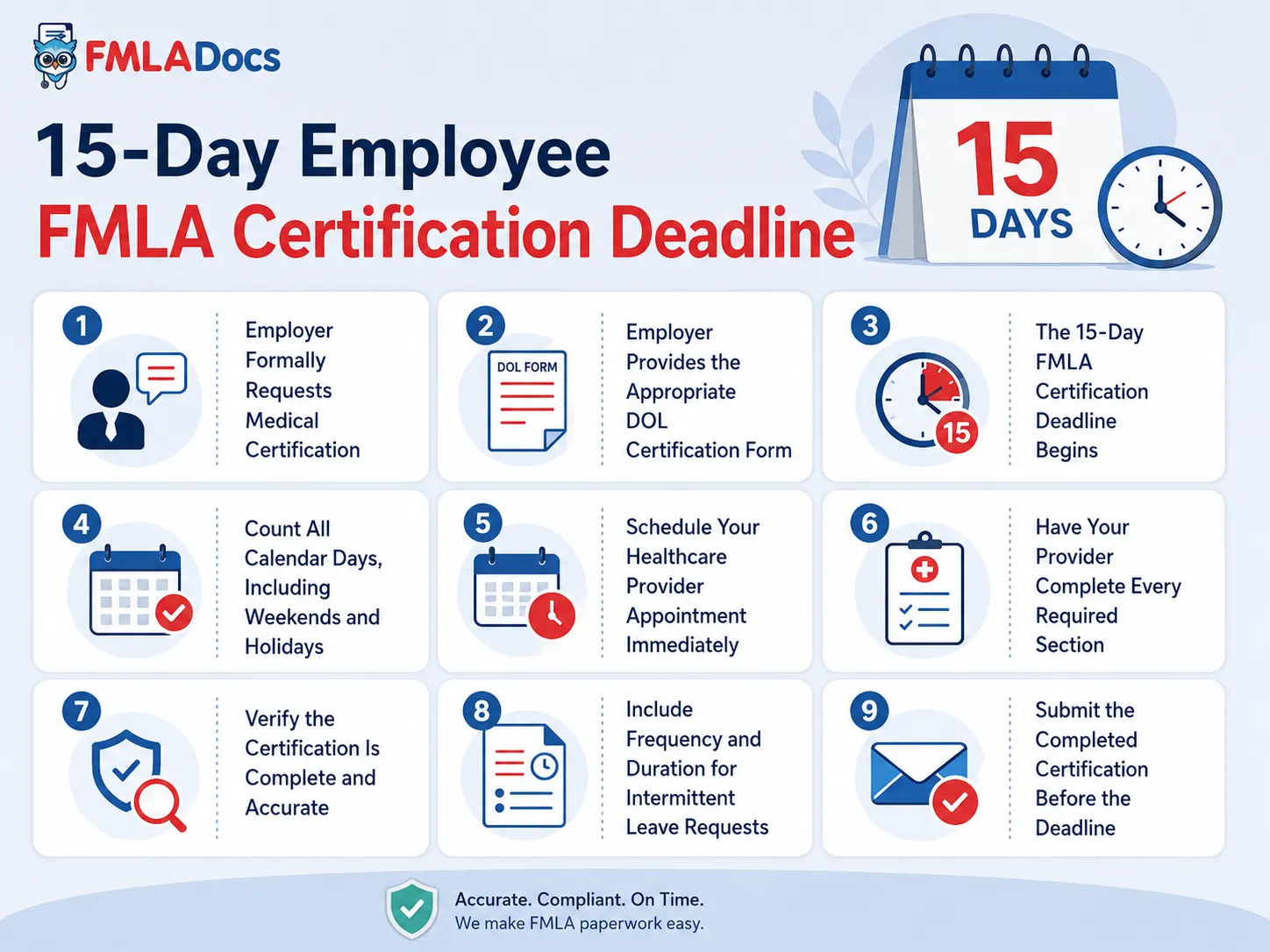
The fmla certification deadline begins only when your employer formally requests medical certification in writing. Not when you first notify them of your need for leave. Not when you mention a health issue. The clock starts when they send the official request.
This distinction trips up many employees. You might tell HR in January that you need leave. But if they don’t formally request certification until February, your 15 days start in February. Understanding the FMLA approval timeline and certification process helps you avoid missing this critical window.
What Triggers the 15-Day Window
Your employer must provide you with the appropriate DOL Form along with written notice. They’ll send Form WH-380-E for your own condition. They’ll send Form WH-380-F for family member care. The notice must state the deadline and consequences of missing it.
The clock starts when the request is sent, not when you receive it. Mail delays can eat into your window without you realizing it. If your employer sends the form on Monday but you don’t check your mail until Friday, you’ve already lost four days.
Calendar Days vs Business Days
These are 15 calendar days including weekends and holidays. Not business days. This catches many employees by surprise and shortens the actual window significantly.
That means if you receive the request on a Friday, the following Saturday and Sunday count. If there’s a holiday during those 15 days, it counts too. You might have only 10-11 actual business days to schedule appointments and get forms completed.
What Counts as Complete Certification
Certification must be complete with all required fields filled out. Your provider must include diagnosis date, expected duration, treatment frequency, and functional limitations. They must sign with credentials and contact information.
If you submit incomplete certification, the 15-day clock doesn’t reset. You must cure deficiencies within the original timeframe or any extension your employer grants. Many employees don’t realize what medical documentation FMLA requires until they’ve already submitted incomplete forms.
For intermittent leave, certification must also include estimated frequency of episodes. Write something like “2-4 times per month” rather than “as needed.” Include expected duration of each episode. Write “4-8 hours” or “1-2 days” instead of “varies.” Vague answers get rejected.
The 5-Day Employer Request Window and Other Employer Deadlines
Understanding the fmla certification deadline means knowing your employer’s obligations too. They can’t delay indefinitely when you request leave. Federal law sets strict timelines for when employers must act.
When Employers Must Request Certification
Your employer has five business days from learning you need leave for a serious health condition to request medical certification. This clock starts when you notify them about your need for FMLA leave. They can’t wait weeks to send you paperwork.
According to the Department of Labor, this five-day window protects employees from unnecessary delays. If your employer misses this deadline, they can’t penalize you for delays caused by their late request. Document when you first notified them.
Eligibility and Designation Notice Deadlines
Within five business days of your leave request, employers must provide an eligibility notice. This confirms whether you meet FMLA requirements. You need 12 months employed, 1,250 hours worked, and your employer must have 50+ employees within 75 miles.
After receiving complete certification, employers have five business days to designate your leave as FMLA-protected or deny it. They must provide written explanation if they deny your request. These deadlines keep the process moving.
What Employers Must Provide With the Request
The certification request must specify what information is needed. It should include the appropriate DOL form and state the 15-day deadline clearly. Employers must explain consequences of failing to provide complete certification.
They cannot contact your healthcare provider directly without your written authorization. They cannot require more information than DOL forms request. For recertification of ongoing conditions, employers can request updated forms every 30 days if the minimum duration has passed. For chronic conditions, they can request updates every six months.
What Happens When Employees Miss the Certification Deadline
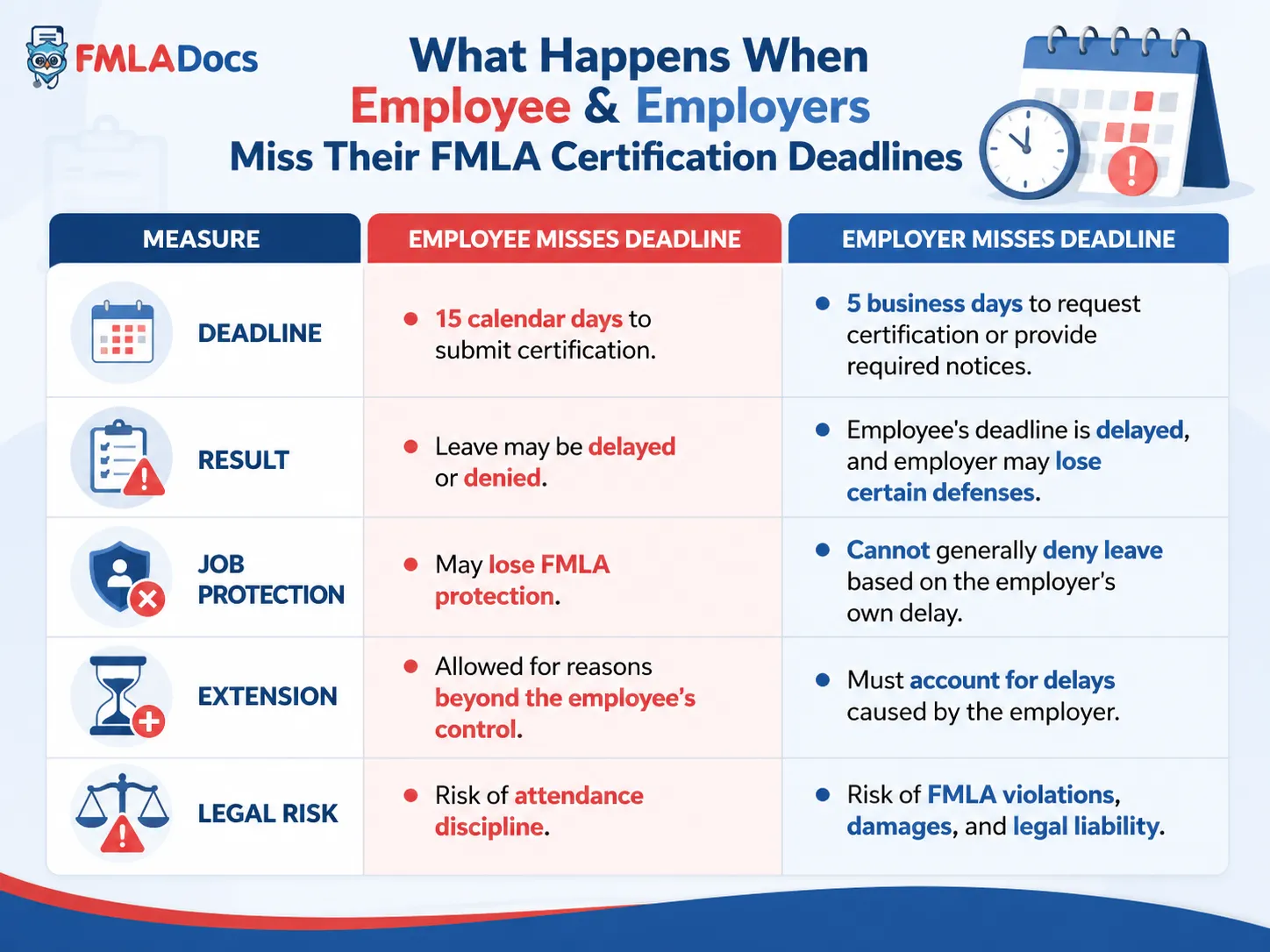
Missing the FMLA certification deadline can put your job protection at risk. Employers can deny FMLA protection if you fail to provide certification within 15 days without a reasonable explanation. Your absence becomes unprotected, leaving you vulnerable to discipline.
Immediate Consequences of Late Submission
When you miss the deadline, your time off may be treated as unexcused under company attendance policies. This can lead to disciplinary action up to and including termination. Without proper certification, you lose the job protection FMLA provides.
Your employer isn’t required to wait indefinitely for paperwork. Once the 15-day window closes, they can move forward with attendance policies as if you never requested FMLA. That’s why understanding what happens when your employer denies your FMLA request matters from the start.
When Employers Must Grant Extensions
Not all late submissions result in denial. Employers must grant extensions if circumstances beyond your control prevented timely submission. These include situations where your doctor was unavailable for appointments within the window.
Other qualifying circumstances include:
-
Medical emergency that prevented you from following up
-
Administrative delays at your provider’s office
-
Mail or transmission failures beyond your control
If you can demonstrate reasonable efforts to obtain certification but faced legitimate obstacles, many employers grant 7-14 day extensions. Documentation of your attempts becomes critical in these situations.
How to Request Additional Time
Late submission doesn’t automatically disqualify you from FMLA protection. Document all attempts to obtain certification, including appointment requests, phone calls, and emails. Communicate delays to HR immediately rather than waiting until after the deadline passes.
Keep copies of everything. Save your certification request with the date received. Store all communications with your provider’s office. Keep submission confirmations and any correspondence with HR about delays.
Some employers have internal policies more generous than federal requirements. Always check your employee handbook for company-specific grace periods. What works at one company may differ at another, so knowing your specific employer’s policies protects you.
What Happens When Employers Miss Their Deadlines
Employers face strict timelines under FMLA. When they miss these deadlines, you gain protections most employees don’t know about.
Late Eligibility or Designation Notices
Your employer must provide eligibility notice within five business days of learning you need leave. If they fail to do this, they can’t later claim you didn’t meet notification requirements.
Their delay waives certain procedural objections. This means if they try to deny your leave citing missed steps, their own failure to notify you on time undermines that argument.
Document when you first requested leave. If no eligibility notice arrived within five days, note that date. This timeline matters if disputes arise later.
Delayed Certification Requests
Employers must request medical certification within five business days after learning of your need for leave. Your 15-day window to submit certification doesn’t start until they actually make the request.
If your employer waits two weeks to request certification, you still get 15 full days from that delayed request date. You can’t be penalized for their administrative lag.
Track when you notified HR and when they formally requested certification. The gap between these dates protects you from qualifying conditions documentation timing issues.
Your Rights When Employer Timing Causes Problems
Employers who miss the five-day designation deadline after receiving complete certification can’t retroactively deny leave you already took in good faith. If you were out for three days before they designated your leave, those days remain protected.
If their late request causes you to miss work before certification is complete, they generally can’t count that time as unexcused once you’re ultimately approved. The key is proving their delay caused the gap.
Employer delays that cause you to exceed the 15-day window through no fault of your own must be considered. You can’t be penalized for their administrative failures. If your employer denies leave citing missed deadlines that resulted from their own delays, file a complaint with the DOL Wage and Hour Division with your documentation.
Intermittent Leave and Recertification Timing Requirements
Intermittent leave certification requires precise detail. Your doctor can’t write “as needed” for frequency. They must specify “2-4 episodes per month” or “1-2 times weekly.” Duration needs the same specificity: “4-8 hours per episode” or “1-3 days per flare.” Vague language gets rejected immediately.
Initial Certification for Intermittent Leave
For chronic conditions like migraines, Crohn’s flares, or panic attacks, certification must explain why you need intermittent leave rather than continuous time off. Your provider should describe unpredictable episodes that prevent work during active symptoms but allow normal function between episodes. This distinction matters because employers evaluate whether your condition truly requires sporadic absences.
The certification should detail how episodes manifest. For panic disorder, that means describing sudden onset, typical duration, and why you can’t remain at work during an attack. For Crohn’s disease, explain bathroom frequency during flares and why this makes sustained work impossible.
When Recertification Can Be Requested
Your employer can request recertification every 30 days if the minimum duration on your original certification has passed and you’re still taking leave. For chronic conditions expected to last more than a year, they can request recertification every six months regardless of what your original form stated. According to FMLA Insights, each recertification request restarts a 15-day window. You must respond within 15 calendar days each time. The same extension rules apply if your doctor needs more time.
Tracking Your 12-Week Entitlement
Your 12-week FMLA entitlement calculates based on actual hours used, not calendar time. If you take four hours for a migraine, you use four hours of your entitlement. This means intermittent leave can stretch across an entire year if episodes happen infrequently.
Keep detailed records of every absence. Document the date, duration, and reason for each instance you take under intermittent FMLA. Disputes often arise about whether you’ve exceeded your 12-week allotment. Your records become critical evidence.
If your condition worsens or circumstances change significantly, submit updated certification even before your employer requests it. Don’t wait for the formal request if your situation has shifted.
Can Your Leave Start Before Certification Is Returned?
Yes, your leave can start before certification is complete. You don’t have to wait for approval to take medically necessary time off. This protects employees who need immediate care while paperwork processes.
Provisional FMLA Designation
Employers may provisionally designate leave as FMLA-protected while waiting for certification. This protects your job during the review period. Your position remains secure even though final approval hasn’t arrived.
For unforeseeable leave like sudden illness or emergency, notify your employer as soon as practicable. This typically means within one to two business days. You don’t need to see a doctor first before giving notice.
Retroactive Approval and Denial
If certification is ultimately approved, your leave is retroactively protected from the start date. Any time you took counts as FMLA leave. It cannot be held against you under company policy.
However, federal regulations on late certification specify that if certification is denied or never submitted, consequences follow. Your employer can retroactively treat those absences as unexcused. This potentially leads to discipline under standard attendance policies.
Managing the Gap Between Request and Approval
For foreseeable leave like planned surgery or childbirth, provide 30 days’ advance notice when possible. This gives you time to complete certification before leave begins. It also helps HR prepare for your absence.
Communicate with HR throughout the process. If your doctor’s appointment is scheduled for day 10 of your 15-day window, let them know. This shows certification is in progress and demonstrates good faith effort.
Never assume silence means approval. Follow up to confirm your leave has been officially designated as FMLA-protected. Get written confirmation through email or formal designation notice. This documentation protects you if disputes arise later.
Conclusion
The FMLA certification deadline system works both ways. You get 15 days to return certification once formally requested. Your employer gets 5 days to request it and designate your leave. Missing these windows creates real problems, but extensions exist when delays aren’t your fault. The sections above covered when your clock starts, what happens when either side misses deadlines, how intermittent leave changes timing, and whether leave can start before certification arrives.
The key is speed. Contact your doctor immediately when you know you need leave. Document every submission with delivery confirmation. Track all dates carefully. If your employer misses their deadlines, note the timeline because their delays can’t hurt your protection.
Here’s the challenge: getting a timely appointment. Many providers book weeks out, which doesn’t work with a 15 day FMLA certification deadline. That’s where FMLADocs helps. We connect you with board-certified physicians who complete certifications within 24 to 48 hours. Our doctors know exactly what employers require and fill every field correctly the first time. No rejected forms. No missed deadlines. No scheduling delays that risk your job protection.
Frequently Asked Questions
When does the 15-day FMLA certification deadline actually start?
The 15-day FMLA certification deadline starts when your employer formally requests medical certification in writing, not when you first notify them about needing leave. The clock begins when they send the official request with the appropriate DOL form. This means if you tell HR about your health issue in January but they don't formally request certification until February, your 15 days start in February. Mail delays can reduce your window since the deadline starts when the request is sent, not when you receive it.
Are the 15 days for FMLA certification calendar days or business days?
The 15-day FMLA certification deadline uses calendar days, not business days. This includes weekends and holidays. If you get the request on a Friday, Saturday and Sunday both count toward your deadline. Any holidays during those 15 days also count. This means you might have only 10-11 actual business days to schedule appointments and get forms completed. Many employees don't realize this distinction and end up with less time than they expected to meet the deadline.
What happens if I submit incomplete FMLA certification within the 15-day deadline?
If you submit incomplete FMLA certification, the 15-day clock doesn't reset. You must fix any deficiencies within the original timeframe or any extension your employer grants. Complete certification requires all fields filled out, including diagnosis date, expected duration, treatment frequency, and functional limitations. Your provider must sign with credentials and contact information. For intermittent leave, you also need estimated frequency like "2-4 times per month" rather than vague terms like "as needed" plus expected duration of each episode.
WWhy do most FMLA applications get delayed?
The U.S. Department of Labor reports that incomplete or late medical certification causes most FMLA application delays. Doctor scheduling delays average 2-4 weeks in many areas. This creates a serious problem because your 15-day FMLA certification deadline can close before you even sit down with your healthcare provider. Many employees assume the clock starts when forms arrive in the mail or when they schedule an appointment. That confusion leads to missed deadlines and denied leave requests that could have been avoided with better timing.
What forms does my employer send for FMLA certification?
Your employer must provide the appropriate DOL form along with written notice when they formally request FMLA certification. They'll send Form WH-380-E if you need leave for your own medical condition. They'll send Form WH-380-F if you need leave to care for a family member. The notice must clearly state the deadline for returning the completed form and explain the consequences of missing it. This formal request with the proper form is what triggers your 15-day certification deadline.
Can mail delays affect my FMLA certification deadline?
Yes, mail delays can significantly reduce your FMLA certification window because the 15-day deadline starts when your employer sends the request, not when you receive it. If your employer mails the form on Monday but you don't check your mail until Friday, you've already lost four days from your deadline. This is why understanding when the clock actually starts is critical. You can't control postal delivery times, but you can stay alert for expected FMLA correspondence and check your mail regularly during this period.
What happens if my employer is late sending the certification request or the designation notice?
The FMLA does not impose an automatic penalty for a late employer notice the way it does for incomplete employee certification. However, a delayed notice can still have legal consequences. If your employer's delay causes you to lose FMLA rights you otherwise would have had, such as job restoration because your leave was not designated on time, the delay may be considered FMLA interference or a violation. In many cases, once the leave is properly designated, FMLA protection applies retroactively. If you encounter this situation, keep written records of the date you first requested leave, when you received any certification requests, and all follow-up communications with HR.
Can my FMLA leave start before my certification paperwork is returned?
Yes. You do not have to wait for approved certification to begin FMLA leave if the need is immediate, such as a sudden medical emergency or the birth of a child. Your leave can begin right away and be provisionally designated as FMLA leave while the certification process is completed during the next 15 days, plus any applicable cure period. If the certification later confirms that your leave qualifies, your FMLA protection applies from the original start date. If the certification does not support FMLA leave and the deficiencies are not corrected, your employer may retroactively deny FMLA protection. However, they generally must provide notice and give you an opportunity to explain or address the issue before taking any employment action.
Meet the author
Nida Hammad
I am a professional writer with over five years of experience creating clear, engaging, and well-researched content. I specialize in healthcare topics, helping readers understand complex information in simple wording. Currently, I write for FMLA DOC, where I focus on producing accurate and trusted guides for people seeking support with FMLA and medical needs.
Get Your FMLA Certification Online in Minutes