

FMLA Employer Requirements 2026: HR Compliance Checklist
 by Anam Moin
Last updated:
Employers face over $10 million in FMLA violation penalties each year, this employer FMLA obligations guide breaks down what triggers them.
Most violations come from misunderstanding basic FMLA employer requirements 2026, not intentional wrongdoing. Missing a single deadline or providing inadequate notice can trigger Department of Labor investigations and costly lawsuits.
The Family and Medical Leave Act creates complex obligations for your business. You must determine employee eligibility correctly. You need to manage intermittent leave schedules. You have to track certification deadlines. Each step carries legal risk if you get it wrong.
This guide breaks down every FMLA employer requirement for 2026. You’ll learn how to verify employee eligibility, meet mandatory notice obligations, manage medical certifications, and protect jobs correctly.
We cover coverage thresholds, posting requirements, recertification rules, and job protection standards. You’ll build compliant processes that protect your business and your employees’ rights.
Let’s start with the coverage question that determines whether FMLA compliance for employers applies to your business at all.
Which employers are covered in 2026
Determining whether your business must comply with FMLA employer requirements 2026 starts with understanding the federal coverage thresholds.
The law applies to private employers with 50 or more employees for at least 20 workweeks in the current or preceding calendar year.
This isn’t about having 50 employees at a single location. It’s about your total workforce across all sites.
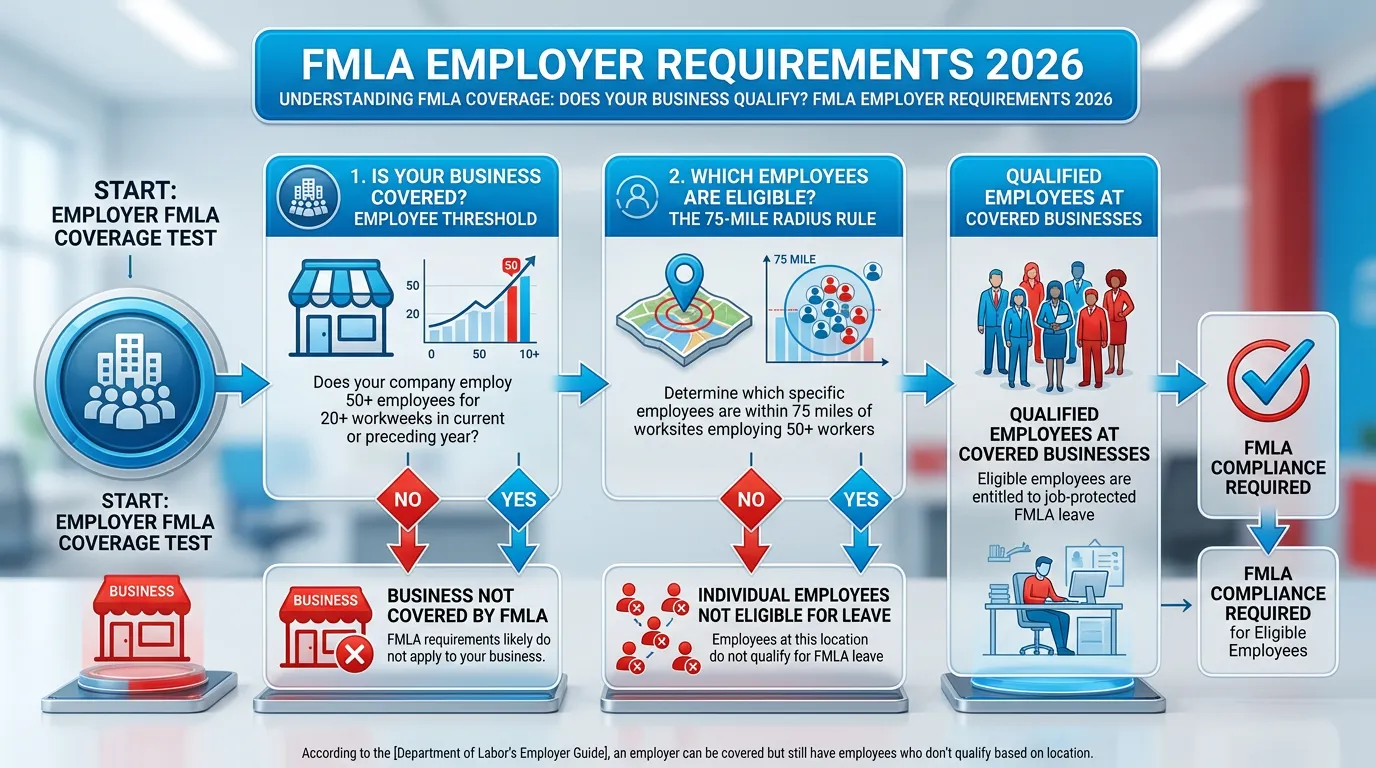
Public agencies and schools operate under different rules. They’re covered regardless of employee count. A small rural school district with 30 employees still must provide FMLA leave.
The same applies to all government entities at federal, state, and local levels.
The 50-Employee Threshold and 75-Mile Radius Rule
The 50-employee threshold determines employer coverage. The 75-mile radius rule determines which employees qualify for leave. These are two separate tests.

Here’s how it works in practice. Your company has 60 employees total. That means you’re covered. But if 15 of those employees work at a satellite office more than 75 miles from any location with 50+ employees, those 15 don’t qualify for FMLA protection.
The 75-mile radius is measured by surface miles using surface transportation over public streets, roads, highways, and waterways. It’s not a straight line on a map. An employee working 70 driving miles away qualifies.
One working 80 miles away doesn’t.
How to Count Employees Correctly
Count every person on your payroll during the workweek.
This includes full-time, part-time, temporary, and seasonal workers. It includes employees on leave of any kind. It includes employees who work remotely or at satellite locations.
Don’t count independent contractors. Don’t count workers employed by a staffing agency unless you meet joint employer criteria. Don’t count volunteers at nonprofit organizations.
The 20-workweek requirement doesn’t have to be consecutive. If you had 50 employees for 15 weeks in early 2026 and 10 weeks in late 2025, you meet the threshold.
Track your headcount weekly throughout the year to know when coverage begins.
Part-time employees count as one employee each, not fractional. Three employees working 15 hours weekly count as three employees, not one full-time equivalent. This often surprises employers who think in FTE terms for other purposes.
Joint Employer and Successor Employer Situations
Joint employment situations require careful coordination. When two companies jointly employ the same workers, both may share employer FMLA obligations for those employees. This commonly happens with staffing agencies, franchises, and parent-subsidiary relationships.
The DOL uses an economic realities test. Do both entities exercise control over the employee’s work? Do both benefit from the work performed? If yes, you may be joint employers.
Both companies’ employees count toward the 50-employee threshold. Both must coordinate leave administration to avoid conflicting obligations.
Successor employers inherit FMLA obligations when they acquire a business. If you buy a company mid-year, you must honor existing FMLA leave for transferred employees.
You can’t restart their 12-month entitlement period. You can’t deny restoration rights because the leave started under previous ownership.
The successor employer rule applies to mergers, acquisitions, and asset purchases where there’s substantial continuity of operations. If you’re acquiring a business, review active FMLA cases during due diligence. Factor those obligations into your transition planning.
Required posters and policy distribution
FMLA employer requirements 2026 include strict eligibility checks before approving leave.
You can’t approve requests without verifying three specific criteria. Missing any of these creates legal exposure and potential DOL complaints.
Employers must confirm each employee meets federal standards. This protects both the business and the employee’s rights.
The 12-Month and 1,250-Hour Tests
Two numeric thresholds determine FMLA eligibility for every request. The employee must have worked for your company at least 12 months. These months don’t need to be consecutive.
The second test requires 1,250 hours worked in the past 12 months. That breaks down to roughly 24 hours per week on average.
Part-time employees can qualify if they meet this threshold.
The third requirement involves worksite size. Your location must have 50 or more employees within a 75-mile radius.
This includes all company worksites in that geographic area, not just the employee’s specific location. You can explore this further in certification deadlines.
| Requirement | Standard | Common Mistake | |
|---|---|---|---|
| Employment Duration | 12 months (non-consecutive allowed) | Rejecting employees with gaps in service | |
| Hours Worked | 1,250 hours in past 12 months | Not tracking part-time hours accurately | |
| Worksite Size | 50+ employees within 75 miles | Counting only the specific location |
Calculating Hours for Salaried and Variable-Schedule Employees
Salaried employees create calculation challenges for FMLA compliance for employers. The DOL presumes full-time salaried workers meet the 1,250-hour test. You need clear evidence to dispute this presumption.
For variable-schedule employees, track actual hours worked. Don’t estimate or use scheduled hours. Use payroll records, time cards, or electronic tracking systems.
At FMLADocs, we help employers understand how to document hours correctly for different employee types. This prevents disputes during the eligibility determination process.
Part-time employees with fluctuating schedules need careful monitoring. Add up actual hours from the 12 months before the leave request date.
Documentation Requirements for Eligibility Determinations
You must provide written notice of eligibility within five business days of a leave request. This notice confirms whether the employee qualifies or explains why they don’t.
Maintain records proving your eligibility determinations for at least three years. These records should include:
-
Hours-worked calculations from payroll records
-
Employment start date and any breaks in service
-
Worksite employee count and geographic radius verification
-
The written eligibility notice you provided
-
Any employee responses or disputes
Missing documentation creates problems during DOL audits. Keep copies of everything related to each FMLA request. Store these separately from general personnel files for easy retrieval.
Your eligibility notice must state whether the leave counts against the employee’s 12-week entitlement. It should also explain their rights and responsibilities during leave.
Designation and eligibility notice deadlines (WH-381/WH-382)
FMLA employer requirements 2026 include specific notice obligations that protect both workers and companies. Employers must post required notices and deliver individual notifications within strict timeframes. Missing these deadlines can prevent you from denying leave requests.
General FMLA Poster Requirements
You must display DOL Form WH-1420 in a conspicuous location where employees can see it. This poster explains FMLA rights, eligibility criteria, and how to request leave. Place it near time clocks, break rooms, or other high-traffic areas.
The poster must be visible to all employees, including remote workers. For distributed teams, post the notice on your company intranet or email it to all staff. Digital posting satisfies the requirement if employees have regular computer access.
According to the official employer responsibilities overview, failure to post this notice can result in DOL penalties. The poster is available free from the Department of Labor website. Update it whenever regulations change.
Eligibility and Rights and Responsibilities Notices
Within five business days of an employee’s leave request, you must provide an eligibility notice.
This document tells the employee whether they qualify for FMLA protection. It must explain why if they don’t qualify.
The rights and responsibilities notice goes out at the same time. This notice details:
-
Medical certification requirements and deadlines
-
The employee’s right to substitute paid leave
-
Premium payment obligations during leave
-
Consequences of failing to meet certification deadlines
Both notices must be in writing. You can deliver them electronically if employees have regular computer access. Email delivery with read receipts creates a clear record. Paper delivery works for employees without computer access.
Many employers use Form WH-381 for notice of eligibility and rights to standardize this process. See the WH-381 form explained for a full breakdown of required elements. Missing this five-day window can prevent you from denying leave later.
Designation Notice Timing and Content
Once you have sufficient information to determine leave qualifies, send a designation notice within five business days. This notice confirms whether the absence counts as FMLA leave.
It must specify the amount of leave that will be designated.
The designation notice should include:
-
Whether leave is approved or denied
-
How much leave time will count toward the 12-week entitlement
-
Requirements for medical certification or recertification
-
The employee’s right to substitute paid leave
-
Key employee status if applicable
For intermittent leave, specify the frequency and duration approved. If you need more information before designating leave, tell the employee what’s missing. Be specific about what additional documentation you need.
Failure to provide required notices on time can prevent you from denying leave requests. It can also block you from designating leave as FMLA-protected. This creates exposure if you later need to take action on attendance. Document every notice you send with dates and delivery method.
Medical certification rules employers must follow
Managing medical certification under FMLA employer requirements 2026 involves strict timelines and specific procedures. You must request certification using DOL Forms WH-380-E or WH-380-F within five business days of learning about the need for leave. These forms provide the medical documentation needed to verify the employee’s condition meets FMLA standards.
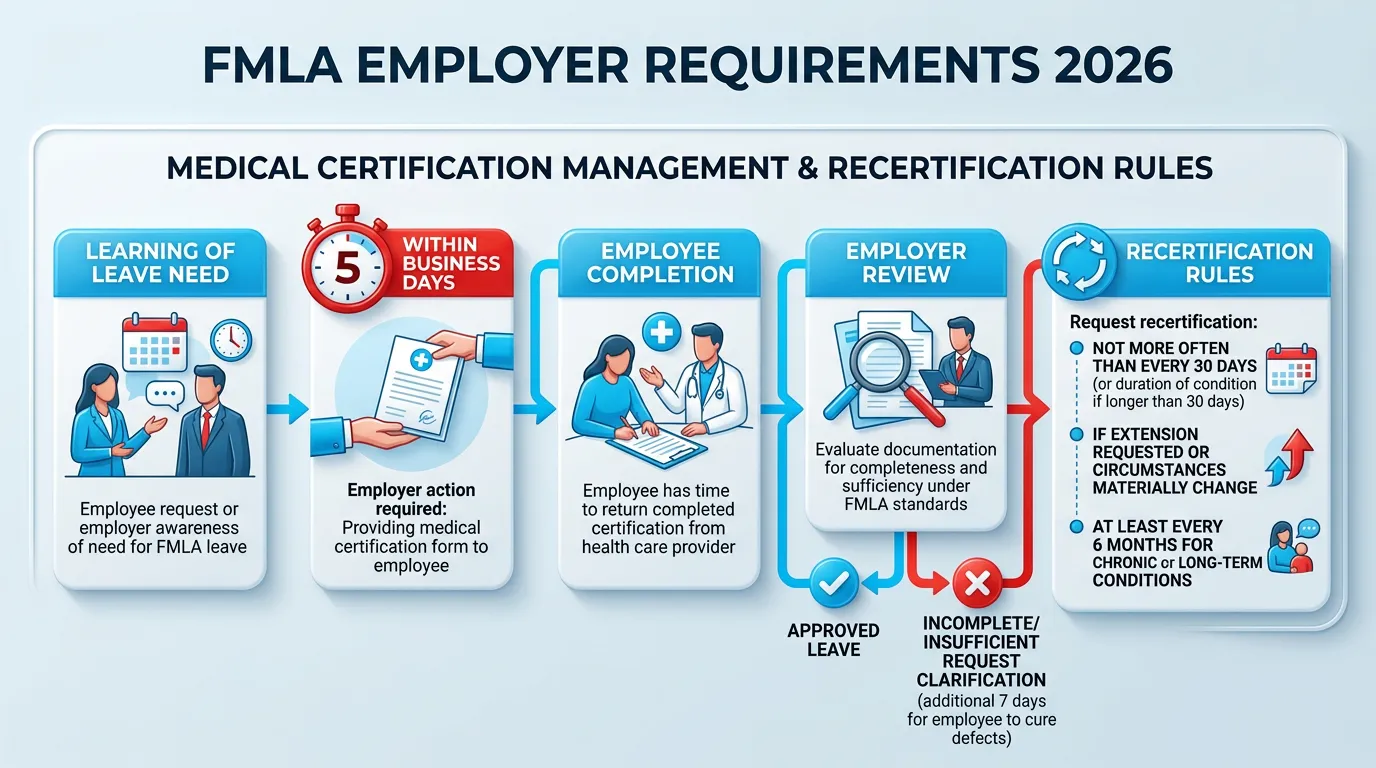
The process protects both parties. Employers get verification of serious health conditions. Employees get job protection while dealing with medical issues. For a full walkthrough of every required form, visit our FMLA paperwork hub.
When You Can Request Certification
You can request medical certification when an employee first applies for FMLA leave. The request must happen within five business days after the employee notifies you of their need for leave.
This applies whether the leave is continuous, intermittent, or reduced schedule.
For ongoing conditions, you can also request recertification. But timing matters. You cannot ask for new certification more frequently than every 30 days unless specific circumstances apply.
The forms you use depend on the situation:
-
Form WH-380-E: Employee’s own serious health condition
-
Form WH-380-F: Family member’s serious health condition
-
Form WH-384: Military family leave
Never contact the employee’s healthcare provider directly. You need written authorization from the employee first. This protects medical privacy under HIPAA regulations.
The 15-Day Return Deadline and Cure Period
Once you request certification, employees have 15 calendar days to return completed forms. Not business days. Calendar days. This deadline starts the day you make the formal request.
What happens if the certification comes back incomplete? You must provide written notice specifying exactly what’s missing or insufficient. This notice must explain what additional information you need and why the current submission doesn’t meet FMLA medical certification rules.
Then you give the employee at least seven calendar days to cure the deficiencies. This cure period lets them go back to their provider and get the missing information. The clock starts when they receive your written notice about the problems.
Here’s how the timeline works:
| Event | Timeframe | Action Required |
|---|---|---|
| Initial request | Within 5 business days | Employer sends certification form |
| Employee return | 15 calendar days | Employee submits completed form |
| Cure notice | Immediately upon review | Employer specifies deficiencies in writing |
| Cure period | At least 7 calendar days | Employee corrects and resubmits |
During this process, you cannot deny leave solely because the initial certification was incomplete. You must give the employee a fair chance to fix the problems.
Recertification Timing and Second/Third Opinion Rights
For ongoing conditions, you can request recertification no more than every 30 days. This applies to intermittent or reduced schedule leave. The 30-day rule protects employees from constant paperwork demands while still letting you verify continuing need.
Three exceptions let you request recertification more often. You can ask if the employee requests a leave extension beyond what the original certification covered. You can also ask if circumstances change significantly from what the certification described.
Finally, you can request new certification if you receive information casting doubt on the employee’s stated reason for leave.
What if you doubt the certification’s validity? You have the right to require a second opinion at your expense. You choose the healthcare provider, but it cannot be someone your company employs regularly. Understanding recertification rules and second opinion procedures helps you handle disputes properly.
If the first and second opinions conflict, you can require a third opinion. Both parties must approve the third provider. That opinion becomes binding on everyone. You pay for this third evaluation too.
The second and third opinion process works like this:
-
You pay all costs for additional medical evaluations
-
The employee must cooperate and attend appointments
-
Second opinion providers cannot be employed by you on a regular basis
-
Third opinion providers must be approved by both employer and employee
-
The third opinion is final and binding
These protections balance employer verification needs with employee privacy rights. They prevent abuse while maintaining FMLA compliance for employers throughout the certification process.
Intermittent leave tracking and abuse-of-rights limits
Tracking intermittent leave creates compliance and operational challenges for employers. You must record every absence that counts toward the employee’s 12-week entitlement, maintain accurate records, and watch for patterns that suggest abuse.
Health insurance maintenance during leave
Employers must maintain health insurance coverage during FMLA leave on the same terms as if the employee were actively working. Employees continue to pay their share of premiums while on leave. You cannot terminate coverage or change plan terms because an employee is on leave.
Prohibited retaliation and recordkeeping
The FMLA prohibits retaliation against employees for requesting or taking leave. You cannot discharge, demote, reduce hours, or otherwise penalize an employee for exercising FMLA rights.
Maintain detailed records of all FMLA-related decisions, notices, and communications for at least three years. Employees can review employee rights under FMLA for a full picture of the protections that apply to them.
State PFML coordination for multi-state employers
Many states now have Paid Family and Medical Leave (PFML) programs that run parallel to federal FMLA. Multi-state employers must coordinate state and federal leave entitlements, manage different notice requirements, and track leave usage across jurisdictions.
Conclusion
Meeting FMLA employer requirements 2026 demands systematic processes across four core areas. You must verify employee eligibility accurately before approving leave.
You need to provide timely notices at every stage. You have to manage medical certification within strict deadlines. And you must protect jobs during the entire leave period.
Most violations happen through poor notice procedures and certification mismanagement. These aren’t intentional failures. They’re process gaps that expose your organization to Department of Labor investigations and employee lawsuits.
Start by reviewing your current FMLA compliance for employers processes today. Update your employee handbook with current notice language. Train your HR staff on certification deadlines and recertification rules. Build tracking systems for intermittent leave that capture every absence.
If FMLA administration feels burdensome, you don’t have to handle it alone. FMLADocs connects employees with licensed healthcare professionals who complete medical certifications quickly and accurately. This streamlines your employer FMLA responsibilities while protecting your workers’ rights.
Get the support you need to stay compliant and focused on running your business.
Frequently Asked Questions
What are employer FMLA requirements?
Covered employers must inform employees of their FMLA rights, provide required eligibility and designation notices, maintain group health benefits during protected leave, accurately track leave, and generally restore employees to the same or an equivalent position. Employers must also avoid interfering with FMLA rights or retaliating against employees for requesting or using protected leave.
**How fast must employers respond to FMLA requests?**
Employers generally must notify an employee of FMLA eligibility within five business days after receiving a leave request or learning that an absence may qualify. Once the employer has enough information to determine whether the leave qualifies, it must generally issue the designation notice within five business days as well, unless extenuating circumstances apply.
**Can employers require their own FMLA forms?**
Yes. Employers may use their own certification forms instead of Form WH-380-E or WH-380-F. However, the form cannot request more information than FMLA regulations permit, and a complete certification containing the required information may be submitted in another format.
How should HR track intermittent FMLA leave?
HR should record intermittent or reduced-schedule leave using the smallest increment the employer uses for other forms of leave, provided that increment does not exceed one hour. The tracking method should be applied consistently, and only the time the employee actually misses may be deducted from the employee’s FMLA entitlement.
Are employers required to pay employees during FMLA leave?
No. Federal FMLA leave is generally unpaid. However, an employee may choose, or an employer may require, the use of accrued paid vacation, sick leave, or PTO at the same time as FMLA leave, subject to the employer’s normal leave policies. State paid-leave programs or employer-provided benefits may also provide income during the absence.
What FMLA posters are required in 2026?
Every covered employer must display the current Department of Labor FMLA general notice where employees and applicants can readily see it, even if the employer currently has no FMLA-eligible employees. Electronic posting may supplement the physical notice and may satisfy the requirement for an entirely remote workforce when all hiring and work are conducted remotely.
Can employers deny telehealth FMLA certifications?
An employer should not reject a certification solely because the employee was evaluated through telehealth. The DOL recognizes qualifying telemedicine visits when the appointment includes an examination, evaluation, or treatment by an authorized healthcare provider and meets applicable licensing requirements. Employers may still require the certification to be complete and sufficient, authenticate or clarify it through authorized personnel, and provide the employee an opportunity to correct deficiencies.
Where can employees get Form WH-380 completed?
Employees can ask a physician or another healthcare provider authorized under the FMLA to complete the certification. Depending on the condition and applicable licensing rules, this may include a provider who evaluates the employee through a telehealth service such as FMLADocs. The provider must supply sufficient medical facts supporting the need for leave, but the FMLA does not require disclosure of the employee’s complete medical records or necessarily the diagnosis.

Meet the author
Anam Moin
I'm Anam Moin, and my work at FMLADocs focuses on workplace leave and FMLA education. I cover certification, documentation, employee rights, and leave-related questions to provide readers with useful information when they need it most.
Get Your FMLA Certification Online in Minutes