
How Does Intermittent FMLA Work? Schedules, HR Rules etc
 by Areeba Imran
 Last updated:
How does intermittent FMLA work? It lets you take job-protected leave in separate blocks rather than one continuous period. You can use it for doctor visits, treatment sessions, or flare-ups that happen without warning. This matters because many workers with chronic conditions don’t know they can protect their jobs this way.
Most employees think FMLA only covers long absences like surgery recovery. But if you deal with migraines, anxiety, diabetes, or Crohn’s disease, you can take intermittent FMLA leave in smaller chunks. Without this protection, you risk attendance discipline for absences that should be legally covered. You just need to understand how the system works.
This guide breaks down everything you need to know. You’ll learn what qualifies for intermittent leave and how it differs from continuous FMLA. We’ll cover intermittent FMLA certification requirements, employer call-in procedures, and how your 12-week entitlement gets calculated when taken in pieces. You’ll also see real examples of conditions that qualify and when your employer can request recertification.
Let’s start with the basics of how does intermittent FMLA work and what makes it different from standard leave.
What Is Intermittent FMLA? How Does Intermittent FMLA Work
How does Intermittent FMLA work? It lets you take job-protected leave in separate blocks rather than one continuous period. You don’t need to use all 12 weeks at once. Instead, you can spread them across the year for recurring medical needs.
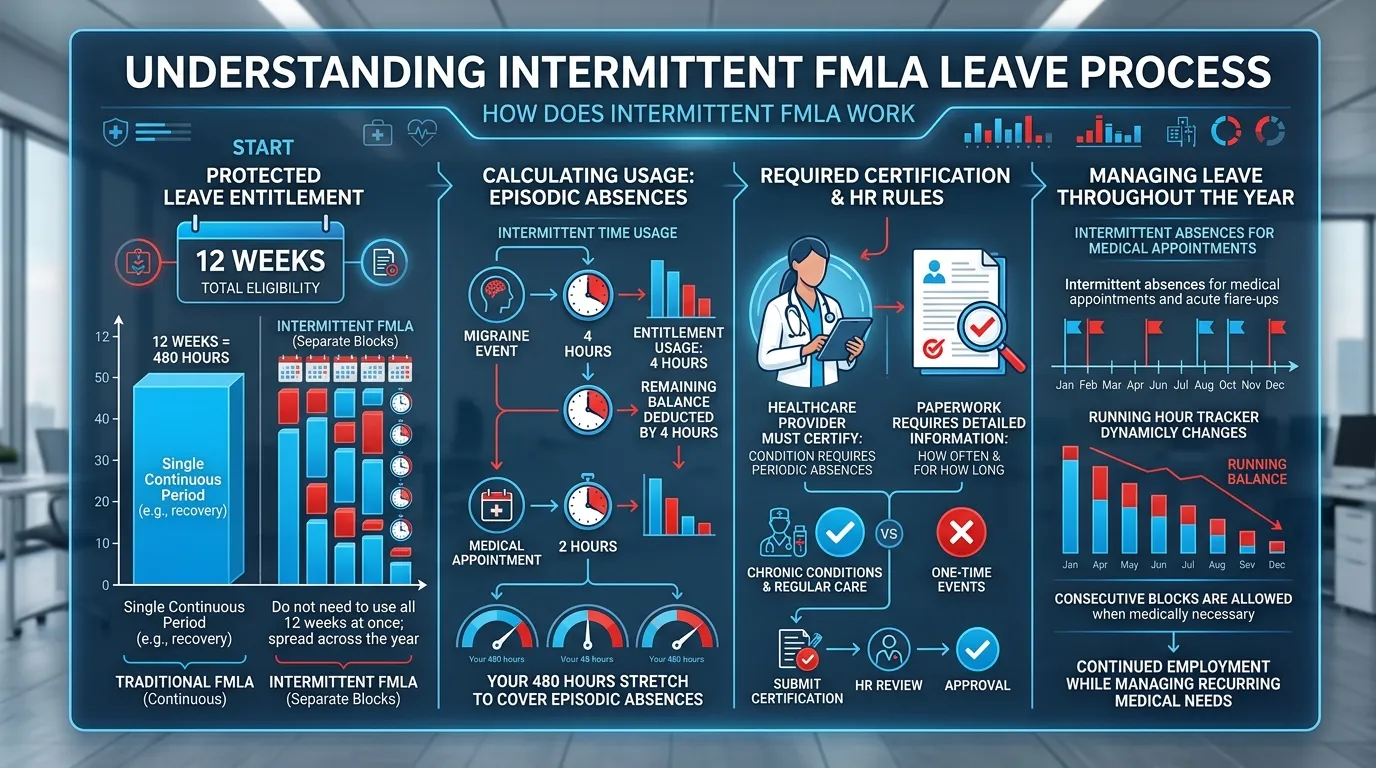
This matters for chronic conditions that flare unpredictably. You only use FMLA hours for actual time absent. A four-hour migraine uses four hours of your entitlement, not a full day. Your 480 hours can stretch to cover an entire year of episodic absences.
Definition and Legal Framework
Intermittent leave means taking FMLA time in separate, non-consecutive blocks. The law allows this when medically necessary. Your healthcare provider must certify that your condition requires periodic absences.
The certification must specify frequency and duration. For example, weekly therapy appointments or unpredictable migraine episodes. FMLA Paperwork requires detailed information about how often you’ll need time off and for how long.
Who Can Use Intermittent Leave
You can use intermittent leave for any qualifying serious health condition. Common examples include recurring Crohn’s flares, dialysis treatments, and weekly physical therapy. Mental health conditions like anxiety or depression also qualify when they cause periodic incapacity.

Your condition must require ongoing treatment or cause episodic symptoms. One-time events don’t qualify. But chronic conditions that need regular care do. FMLADocs connects you with licensed doctors who understand these requirements and complete certifications quickly.
How It Differs From Reduced Schedule Leave
Intermittent leave means sporadic, unpredictable absences. You might miss work two days this week and none next week. Reduced schedule leave is different. It’s a permanent part-time arrangement.
With reduced schedule, you work fewer hours every week consistently. For example, dropping from 40 to 30 hours weekly. Both types protect your job. But they serve different medical needs and require different certification language.
Continuous vs. Intermittent FMLA
Understanding how does intermittent FMLA work starts with knowing the difference between continuous and intermittent leave. Both protect your job. But they serve different medical situations.
Continuous leave means one uninterrupted block of time off. You take all your leave at once. Then you return to work.
When Continuous Leave Makes Sense
Continuous leave works best for predictable medical events. Surgery recovery is a common example. You know the date. You plan ahead. You take six weeks off to heal.
Childbirth and postpartum care also fit this pattern. You take 12 weeks after delivery. Extended hospitalization for serious illness requires continuous leave too.
These situations need full days or weeks off consecutively. You can’t work during recovery. Your employer tracks this leave in full-day increments.
When Intermittent Leave Is Appropriate
Intermittent leave covers chronic conditions that cause periodic symptoms. You work most days. But you need time off when symptoms flare.
Migraines that strike twice monthly qualify. Chemotherapy appointments every two weeks fit this pattern. Chronic back pain causing unpredictable episodes works too. Many FMLA Conditions require this flexible approach.
With Intermittent FMLA, you only use leave for actual hours absent. A four-hour migraine uses four hours of your 12-week entitlement. Your employer tracks this in the smallest increment they use for other leave types.
Can You Switch Between Types?
Yes, you can request to change from continuous to intermittent leave. But you need updated medical certification showing why your circumstances changed.
For example, you planned continuous leave for surgery. But complications require ongoing treatment appointments. Your doctor must certify the new intermittent need.
The reverse works too. You might start with intermittent leave for chronic pain. Then need surgery requiring continuous leave. Updated certification makes the switch possible.
Medical Certification Requirements for Intermittent FMLA
Getting your intermittent FMLA certification right the first time makes the difference between approval and denial. The medical certification process has strict requirements that trip up many employees.
What Information Must Be Included
Your doctor must complete Form WH-380-E for your own condition or Form WH-380-F for a family member’s condition. These forms require specific details, not vague statements.
The certification must include frequency of episodes. Write “2-4 times per month” instead of “as needed.” It must state expected duration per episode. Write “4-8 hours” or “1-3 days” instead of “varies.” Your provider must explain whether episodes are predictable or unpredictable.
Most importantly, the form must show medical justification for why intermittent leave is necessary. Your doctor needs to explain how your condition affects your ability to do your job during episodes. A diagnosis alone doesn’t prove you can’t work.
According to Federal Intermittent FMLA regulations, providers must detail functional limitations during episodes. This means describing symptoms that prevent you from performing job duties.
The 15-Day Certification Deadline
You have 15 calendar days to submit completed certification after your employer requests it. Not business days. Calendar days. This deadline catches most employees off guard.

Many doctors’ offices have two to four week wait times for appointments. If you wait until the formal request arrives, you’re already behind. Contact your provider immediately when you notify HR about needing leave.
FMLADocs physicians complete certifications within 24-48 hours with all required details. This turnaround helps you meet the deadline when your regular doctor can’t see you in time.
Common Certification Mistakes That Lead to Denial
Vague answers get forms rejected every day. Writing “ongoing” for duration doesn’t establish a timeline. Writing “varies” without specifics leaves too much uncertainty.
Incomplete forms come back for corrections, burning through your 15-day window. Missing signature, credentials, or contact information causes automatic rejection. Failing to explain functional impact means employers can’t verify your need for leave.
Some providers aren’t familiar with FMLA requirements and leave sections blank. Others provide medical information without connecting it to work limitations. Both mistakes delay approval.
Requirements vary by state, so check State Vs Federal FMLA rules before submitting paperwork. Some states have additional protections that affect certification requirements.
Employer Call-In Policies During Intermittent FMLA
You must still follow your company’s normal call-in procedures when using intermittent FMLA leave. This means calling your supervisor, using the absence hotline, or following whatever process your employer requires for all employees. FMLA doesn’t exempt you from these standard protocols.
Some employers require you to state “FMLA” when calling in. Others track your protected absences automatically. Ask HR which approach your company uses so you don’t accidentally jeopardize your protection.
Notice Requirements for Foreseeable Leave
For foreseeable leave like scheduled appointments, you must give as much advance notice as possible. This applies to planned therapy sessions, regular treatments, or predictable medical visits.
If you know you’ll need time off next Tuesday for physical therapy, tell your supervisor now. Don’t wait until Monday afternoon. The more notice you give, the easier it is for your employer to plan coverage.
Procedures for Unforeseeable Absences
Unforeseeable leave happens when symptoms strike without warning. You must notify your employer as soon as you can. This usually means the same day or next business day.
“As soon as practicable” means before your shift starts if possible. If you wake up with a migraine at 6 a.m. and your shift starts at 8 a.m., call immediately. If symptoms hit during your shift, notify your supervisor as soon as you’re able.
According to Conditions for Intermittent FMLA, the timing of your notification matters for maintaining protection. Don’t wait until the next day if you can call the same day.
What Happens If You Don’t Follow Call-In Rules
Failure to follow call-in procedures can result in delay or denial of FMLA protection for that specific absence. Your employer can discipline you for not calling in properly, even if the absence itself was FMLA-protected.
Here’s what you need to know:
-
Your employer cannot make call-in requirements more restrictive for FMLA leave than for other absences
-
If other employees can text their supervisor, you can too
-
If the company requires a phone call for everyone, you must call
-
Missing the call-in deadline once won’t end your FMLA protection, but repeated violations can
Document every call-in. Note the date, time, who you spoke with, and what you said. This protects you if disputes arise later about whether you followed procedures.
How Intermittent FMLA Counts Against Your 12 Weeks
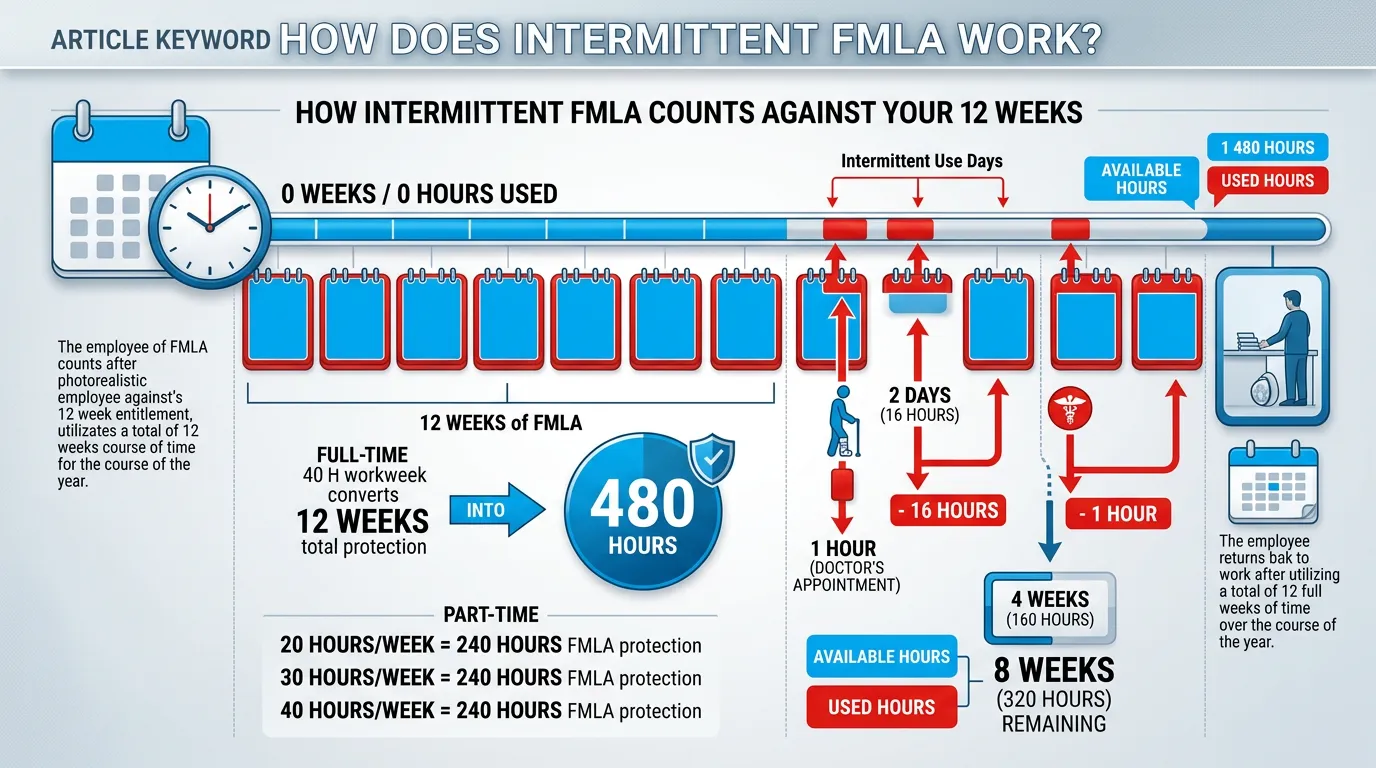
When you take intermittent FMLA leave, your employer tracks time differently than continuous leave. Instead of counting weeks, they convert your 12-week entitlement to hours. This lets them deduct only the time you actually miss.
Converting Your 12-Week Entitlement to Hours
Full-time employees get 480 hours of FMLA protection per year. That’s 40 hours per week times 12 weeks. Part-time workers get less based on their average schedule.
If you work 30 hours weekly, your entitlement is 360 hours. If you work 25 hours weekly, you get 300 hours. The calculation uses your average hours over the past 12 months.
According to Califronia State, this hour-based system protects employees who need frequent short absences. Your 480 hours can stretch across an entire year if you use them wisely.
How Employers Track Intermittent Leave Time
Your employer tracks every absence against your balance. They can set minimum increments like one or two hours. But they can’t require increments larger than what their payroll system uses.
Most employers track intermittent FMLA hours in their timekeeping software. They deduct actual hours missed from your 480-hour bank. Some use a rolling 12-month period. Others use a calendar year or fixed year.
| Example Usage | Hours Deducted | Remaining Balance |
|---|---|---|
| 4-hour migraine episode | 4 hours | 476 hours |
| 2-day flare-up (16 hours) | 16 hours | 460 hours |
| Weekly 2-hour therapy (monthly) | 8 hours | 452 hours |
Track your own usage in a spreadsheet. Employer errors happen more often than you’d think. Catching mistakes early protects your job.
What Happens When You Exhaust Your FMLA Balance
Once you use all 480 hours, your job protection ends. You can’t take more FMLA leave until your 12-month period resets. Your employer can treat future absences as unexcused.

You might qualify for other leave policies after FMLA runs out. Check if your company offers additional sick time or disability leave. Some states provide extra protections beyond federal FMLA.
Without FMLA protection, you face potential attendance discipline. Your employer can apply their standard absence policy. This could mean warnings, write-ups, or termination for excessive absences.
That’s why tracking matters. Know your balance before each absence. Plan your intermittent leave carefully to make your 480 hours last.
Common Examples of Intermittent FMLA
Intermittent FMLA leave covers many conditions that cause unpredictable absences. You don’t need to know exactly when symptoms will strike. The law protects you even when episodes happen without warning.
Mental Health Conditions
Mental health issues qualify for intermittent FMLA when they cause periodic incapacity. Major depression can make getting out of bed impossible some days. Panic disorder triggers sudden attacks that force you to leave work.
Other qualifying conditions include generalized anxiety disorder, PTSD, and bipolar disorder. These conditions often need periodic therapy sessions. They can also cause episodic incapacity that prevents you from working.
Chronic Illnesses
Chronic physical conditions frequently qualify for intermittent leave. Migraines affect millions of workers who experience 4-6 episodes monthly. Each episode can last 8-24 hours with severe pain and light sensitivity.
Diabetes complications, severe asthma attacks, and rheumatoid arthritis flares also qualify. These conditions cause unpredictable episodes that make sustained work impossible. You can’t always predict when a flare-up will hit.
Ongoing Medical Treatments
Regular medical appointments qualify for intermittent FMLA certification requirements. Chemotherapy sessions happen on a set schedule but cause varying side effects. Radiation appointments follow similar patterns.
Dialysis typically occurs three times weekly and takes several hours. Physical therapy and infusion therapy also count as ongoing treatments. Each appointment uses only the actual hours you’re absent from work.
Flare-Ups of Serious Health Conditions
Conditions with unpredictable flare-ups are protected under intermittent leave. Crohn’s disease can require bathroom access every 15-30 minutes during episodes. Ulcerative colitis causes similar urgent needs.
Endometriosis pain, fibromyalgia flares, and MS symptoms also qualify. According to Texas State workforce guidance, pregnancy complications like hyperemesis gravidarum need frequent monitoring. Gestational diabetes and preeclampsia require regular check-ups throughout pregnancy.
The unpredictability of these conditions doesn’t disqualify you. Panic attacks, IBS episodes, and migraine onset can’t always be predicted. But they still qualify for job-protected leave when properly certified.
When Can an Employer Request FMLA Recertification?
Your employer can’t ask for recertification whenever they feel like it. Federal regulations set specific rules about when and how often they can request updated medical documentation for intermittent FMLA leave.
Recertification Triggers and Timing
Three situations allow your employer to request recertification. First, when the minimum duration on your original certification expires. If your doctor certified you for six months, your employer can ask for recertification in month seven.
For chronic ongoing conditions, timing works differently. If your certification states episodes will last more than 30 days, your employer can request recertification every 30 days. For conditions lasting beyond one year, they can ask every six months.
These timelines protect you from constant paperwork demands. Your employer can’t ask for updates more frequently than regulations allow, even if they question your absences.
What Changed Circumstances Mean
Your employer can request recertification outside normal timelines if circumstances change. This includes a big increase in absence frequency. It also covers longer episode durations than originally certified.
A pattern inconsistent with your certification triggers recertification rights too. If your doctor said episodes would last four hours but you’re missing full days, that’s a changed circumstance. If your employer questions the validity of your stated reason or duration, they can request updated documentation.
Changed circumstances must be real and documented. Your employer can’t claim circumstances changed just because they don’t like your absence pattern.
Your Rights During Recertification
You have the same 15-day deadline to submit recertification that you had for original certification. This timeline starts when your employer formally requests the documentation. States like New York offer additional protections through paid family leave programs that run alongside FMLA.
Recertification can’t ask for new information beyond what was on your original certification unless circumstances actually changed. Your employer can’t use recertification to fish for different details or expand the scope of medical inquiry.
Work with healthcare providers who understand FMLA recertification requirements. They need to complete forms quickly and thoroughly to protect your job-protected leave status.
Conclusion
You now know how intermittent FMLA works. It protects your job when chronic conditions require unpredictable time off. Your 12 weeks can stretch across an entire year.
The critical element is proper medical certification. Your doctor must document specific frequency estimates and episode duration. Then you follow normal call-in procedures each time you need leave. Your employer tracks hours in their smallest payroll increment.
Intermittent FMLA certification requirements include detailed medical justification. This differs from continuous leave documentation. Your provider must explain why you need time off in separate blocks.
Don’t let incomplete paperwork derail your approval. Missing the 15-day certification deadline puts your job protection at risk. FMLADocs connects you with board-certified physicians who specialize in FMLA documentation. Our doctors complete certifications within 24-48 hours. They understand precisely what employers need to see. Get your intermittent FMLA leave approved without scheduling delays or documentation gaps.
Need intermittent FMLA paperwork? FMLADocs helps you get the documentation you need. Start your request today.
Frequently Asked Questions
How does intermittent FMLA work differently from taking all 12 weeks at once?
Intermittent FMLA lets you take job-protected leave in separate blocks rather than one continuous period. You don't need to use all 12 weeks at once. Instead, you spread them across the year for recurring medical needs. You only use FMLA hours for actual time absent. A four-hour migraine uses four hours of your entitlement, not a full day. Your 480 hours can stretch to cover an entire year of episodic absences. This matters for chronic conditions that flare unpredictably.
What conditions qualify for intermittent FMLA leave?
You can use intermittent leave for any qualifying serious health condition. Common examples include recurring Crohn's flares, dialysis treatments, and weekly physical therapy. Mental health conditions like anxiety or depression also qualify when they cause periodic incapacity. Migraines, diabetes, and chronic conditions that need regular care all fit. Your condition must require ongoing treatment or cause episodic symptoms. One-time events don't qualify. But chronic conditions that need regular care do.
What does my healthcare provider need to certify for intermittent FMLA?
Your healthcare provider must certify that your condition requires periodic absences. The certification must specify frequency and duration. For example, weekly therapy appointments or unpredictable migraine episodes. The paperwork requires detailed information about how often you'll need time off and for how long. This certification proves your condition needs intermittent leave rather than one continuous block. Without proper certification, your employer can deny intermittent leave requests.
How is intermittent leave different from reduced schedule leave?
Intermittent leave means sporadic, unpredictable absences. You might miss work two days this week and none next week. Reduced schedule leave is different. It's a permanent part-time arrangement. With reduced schedule, you work fewer hours every week consistently. For example, dropping from 40 to 30 hours weekly. Both types protect your job. But they serve different medical needs and require different certification language. Intermittent fits unpredictable flare-ups. Reduced schedule fits ongoing capacity limits.
When does continuous FMLA make more sense than intermittent leave?
Continuous leave works best for predictable medical events. Surgery recovery is a common example. You know the date. You plan ahead. You take six weeks off to heal. Childbirth and postpartum care also fit this pattern. Continuous leave means one uninterrupted block of time off. You take all your leave at once. Then you return to work. This differs from intermittent leave, which covers unpredictable absences spread throughout the year.
Can I use intermittent FMLA for doctor visits and treatment sessions?
Yes, you can use intermittent FMLA for doctor visits, treatment sessions, or flare-ups that happen without warning. This protection matters because many workers with chronic conditions don't know they can protect their jobs this way. Most employees think FMLA only covers long absences like surgery recovery. But if you deal with migraines, anxiety, diabetes, or Crohn's disease, you can take intermittent leave in smaller chunks. Without this protection, you risk attendance discipline for absences that should be legally covered.

Meet the author
Areeba Imran
I am a healthcare professional and seasoned medical writer with 13+ years of experience across health, wellness, and clinical content. My work focuses on delivering trustworthy, evidence-based information that empowers readers to make informed decisions. With a keen interest in innovation and evolving areas of patient care, I bring a modern perspective to today's healthcare setup.
Get Your FMLA Certification Online in Minutes