How to Appeal an FMLA Denial: A Step-by-Step Guide
 by Areeba Imran
 Last updated:
Getting your FMLA request denied feels like a punch to the gut. You need time off for a serious health condition or family emergency. You submitted paperwork and followed every rule. Then the rejection letter arrives. But here’s what most people don’t know: how to appeal an FMLA denial through multiple pathways that can overturn the decision and restore your job protection.
Thousands of FMLA requests get denied each year. Reasons range from incomplete paperwork to employer disputes about eligibility. Many employees assume the denial is final. They give up on their rights without understanding the FMLA denial appeal process. Federal law gives you specific tools to challenge these decisions.
This guide shows you precisely how to fight back. You’ll learn why denials happen, how to gather the right documentation, and when to escalate to the Department of Labor. We’ll walk through internal appeals, formal complaints, and the timelines that matter. You’ll see which denials you can fix quickly and which require formal action.
Start by understanding your denial letter. Then build your case with the right evidence. Most appeals succeed when you know the precise steps to take.
Understanding Why Your FMLA Request Was Denied: How to Appeal an FMLA Denial
When your employer denies your FMLA request, they must send you a written notice within five business days. This notice should state the specific reason for denial. Without this documentation, you can’t build an effective appeal strategy.
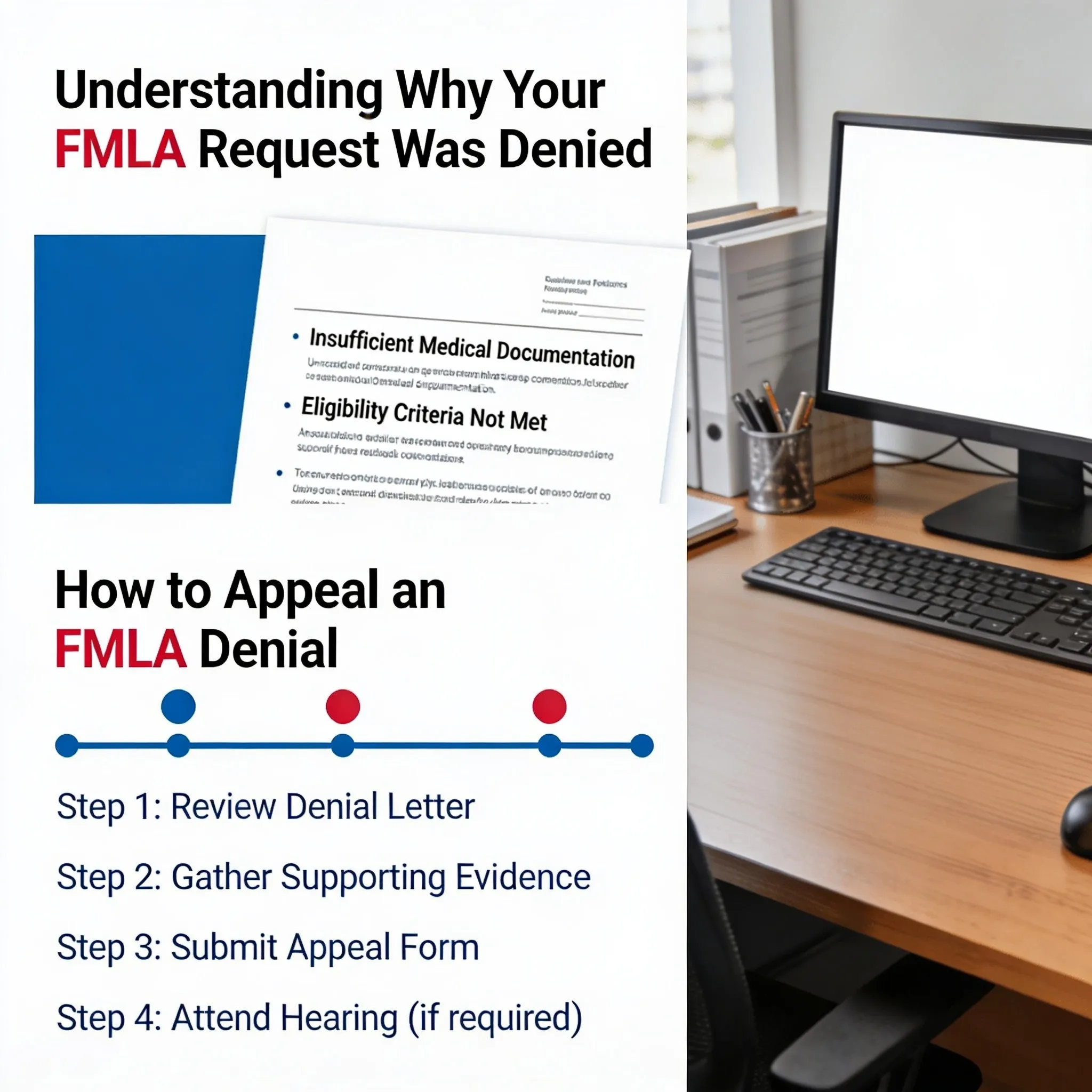
The denial process starts with two forms you should have received earlier. Form WH-381 tells you whether you meet basic eligibility requirements. Form WH-382 designates whether your specific leave request was approved or denied. If you never received these forms, your employer may have violated Department of Labor regulations.
Confirm You Received Form WH-381 or WH-382
Form WH-381 is your Notice of Eligibility and Rights & Responsibilities. Your employer must provide this within five business days of learning you need FMLA leave. It confirms whether you meet the 12-month employment requirement, the 1,250-hour threshold, and the 50-employee rule.
Form WH-382 is your Designation Notice. This form tells you whether your leave was approved, denied, or needs more information. It also specifies how much leave you can take and whether it counts as continuous or intermittent. FMLADocs helps employees understand these forms and prepare proper responses when denials occur.
Save copies of both forms immediately. You’ll need them if you file an appeal or complaint. Missing forms can indicate your employer didn’t follow proper procedures, which strengthens your case.
Common Reasons Employers Deny FMLA Requests
Most denials fall into four categories. Incomplete medical certification tops the list. Your doctor may have left sections blank or provided vague answers that don’t meet DOL standards.
Missing eligibility requirements come next. Your employer might claim you haven’t worked 1,250 hours in the past 12 months. They might say you don’t qualify because the worksite has fewer than 50 employees within 75 miles. Sometimes these claims are accurate. Other times, they result from payroll errors or miscounting.
Insufficient notice causes many denials, too. If your leave was foreseeable and you didn’t give 30 days’ notice, your employer can delay your start date. For unforeseeable leave, you must notify them as soon as possible, typically within one to two business days.
The fourth common reason involves certification deadlines. You have just 15 calendar days to return completed medical forms after your employer requests them. Miss this deadline, and your employer can deny your request outright. FMLA Certification services can help you meet tight deadlines when your regular doctor isn’t available.
Reading Your Denial Notice
Your denial letter must state the specific reason your request was rejected. Look for clear language explaining what went wrong. If the letter says “incomplete certification,” it should identify which sections need correction. If it claims you don’t meet eligibility requirements, it should explain which requirement you failed.
Vague denial letters violate DOL regulations. Phrases like “does not qualify” or “insufficient documentation” without specifics may indicate your employer didn’t follow proper procedures. This strengthens your position if you appeal or file a complaint.
Some denials are legitimate. You might truly fall short of the 1,250-hour threshold. Your condition might not meet the “serious health condition” standard. But many denials result from the employer’s misunderstanding of FMLA law or administrative errors.
Review every detail in your denial notice. Compare it against the forms you submitted and the documentation you provided. Look for inconsistencies or errors in how your employer calculated your hours or interpreted your medical certification. Understanding FMLA Compliance requirements helps you spot when your employer made mistakes that justify an appeal.
Document everything you find. Take notes on discrepancies between what your denial letter says and what your records show. This documentation becomes the foundation of your appeal strategy.
Gather Your Medical Certification and Email Trail
Before you start the FMLA denial appeal process, compile every document related to your leave request. This documentation package becomes the foundation for every step forward. Missing even one piece can weaken your case or delay your appeal.
Collecting Your Documentation
Start with your medical certification forms. You need Form WH-380-E if the leave was for your own condition. You need Form WH-380-F if you were caring for a family member. Include any revisions or corrections you submitted after the initial filing.
Next, gather your employment records. Pull pay stubs, timesheets, and any documentation showing your start date. You need proof that you meet the 1,250-hour threshold if your employer questions your eligibility. These records show you qualified for protection under Federal FMLA laws from the start.
Don’t skip the small details. Include notes from phone conversations with dates, times, who you spoke with, and what was discussed. These notes can prove you followed proper procedures when your employer claims otherwise.
Building Your Paper Trail
Save all email correspondence with HR, your supervisor, and anyone involved in your leave request. Forward these to a personal email account right away. Don’t rely on work email access after a denial.
Text messages count too. Screenshot any texts about your leave request, approval discussions, or denial notifications. Include portal submissions if your company uses an online system. The FMLA Employee Guide explains which documents carry the most weight in appeals.
This paper trail protects you when disputes arise about what was said or when you gave notice. Employers sometimes claim they never received your request or that you missed a deadline. Your saved emails and screenshots prove otherwise.
What to Include in Your Appeal Package
Your complete appeal package should contain every medical certification form you submitted. Add all email threads showing your communication with HR. Include employment records proving your eligibility wasn’t in question.
Organize everything chronologically. Start with your initial leave request and move forward through each interaction. This timeline helps reviewers see exactly what happened and when. Understanding your FMLA Employee Rights Protection helps you identify which documents matter most.
Keep copies of everything you submit. You may need these same documents if you escalate your appeal to the Department of Labor. Store digital copies in multiple locations so you can access them quickly when needed.
Fixable Issues vs. Substantive Disputes: Know the Difference
Not all FMLA denials are created equal. Some are quick fixes. Others require formal appeals. Understanding which type you’re facing determines your next steps and how much time you’ll need to resolve the issue.
The difference matters because fixable issues can often be resolved in days. Substantive disputes may take weeks or months. Knowing what you’re dealing with helps you plan your response strategy.
Missing Forms and Incomplete Paperwork
Fixable issues are administrative problems that don’t challenge your eligibility. These are paperwork errors that can be corrected by resubmitting documentation.
Common fixable issues include:
-
Incomplete medical certification with missing dates or signatures
-
Unsigned forms or missing provider credentials
-
Vague symptom descriptions that need clarification
-
Missing sections on DOL forms
-
Paperwork submitted after the 15-day deadline, but with valid reasons
Your employer typically gives you 15 calendar days to fix these problems. The FMLA 3 Day Rule also applies to certain incapacity situations that require specific documentation.
If your doctor left the “frequency of episodes” blank, you can get them to complete it. If they wrote “ongoing” instead of a specific duration, they can revise it. If a signature is missing, they can sign and resubmit.
These corrections don’t require formal appeals. You simply fix the paperwork and resubmit within the timeframe provided. This approach is faster and less adversarial than escalating to HR disputes.
Substantive Eligibility Disputes
Substantive disputes challenge whether you qualify for FMLA at all. These involve disagreements about facts or law, not just paperwork errors.
Common substantive disputes include:
-
Employer claims you don’t meet the 1,250-hour requirement.
-
Disputes about whether your condition qualifies as “serious”
-
Claims you didn’t provide proper notice
-
Employer argues they have fewer than 50 employees within 75 miles
These issues can’t be fixed by correcting forms. They require formal appeals because your employer is questioning your fundamental eligibility. You may need to provide time records proving you worked 1,250 hours. You might need additional medical documentation showing your condition meets the serious health condition standard.
Understanding how ADA for FMLA protections interact can strengthen your position in these disputes. Some conditions qualify under both laws, giving you additional protection.
Substantive disputes typically involve HR meetings, written appeals, and potentially Department of Labor involvement. The process takes longer and requires more documentation than fixing paperwork errors.
Which Type of Denial You’re Facing
Read your denial notice carefully. It should state the specific reason for denial. This tells you whether you’re dealing with a fixable issue or a substantive dispute.
If the notice says “incomplete medical certification” or “missing information,” you have a fixable issue. If it says “does not meet eligibility requirements” or “condition does not qualify,” you have a substantive dispute.
Start with the simplest solution. If your denial involves a fixable issue, correct the paperwork first before escalating. This saves time and maintains a better relationship with your employer. State laws may also affect your options. California has additional protections through CFRA that run parallel to FMLA.
If your denial involves a substantive dispute, prepare for a longer process. Gather all documentation proving your eligibility. Request your work hours from HR. Get a detailed medical certification that clearly explains how your condition meets FMLA standards.
Don’t assume you can’t fix a substantive dispute. Many eligibility challenges can be resolved with proper documentation. But recognize these take more time and effort than simple paperwork corrections.
Step 1: Submit a Written Appeal to Your HR Department
Start with internal resolution before escalating to government agencies. Many denials get reversed at this stage. Most employers don’t have formal internal appeal procedures for FMLA. But creating this written record strengthens your position for external complaints if needed.
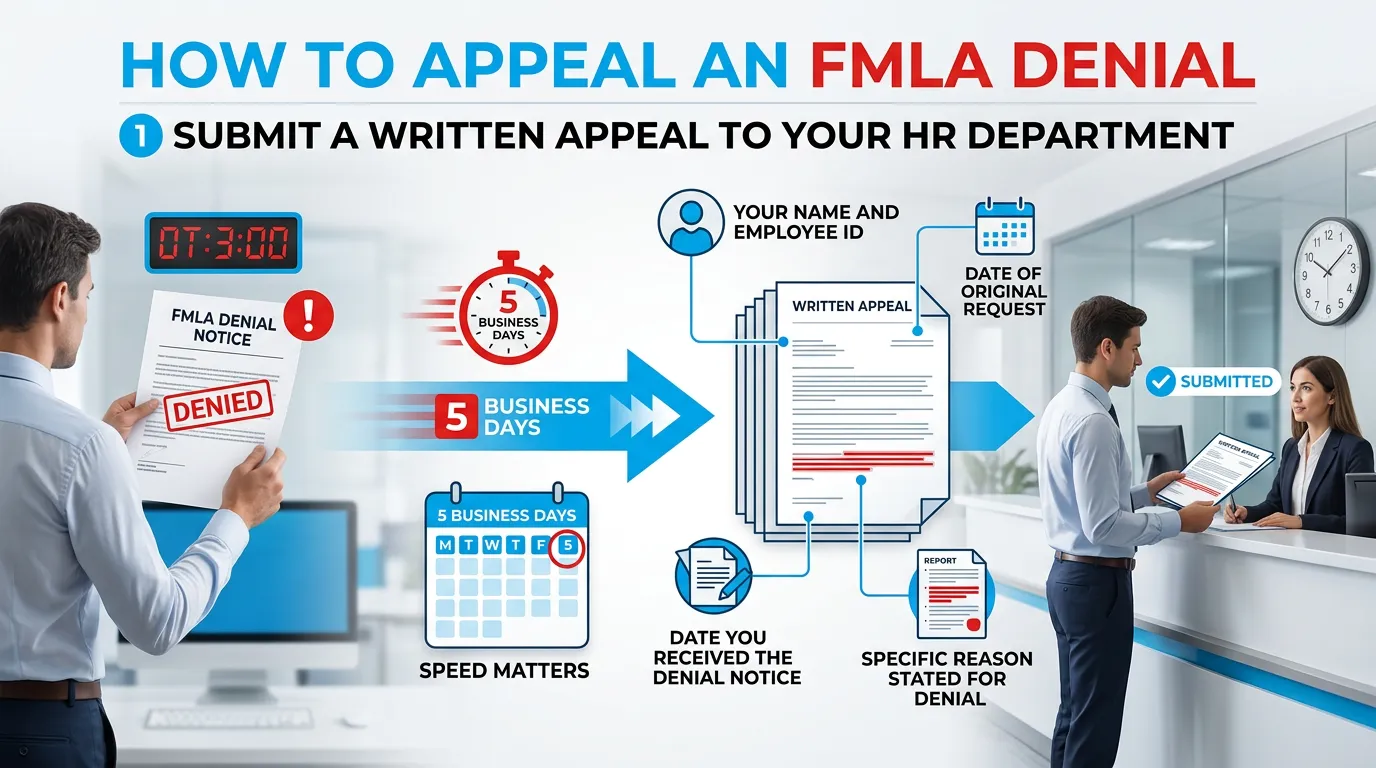
Submit a formal written appeal to your HR director or designated FMLA administrator within 3-5 business days of receiving your denial notice. Speed matters here. The faster you respond, the more seriously your employer takes the appeal.
Writing Your Internal Appeal Letter
Your appeal letter should be professional and factual. Avoid emotional language even though the situation is stressful. Stick to facts, dates, and documentation.

Send your appeal via certified mail or email with a read receipt. This creates proof of delivery. You need evidence that your employer received your appeal on a specific date.
What to Include in Your Appeal
Your appeal letter must include specific information. Missing any of these elements weakens your case.
-
Your name and employee ID
-
Date of your original FMLA request
-
Date you received the denial notice.
-
The specific reason stated for the denial
-
Detailed explanation of why the denial was incorrect
-
Supporting documentation attached
-
What resolution you’re requesting
Attach all supporting documentation with your appeal. This includes corrected medical forms if applicable. Add eligibility proof like pay stubs or employment records. Include a timeline of events showing you met notice requirements. Attach copies of all previous correspondence.
Some states, like Texas and New York have additional protections that may strengthen your appeal. Check your state’s specific requirements.
Following Up After Submission
Request a written response within 10 business days. Ask for a meeting to discuss the appeal if appropriate. This shows you’re serious about resolving the issue.
Follow up with an email three days after submission. Confirm receipt and ask about next steps. Don’t assume silence means your appeal is being processed. Stay on top of the timeline.
Document every interaction during the FMLA denial appeal process. Save emails, take notes after phone calls, and keep copies of everything you submit. This documentation becomes critical if you need to file a Department of Labor FMLA complaint later.
Step 2: File a Complaint With the Department of Labor Wage and Hour Division
If your internal appeal fails or your employer refuses to reconsider, you can file a complaint with the DOL Wage and Hour Division (WHD). This federal agency investigates FMLA violations and has the authority to order remedies. Filing a complaint is free, and you don’t need a lawyer, though you can have one if you choose.
When to Involve the DOL
File a DOL complaint when your employer denies your FMLA request without a valid reason. Also, file if they refuse to respond to your internal appeal within a reasonable timeframe.
You should also involve the DOL if your employer retaliates against you for requesting leave. Termination or discipline after filing raises serious red flags. The WHD investigates these situations and can order reinstatement.
Some states have their own paid family leave programs with separate complaint processes. For example, Massachusetts handles state-level benefits differently from the federal FMLA. However, federal FMLA complaints always go through the DOL regardless of your state.
How to File Your WHD Complaint
You can file online at dol.gov/agencies/whd/fmla/complaint, by phone at 1-866-487-9243, or in person at your local WHD office. The online portal is fastest and provides immediate confirmation.
Your complaint should include specific information:
-
Your contact information and employment details
-
Employer details, including name, address, and number of employees
-
Dates of your FMLA request and denial
-
Detailed description of what happened and why you believe the denial was wrong
-
Copies of all documentation: denial letter, medical certification, correspondence
-
What outcome you’re seeking: leave approval, job restoration, back pay
Be thorough and specific. Vague complaints take longer to investigate. Include every relevant document you have. The more evidence you provide upfront, the faster investigators can act.
Understanding Timing and Statute of Limitations
You must file within two years of the violation. If the violation was willful, you have three years. Don’t wait too long, or you lose your right to file. This deadline is strict, and the DOL cannot extend it.
After you file, DOL investigators will contact your employer. They review records, interview witnesses, and determine if FMLA violations occurred. Investigation timelines vary from weeks to months, depending on case complexity and office workload.
Be patient, but follow up monthly to check status. Some offices in states like North Carolina handle high caseloads that can slow processing. Persistent but polite follow-up keeps your case moving.
If the DOL finds violations, they can order your employer to grant leave. They can also restore your position and pay back wages for lost income. Liquidated damages equal to back wages may also be awarded, effectively doubling your financial recovery.
Conclusion
An FMLA denial doesn’t mean your case is over. Most denials stem from paperwork errors or incomplete medical forms. You can fix these issues through a proper appeal.
Start by gathering all your documents and emails. Then decide if you’re dealing with fixable paperwork or a real dispute. Submit your written appeal to HR first. If that fails, file a complaint with the Department of Labor Wage and Hour Division.
Time matters when you’re appealing an FMLA rejection. Start your appeal right after you get the denial notice. Delays hurt your chances of success.
Don’t let an incomplete medical certification block your appeal. FMLADocs connects you with licensed physicians who complete your paperwork in 24-48 hours. You get the documentation you need without leaving home.
Follow these steps on how to appeal an FMLA denial and you’ll give yourself the best shot at getting the job-protected leave you deserve. Take action now while your case is fresh and your documentation is ready.
Got More Questions? Reach Out To FMLADocs for Answers!
Frequently Asked Questions
What forms should I receive when my employer denies my FMLA request?
You should receive Form WH-381 and Form WH-382 from your employer. Form WH-381 is your Notice of Eligibility and Rights & Responsibilities. It confirms whether you meet the 12-month employment requirement, the 1,250-hour threshold, and the 50-employee rule. Form WH-382 is your Designation Notice. This form tells you whether your leave was approved, denied, or needs more information. Your employer must provide Form WH-381 within five business days of learning you need FMLA leave. Save copies of both forms immediately because you'll need them if you file an appeal or complaint.
How quickly must my employer send me written notice after denying my FMLA request?
Your employer must send you written notice within five business days after denying your FMLA request. This notice should state the specific reason for denial. Without this documentation, you can't build an effective appeal strategy. If you never received these forms, your employer may have violated Department of Labor regulations. Missing forms can indicate your employer didn't follow proper procedures, which strengthens your case when you appeal. The written notice gives you the foundation you need to understand exactly why your request was rejected and what steps to take next.
What happens if my doctor leaves sections blank on my FMLA medical certification?
Incomplete medical certification is the top reason employers deny FMLA requests. If your doctor leaves sections blank or provides vague answers that don't meet DOL standards, your employer can reject your request. You have just 15 calendar days to return completed medical forms after your employer requests them. Miss this deadline and your employer can deny your request outright. To avoid this problem, make sure your doctor fills out every required section with specific details about your condition. FMLA certification services can help you meet tight deadlines when your regular doctor isn't available.
Can my employer deny FMLA leave if I didn't give 30 days' notice?
Yes, if your leave was foreseeable and you didn't give 30 days' notice, your employer can delay your start date. Insufficient notice causes many FMLA denials. For unforeseeable leave, you must notify your employer as soon as possible, typically within one to two business days. The notice requirement protects employers from sudden staffing gaps when leave is predictable. However, if your medical situation was truly unforeseeable, you have a strong case to appeal the denial. The key is documenting why you couldn't provide advance notice and showing you notified your employer as quickly as circumstances allowed.
Why might my employer claim I don't meet FMLA eligibility requirements?
Your employer might claim you haven't worked 1,250 hours in the past 12 months. They might say you don't qualify because the worksite has fewer than 50 employees within 75 miles. Missing eligibility requirements are a common reason for FMLA denials. Sometimes these claims are accurate. Other times they result from payroll errors or miscounting. Form WH-381 confirms whether you meet the basic eligibility requirements. If you believe your employer miscalculated your hours or employee count, gather your own documentation like pay stubs, timesheets, and work schedules to prove you meet the thresholds.
What should I do immediately after receiving an FMLA denial letter?
Start by reading your denial letter carefully to understand the specific reason for rejection. Your denial notice must state the precise grounds for denial. Save copies of Form WH-381 and Form WH-382 immediately because you'll need them if you file an appeal or complaint. Then gather the right documentation to build your case. Most appeals succeed when you know the precise steps to take. Check whether the denial resulted from incomplete paperwork, missing eligibility requirements, insufficient notice, or missed certification deadlines. Each reason requires a different appeal strategy, so identifying the exact problem is your first critical step.

Meet the author
Areeba Imran
I am a healthcare professional and seasoned medical writer with 13+ years of experience across health, wellness, and clinical content. My work focuses on delivering trustworthy, evidence-based information that empowers readers to make informed decisions. With a keen interest in innovation and evolving areas of patient care, I bring a modern perspective to today's healthcare setup.
Get Your FMLA Certification Online in Minutes