
How to Apply for FMLA: Complete Guide to the FMLA Application Process
 by Nida Hammad
 Last updated:
The Family and Medical Leave Act (FMLA) is a federal law that gives eligible employees of covered employers the right to take unpaid, job-protected leave for qualifying family and medical reasons. Introduced in 1993, FMLA ensures employees can take time off during important life events without fear of losing their employment or health benefits.
Key protections include:
- Job protection: Your employer must reinstate you to the same position or an equivalent one upon return.
- Health insurance continuation: Group health coverage continues under the same terms as if you were actively working.
- Protected reasons for leave: FMLA covers personal serious health conditions, care for immediate family members with serious health conditions, and certain situations related to military service.
The purpose of FMLA is to provide employees with flexibility to balance work and personal life during significant medical and family events while protecting their employment rights. Understanding these protections is critical before you start the FMLA application process.
What is FMLA Leave?
FMLA leave allows eligible employees to take time off from work during critical life events without losing job security or benefits. Learn how FMLA certification works. The law defines several specific reasons for which FMLA leave can be taken:
- Birth of a child and care within one year of birth. Parents may take leave to bond with a newborn.
- Adoption or foster care placement and care of the child. Leave must be taken within 12 months of placement, and applies to both adoptive and foster parents.
- Employee’s own serious health condition that makes the employee unable to perform essential job functions.
- Care for a spouse, child, or parent with a serious health condition.
- Qualifying exigencies related to military service, including arranging childcare, attending meetings, or dealing with emergencies when a spouse, child, or parent is on covered active duty.
- Care for an injured or recovering service member under military caregiver leave.
FMLA leave can be taken continuously (e.g., several weeks for surgery recovery) or intermittently (e.g., periodic medical treatments). Understanding your specific situation helps determine how leave can be scheduled.
Eligibility Criteria
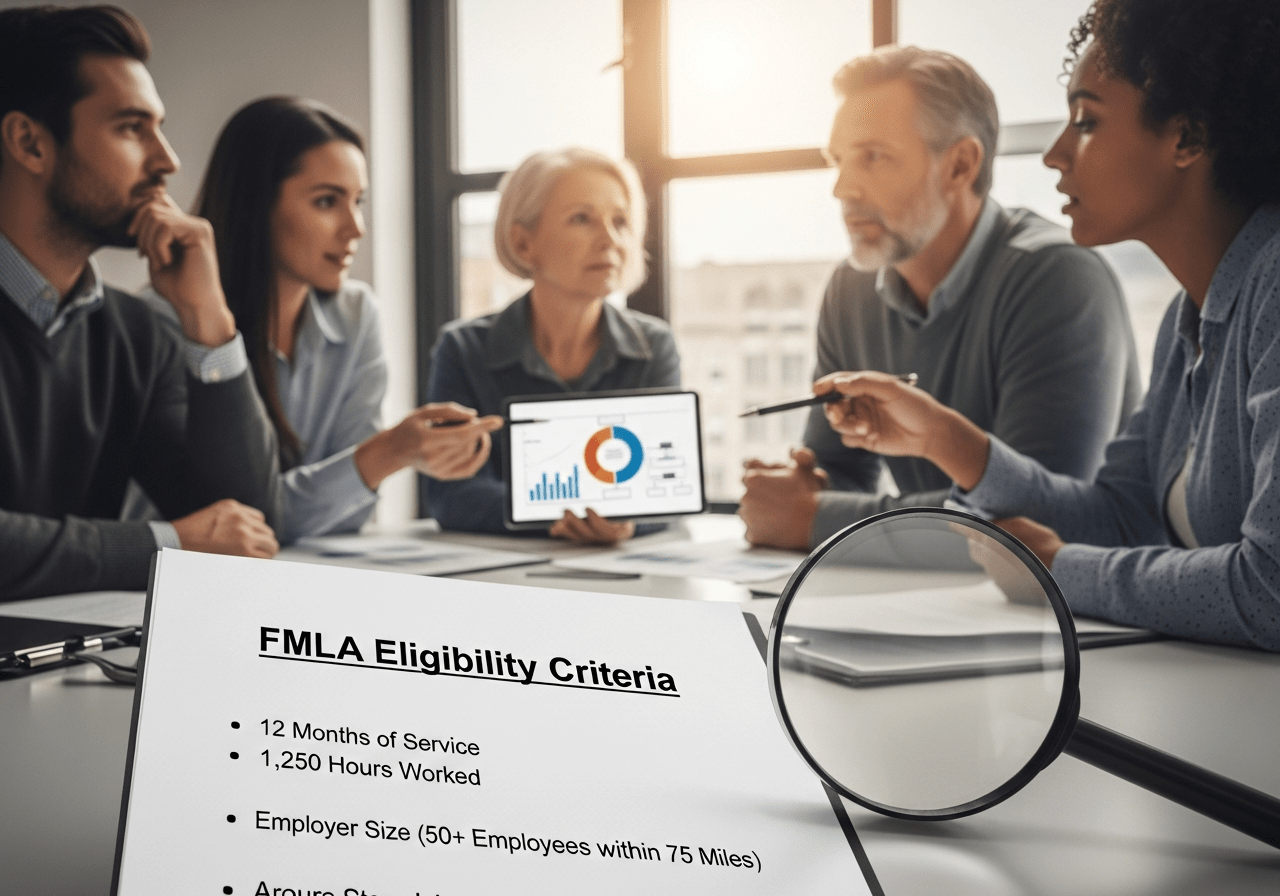
Before beginning the FMLA application process, it is essential to confirm you meet the FMLA eligibility requirements:
1. Employment Duration
- You must have worked for your employer for at least 12 months. These 12 months do not need to be consecutive in most cases.
- Prior employment with the same employer counts unless a break of more than seven years occurred, except for certain military service exceptions.
2. Hours Worked
- You must have worked at least 1,250 hours in the previous 12 months.
- Hours worked include all actual work time; unpaid leave generally does not count.
- Example: If you average 25 hours per week over 50 weeks, you have worked 1,250 hours and meet the threshold.
3. Employer Coverage
- Your employer must have 50 or more employees within 75 miles of your worksite.
- Small employers with fewer than 50 employees may not be covered by federal FMLA but may be subject to state or local family leave laws.
If you do not meet these criteria, you are not eligible for FMLA leave, but alternative leave options may be available under company policy or state law.
Step-by-Step on How to Apply for FMLA: Detailed Guide with Examples
The Family and Medical Leave Act (FMLA) protects eligible employees by providing unpaid, job-protected leave for qualifying medical and family reasons. To maximize your protections and avoid delays, it’s important to follow the FMLA application process carefully. Here’s a detailed breakdown of each step, with examples, timelines, and tips.
Step 1: Giving Notice to Your Employer
Proper notice is the first and most crucial step. Informing your employer in advance helps them plan for your absence and ensures your leave request is considered under FMLA.
Timing of Notice:
- Foreseeable Leave: If your leave is planned, such as childbirth, adoption, or scheduled surgery, provide at least 30 days’ notice. For example, if you are scheduled for knee surgery on March 15, you should notify your employer by February 13.
- Unforeseeable Leave: If your leave arises unexpectedly, like a sudden illness or injury, notify your employer as soon as possible, generally the same or next business day. For instance, if you are hospitalized due to appendicitis, contact HR immediately, even if it is after office hours via email.
How to Notify:
- Use your employer’s standard procedure: email, HR portal, or formal letter.
- Include sufficient detail so your employer can determine whether your leave qualifies for FMLA. Essential information includes:
- Reason for leave (e.g., personal health, family member care, military exigency)
- Expected start date
- Estimated duration
Example Email: Subject: Request for FMLA Leave Dear [HR Manager Name], I would like to request FMLA leave due to a serious health condition. The anticipated start date is March 15, with an estimated duration of six weeks. Please let me know what forms or documentation you require. Thank you, [Your Name]
Practical Tips:
- Keep a copy of your notice for records.
- Follow up with HR if you do not receive acknowledgment within a few days.
Step 2: Employer Response and Eligibility Notice
After receiving your notice, the employer must respond within five business days. This response clarifies your eligibility and informs you of any documentation needed.
Employer Responsibilities:
- Confirm eligibility for FMLA based on tenure (12 months), hours worked (1,250 hours in the last 12 months), and employer coverage (50+ employees within 75 miles).
- Provide a written explanation if ineligible.
- Issue a Rights and Responsibilities notice outlining protections and obligations.
- Indicate whether medical certification or additional documentation is required.
Example Scenario: Jane submits notice for planned maternity leave. Within three business days, HR sends WH-381 (Eligibility & Rights Notice), confirming her eligibility and specifying the need for a doctor’s certification (WH-380-E) to verify her expected leave period.
Tips:
- Respond promptly to employer queries to avoid delays.
- Retain all communications for documentation.
Step 3: Medical Certification (If Required)
If leave is due to a serious health condition, your employer may request medical certification to verify the need and expected duration.
Timeline:
- Certification is typically requested once notice is received.
- Employees usually have 15 calendar days to submit it.
Information Required:
- Healthcare provider contact details.
- Diagnosis or description of condition.
- Expected duration of leave.
- Impact on work or caregiving responsibilities.
- Frequency and length of intermittent leave (if needed).
- Signature of provider.
Example Scenario: Tom needs intermittent FMLA leave for chemotherapy. His doctor completes WH-380-E, specifying he will miss two half-days per week for treatment over three months.
Tips:
- Submit certification promptly to prevent processing delays.
- Keep a copy for your records.
- Clarify with your doctor if intermittent or reduced-schedule leave is needed.
Step 4: Employer Leave Designation
Once the employer receives sufficient documentation, they must designate leave as FMLA within five business days.
Key Points:
- Designated leave counts against your 12-week FMLA entitlement.
- If documentation is incomplete, the employer must inform you of what is missing.
Example: HR receives Tom’s WH-380-E and sends WH-382 (Designation of Leave) within three days, confirming that his intermittent chemotherapy absences are FMLA-protected and will not affect his job or benefits.
Tips:
- Verify that the designation covers all requested leave dates.
- Address any discrepancies immediately with HR.
Step 5: Using Your FMLA Leave
FMLA leave can be taken in multiple ways:
Continuous Leave:
- Taken in a single block, e.g., six weeks for surgery recovery.
- Example: Maria takes eight weeks after a knee replacement surgery.
Intermittent Leave:
- Taken in separate blocks as needed.
- Example: Tom attends chemotherapy twice per week over three months.
Reduced Schedule Leave:
- Temporarily reducing normal work hours.
- Example: Emma works four hours daily instead of eight during recovery.
Practical Tips:
- Track leave dates and hours accurately.
- Communicate with HR about any changes to leave schedule.
- Ensure health benefits remain active and understand any payroll implications.
Example Timeline for Intermittent Leave:
- Week 1: Monday and Thursday absent for treatment.
- Week 2: Tuesday and Friday absent.
- Week 3: Adjusted schedule, working half-days on treatment days.
By documenting leave usage and maintaining communication with HR, employees can avoid exceeding their FMLA entitlement.
Step 6: Returning to Work
When your FMLA leave ends, you are entitled to return to your same job or an equivalent position.
Key Points:
- Equivalent position must have the same pay, benefits, and working conditions.
- Employers may require a fitness-for-duty certification, applied consistently to all employees in similar situations.
Example Scenario: Maria returns from her eight-week surgery leave. Her employer reinstates her as a full-time nurse in her same unit, with identical salary and benefits. HR requires her doctor’s note confirming she can perform all job duties safely.
Practical Tips:
- Provide advance notice of your return.
- Confirm any documentation requirements.
- Keep personal copies of all certifications and communications.
Intermittent Leave Return:
- If using intermittent leave, coordinate with HR on work schedules.
- Submit updates or revised medical certifications if needed.
Required FMLA Forms
While employers may have their own paperwork, the Department of Labor provides optional FMLA forms widely accepted:
Certification Forms:
- WH-380-E: Employee’s serious health condition
- WH-380-F: Family member’s serious health condition
- WH-384: Qualifying exigency (military)
- WH-385 / WH-385-V: Military caregiver leave
Notice Forms:
- General FMLA poster: Employer requirement
- WH-381: Eligibility notice & rights and responsibilities
- WH-382: Designation of leave
Employers must accept any completed certification containing required information, even if not on DOL forms.
Guide to FMLA Forms: Certification and Notice Forms Explained
1. WH-380-E: Employee’s Serious Health Condition
Purpose: This form is used when an employee needs FMLA leave for their own serious health condition. It helps the employer verify the medical necessity and determine the leave duration.
Who completes it: The employee’s healthcare provider (doctor, nurse practitioner, or authorized provider).
What it includes:
- Patient’s information (employee’s name, diagnosis, and condition).
- Medical facts supporting the need for leave (e.g., incapacity, treatment plan).
- Dates the employee is incapacitated or expected to be absent.
- Whether the leave is continuous, intermittent, or on a reduced schedule.
- Estimated frequency and duration of absences if intermittent.
- Healthcare provider’s signature and contact information.
Usage Example: An employee scheduled for surgery would have their doctor complete WH-380-E to confirm the medical necessity and expected recovery period. The employer can then grant FMLA leave based on this certification.
2. WH-380-F: Family Member’s Serious Health Condition
Purpose: This form is for employees requesting FMLA leave to care for a spouse, child, or parent with a serious health condition.
Who completes it: The healthcare provider of the family member.
What it includes:
- Patient (family member) information and relationship to the employee.
- Medical facts supporting the need for care.
- Expected duration and schedule of leave.
- Specific care requirements (e.g., assisting with daily activities, transportation, or treatments).
- Frequency of intermittent leave if needed.
- Healthcare provider’s signature and contact details.
Usage Example: An employee’s parent is hospitalized with a chronic illness. The doctor completes WH-380-F to confirm the need for care, enabling the employee to take intermittent or continuous FMLA leave.
3. WH-384: Qualifying Exigency Leave (Military Families)
Purpose: This form applies when an employee requests leave for qualifying exigencies arising from a family member’s military deployment. It ensures the leave meets legal military-related requirements.
Who completes it: The employee provides information about the need, often supported by military documentation if required.
What it includes:
- Type of qualifying exigency (e.g., childcare, attending meetings, arranging legal matters).
- Relationship to the military member (spouse, child, or parent).
- Dates and duration of leave needed.
- Supporting documentation from the military, if required.
Usage Example: A spouse of a deployed service member needs leave to arrange childcare during the deployment. WH-384 documents the leave request as a legal FMLA qualifying exigency.
4. WH-385 / WH-385-V: Military Caregiver Leave
Purpose: Used when an employee requests FMLA leave to care for a covered service member (current or veteran) who has a serious injury or illness.
Who completes it:
- WH-385: For current service members.
- WH-385-V: For veterans (within five years of discharge). The service member’s healthcare provider completes the medical portion, while the employee provides personal and relationship information.
What it includes:
- Covered service member information (name, branch of service, duty status).
- Description of the injury or illness requiring care.
- Medical facts confirming necessity of caregiver support.
- Estimated duration of leave, frequency, and schedule.
- Healthcare provider signature and contact information.
Usage Example: An employee caring for a spouse who suffered a service-related injury completes WH-385 or WH-385-V to request up to 26 weeks of caregiver leave under FMLA.
Notice Forms
1. General FMLA Poster
Purpose: Employers are required to post a notice of FMLA rights in the workplace so employees are informed about their protections under the law.
Who provides it: The employer, usually posted in break rooms or common areas.
What it includes:
- Employee rights and responsibilities under FMLA.
- Eligibility requirements.
- How to request leave.
- Contact information for the employer’s FMLA coordinator.
Usage Example: A company posts the General FMLA poster in the HR area and break room so all employees are aware of FMLA protections.
2. WH-381: Eligibility Notice & Rights and Responsibilities
Purpose: After an employee requests FMLA leave, the employer uses WH-381 to inform the employee about eligibility and explain their FMLA rights and responsibilities.
Who completes it: The employer/HR department.
What it includes:
- Whether the employee is eligible for FMLA leave.
- Explanation of rights and responsibilities (including health benefits and job protection).
- Required medical certification or additional information.
- Instructions for providing documentation or certification.
Usage Example: Once an employee requests leave, HR sends WH-381 confirming eligibility and explaining steps for submitting required certification forms.
3. WH-382: Designation Notice
Purpose: This form is used after the employer reviews the certification and determines whether the leave qualifies as FMLA leave.
Who completes it: The employer/HR department.
What it includes:
- Confirmation that leave is designated as FMLA.
- Start and end dates of FMLA leave.
- Whether leave will be continuous, intermittent, or reduced schedule.
- Remaining FMLA entitlement after this leave.
- Instructions for submitting updates or recertification if needed.
Usage Example: After receiving WH-380-E from a doctor, the employer sends WH-382 to confirm the leave qualifies under FMLA, providing official designation and counting it against the employee’s 12-week entitlement.
Summary Table for Quick Reference
| Form | Purpose | Completed By | Key Info |
|---|---|---|---|
| WH-380-E | Employee’s own serious health condition | Healthcare provider | Diagnosis, incapacity, leave duration, intermittent schedule |
| WH-380-F | Family member’s serious health condition | Family member’s healthcare provider | Relationship, medical facts, care requirements, leave duration |
| WH-384 | Qualifying exigency (military) | Employee (supported by military docs) | Type of exigency, dates, relationship |
| WH-385 / WH-385-V | Military caregiver leave | Service member’s healthcare provider | Injury/illness details, caregiver need, duration |
| General FMLA poster | Employee awareness | Employer | Rights, responsibilities, how to request leave |
| WH-381 | Eligibility & Rights | Employer | Eligible status, rights, documentation required |
| WH-382 | Designation of Leave | Employer | FMLA approval, leave dates, type, remaining entitlement |
Tips to Apply Successfully
- Submit notice early and in writing.
- Keep copies of all correspondence and forms.
- Follow your employer’s leave procedures exactly.
- Respond promptly to additional documentation requests.
- Remind employer politely of legal deadlines if needed.
- Track your FMLA hours used and remaining entitlement.
Common Challenges & How to Resolve Them
While the Family and Medical Leave Act (FMLA) provides strong protections for eligible employees, navigating the application process can sometimes be challenging. Understanding common obstacles and knowing how to address them can ensure your leave is processed smoothly and your rights are fully protected. Below are the most frequent challenges employees face, along with practical solutions.
1. Certification Delays
Challenge: A common hurdle in the FMLA application process is delays in receiving medical certification from a healthcare provider. These delays can occur due to busy medical offices, incomplete forms, or miscommunication regarding the information required. Without proper certification, your employer may not approve your FMLA leave on time, potentially affecting your job protection.
How to Resolve It:
- Request certification early: As soon as you know you may need leave, ask your healthcare provider to complete the appropriate FMLA form (e.g., WH-380-E or WH-380-F).
- Provide all necessary forms and instructions: Include the correct DOL form and any employer-specific instructions to reduce back-and-forth clarification.
- Communicate deadlines clearly: Politely remind your provider of the employer’s submission deadline and follow up if needed.
- Keep copies: Always retain a copy of the completed certification for your records in case questions arise later.
By planning ahead and clearly communicating with your healthcare provider, you can prevent certification delays and ensure your leave is approved on time.
2. Employer Misclassification of Leave
Challenge: Sometimes employers may incorrectly classify leave as non-FMLA or claim an employee is ineligible. This can happen due to misunderstanding the law, errors in HR records, or miscommunication between management and HR. Misclassification can result in denied job protection or unpaid leave that should have been FMLA-protected.
How to Resolve It:
- Request a written explanation: If your employer states that your leave is not FMLA, ask for a written explanation detailing why. This provides documentation in case of further dispute.
- Provide supporting documentation: Submit any medical certifications, notices, or other documents that demonstrate your eligibility.
- Contact the Wage and Hour Division (WHD): If disputes persist, you can file a complaint or seek guidance from the U.S. Department of Labor’s WHD, which enforces FMLA protections.
- Maintain clear communication: Keep a record of all conversations, emails, and notices related to your leave to support your case if needed.
Understanding your rights and keeping organized documentation is critical for resolving misclassification issues.
3. Confidentiality Concerns
Challenge: FMLA leave often involves sensitive medical information, and employees may worry about privacy. Sometimes, supervisors or coworkers might request personal medical details that are not necessary for the leave process, which can create discomfort or potential legal issues.
How to Resolve It:
- Provide information only to HR or designated staff: Submit completed certification forms directly to the HR department or the FMLA coordinator, not your immediate supervisor or manager.
- Follow employer policies: Most organizations have policies outlining who may handle confidential medical information. Adhering to these policies ensures your privacy is protected.
- Keep personal copies: Retain copies of all medical certifications and correspondence for your own records.
- Be clear in communication: Politely redirect any inappropriate requests for medical details to HR or your FMLA coordinator.
Protecting your confidential medical information is an important part of the FMLA process. Following these steps ensures that your privacy is respected while your leave is properly documented and approved.
The FMLA application process can involve obstacles such as delayed certifications, misclassification by employers, and confidentiality concerns. Addressing these challenges proactively, by planning early, maintaining documentation, communicating clearly, and knowing your rights, can help ensure that your FMLA leave is approved efficiently and that your employment and benefits remain fully protected.
Frequently Asked Questions
How do I begin the FMLA application process?
To start the FMLA process, notify your employer that you need leave. Your notice should include the reason for leave, the expected start date, and the estimated duration. For example, if you are scheduled for knee surgery on March 20 and expect six weeks of recovery, notify HR by February 18. Providing sufficient notice helps your employer determine whether your leave qualifies and request any required documentation.
Do I have to use DOL forms to apply?
No. While the DOL provides optional FMLA forms like WH-380-E or WH-380-F, you may use your employer's forms or other documentation as long as all required information is included. Employers must accept any valid certification that contains the necessary details about the medical condition and leave schedule.
What if my employer denies coverage?
If your employer determines you are not eligible for FMLA leave, they must provide a written explanation stating the reason. This could be due to insufficient tenure, hours worked, or employer coverage. If you believe the denial is incorrect, you can contact the Wage and Hour Division (WHD) of the U.S. Department of Labor to challenge the decision or seek clarification.
Can my employer make me provide detailed medical information?
No. Employers may only request information necessary to determine leave eligibility, typically certification from a healthcare provider confirming the serious health condition and expected duration. They cannot require full medical records or personal health history unrelated to the condition.
How much FMLA leave am I entitled to?
Eligible employees are entitled to up to 12 workweeks of unpaid leave in a 12-month period for qualifying family or medical reasons. For military caregiver leave, eligible employees may take up to 26 workweeks to care for a covered service member. The 12-week entitlement may be taken continuously, intermittently, or on a reduced schedule.
Are my health benefits protected during FMLA leave?
Yes. Employers must maintain your group health insurance under the same terms as if you were actively working. You are still responsible for your share of premiums while on leave. This protection ensures you do not lose medical coverage during your FMLA leave period.
Can my employer retaliate against me for taking FMLA leave?
No. It is illegal for an employer to retaliate against employees for using FMLA leave. Retaliation can include firing, demotion, reducing hours, or any adverse action related to taking leave. If retaliation occurs, you can file a complaint with the Wage and Hour Division of the Department of Labor.
Meet the author
Nida Hammad
I am a professional writer with over five years of experience creating clear, engaging, and well-researched content. I specialize in healthcare topics, helping readers understand complex information in simple wording. Currently, I write for FMLA DOC, where I focus on producing accurate and trusted guides for people seeking support with FMLA and medical needs.
Get Your FMLA Certification Online in Minutes